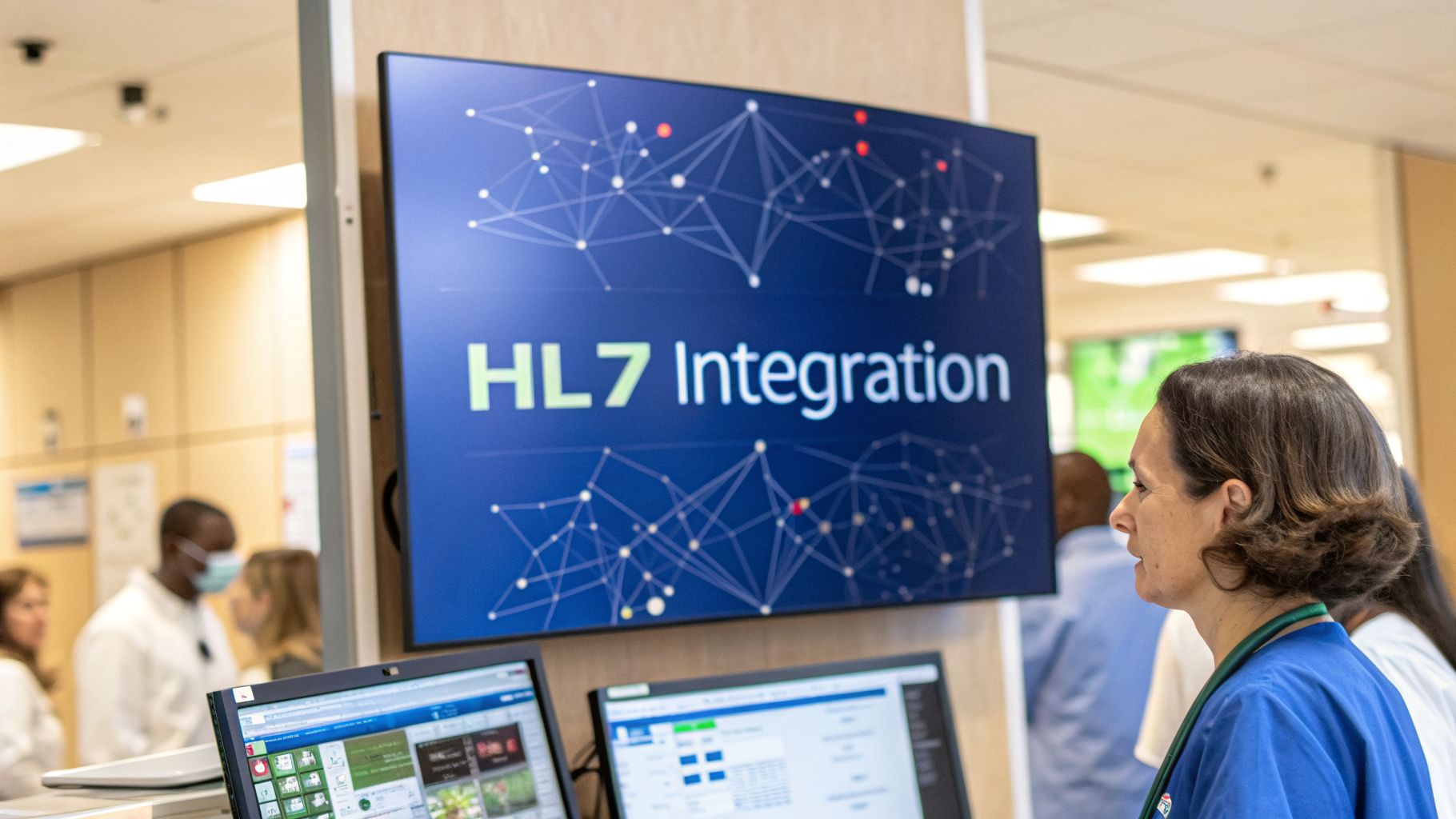


Picture this: a patient’s entire health story, from a family doctor’s notes in Toronto to a critical lab result from Vancouver, all instantly available right where it's needed most. That’s the real-world power of HL7 integration. It's the universal language that finally gets different healthcare software systems talking to each other.
What Is HL7 Integration and Why Does It Matter?
Think of Health Level Seven (HL7) as the digital Rosetta Stone for health data. It’s the established set of rules that allows a hospital’s Electronic Medical Record (EMR) to properly understand a prescription order sent from a completely different clinic’s software. Without this common language, patient data is trapped in digital silos. It can't be shared, which leads directly to inefficiencies, dangerous errors, and disjointed patient care.
In simple terms, HL7 integration is a specialised form of application integration built specifically for healthcare. It’s the nuts and bolts of connecting different systems to share information. This isn't just a technical nice-to-have; it's the very foundation of modern, effective healthcare. By creating a truly connected ecosystem, we unlock massive improvements for everyone involved: patients, providers, and the entire health system.
The Critical Role of HL7 Integration
You really can't overstate how important it is to connect these systems. When data flow breaks down, the consequences can be severe, ranging from delayed diagnoses to life-threatening medication mistakes. On the flip side, a well-designed HL7 integration strategy creates a solid framework for delivering much better healthcare.
Here’s where it makes a tangible difference:
Improved Patient Safety: When a clinician has a patient's complete and accurate history at their fingertips, it drastically cuts down on medical errors like adverse drug reactions or ordering duplicate tests. This leads to safer, more effective decisions.
Streamlined Clinical Workflows: Think about all the time wasted on manual processes. Automating the exchange of patient admissions, lab orders, and results frees up healthcare professionals to do what they do best: focus on patient care.
Enhanced Operational Efficiency: Seamless data sharing virtually eliminates the need for manual data entry, which is not only slow but also a huge source of errors. The result is lower administrative costs and smoother, faster operations across the board.
The Canadian Healthcare Context
In Canada, the drive toward digital health is a national priority. Recent data shows that 86% of family doctors are using primary health care electronic medical records (PHC EMRs). That sounds great, but here’s the catch: only 25% of them can actually exchange patient summaries electronically with other physicians.
This gap reveals a critical need for better interoperability. It's a challenge that new legislation, like Bill C-72 (the Connected Care for Canadians Act), is designed to tackle by mandating that health IT systems can talk to each other, a mandate heavily influenced by HL7 standards. For any organisation in the Canadian health sector, mastering HL7 integration is no longer a choice. It's an absolute necessity for building efficient, compliant, and future-ready systems. You can find a deeper analysis of these health data findings on the Competition Bureau Canada website.
Comparing Key HL7 Versions: From V2 to FHIR
To get your HL7 integration strategy right, you really need to understand how the standards have evolved. The path from the old-school Version 2 (v2) all the way to modern FHIR is more than just a version bump; it's a complete rethinking of how healthcare information should move between systems. Each version has its own strengths and is built for different jobs, so knowing the lay of the land is crucial for supporting your existing infrastructure while preparing for what's next.
I find it helpful to think of it this way: if your patient data is a package, the HL7 version is the delivery service.
HL7 v2 is like that reliable, old-school courier who's been on the same route for 30 years. They know every back road, but they have their own peculiar way of doing things.
HL7 v3 was the ambitious plan to build a massive, perfectly synchronised global logistics network. The theory was flawless, but it was just too complicated and expensive for most people to actually use.
FHIR is the modern delivery app on your phone. It’s fast, flexible, tracks everything in real-time, and just works the way you expect it to.
Let's break down what this means in practice.
HL7 v2: The Enduring Workhorse
For over 30 years, HL7 v2 has been the undisputed workhorse of healthcare data exchange. To this day, it's the standard you’ll find running behind the scenes in the vast majority of hospitals, clinics, and labs. It uses a character-based format with pipes (|) and carets (^) to separate data fields, which is computationally efficient but a nightmare for developers to read and debug.
The biggest issue with v2 is that its flexibility is both a blessing and a curse. It allows for so much local variation that it’s often called a "non-standard standard." An ADT (Admit, Discharge, Transfer) message from one hospital’s EHR might look completely different from another's, forcing developers to build custom maps for every single connection.
Despite its age, HL7 v2 is deeply embedded in the vast majority of existing healthcare systems. Any successful integration project today must be able to communicate fluently with v2, as it will remain a critical part of the healthcare ecosystem for years to come.
This is why a well-designed integration strategy is so important; it bridges the old and the new to create a more unified system.

As you can see, the end goal is always to connect these disparate systems to improve patient safety, make operations more efficient, and lay the groundwork for future innovation.
HL7 v3: The Ambitious but Complex Model
HL7 v3 was born from a desire to fix the wild-west nature of v2. The creators aimed for perfect, unambiguous communication by developing a strict, model-driven methodology based on XML and a massive, all-encompassing Reference Information Model (RIM). The goal was noble: create a world where data’s meaning could never be lost in translation.
Unfortunately, that precision came at a huge cost. The complexity was staggering. Implementing v3 required a very steep learning curve and a massive amount of upfront work, which became a major barrier to adoption. While the core ideas were sound, their rigidity and development overhead meant most organisations simply couldn't justify the effort.
HL7 FHIR: The Modern, Developer-Friendly Standard
This brings us to FHIR (Fast Healthcare Interoperability Resources), pronounced: "fire." FHIR is the game-changer. It takes the hard-won lessons from its predecessors, combining the practical, real-world focus of v2 with the strong data modelling principles of v3, and wraps it all in modern web technologies.
What makes FHIR so different? It’s built for the way developers work today.
Built on Web Standards: It uses RESTful APIs, the same technology that powers the world’s biggest web platforms. This means millions of developers already have the skills to start building with it.
Easy to Work With: Instead of pipes and hats, FHIR uses clean, human-readable formats like JSON and XML. A developer can look at a piece of data and immediately understand what it is.
Focus on Resources: FHIR intelligently breaks down healthcare data into small, logical chunks called "Resources", think of a
Patientresource, aMedicationresource, or anObservationresource. This makes it incredibly easy to ask for and receive only the specific piece of information you need, rather than a giant, monolithic message.
Because of its modern, developer-centric design, FHIR is the clear choice for any new project, especially for mobile health apps, cloud-based services, and patient portals. It’s flexible enough to allow for rapid innovation while still providing clear pathways to map data back to legacy standards like v2.
If you’re embarking on a new build, you can dive deeper into how to integrate FHIR with EHR systems in our dedicated guide.
HL7 Version Comparison V2 vs V3 vs FHIR
Choosing the right standard depends entirely on your project's context. Are you connecting to a 20-year-old lab system or building a brand new patient app? This table gives you a side-by-side look at the key differences to help guide your decision.
| Feature | HL7 v2 | HL7 v3 | HL7 FHIR |
|---|---|---|---|
| Data Format | Pipe-and-hat ( | , ^, ~), text-based | XML-based, text-based, not human-readable |
| Paradigm | Message-based. Sends large, event-triggered messages (e.g., ADT). | Model-driven and document-centric. Based on the rigid Reference Information Model (RIM). | Resource-based. Data is exchanged as modular "Resources" (e.g., Patient, Observation). |
| Architecture | Point-to-point connections, often requiring a central interface engine. | SOAP-based web services. | RESTful API. Follows modern web architecture principles. |
| Implementation Ease | Steep learning curve due to high variability and lack of strict standards. | Extremely difficult. Requires deep expertise in the RIM and complex tooling. | Easy for modern developers. Familiar web standards lower the barrier to entry. |
| Flexibility | Very flexible, but leads to non-standard variations that harm interoperability. | Very rigid. The strict model makes customisation difficult. | 80/20 rule. 80% is fixed for interoperability, 20% is extensible for specific needs. |
| Primary Use Case | Legacy system integration within hospitals (EHR, LIS, RIS). | Limited adoption, mainly in large-scale government or public health projects. | Mobile apps, cloud platforms, API-based integrations, and patient-facing applications. |
Ultimately, v2 remains essential for connecting with the healthcare systems of today, while FHIR is the undeniable path forward for building the connected health solutions of tomorrow. A complete integration strategy needs to account for both.
How To Design Your HL7 Integration Architecture
Getting HL7 integration right from the start isn't luck; it all comes down to smart architectural choices. The framework you choose today directly impacts how scalable, stable, and manageable your health data ecosystem will be down the road. This is arguably the most critical decision you'll make in any interoperability project.
Think of it like wiring an office for communication. You could run a separate, direct phone line from every single desk to every other desk. Or, you could install a central switchboard to route all the calls. The first option seems simple enough for two or three people, but it quickly devolves into an unmanageable mess of wires. The second option is organised, efficient, and built to grow.
That's the fundamental difference between the two main architectural models for HL7 integration: point-to-point and hub-and-spoke.

The Point-to-Point Model: A Tangled Web
The point-to-point (P2P) model is exactly what it sounds like. You build a direct, custom connection for every pair of systems that need to exchange data. If the Electronic Health Record (EHR) needs to send an admission message to the lab system, you build one interface. When it also needs to send billing information to the finance system, you build a completely separate second interface.
While this might feel like a quick win for a single connection, the complexity grows exponentially as you add more systems. The formula for calculating the connections is n(n-1)/2, where 'n' is the number of systems.
3 systems = 3 connections
5 systems = 10 connections
10 systems = 45 connections
You end up with a brittle, spaghetti-like architecture that is a nightmare to maintain. When one system gets an update, every single interface attached to it is at risk of breaking. This triggers a cascade of expensive, time-consuming fixes. P2P is a short-term fix that digs a very deep hole of long-term technical debt.
The Hub-and-Spoke Model: A Centralised Approach
This brings us to the modern, and frankly, the only sustainable approach: the hub-and-spoke model. This architecture relies on a central integration engine to act as a universal translator and air traffic controller for all your healthcare data.
Instead of a web of direct connections, each application only needs to connect to one place: the central hub. The integration engine handles all the heavy lifting, message routing, data transformation, and monitoring.
An integration engine is the workhorse of healthcare interoperability. It acts as a central 'switchboard,' receiving messages from a source system, translating them into the format the destination system understands, and securely routing them to the correct endpoint. This model dramatically simplifies development and maintenance.
Need to bring a new Lab Information System (LIS) online? You just build one connection to the engine, not a dozen new connections to every other application. This keeps your entire architecture modular, scalable, and so much easier to manage.
The Critical Role of an HL7 Integration Engine
An integration engine is much more than a simple message forwarder; it’s a full-blown platform for managing your data exchange environment. The leading engines on the market give you a powerful toolkit that is essential for any serious HL7 integration work.
Some of the most popular and powerful engines you'll encounter are:
Mirth Connect: An incredibly popular open-source engine known for its flexibility and massive community. Its cross-platform nature and powerful transformation capabilities, often using JavaScript, make it a favourite for organisations that need to build highly custom integrations.
Rhapsody (by Lyniate): A top-tier commercial engine that is prized for its rock-solid reliability and visual interface. It’s built for high-performance message processing in large, demanding enterprise environments.
Corepoint (by Lyniate): Another leading commercial engine that shines with its user-friendly, graphical approach. It's designed to speed up development and make maintenance easier, often with less need for custom code.
By using an engine, you centralise all your control. You get a single place to monitor message flows, track down errors, and guarantee data integrity. They abstract away the tangled complexity of individual connections, empowering your team to build a reliable and future-proof foundation for data exchange.
Mastering HL7 Message Mapping and Transformation
Once you’ve settled on an architecture, you get to the real heart of any HL7 integration project: message mapping and transformation. This is the intricate work of teaching different systems how to speak the same language. Think of it less like a simple translation and more like having a skilled interpreter who understands the nuance and context behind every word.
It's a common scenario. A hospital's EHR stores a patient's last name in the classic HL7 v2 segment PID-5.1. But a new patient portal, built on FHIR, is looking for that same piece of information in a field called Patient.name.family. Without a clear map to bridge that gap, the data simply won't flow. The integration engine is ready to do the translating, but it's useless without precise instructions.
The Art and Science of Data Mapping
True message mapping goes far beyond just connecting Field A to Field B. It demands a deep, semantic understanding of what the data actually means in both the source and target systems. This is the crucial difference between merely matching formats (syntactic interoperability) and ensuring the meaning remains intact (semantic interoperability).
A solid mapping strategy always involves a few core activities:
Creating Detailed Mapping Documents: These are your integration blueprints. They must clearly spell out the source field, the target field, any transformations needed, and the specific logic for what to do if data is missing or formatted incorrectly.
Managing Code System Translations: Healthcare is full of different code sets. A lab system might use local codes for tests, but a provincial repository will require standardised LOINC codes. Your mapping has to include translation tables to make sure these are converted accurately.
Handling Data Transformations: Data is rarely a perfect fit. You'll often need to perform transformations, like combining a first and last name into a single full-name field, converting date formats, or parsing a single address line into separate street, city, and postal code components.
Taming the Wild West of Z-Segments
One of the most notorious challenges in the world of HL7 v2 is wrangling custom "Z-segments." These are non-standard segments that vendors and hospitals create to pass along data that isn't covered in the official HL7 specification. They’re essentially local dialects that break the rules of standardised communication.
Because Z-segments are entirely custom, they can bring interoperability to a grinding halt. A core part of your mapping strategy must be figuring out what these segments contain and how to map them, whether to standard fields in another system or to custom extensions in FHIR. This almost always means getting on the phone with the system vendors.
Working with Z-segments is part detective work, part diplomacy. You have to analyse message logs, dig through dusty vendor documentation, and collaborate directly with the other organisation's technical team to decode what each custom field represents. Getting this right is absolutely critical. For a closer look at the benefits and challenges of this process, our guide on healthcare EHR integration offers further context.
This effort to create a common language is a central theme in Canadian healthcare. Groups like the HL7 Canada Community, led by Canada Health Infoway, are pushing hard for pan-Canadian standards to align these different dialects. Their work supports over 500 active patient summary implementations, a vital initiative when you consider that while 86% of family doctors use EMRs, only 25% can electronically exchange data with other providers.
Ensuring Security and Compliance With Canadian Privacy Laws

When you’re working with health data in Canada, protecting patient privacy isn't just a best practice; it's a legal mandate. A truly successful HL7 integration goes beyond technical functionality. It must be built on a foundation of airtight security and privacy that earns the trust of both patients and partners.
Navigating Canada's web of privacy legislation, from federal rules to provincial laws like Ontario's Personal Health Information Protection Act (PHIPA), demands a thoughtful, multi-layered security strategy. Getting this wrong isn't an option. The consequences include steep legal penalties, serious damage to your reputation, and a loss of patient trust that’s incredibly difficult to win back.
Core Pillars of a Secure HL7 Integration
Think of a secure HL7 integration as a fortress. It needs multiple layers of defence to protect the sensitive personal health information (PHI) passing through it. These aren't just suggestions; they are the non-negotiable pillars of a sound security framework.
Your security checklist should absolutely include:
Encryption in Transit: Any data moving between systems must be scrambled and unreadable. This is where protocols like Transport Layer Security (TLS) come in, ensuring that if data is ever intercepted, it’s completely useless to unauthorised eyes.
Encryption at Rest: Protection doesn’t stop once the data arrives. You must encrypt the databases and file systems where HL7 messages are stored or logged. This keeps the information safe even if a physical server is breached.
Strict Access Controls: The principle of least privilege is key. By implementing Role-Based Access Control (RBAC), you ensure people and systems can only access the bare minimum of data needed to do their specific jobs. No more, no less.
Detailed Audit Logging: You need a complete, unalterable record of every single interaction with PHI. Detailed logs should show who accessed what data, when they did it, and from where. This is absolutely critical for accountability and for investigating any incidents that might occur.
Before you even think about going live with a new integration, a thorough Privacy Impact Assessment (PIA) is non-negotiable. A PIA is a formal risk management process that forces you to identify and address potential privacy risks upfront, making sure your system is compliant with Canadian law from day one.
Proactive Compliance and Looking Ahead
Because HL7 integrations are all about exchanging sensitive health data, a strong security posture is foundational. To build a broader knowledge of essential security principles, it's worth exploring expert resources on healthcare cybersecurity.
This need for secure, compliant integration is only growing. Global initiatives are raising the stakes. For example, as of 2026, programs like the International Patient Summary (IPS) are being piloted in Canada and have already been used for over 200,000 global pilgrims. Secure HL7 integration is what makes this possible.
We're already seeing the real-world impact here at home. Companies like Calian have successfully connected over 4,000 military families to doctors, proving that a well-designed HL7 project delivers a strong return on investment through fewer errors and compliant growth. You can discover more insights about HL7 in Canada from Infoway to see how these initiatives are unfolding.
For medium-sized enterprises, finding a way to optimise these operations securely is the key to scaling. If you're curious about how technology is evolving, you can learn more about AI in healthcare data privacy in Canada and see how modern tools can help automate the secure exchange of health data while staying compliant. At the end of the day, a proactive and unwavering commitment to security and privacy is the only way to build a digital health solution that people can trust.
Real-World HL7 Integration Success Stories in Canada
It’s one thing to talk about architecture and standards in a boardroom. It’s another thing entirely to see them working in the real world. In Canada, we’re past the point of just running pilot projects; modern HL7 integration, especially with FHIR, is delivering results that are actively changing how patient data moves across the country.
These aren't just technical wins. For clinicians who have been working in silos for decades, this marks a genuine turning point. We're finally starting to see the connected care ecosystem we’ve been promised, and the momentum is undeniable.
Connecting Provinces With the Patient Summary
One of the most exciting developments on the ground is the pan-Canadian Patient Summary (PS-CA) project. Driven by Canada Health Infoway, the initiative uses HL7 FHIR to create a consistent, core snapshot of a patient's health record. The goal is simple but powerful: give any authorised clinician a unified view of a patient’s story, no matter where they received care in Canada.
As of late 2024, this isn't just a goal; it's happening. Provinces like New Brunswick and Alberta have live PS-CA implementations. What this means in practice is that a doctor in a Fredericton emergency room can instantly pull up crucial information, allergies, medications, and recent diagnoses, for a tourist visiting from Calgary. This directly improves the speed and, more importantly, the safety of care.
The Scale of Implementation
The commitment to this vision is clear when you look at the numbers. Major electronic medical record (EMR) vendors, like MEDITECH Canada, are throwing their weight behind not just the national PS-CA standard but also its provincial variations, which is crucial for broad adoption.
This has lit a fire under HL7 integration efforts, connecting facilities at a remarkable pace.
British Columbia: 197 active implementations
Ontario: 139 active implementations
Alberta: 128 active implementations
These figures represent hundreds of hospitals, clinics, and labs that can now share data more fluidly than ever before. It's been a long time coming. This work is finally starting to close the frustrating gap where, despite 86% of primary care physicians using EMRs, only 25% were previously able to share patient summaries electronically. You can read the full research about these Canadian interoperability findings to see the data for yourself.
Cloud Platforms as a Game-Changer
The other piece of the puzzle accelerating all this progress is the arrival of powerful, cloud-based health data platforms here in Canada. The launch of services like AWS HealthLake in the Canada (Central) Region gives organisations a secure and affordable way to manage enormous amounts of FHIR data without building everything from scratch.
These platforms are built to handle the immense scale required for national interoperability. By using HL7 FHIR R4, they empower organisations to ingest and analyse billions of health resources with high accuracy while achieving significant cost savings compared to traditional on-premise solutions.
Instead of getting bogged down in maintaining expensive, on-premise infrastructure, healthcare providers and technology partners can now focus their resources on what really matters: building the applications and tools that improve patient outcomes. This combination of national standards, vendor buy-in, and scalable cloud technology is what's making HL7 integration a true Canadian success story.
Frequently Asked Questions About HL7 Integration
As you start navigating healthcare interoperability, you're bound to run into some questions. It's a field with its own language and complexities. Here are a few of the most common ones we hear from organisations planning their HL7 integration strategy.
What Is the Difference Between HL7 and FHIR?
It's helpful to think of HL7 (Health Level Seven) as the organisation that writes the rulebooks for exchanging health data. FHIR (Fast Healthcare Interoperability Resources), pronounced "fire", is simply their newest and most modern rulebook.
The real difference is the underlying technology. The older HL7 v2 standard, which is still incredibly widespread, works a bit like an old landline telephone. It's reliable for its specific purpose, but it's rigid and wasn't built for the internet age.
In contrast, FHIR was designed from the ground up using the same web technologies that power modern apps and websites (RESTful APIs). This makes it incredibly flexible, easier for developers to work with, and a natural fit for mobile health apps and cloud platforms.
Key Takeaway: HL7 is the standards body. FHIR is its modern, API-based standard built for today's web. While both aim for interoperability, FHIR is undoubtedly the path forward for any new development.
Do I Need an Integration Engine for HL7 Integration?
If you're connecting more than two systems, the answer is a resounding yes. You could, in theory, build direct point-to-point connections between each application, but this quickly devolves into a tangled mess often called "spaghetti architecture." It's fragile, difficult to troubleshoot, and becomes astronomically expensive to maintain.
An integration engine acts as a central hub or a smart "switchboard" for all your health data. It manages all the message routing, transformation, and monitoring from one place. This approach saves an immense amount of time and money, especially as your network of connected systems grows.
Is HL7 v2 Still Relevant in Canada?
Absolutely. HL7 v2 isn't just relevant; it's the operational backbone for countless legacy systems running in Canadian hospitals, labs, and clinics every single day. It remains the workhorse for a huge volume of internal health data exchange.
While any new project should prioritise the modern and flexible FHIR standard, a realistic HL7 integration strategy in Canada must account for v2. You have to be able to connect with these existing systems. A successful approach means supporting both the present (v2) and the future (FHIR) to effectively bridge the old with the new.
At Cleffex Digital Ltd, we specialise in designing and implementing secure, scalable, and compliant HL7 integration solutions that bridge the gap between legacy systems and modern applications. We help healthcare organisations in Canada and beyond build the connected ecosystems needed to improve patient care and streamline operations.
Ready to solve your interoperability challenges? Visit us at https://www.cleffex.com to learn how we can help.