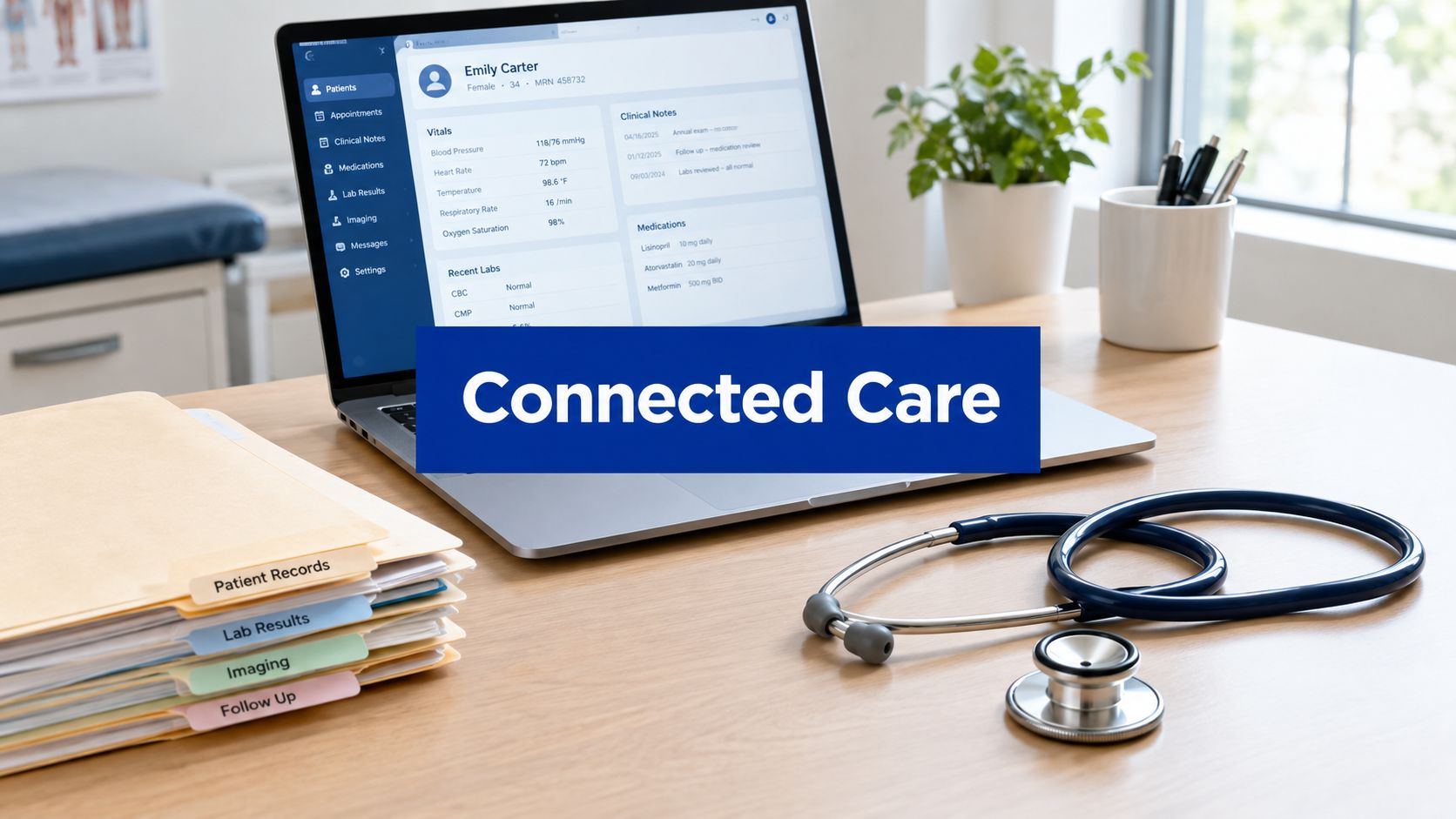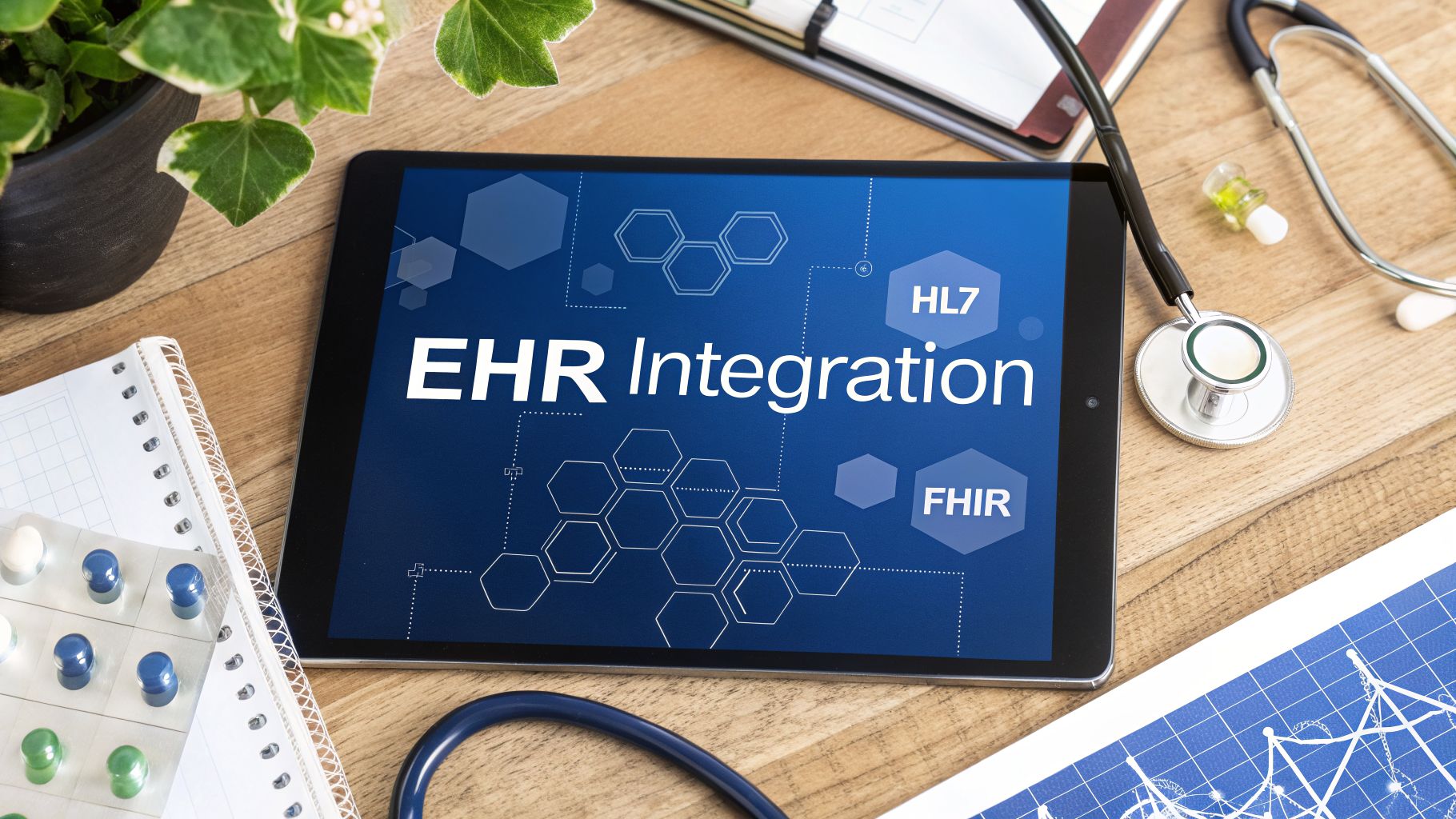


At its core, EHR integration is what connects all the different software systems in a healthcare setting, allowing them to share information without a hitch. Think of it like a universal translator that lets your Electronic Health Record (EHR), your lab system, and your pharmacy software all speak the same language. This process creates a single, unified view of patient information across your entire practice.
What Are EHR Integration Services Really Doing?

Picture your healthcare practice as a team of world-class specialists. The problem? Each one, from the lab technician to the front-desk administrator, speaks a completely different language. The lab system can't automatically update the main patient record with new blood test results. Your billing software has no idea what procedures were just performed unless someone painstakingly keys in the data. This is what a disconnected healthcare environment feels like.
EHR integration services are the solution that tears down these communication walls. They build the digital bridges that connect all your separate software applications, creating a smooth and automated flow of information. The real goal here is to turn isolated data points into a cohesive, real-time patient story that every authorised provider can access.
The Immediate Impact of Connectivity
When your systems can finally talk to each other, the benefits ripple through your practice almost instantly. This connectivity isn't just a matter of convenience; it fundamentally changes how you deliver and manage care. The most immediate effects you'll see include:
A Lighter Administrative Load: Those repetitive, soul-crushing tasks like manual data entry simply disappear. One study found that 87.2% of nurses agreed EHRs improved their documentation, a benefit that gets supercharged with proper integration.
Faster, More Informed Decisions: Clinicians get the full picture, right now. They can see a complete patient history, including lab results, imaging reports, and medications from other departments, all in one place. This complete view leads to quicker, more accurate diagnoses.
Fewer Errors and Better Safety: Automating data transfer drastically cuts down on human error from re-typing patient information or transcribing orders. This closes dangerous gaps in patient care that could otherwise lead to serious problems.
"At its heart, EHR integration is about making the right information available to the right person at the right time. It's the technical backbone that enables coordinated, patient-centred care by ensuring every part of the healthcare team is working from the same script."
To get a better handle on the scope of EHR integration, it can be helpful to see how it fits into the broader field of enterprise software. If you're curious, you can learn more by exploring resources on mastering enterprise software integration.
Moving Beyond Data Silos
Ultimately, EHR integration services are designed to solve the problem of "data silos." A data silo is just an isolated island of information that’s cut off from the rest of the organisation. In healthcare, these silos aren't just inefficient; they're a real threat to patient safety and a major cause of provider burnout.
You can learn more about how custom solutions solve these issues in our guide on custom software development for healthcare. By creating a single source of truth for patient data, these services build the foundation for a much more efficient, collaborative, and safer healthcare system for everyone.
Speaking the Languages of Healthcare Data

For different healthcare systems to talk to each other, they need a common language. Think of it like a universal translator connecting people who speak different languages; these data standards connect various software applications so they can share information seamlessly. They provide the "grammar and vocabulary" for medical data, ensuring that when one system sends a patient's lab results, the receiving system knows exactly what it means.
These languages, known as interoperability standards, are the hidden engine that drives effective EHR integration services. Without them, data sharing would be a chaotic mess of one-off, custom-coded connections, each one brittle, expensive, and a nightmare to maintain. Standards give us a predictable and reliable framework for communication.
Two of the most dominant languages in healthcare are HL7 and FHIR. While they share the same goal of interoperability, they come from different technological eras and solve problems in very different ways. Knowing how they work is crucial for making smart decisions about your practice's technology.
HL7: The Established Standard for Healthcare Messaging
Think of Health Level Seven (HL7), especially HL7 version 2 (v2), as the foundational language of healthcare IT. For decades, it's been the trusted workhorse, and even today, an estimated 95% of healthcare organisations in the United States rely on it for transmitting clinical and administrative data. It’s the dialect spoken by the vast majority of established EHRs, lab systems, and hospital information systems.
HL7 v2 is built around a messaging system. When a specific event happens, like a patient admission or a new lab order, the system packages up all the relevant details into a structured text message. This message is then fired off to other systems that need to be updated.
For example, an "ADT-A01" message is the standard HL7 v2 code for a patient admission. This message has specific segments for the patient's name, demographics, insurance details, and admitting doctor. Any system that understands HL7 v2 can read this message perfectly and update its own records.
This event-driven model is incredibly dependable for managing workflows inside a hospital or clinic. However, its structure, though powerful, wasn't built for the modern internet. It can be rigid and quite complex to work with, particularly for web and mobile app development.
FHIR: The Modern Language for Web and Mobile
If HL7 v2 is the formal, institutional language, then Fast Healthcare Interoperability Resources (FHIR) is the modern, web-friendly dialect that’s taking over. Pronounced "fire," FHIR was developed by the same organisation, HL7 International, to overcome the limitations of older standards in a world driven by smartphones, cloud services, and APIs.
FHIR takes a completely different approach. It breaks down healthcare data into modular building blocks called "Resources." A Resource can be a patient, a practitioner, a medication, or an observation, any distinct piece of information. These Resources are designed to work with common web standards like RESTful APIs, JSON, and XML, which are the native tongue of today's internet developers.
This makes FHIR incredibly flexible and developer-friendly. Instead of parsing a dense, complicated message, a programmer can make a simple request for a specific piece of data. For instance, a mobile health app can make a direct API call to a hospital's server asking for just one thing: "Give me the current allergy list for this patient." The server then sends back a lightweight, easy-to-read FHIR "AllergyIntolerance" Resource.
To make sense of it all, here's a look at how these key standards stack up against each other.
Comparing Key Healthcare Integration Standards
| Standard | Primary Use Case | Data Format | Key Strength | Best For |
|---|---|---|---|---|
| HL7 v2 | Backend system-to-system messaging within a healthcare facility. | Segment-based text messages (pipe-and-hat format). | Widespread adoption and support in legacy systems. | Reliable, event-driven data exchange inside a hospital or between established clinical systems. |
| FHIR | Real-time data access for web, mobile, and cloud applications. | RESTful APIs using JSON or XML Resources. | Simplicity, flexibility, and ease of use for modern development. | Powering patient-facing apps, connecting to third-party tools, and sharing specific data points on demand. |
Choosing between, or, more commonly, combining, these standards is a fundamental part of any EHR integration services strategy. Most modern healthcare environments need a hybrid solution: using HL7 v2 for dependable internal messaging while using FHIR to connect with new patient apps and innovative cloud-based tools.
Choosing Your EHR Integration Architecture
Once you have a handle on the different languages that healthcare data speaks, the next question is: how do you physically connect all your software systems? This is where your integration architecture comes in. Think of it as the blueprint for how information will flow through your practice. The choice you make here will directly shape your efficiency, costs, and ability to grow in the future.
There are a few proven architectural patterns for EHR integration services, and each has its own trade-offs. The right one for you really depends on your specific needs, how many systems you're trying to connect, and what your long-term vision looks like.
The Point-to-Point API Approach
The most direct way to connect two systems is with a point-to-point (P2P) connection, which is typically built using APIs. Imagine it as running a private, dedicated phone line straight from your EHR to your lab system. When the lab gets a new result, it uses that exclusive line to send the information directly into the patient's chart.
This method is quick, easy to understand for a single connection, and doesn't cost a lot to set up initially. It's a great solution when you only have two or three systems to link up.
But don't let the simplicity fool you, P2P has a major scaling problem. For every single new application you add, you have to build a brand-new connection to every other system it needs to communicate with.
Connecting 3 systems requires 3 P2P connections.
Connecting 5 systems requires 10 connections.
Connecting 10 systems requires a whopping 45 separate connections.
It doesn't take long for this to become a tangled, unmanageable mess of integrations that’s a nightmare to maintain and troubleshoot. It’s like having dozens of individual phone lines crisscrossing an office instead of using a central switchboard. Pure chaos.
The Interface Engine or Middleware Hub
To escape the chaos of point-to-point, most growing healthcare practices turn to an interface engine or middleware. This approach acts like a central switchboard or a smart traffic hub for all your data.
Instead of connecting every system to every other system, you just connect each application once to the central engine. When your lab system needs to send results, it sends them to the engine. The engine then cleverly routes the information to the EHR, the billing software, and anywhere else it needs to go, translating the data into the right format for each one along the way.
This is often called a "hub-and-spoke" model. The interface engine is the central hub, and each of your software systems is a spoke. This structure makes management and growth so much simpler. Adding a new pharmacy system? You only need to build one connection to the hub, not five new connections to every other application.
This model is the bedrock of strong, scalable EHR integration services. It gives you a single point of control to monitor, route, and transform all the data traffic in your organisation, making it a much more durable and future-proof solution.
The ETL Process for Bulk Data Movement
Finally, we have the Extract, Transform, and Load (ETL) process. This isn’t for the real-time, minute-by-minute data exchange you see in daily operations. Instead, think of ETL as the professional moving company for your data; it’s built for moving huge volumes in batches.
ETL is the right tool for jobs like:
Extracting years of historical patient data from an old EHR you're decommissioning.
Transforming that data into the specific format a new system requires.
Loading it into your new EHR or a separate data warehouse for analytics.
This architecture is perfect for data migration projects, feeding business intelligence platforms, or handling periodic backups. It’s not designed for the immediate, event-driven updates you need for clinical workflows, but it’s essential for managing large datasets.
Getting these foundational patterns right is the key to designing a system that works for you. For a deeper look at how these ideas apply on a larger scale, check out our post on enterprise application architecture patterns. Picking the right architecture is what ensures your integration strategy can support your practice today and scale with you tomorrow.
Securing Patient Data During Integration
Connecting different healthcare systems is a game-changer, but it also creates new digital pathways for sensitive data to travel. This is why security isn't just another feature of EHR integration services; it’s the absolute bedrock of the entire project. One weak link can be all it takes to expose patient information, shatter trust, and lead to devastating legal and financial penalties.
Think about it this way: when you integrate separate systems, you're building digital corridors between what were once locked rooms. Without security guards and locked doors, those corridors become open invitations for trouble. Protecting Personal Health Information (PHI) as it moves between systems isn't just a good idea; it’s a non-negotiable part of the process, mandated by strict laws.
Adhering to Compliance Frameworks
For any healthcare organisation in Canada, the governing regulation is the Personal Information Protection and Electronic Documents Act (PIPEDA). South of the border, the Health Insurance Portability and Accountability Act (HIPAA) sets the standard. While their specifics differ, their core mission is identical: to guarantee the confidentiality, integrity, and availability of patient data.
These aren't just guidelines; they are legal mandates with steep fines for non-compliance. Any integration project has to be built from the ground up with these rules embedded in its DNA. As you connect your EHRs, ensuring rock-solid data privacy is paramount. Getting a handle on HIPAA compliance for small business can be a great way to start understanding your responsibilities.
Key Security Measures for Integration
To satisfy these compliance demands and genuinely protect your data, a few technical safeguards are essential. These measures work in concert to create a layered defence, protecting data whether it's sitting on a server or moving between systems.
End-to-End Encryption: This is the digital equivalent of sending patient data in a sealed, tamper-proof envelope. Information is scrambled the instant it leaves one system and can only be unscrambled by the authorised destination, making it completely unreadable to anyone who might intercept it along the way.
Access Controls: Not everyone in your organisation needs to see everything. Role-based access control (RBAC) is a powerful tool that ensures users can only view or change the specific data required for their jobs. A billing clerk, for instance, does not need to access a patient's detailed clinical notes.
Secure Authentication: This is all about proving that users and systems are who they say they are. Modern methods like multi-factor authentication (MFA) add a critical security layer by requiring more than just a simple password to grant access.
"A well-executed integration project doesn't just improve efficiency, it strengthens your overall security posture. By centralising data flow through secure, monitored channels, you often eliminate the risky workarounds and shadow IT that thrive in disconnected environments."
Maintaining Trust With Audit Trails
In an integrated environment, one of your most powerful security tools is the audit trail. Think of it as a meticulous security logbook that records every single action taken on patient data. It answers the crucial questions: Who accessed the data? What did they do with it? And when did they do it?
This capability is vital for both security and compliance. If you ever suspect a breach, audit trails provide the digital forensics needed to trace exactly what happened. They create transparency and accountability, demonstrating to patients and regulators that you are a responsible guardian of their most sensitive information. You can explore this topic further by reading about the importance of cybersecurity in the healthcare industry.
Your Step-By-Step Integration Roadmap
Kicking off an EHR integration project can feel like a massive undertaking. The key is to break it down into a clear, phased approach. Think of it like building a house: you need a detailed blueprint before you start hammering away. This roadmap will help turn a complex technical initiative into an actionable plan, walking you through each crucial stage from the initial idea to a fully connected healthcare environment.
Successful EHR integration services rely on a structured, multi-phase lifecycle. Each phase builds on the one before it, making sure the final solution is secure, scalable, and perfectly aligned with your clinical and business goals. Trying to rush or skip a phase is a recipe for costly rework and project delays.
The timeline below shows how data security is woven into every stage of the integration process, from the moment data is created to ensuring it meets all regulatory requirements.

This illustrates that security isn't just a single checkbox; it's a continuous process of protecting data at every point in its journey through your integrated systems.
Phase 1: Discovery and Assessment
This first phase is all about investigation. Before a single line of code gets written, you need a complete picture of your current state. It involves meticulously mapping out your existing systems, workflows, and all the places data gets stuck in silos.
The main goals here are to identify every single application that needs to be connected, from your main EHR to smaller departmental tools. You'll also analyse how data currently moves (or fails to move) between them. This deep dive uncovers the exact pain points you’re trying to solve and sets the project's scope.
A thorough discovery phase is the single most important predictor of a successful integration. It’s where you define what "done" looks like and create the foundational document that will guide the entire project.
- Typical Timeline: 2-4 weeks
Phase 2: Planning and Design
With a clear map of your current landscape, it's time to design the future. In this phase, you and your integration partner will create the technical blueprint for the entire solution. This is where you’ll choose the right integration architecture, whether that’s a direct point-to-point connection, a central interface engine, or an API-based strategy.
This stage involves making critical decisions about data standards (like HL7 or FHIR), security protocols, and exactly how data will be transformed as it moves between systems. The result is a detailed project plan, complete with architectural diagrams, resource allocation, and a firm timeline. Think of this as the detailed architectural drawings before construction begins.
- Typical Timeline: 3-6 weeks
Phase 3: Development and Testing
Now, the plan becomes reality. The development team gets to work, building the actual connectors, APIs, and middleware configurations detailed in the design phase. They are essentially establishing the digital pathways that will allow your different systems to finally talk to each other.
But building the connections is only half the battle. Rigorous testing is arguably the most critical part of this phase. Every connection has to be validated to ensure data is not only transferred but is also accurate, secure, and arrives in the correct format. This involves multiple rounds of testing, including unit testing, system integration testing, and user acceptance testing (UAT), where your own staff gets to validate the new workflows.
- Typical Timeline: 6-16 weeks (highly variable based on complexity)
Phase 4: Deployment and Ongoing Maintenance
After exhaustive testing and final validation, it's time for "go-live." The deployment phase is when the new integration is carefully rolled out into your live clinical environment. This is often done in stages to minimise disruption, maybe starting with a single department or workflow before expanding across the organisation.
But the journey doesn't end at deployment. Post-launch support is vital for addressing any immediate issues that crop up. Beyond that, EHR integration services include ongoing maintenance to monitor performance, apply security updates, and adapt the integration as your needs change. A successful integration is a living system that grows with your practice.
- Typical Timeline: 1-2 weeks for go-live, followed by ongoing support.
Common EHR Integration Pitfalls To Avoid
Knowing what can go wrong with an integration project is half the battle. Even the most carefully crafted plans can hit snags, but if you know where the common tripwires are, you can build a strategy to sidestep them. Avoiding these all-too-common mistakes is key to keeping your project on schedule, on budget, and actually delivering what you need from your EHR integration services.
So many projects go off the rails because they’re treated as purely technical puzzles. The team focuses on the code but completely forgets to map out the real-world clinical and administrative workflows. The result? A new, "integrated" system that just gets in the way of how people do their jobs, leading to frustration and abysmal user adoption.
Overlooking Scalability Needs
One of the biggest and most expensive mistakes is building for today without any thought for tomorrow. That simple point-to-point integration might seem like a quick fix, but it's really just racking up technical debt that will come back to haunt you when it's time to grow.
Imagine a small clinic connecting its new patient portal directly to the EHR. It works beautifully. But then, a year down the road, they decide to bring in a telehealth platform and a specialised billing system. Suddenly, they're stuck building and maintaining a whole new set of individual connections. It becomes a tangled, costly web that a central interface engine could have easily prevented from the start.
Underestimating project complexity is the silent budget killer. A successful integration requires careful planning not just for the 'now,' but for the 'next.' A system designed without future needs in mind is a system designed to be replaced.
Unclear Data Governance
Another classic pitfall is diving in without establishing clear data governance. This is a fancy way of saying nobody decided who owns the data, who's responsible for its quality, and what the rules are for using it. Without these ground rules, you’re practically begging for a "garbage in, garbage out" situation, where bad data from one system starts corrupting another.
Think about it: if the front desk enters a patient's name one way and the lab system enters it another, which one is the source of truth? Solid governance sets up rules for standardising data and puts people, data stewards, in charge of keeping it clean.
To get ahead of these issues, your integration game plan needs to have:
Comprehensive Workflow Analysis: Before a single line of code is written, you need to map out exactly how your team gets work done. The tech should adapt to your people, not the other way around.
A Forward-Thinking Architecture: Opt for a scalable approach, like an interface engine. It gives you a central hub that makes it much simpler to plug in new systems as your practice evolves.
Robust Data Governance Policies: Hammer out the rules for data ownership, quality standards, and security before you even think about connecting anything.
Thinking about these potential disasters ahead of time turns them into manageable challenges, ensuring your integration project is a long-term win, not a short-term headache.
Frequently Asked Questions About EHR Integration
When you start exploring EHR integration, a few practical questions always come up. It's completely normal to wonder about costs, timelines, and whether your existing systems can even keep up. Let's tackle some of the most common questions we hear from healthcare providers so you can plan your project with confidence.
How Much Do EHR Integration Services Typically Cost?
This is the big question, and the honest answer is: it depends. The price for EHR integration can swing wildly depending on what you need to connect. A straightforward link between two modern systems using a ready-made API could be a relatively small project, starting in the low thousands. On the other hand, a hospital-wide overhaul connecting multiple legacy systems through a sophisticated interface engine can easily reach six-figure territory.
Remember to think beyond the initial setup cost. Your total budget should also factor in ongoing expenses like maintenance, system monitoring, and support. While the upfront investment might seem significant, the return on investment is often huge. Think about the savings from less administrative work, the reduction in clinical errors, and the overall boost in efficiency. A detailed quote after a proper discovery phase is non-negotiable.
How Long Does an Integration Project Usually Take?
Just like cost, the timeline is all about complexity. A simple API connection between two up-to-date systems? We could have that running for you in as little as 4-8 weeks.
However, a more ambitious project, one that involves wrangling data from several older systems, building custom workflows, and performing extensive data clean-up, will naturally take longer. For these, a timeline of 6-12 months or more is realistic. The schedule is heavily influenced by factors like the state of your current data, how well your software vendors play together, and the thoroughness of testing. Many practices opt for a phased rollout to get the most important connections live sooner.
Can Our Old Legacy EHR Be Integrated With New Apps?
Yes, absolutely. Integrating older, legacy EHRs with modern applications is not only possible but also a very common project. It's indeed more challenging than connecting two new, API-friendly systems. The process often requires special middleware that acts as a translator, converting outdated data formats using reliable standards like HL7 v2.
While it might be more complex and require a bigger budget, this approach is often the smartest move. It lets you breathe new life into a system you've already invested heavily in, adding modern features like patient portals or telehealth without going through the pain of a full rip-and-replace.
Ready to unlock the full potential of your healthcare data? The experts at Cleffex Digital Ltd specialise in creating secure, scalable, and efficient EHR integration solutions tailored to your practice's unique needs. Get in touch with us today to start your integration journey.