A managed cloud service is what happens when a business hands over the day-to-day grind of managing its cloud infrastructure to a third-party expert, known as a Managed Service Provider (MSP). This move lets your in-house team step away from complex tasks like security patching, constant monitoring, and performance tuning. Instead, they can get back to focusing on what they do best: driving your core business forward. It's the difference between just having a cloud presence and actually using it to fuel real growth.
What Is a Managed Cloud Service?
Think of your cloud infrastructure as a high-performance race car. Sure, you could learn to be the mechanic, the engineer, and the driver all at once. But that’s a steep learning curve with a massive time commitment. Hiring a managed cloud service provider is like bringing in a professional pit crew.
They handle the engine tuning (performance optimisation), check the safety systems (security), manage the fuel (cost control), and even help with race-day strategy. This leaves you free to do the one thing that matters: focus on winning the race and hitting your business goals.
This kind of partnership goes way beyond a simple maintenance contract. A good MSP becomes a true extension of your team, bringing a depth of expertise that’s often too expensive and difficult to build from scratch. They shift the focus from putting out fires to proactively keeping your environment stable, secure, and ready for whatever comes next.
The Role of a Managed Service Provider
An MSP takes full responsibility for specific parts of your cloud environment, all defined in a clear Service Level Agreement (SLA). Their job is to make sure your cloud isn't just a line item on an expense report, but a genuine asset driving business value. To really grasp the scope, it helps to look into the different types of IT managed services that underpin this model.
Key responsibilities typically include:
Proactive Monitoring and Management: Keeping a constant eye on your infrastructure to spot and fix problems before they can cause an outage. This covers everything from servers and databases to network configurations.
Cybersecurity and Threat Mitigation: Putting advanced security measures in place, managing firewalls, running vulnerability scans, and providing 24/7 incident response.
Compliance and Governance: Making sure your cloud setup meets all the necessary industry and regional regulations, like PIPEDA in Canada, which is essential when you're dealing with sensitive data.
Cost Optimisation: Digging into your cloud spending to find and cut waste, resize resources correctly, and establish financial controls to keep your budget in check.
Strategic Guidance: Offering expert advice on your cloud architecture, helping you adopt new technologies, and future-proofing your infrastructure to support long-term growth.
A true managed cloud service provider doesn't just manage your technology; they align it with your business outcomes. The goal is to transform your cloud investment from a necessary expense into a powerful competitive advantage.
By handing off these complex operations to a dedicated team, your business can unlock new levels of efficiency and innovation. You get access to enterprise-grade skills without the massive overhead, allowing your own people to work on projects that directly impact your bottom line. For any organisation serious about scaling securely and efficiently, exploring professional cloud services is a critical step toward building a resilient digital foundation.
Understanding IaaS, PaaS, and SaaS Cloud Models
To really get what a managed cloud service does, you first need to understand the building blocks of the cloud itself. I like to use a simple pizza analogy. When you want pizza, you have a few options, and each one gives you a different level of control versus convenience. These options line up perfectly with the main cloud service models.
The three big models are Infrastructure as a Service (IaaS), Platform as a Service (PaaS), and Software as a Service (SaaS). Each one defines how much of the tech you have to manage yourself versus what the cloud vendor takes care of. Once you see that division of labour, it becomes crystal clear where a managed service provider (MSP) fits in.
Software as a Service (SaaS): The Dine-In Experience
Let's start with the simplest one: Software as a Service (SaaS). In our pizza analogy, this is like walking into a restaurant and ordering a pizza. You don't have to think about buying ingredients, kneading dough, or firing up an oven. You just order, and a finished pizza arrives at your table. Easy.
In the tech world, SaaS is ready-to-use software delivered right over the internet. You just log in through your web browser, and the provider handles absolutely everything in the background: the servers, the code, the updates, you name it. A great example is a comprehensive business tool like Microsoft Dynamics 365, which gives you powerful capabilities with zero infrastructure headaches.
With SaaS, your job is basically to manage user accounts and the data you feed into the platform. It's maximum convenience, but it also means you have the least technical control.
Platform as a Service (PaaS): The Take-and-Bake Kit
Next up is Platform as a Service (PaaS), which gives you a bit more hands-on control. Think of this as getting a "take-and-bake" pizza kit. The shop provides the dough, sauce, and all the toppings, but it’s up to you to assemble it, pop it in your own oven, and decide when it’s perfectly cooked.
PaaS gives developers a ready-made framework to build, test, and launch their own applications without worrying about the underlying hardware. The cloud provider manages the servers, networking, and operating system, so your team can pour all their energy into writing great code and managing the app itself.
This model is a dream for development teams. It strips away the tedious operational work, letting them focus on what they do best: innovating and building features.
Infrastructure as a Service (IaaS): Making Pizza from Scratch
Finally, we have Infrastructure as a Service (IaaS), which offers the most control and flexibility. This is the equivalent of making your pizza completely from scratch. You go out and buy the flour, yeast, and fresh tomatoes. You control every single ingredient and every step of the process. The final result is entirely up to you.
With the IaaS model, a cloud provider gives you the raw computing ingredients: virtual servers, storage, and networking – on demand. From there, it’s all on you. Your team is responsible for managing almost everything on top of it, including:
The operating system (like Windows or Linux)
Databases and middleware
The application code and all its data
IaaS is the foundation of cloud computing, perfect for organisations that need complete command over their environment. But all that control comes with a much bigger management workload.
So, how does this all connect back to managed services? The diagram below shows how an MSP sits between your business and the raw cloud infrastructure, adding a layer of expertise.
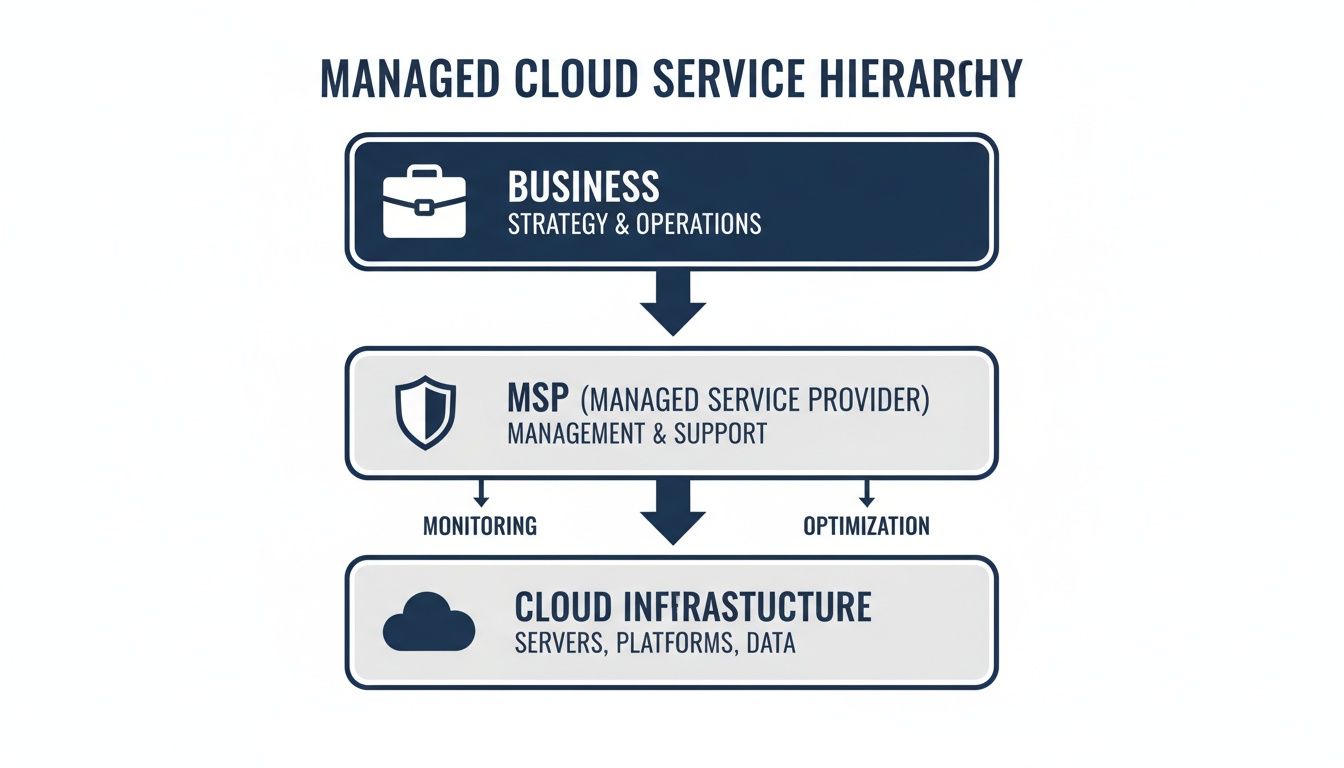
The MSP becomes the crucial link, turning complex cloud technology into real-world business results.
A managed cloud service is most valuable in the IaaS and PaaS models. While these models give you control, an MSP acts like your expert chef; they take over the complex kitchen operations so you can focus on your business goals without getting burnt out.
Key Benefits of Using a Managed Cloud Provider

Bringing a managed cloud provider on board is far more than just outsourcing a few IT tasks. It’s a strategic move that can genuinely unlock new levels of efficiency, fortify your security, and spark innovation. A managed cloud service helps your organisation shift from a reactive, break-fix mentality to a proactive, growth-oriented approach. The benefits are felt right across the business, from your bottom line to your competitive standing.
Instead of your team getting bogged down in routine maintenance, patching, and troubleshooting, they're suddenly free to focus on projects that actually move the needle and generate revenue. It's a fundamental shift that lets your business stop managing technology and start using it as a strategic tool for growth. This ensures your cloud environment becomes a powerful asset, not just a line-item expense.
Achieve Strategic Cost Optimisation
Let's be honest: one of the biggest and most immediate wins from a managed cloud service is getting a handle on your costs. Without an expert keeping watch, cloud bills can spiral out of control thanks to oversized resources, forgotten instances, and confusing pricing schemes. It’s not uncommon for companies to see 20-40% budget overruns in their first year of trying to manage the cloud on their own.
An MSP brings financial discipline to the table from day one. They use specialised tools and years of experience to right-size your infrastructure, making sure you only pay for what you truly need. This proactive financial governance stops waste before it starts and gives you predictable monthly spending. Suddenly, your cloud costs transform from a volatile headache into a stable, manageable investment. To get a head start, it’s worth exploring the specific cloud cost optimisation strategies that MSPs put into practice.
This kind of expertise is becoming more critical than ever. The managed services market in Canada was valued at USD 19,895.0 million in 2024 and is on track to hit USD 43,608.8 million by 2030. That growth is fuelled by businesses just like yours trying to rein in costs and boost efficiency in their cloud operations. You can dig deeper into cloud strategy trends in Canada to see where the market is headed.
Access Enterprise-Grade Security and Compliance
Navigating today's complex threat landscape requires specialised knowledge and relentless vigilance. A managed cloud service provider offers a level of security that most small and medium-sized businesses simply couldn't afford to build in-house. They implement sophisticated security frameworks and take the complexities of data protection off your plate.
This means round-the-clock monitoring, active threat detection, and a clear incident response plan to safeguard your most important assets. For any business operating in Canada, complying with data privacy laws like the Personal Information Protection and Electronic Documents Act (PIPEDA) is absolutely non-negotiable. A good MSP ensures your cloud architecture is configured to meet these strict requirements, shielding you from hefty fines and reputational harm.
A managed security approach means your defences are always up-to-date and managed by experts whose sole focus is protecting digital assets. It's the difference between having a lock on the door and having a dedicated 24/7 security team guarding the entire building.
Unlock Your Internal Team's Potential
Perhaps the most overlooked benefit is what happens to your own IT team. When they’re finally freed from the daily grind of operational management, your talented people can focus on the high-value initiatives that truly drive the business forward.
Just imagine your team building a new customer-facing app, integrating AI to streamline business processes, or refining your data analytics to uncover new opportunities. These are the kinds of projects that create a real competitive advantage.
A managed cloud service gives you access to a deep bench of certified experts without the steep cost of hiring them directly:
Cloud Architects who design resilient and scalable infrastructure from the ground up.
Security Specialists who proactively hunt for and defend against cyber threats.
DevOps Engineers who automate processes to help you get to market faster.
This partnership empowers your internal team to become strategic leaders instead of just system administrators. By offloading the operational burden, you’re investing directly in your company's ability to innovate and succeed long-term, ensuring your technology budget fuels growth instead of just keeping the lights on.
Managed Cloud Services in Canadian Industries

The theory behind managed cloud services is great, but where the rubber really meets the road is in solving the specific, day-to-day problems faced by Canadian industries. From the strict compliance demands of healthcare to the high-stakes world of finance, these services aren't just about managing servers; they're about enabling business, ensuring compliance, and fuelling real growth across the country.
Think of a managed service provider (MSP) as a specialist guide. For a hospital in Alberta or a financial firm in Toronto, they navigate the unique operational and legal terrain of that industry, translating complex cloud tools into practical solutions that solve tangible problems.
Healthcare: A Prescription for Compliance and Innovation
In Canadian healthcare, data security isn't just a good idea; it's the law. The challenge is huge: you have to protect sensitive patient information according to provincial rules like Ontario's PHIPA, while also trying to innovate with telehealth and digital records. This is exactly where an MSP becomes indispensable.
The Challenge: A regional Ontario clinic wants to roll out a telehealth platform to better serve patients in remote areas. This means all video calls and patient data must be encrypted, stored securely within Canada, and be fully PHIPA compliant to avoid crippling fines. Their small in-house IT team just doesn't have the niche cybersecurity expertise for a project of this scale.
The Managed Cloud Solution:
PIPEDA/PHIPA Compliant Architecture: The MSP steps in to design and deploy the entire infrastructure in a Canadian data centre, which guarantees data sovereignty from the start.
Robust Security Protocols: They layer on advanced encryption, multi-factor authentication, and continuous threat monitoring to create a digital fortress around patient records.
High-Availability Infrastructure: The provider guarantees 99.99% uptime, making sure the telehealth platform is always online and ready for appointments.
By bringing in an MSP, the clinic can launch its platform with confidence, knowing they are expanding patient care without cutting any corners on security or compliance. You can dive deeper into the specific needs of this sector in our guide to cloud-based healthcare software in Canada.
Financial Services: Securing Transactions and Sovereignty
Canada's financial services sector is under constant pressure. It needs high-performance computing for things like risk modelling and absolutely ironclad security for every transaction. On top of that, data sovereignty is a non-negotiable, meaning sensitive financial data must stay within Canadian borders.
A managed cloud service provider gives financial institutions the best of both worlds: the agility to compete on a global scale while sticking to strict local regulations. They deliver the secure, high-performance infrastructure needed for everything from algorithmic trading to real-time fraud detection.
The Challenge: A national investment firm needs to run incredibly complex risk-analysis models. These models require massive, but temporary, bursts of computing power. Building an on-premise supercomputer for this is financially out of the question, but using a generic public cloud raises red flags around data security and compliance.
The Managed Cloud Solution: The MSP implements a smart hybrid cloud. Day-to-day operations live on a secure private cloud, but when it's time to run the heavy-duty risk models, the workload "bursts" to a managed public cloud. This way, the firm only pays for the extra power when it's needed. The provider ensures all data stays in Canada and manages the secure connection, delivering enterprise-grade performance for a fraction of the cost.
Small and Medium-Sized Businesses: Levelling the Playing Field
For the small and medium-sized businesses (SMBs) that are the heart of Canada's economy, managed cloud services are a game-changer. It gives them access to the kind of powerful technology, security, and expertise that was once reserved for huge corporations, all for a predictable monthly fee.
This shift is changing how Canadian businesses operate. While an impressive 92% of Canadian companies already use public cloud services, many aren't getting the full value out of their investment. That's why so many are now looking to managed solutions to close the gap.
The Challenge: A growing e-commerce shop in British Columbia keeps having its website crash during the holiday shopping rush, leading to lost sales and unhappy customers. They can't afford to hire a full-time, 24/7 IT team to manage server loads and fend off security threats.
The Managed Cloud Solution: An MSP moves their website to a scalable cloud platform that automatically adds more resources when traffic spikes. The provider also delivers around-the-clock monitoring, proactive security updates, and cost optimisation, ensuring the site is fast and secure even on Black Friday. The SMB gets a rock-solid online presence for a flat fee and can finally focus on what they do best: growing their business.
How to Choose the Right Managed Cloud Provider
Picking a managed cloud provider isn't just about outsourcing a task; it's about finding a partner who will become an extension of your own team. Get it right, and you’ll accelerate growth, lock down your security, and give your internal team the freedom to focus on what they do best. But a bad fit can quickly lead to blown budgets, gaping security holes, and a whole lot of frustration.
This is a decision that demands a bit of homework. You need to look past the slick sales presentations and dig into what a provider can actually deliver. A solid partnership is always built on proven expertise, clear promises, and a genuine grasp of your company's unique challenges and goals.
There's a reason the managed services market here in Canada is taking off. Businesses are scrambling for experts to help them navigate the ever-growing complexity of the cloud, especially as hybrid and multi-cloud setups become the norm. The market hit USD 19,895.0 million in 2024 and is on track to reach a staggering USD 43,608.8 million by 2030. This boom tells you one thing: having the right cloud partner is no longer a luxury; it's essential for staying competitive. You can get a deeper look at the booming Canadian market on ResearchAndMarkets.com.
Evaluate Their Technical Expertise and Certifications
First things first: you have to confirm that any potential provider has the technical chops to handle your specific cloud environment. Don't just take their word for it. Look for hard evidence, like official certifications from the major cloud platforms. Since the "big three": Amazon Web Services (AWS), Microsoft Azure, and Google Cloud Platform (GCP), own over 63% of the global cloud market, deep expertise in at least one of them is table stakes.
Drill down and look for specific partnership levels or competencies:
AWS: Are they an AWS Advanced or Premier Tier Services Partner? Do they have engineers on staff with certifications like the AWS Certified Solutions Architect?
Microsoft Azure: Have they earned designations like Azure Expert MSP or are they a Solutions Partner for Infrastructure?
Google Cloud: Are they a recognised Google Cloud Premier Partner with certified Professional Cloud Architects on their team?
These credentials aren't just fancy logos for a website. They're proof that the provider has invested serious time and money into training and has a history of successful projects that have been validated by the cloud giants themselves.
Dissect the Service Level Agreement
The Service Level Agreement (SLA) is the single most important document you'll sign. Think of it as the rulebook for your relationship. It’s a legally binding contract that spells out exactly what services you're getting, the performance standards they have to meet, and what happens when things go wrong. Reading the fine print here is non-negotiable.
A good SLA will clearly define:
Uptime Guarantees: Look for a specific number, like 99.9% or 99.99%, and make sure you understand what it actually covers. Is it just for network connectivity, or does it apply to your entire application?
Support Response and Resolution Times: It should break down how quickly they’ll acknowledge an issue, and more importantly, how fast they promise to fix it, usually based on severity level.
Scope of Services: This is huge. The SLA needs to list every single service included, from 24/7 security monitoring and patch management to cost optimisation reports. Anything not on that list will almost certainly cost you extra.
An SLA isn't just a safety net; it's a blueprint for your partnership. A provider who offers a vague or confusing SLA is waving a major red flag. Demand clarity and precision.
Vet Security Credentials and Canadian Compliance
For any business operating in Canada, security and data privacy are top of mind. Your provider absolutely must have a deep understanding of the Canadian regulatory scene and the security credentials to prove it. How they protect your data is a direct reflection of how they protect your business.
Start by asking some tough questions:
Data Sovereignty: Can they guarantee that all of your sensitive data will be stored and processed on Canadian soil, inside Canadian data centres?
Compliance Expertise: Do they have hands-on experience with environments that need to follow federal laws like PIPEDA or provincial ones like Quebec's strict Law 25?
Security Audits: Ask to see their third-party audit reports. A SOC 2 Type II report, for instance, is a great indicator because it validates their security controls and operational effectiveness over a period of time.
Choosing a provider is a high-stakes decision that will shape your company's trajectory. By methodically checking their expertise, scrutinising their promises, and verifying their security posture, you can build a partnership that doesn’t just protect your assets but actively helps drive your business forward.
Common Questions About Managed Cloud Services
Stepping into the world of managed cloud services is a big move, and it’s natural to have a lot of questions. For business leaders, the decision isn't just about technology; it's about cost, security, and how this new partnership will fit into your existing operations. Getting clear, straightforward answers is the first step toward making a confident and informed decision.
This section tackles the most common and pressing questions we hear from organisations considering a managed cloud service. We’ll give you direct answers to help cut through the noise and understand what a partnership with a managed service provider (MSP) really looks like.
What Are the Typical Pricing Models?
One of the first questions on any leader's mind is, "What is this going to cost?" Unlike the often unpredictable nature of self-managed cloud billing, MSPs aim for predictability. While every provider has their own flavour, pricing usually falls into one of these common models.
Per-Device or Per-User Pricing: This is a simple, straightforward model where you pay a flat monthly fee for each device (like a server or workstation) or each employee being managed. It’s easy to budget for and scales predictably as your team grows.
Tiered Pricing: Many providers offer bundled packages or tiers (e.g., Bronze, Silver, Gold). Each tier includes a progressively larger set of services, allowing you to choose the level of support that best fits your needs and budget.
Value-Based Pricing: This model is less common but highly strategic. Here, the cost is tied directly to the business value the MSP delivers, such as guaranteed cost savings or specific performance improvements. It aligns the provider's goals directly with your own.
The key takeaway is that a managed service moves your IT costs from a volatile capital expenditure (CapEx) to a predictable operating expenditure (OpEx).
How Will an MSP Protect Our Sensitive Business Data?
In an environment where data breaches are a constant threat, security is non-negotiable. This is especially true in Canada, where laws like the Personal Information Protection and Electronic Documents Act (PIPEDA) and Quebec's Law 25 impose strict rules on how customer data is handled. A reputable MSP makes security the bedrock of their service.
They protect your sensitive data through a multi-layered approach:
Data Sovereignty: A Canadian MSP will guarantee that your data is stored and processed exclusively within Canadian data centres, a key requirement for compliance.
Proactive Threat Monitoring: They use advanced tools to monitor your environment 24/7/365, actively hunting for suspicious activity before it can become a breach.
Regular Security Audits: Providers conduct frequent vulnerability assessments and penetration tests to identify and patch any weaknesses in your defences.
Compliance Management: They have deep expertise in Canadian privacy laws and will configure your cloud environment to meet all necessary regulatory standards, taking that burden off your shoulders.
A managed cloud provider acts as your dedicated security guardian. Their job isn't just to react to threats but to build a resilient and compliant environment that prevents them from happening in the first place.
What Does the Migration Process Actually Look Like?
The idea of moving your entire infrastructure to the cloud can seem daunting, but a seasoned MSP follows a well-defined process to make it as smooth and disruption-free as possible. They handle the heavy lifting, guiding you through each stage with clear communication.
The journey typically follows these key phases:
Assessment and Discovery: The process begins with a deep dive into your current IT environment. The MSP analyses your applications, infrastructure, and business goals to create a detailed migration roadmap.
Design and Planning: Based on the assessment, the provider designs your new cloud architecture. This plan outlines which workloads will move, the timeline for migration, and the security protocols that will be put in place.
Migration and Execution: This is the hands-on phase where your data and applications are moved to the new cloud environment. This is often done in stages over weekends or off-peak hours to minimise any impact on your daily operations.
Testing and Cutover: Once everything is moved, rigorous testing ensures all systems are running perfectly. After your team gives the final sign-off, the "cutover" happens, and your business officially begins operating from the cloud.
Optimisation and Management: The journey doesn't end at migration. Post-cutover, the MSP immediately begins the ongoing process of monitoring, managing, and optimising your new environment for performance and cost.
Can an MSP Work with Our Existing IT Department?
Absolutely. This is one of the most common and effective ways to use a managed cloud service. The goal is rarely to replace your internal IT team but rather to empower them. This collaborative approach is known as a co-managed IT model, and it offers the best of both worlds.
In this partnership, your internal team maintains control over strategy and user-facing support, while the MSP handles the complex, time-consuming backend infrastructure.
Your IT Team Focuses On:
Strategic technology planning
Business-specific application support
End-user helpdesk and training
The MSP Manages:
24/7 infrastructure monitoring and alerts
Cybersecurity and threat mitigation
Backup and disaster recovery
Cloud cost optimisation
This model frees your talented team from firefighting and allows them to focus on high-value projects that drive business growth, turning your IT department from a cost centre into an innovation engine.
At Cleffex Digital Ltd, we specialise in creating secure, scalable, and cost-effective managed cloud solutions that align with your business objectives. Discover how we can empower your team and secure your digital future at Cleffex.com.