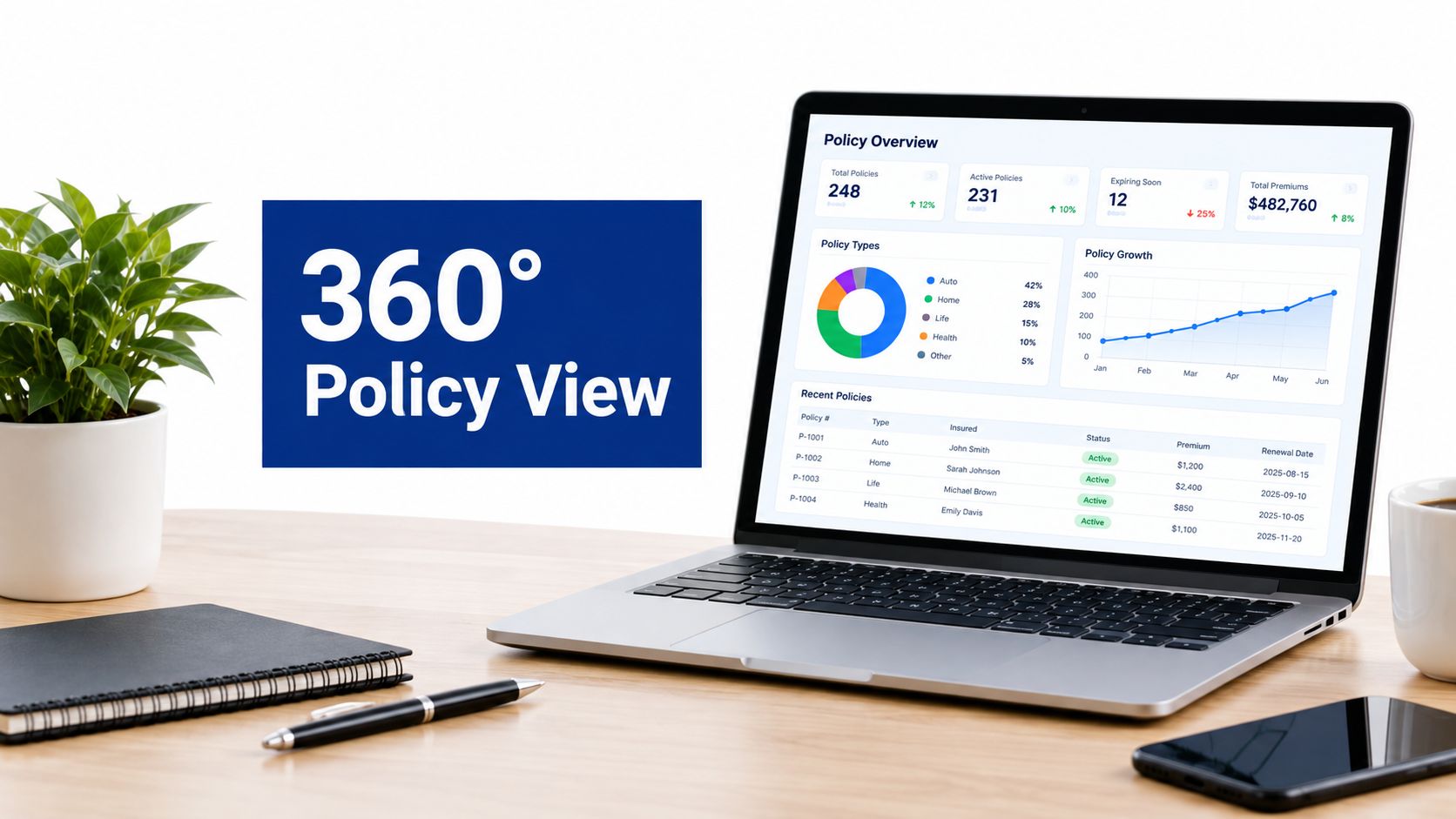
At its core, a healthcare CRM is a specialised system built to manage the complex web of patient relationships and streamline the day-to-day chaos of running a clinic or hospital. Think of it as the central nervous system for all patient data, communications, and administrative tasks.
This technology enables providers to deliver more personalised and efficient care while staying compliant with stringent regulations, such as HIPAA.
What Is CRM Software in a Healthcare Setting?
Picture the old-school clinic setup: patient charts in a massive filing cabinet, billing records locked away in another office, and appointment books stacked on the front desk. Information is trapped in different places, making it nearly impossible for anyone to get a clear, complete picture of a patient's journey.
A healthcare CRM shatters those information silos. It pulls everything into a single, cohesive digital space, giving you a dynamic, 360-degree view of each patient. It tracks every single interaction, from their first visit to your website and booking an appointment, all the way to clinical follow-ups and feedback surveys, and lays it all out in one unified timeline. This is the fundamental shift a CRM brings: moving from isolated, transactional encounters to genuine, relationship-focused care.
Beyond a Digital Address Book
It’s a common mistake to think of a healthcare CRM as just a fancy digital rolodex. In reality, it’s the operational engine that powers the entire patient experience. It gives healthcare providers the tools to:
Personalise Communication: You can group patients by their specific condition, appointment history, or even demographics to send them targeted health reminders, educational materials, and tailored follow-up care instructions.
Automate Administrative Tasks: Think of all the manual work that bogs down your staff. A CRM automates appointment scheduling, sends out reminders, handles digital patient intake forms, and even manages billing notifications.
Improve Team Collaboration: When every department, from the front desk to the clinical team, has access to the same up-to-the-minute patient information, care becomes consistent, coordinated, and far more effective.
Enhance the Patient Journey: You can proactively guide patients through every step of their care, offering pre-visit instructions and post-discharge support to create an experience that feels seamless and genuinely supportive.
A Growing Market Driven by Need
The demand for these systems is exploding. The global healthcare CRM market hit a value of USD 16.84 billion in 2023, with North America leading the charge, making up about 58.3% of that total.
This massive growth is a direct response to the need to bring everything together: appointment histories, telehealth calls, and patient data, into one reliable source. For healthcare organisations in places like Canada, managing diverse patient populations means adopting tools with smart analytics and automation, which is no longer a luxury; it’s essential for meeting patient expectations and navigating our stringent privacy laws.
A healthcare CRM transforms the patient experience from a series of disconnected appointments into a continuous, supportive relationship. It ensures that care is not just delivered, but orchestrated with precision, context, and empathy.
Ultimately, this technology allows healthcare organisations to do more than just treat illnesses. It empowers them to build lasting trust with their patients, improve health outcomes, and operate far more efficiently in an increasingly demanding world.
Navigating Critical Compliance and Integration Hurdles
Bringing new software into a healthcare setting isn't like downloading a new app. It's a high-stakes process, governed by a maze of regulations and technical complexities. When we talk about CRM software for the healthcare industry, two massive hurdles immediately come to mind: ironclad regulatory compliance and a seamless technical fit with the systems you already use.
Getting these two things right isn't just a "nice-to-have"; it's foundational. Mess up compliance, and you're looking at crippling fines and a loss of patient trust. Botch the integration, and you've just created a digital mess of data silos and chaotic workflows. Think of these hurdles less as roadblocks and more as the essential guardrails that make your technology investment safe, secure, and genuinely useful.
The Unbreakable Rules of Patient Data Privacy
In healthcare, nothing is more sacred than patient data. Protecting that information isn't a suggestion; it’s the law. Regulations like the Health Insurance Portability and Accountability Act (HIPAA) set the standard, and they are unforgiving. A CRM that wasn't built from the ground up with these rules in mind is a lawsuit waiting to happen.
This is where a healthcare CRM truly shows its value – by acting as a central hub that connects patient care, operations, and relationship management, all while staying inside these strict legal lines.
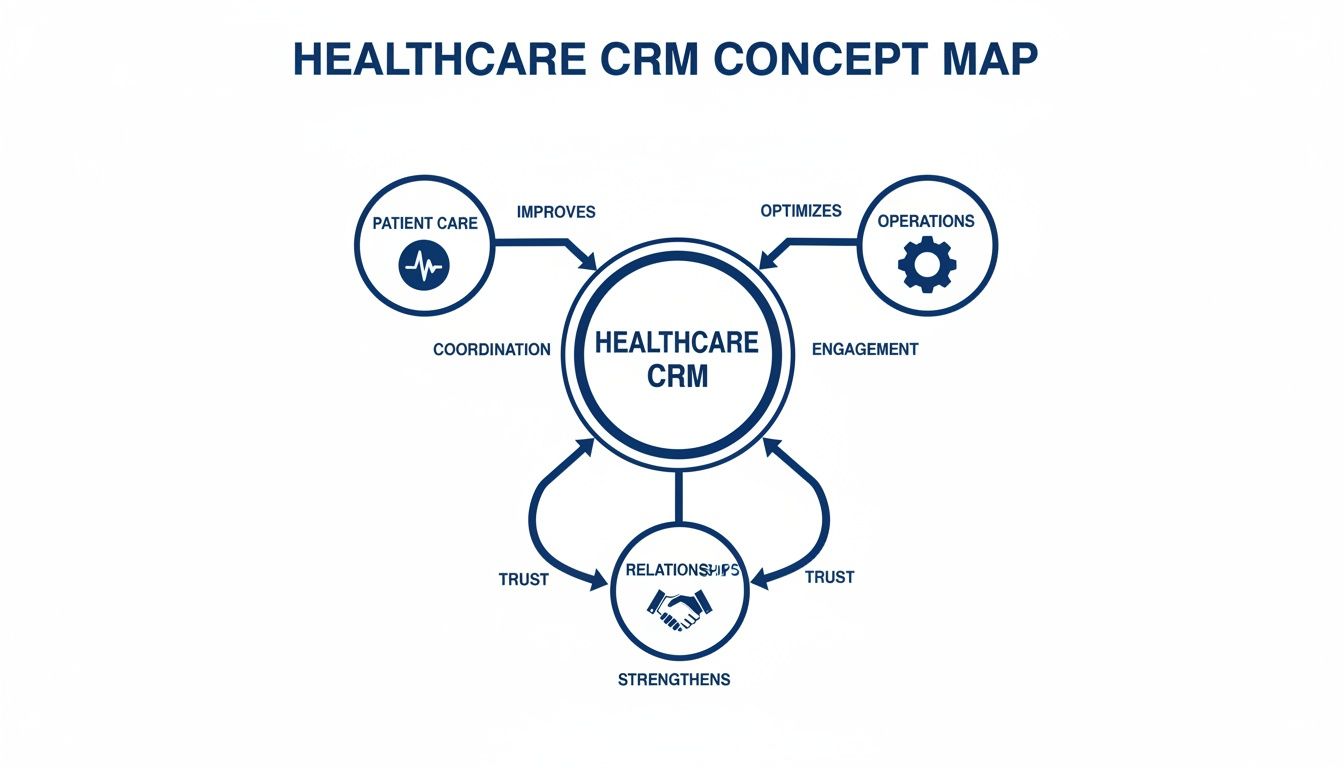
As you can see, a CRM’s power comes from its ability to unify all these moving parts. That's why solid compliance and integration aren't just features; they're the very foundation it's built on.
For a CRM to even be in the running, it must have these non-negotiable security features baked in:
End-to-End Data Encryption: All patient information, whether it’s sitting on a server or being sent in a message, has to be scrambled and unreadable to anyone without authorisation.
Strict Access Controls: The system needs to let you create clear roles and permissions. Your front desk staff shouldn't see clinical notes, and a physician doesn't need to see detailed billing reports.
Detailed Audit Trails: A compliant CRM keeps a meticulous log of every single action. Who looked at what patient record? When? This accountability is critical for security and investigations.
When you start plugging communication tools into your CRM, it's absolutely vital to choose from HIPAA-compliant texting platforms to keep patient outreach secure.
Building the Digital Bridge to Your Existing Systems
Picture your Electronic Health Record (EHR) and Practice Management System (PMS) as two separate islands, each holding critical pieces of the patient puzzle. A good healthcare CRM is the bridge that connects them. It lets data flow freely between the islands, creating a single, reliable source of truth for everyone.
Without that bridge, your team is stuck manually entering the same data into multiple systems – a mind-numbing task that’s a breeding ground for typos and errors. A well-integrated CRM automates that flow. Patient demographics, appointment history, and billing info stay perfectly in sync across all your tools. This is where a holistic plan comes in; it pays to explore what goes into effective healthcare data management software development.
An integrated CRM doesn't just connect software; it connects departments. It breaks down the walls between clinical and administrative teams, giving everyone a complete and consistent view of the patient's journey.
The good news is that the groundwork for this kind of integration is already laid in many places. Take California, for example. The state’s high adoption rate of EHRs has created the perfect environment for CRMs to thrive. By 2018, 96% of California hospitals were using at least a basic EHR, and around 73% were on federally certified systems.
That means the backend plumbing needed for a CRM to connect clinical and administrative data is already in place, making it far easier to roll out powerful features like automated appointment reminders and coordinated care workflows.
What's Under the Hood? Core vs. Advanced Healthcare CRM Features
When you're looking at CRM software for the healthcare industry, it helps to think of it like a doctor's bag. Some tools are absolute must-haves for every single day – the stethoscope, the blood pressure cuff. Others are highly specialised instruments you pull out for more complex situations. A modern healthcare CRM is built the same way, mixing essential, non-negotiable features with advanced tools that get you ready for the future of patient care.
Getting this distinction right is crucial. It’s the difference between buying a tool that solves today's headaches and investing in a platform that will grow with you tomorrow. The best systems give you a rock-solid foundation for managing patient relationships while also providing the power to innovate and deliver truly exceptional care.
So, let's break down what these features actually look like in practice.
The Must-Haves: Core Functionalities Every Practice Needs
These are the absolute bedrock of any decent healthcare CRM. Without them, you essentially have a glorified digital address book. These features are all about streamlining your day-to-day operations, making communication easier, and creating one single, reliable place for all patient information.
Think of these as the table stakes for any clinic, hospital, or health-tech company serious about organising its patient interactions.
Unified Patient Profiles: This is the heart and soul of the CRM. It pulls every shred of patient data: contact info, appointment history, communication logs, billing status, and even notes on personal preferences, into one single, 360-degree view. No more hunting through different systems.
Intelligent Appointment Scheduling: We're talking about more than just a calendar. A solid CRM automates the booking process, lets patients schedule themselves online, and automatically sends out reminders via email or text to slash no-show rates. It also helps manage all the necessary follow-ups.
Automated Communication Workflows: This feature puts routine patient outreach on autopilot. It can send out pre-visit instructions, share after-care tips once a patient is discharged, or send reminders for annual check-ups. You get consistent, timely communication without anyone having to lift a finger.
These core features work in concert to build a much more efficient, patient-focused backbone for your operations. Streamlining operations is a key goal, and many modern CRMs are designed to work with or support initiatives like healthcare documentation automation.
The Game-Changers: Advanced Capabilities That Drive Innovation
If core features keep the lights on, advanced features are what set you apart from the competition. These tools tap into newer technologies like AI and deeper system integrations to shift you from simply managing patients to proactively caring for them. This is where you unlock new levels of efficiency and truly connect with your patients.
Advanced CRM features turn patient data from a static file into a living, intelligent asset. They give you the power to anticipate what a patient needs, personalise their care journey, and constantly improve your services based on real, honest feedback.
These are the capabilities where a purpose-built CRM software for healthcare industry really shows its value.
AI-Driven Predictive Analytics: This is a powerhouse. The system analyses patient data to spot trends and predict future health risks. It can flag patients who are at a high risk of being readmitted or those likely to skip a critical follow-up, letting your clinical team step in before a problem arises. For a closer look, you can explore how healthcare data analytics solutions are fundamentally changing patient outcomes.
Telehealth and Virtual Care Integrations: Modern healthcare doesn't just happen within four walls. A top-tier CRM connects directly with telehealth platforms. This means you can manage virtual visits, secure messaging, and remote patient monitoring seamlessly, with every interaction logged right in the patient’s unified profile.
Automated Patient Feedback and Sentiment Analysis: The system can automatically send surveys and feedback forms after an appointment. The really smart platforms use AI to analyse the tone and sentiment of those responses, giving you a real-time pulse on patient satisfaction and pointing out exactly where you can improve.
To make this clearer, let's compare these two tiers of functionality side-by-side. The table below helps you map out your organisation's current needs and future goals to the right set of features.
Core vs Advanced Healthcare CRM Features
| Feature Category | Core Functionality (The Must-Haves) | Advanced Functionality (The Game-Changers) |
|---|---|---|
| Patient Data | Unified Patient Profiles with 360-Degree View | Predictive Analytics for At-Risk Patient Identification |
| Scheduling | Automated Appointment Reminders and Follow-Ups | Direct Telehealth and Virtual Visit Integration |
| Communication | Template-Based Email and SMS Outreach | Automated Patient Feedback Collection and Sentiment Analysis |
| Operations | Basic Reporting and Dashboards | AI-Powered Workflow Optimisation and Automation |
Having this distinction in mind is key to making a smart choice – one that solves your immediate challenges while setting you up for long-term success.
How Healthcare Providers Actually Use CRM Software
Let's move past the theory and look at what a healthcare CRM does on the ground. This isn't just about adding another piece of software; it's about fundamentally changing how you operate and solving the real, everyday headaches that plague providers of all sizes. By walking through a couple of practical scenarios, we can see exactly how a CRM makes a tangible difference in patient care and operational efficiency.
We'll explore two very different environments: a large, multi-department hospital and a smaller, community-focused private clinic. Each has its own unique set of challenges, but a well-chosen CRM provides concrete solutions for both.
Scenario One: The Large Hospital
Picture a busy city hospital. Hundreds of patients are referred between departments every single day. The cardiology unit needs to send a patient over to the diabetes management centre, which then needs to loop in the nutrition department. Without a central system, this is pure chaos – a tangled web of phone tag, misplaced faxes, and redundant data entry that ultimately leads to delays in care and seriously frustrated patients.
This is where a healthcare CRM steps in to act as the central nervous system for this complex network. When a referral is made, the CRM automates the entire workflow from start to finish.
A seamless handover: The cardiologist enters the referral directly into the patient's single, unified profile. That one action automatically creates a task for the diabetes centre's intake coordinator.
The full picture: The coordinator can instantly see the patient's complete history, the reason for the referral, and all relevant clinical notes. No more chasing down information.
Automated, clear communication: The system then triggers an automated message to the patient, letting them book their appointment online with the new department and even providing pre-visit instructions.
This smooth process cuts down on administrative friction and makes sure the patient never feels like they've been dropped or forgotten.
But the CRM's job doesn't stop with individual patient journeys. Hospitals also have a massive responsibility to public health.
A CRM transforms a hospital’s patient database from a static record-keeping system into a powerful public health tool. It enables proactive, targeted outreach that can genuinely improve community well-being.
Take flu season, for instance. The hospital can use its CRM to launch a highly targeted vaccination campaign. It can easily segment its entire patient population based on age and specific risk factors, then send personalised reminders directly to the most vulnerable groups. This data-driven approach is worlds more effective than a generic billboard, boosting vaccination rates and easing the burden on emergency services.
Scenario Two: The Private Clinic
Now, let's shift to a smaller private clinic. Here, success is all about building strong, lasting relationships with patients and maintaining an excellent local reputation. One of the biggest operational drains is the classic appointment no-show, which wastes the physician's valuable time and directly hits the clinic's revenue.
This is exactly the kind of problem that CRM software for healthcare industry is built to solve.
Smart, personalised reminders: The CRM automates appointment confirmations and sends out a series of reminders through the patient's preferred channel, whether that’s email or an SMS text.
Effortless rescheduling: If a patient needs to cancel, they can do it with a single click in the reminder message. That action immediately frees up the time slot, allowing another patient to book it online.
Fewer empty chairs: It’s not uncommon for clinics using these automated systems to see their no-show rates drop by up to 30%, which has an immediate and direct impact on the bottom line.
Beyond just scheduling, the clinic has to actively manage its online reputation. After a patient has a good experience, the CRM can be set to automatically send a follow-up email a day later, gently asking them to leave a review on Google or other key platforms. This simple, automated step is crucial for building the kind of strong online presence that attracts new patients in a competitive market. It’s this direct, personal communication that makes patients feel valued, turning a routine check-up into a genuine, relationship-building experience.
Measuring the ROI of Your Healthcare CRM
Putting a healthcare CRM in place is a significant investment, so you need to be able to prove it is worth the cost. This goes way beyond just feeling like things are running better. To get everyone on board, from the C-suite to the clinicians, you need a solid, data-backed way to measure its return on investment (ROI). It’s about ditching the vague benefits and focusing on specific Key Performance Indicators (KPIs) that tell a clear story about your finances and operations.
A good healthcare CRM should deliver real, measurable improvements in two main areas: how efficiently you run your practice and how well you engage with your patients. By keeping a close eye on the right metrics in both of these categories, you can build an undeniable case for the software's impact on your bottom line and the quality of care you provide.

Tracking Operational Efficiency Gains
Often, the quickest wins you'll see from a CRM come from cutting down on the administrative busywork that eats up so much of your staff's day. When you can put a number on these improvements, you have the kind of hard data that really gets the attention of financial decision-makers.
Here are a few key operational KPIs to watch:
Reduced Patient No-Show Rates: Automated reminders for appointments can make a huge difference in cutting down on missed slots. Track the percentage drop in no-shows each month to calculate the direct revenue you've saved.
Lower Administrative Hours: How much time is your team no longer spending on manual phone calls, tedious data entry, or coordinating referrals? Every hour saved is a direct reduction in labour costs.
Optimised Appointment Scheduling: A smart CRM can automatically fill last-minute cancellations, which keeps your practitioners' schedules full and maximises your clinic’s revenue potential.
A well-implemented CRM doesn't just add a layer of technology; it removes layers of inefficiency. The goal is to turn saved minutes into improved patient outcomes and a healthier financial outlook for the organisation.
Gauging Patient Engagement and Satisfaction
While operational metrics provide immediate proof of value, the true long-term power of a healthcare CRM comes from building stronger, more lasting relationships with patients. These KPIs show how the software is directly impacting patient loyalty, satisfaction, and their ability to take a more active role in their own health.
Essential patient engagement metrics to track are:
Net Promoter Score (NPS): Regularly ask your patients how likely they are to recommend your practice. A rising NPS is one of the clearest signs that patient satisfaction and loyalty are on the upswing.
Patient Portal Adoption Rate: Keep an eye on how many patients are actually logging in and using the portal to schedule appointments, send messages, or view their health records. High adoption means your engagement strategy is working.
Interaction with Educational Materials: Are patients opening your health newsletters or clicking on the links to articles you send through the CRM? This data tells you how effective your proactive patient education efforts really are.
The good news is that many healthcare providers aren't starting from scratch. They already have the core technology needed to link clinical data with these engagement metrics. For instance, research on California community health centres found that by the mid-2010s, over 80% had adopted EHR systems and nearly half had health information exchange capabilities. This existing infrastructure creates a fantastic foundation, making it much easier to sync patient data and measure the true impact of a CRM on both efficiency and patient care.
Your Checklist for Choosing the Right Healthcare CRM
Picking the right CRM software for your healthcare practice can feel like a massive undertaking. The market is flooded with options, the feature lists are often confusing, and the stakes – patient privacy and keeping your operations running smoothly – couldn't be higher. But if you break the decision down into a clear, step-by-step process, you can turn this overwhelming choice into a focused project that lands you the perfect solution.
Think of this checklist as your roadmap, guiding you from the initial planning stages right through to making a confident final decision.
Step 1: Assemble Your Selection Team
First things first, you need to pull together a cross-functional team to spearhead the selection process. A CRM touches nearly every corner of your organisation, and your team should mirror that reality. Bringing in people from different departments ensures every critical need is actually heard and considered.
A solid team should include:
Clinical Staff: A physician or nurse who lives the daily workflow and knows exactly what’s needed from an EHR integration perspective.
Administrative Leaders: A practice manager or front-desk lead who grapples with the realities of scheduling, billing, and patient communication.
IT Specialists: An IT manager who can properly vet the technical specs, security protocols, and integration muscle of any potential system.
Executive Stakeholders: A key decision-maker who can make sure the final choice lines up with the clinic's bigger business and financial picture.
Step 2: Define Your Core Pain Points
Before you even start looking at vendors, you have to get crystal clear on the problems you’re actually trying to solve. What are the specific bottlenecks, communication breakdowns, or patient frustrations that you need this new software to fix?
Don't be vague. Are you wrestling with:
Frustratingly high appointment no-show rates?
Choppy communication between departments?
A messy, hard-to-track patient referral process?
No real data to measure and improve patient satisfaction?
By starting with your problems, you make sure the search is driven by your clinic's unique needs, not just a vendor's slick sales pitch. This focus is what separates a tool that delivers a real ROI from one that just adds another login to remember.
Step 3: Audit Your Current Technology Stack
A healthcare CRM doesn't work in isolation. It has to play nicely with your existing systems, especially your Electronic Health Record (EHR) and Practice Management System (PMS). It's time to map out your entire tech ecosystem and pinpoint every single integration point that’s non-negotiable.
This is also the perfect moment to ask a critical question: is an off-the-shelf solution going to cut it, or do your unique workflows demand something more specific? For practices with highly specialised needs, exploring the path of custom healthcare software in Canada might be the only way to get a solution that’s truly built around your processes.
Step 4: Create a Vendor Shortlist and Ask the Right Questions
Once you’ve defined your needs, you can build a shortlist of vendors that actually specialise in healthcare. When you get to the product demo stage, you need to push past the standard pitch and ask pointed questions that get to the heart of what matters to you.
Compliance and Security: How, specifically, do you maintain HIPAA compliance? Can you walk me through your data encryption methods, access controls, and audit trail capabilities?
EHR Integration: Let's talk about integrating with our specific EHR system. Is it a native, two-way integration, or does it depend on a third-party API?
Implementation and Support: What does your onboarding process actually look and feel like for a clinic of our size? Who becomes our go-to person for support once we're up and running?
Following this methodical plan helps you cut through the marketing noise and confidently choose the CRM that will truly support your patients and your team.
Frequently Asked Questions
Jumping into the world of healthcare CRMs can bring up a lot of questions. Security, cost, how it fits with existing systems; it's a lot to consider. Here are some straightforward answers to the questions we hear most often, designed to clear things up as you weigh your options.
What Is the Difference Between a Healthcare CRM and an EHR?
It’s a common point of confusion, but the distinction is actually quite simple. Think of your Electronic Health Record (EHR) as the patient’s clinical diary, while the healthcare CRM is their relationship manager.
EHR (The Clinical Diary): This is where all the hard medical data lives: diagnoses, lab results, medications, and treatment plans. Its entire focus is on documenting and supporting direct clinical care.
CRM (The Relationship Manager): This system is all about the patient journey. It manages communications, appointment scheduling, feedback, and educational outreach. A CRM’s job is to improve the patient experience and make administrative tasks smoother. It doesn't handle the clinical side; it manages all the interactions that wrap around that care.
A CRM isn't meant to replace your EHR. The best CRM software for healthcare industry works with your EHR, integrating seamlessly so that patient relationship data and clinical data sit side-by-side. This creates a truly complete view of the patient.
How Does a CRM Ensure HIPAA Compliance?
This is a non-negotiable, and any CRM built for healthcare is designed from the ground up with privacy laws like HIPAA at its core. They aren't just features tacked on; they're part of the system's DNA.
Here are the essential safeguards you should expect:
End-to-End Encryption: All patient data is scrambled and unreadable, whether it's sitting on a server or being sent between systems. This prevents unauthorised access.
Role-Based Access Controls: The system ensures people only see what they need to see. A marketing coordinator, for instance, has no business looking at clinical notes, and the CRM enforces that boundary.
Detailed Audit Trails: Every single action taken inside the CRM is logged. This creates a transparent record of who accessed what data and when, which is absolutely critical for security audits and accountability.
Is It Better to Choose a Niche Healthcare CRM or a General CRM?
While you could try to adapt a general-purpose CRM, a solution designed specifically for healthcare will almost always be the smarter choice. A niche healthcare CRM arrives with compliance features already built in, uses terminology that makes sense in a clinical setting, and includes workflows designed for things like referral management and patient intake.
This specialisation means you're not starting from scratch. It dramatically cuts down on setup time, ensures you’re meeting regulatory requirements from day one, and gives your team tools that actually solve the real-world challenges of managing patient relationships.
Ready to see how a purpose-built software solution can transform your practice? The team at Cleffex Digital Ltd specialises in developing secure, compliant, and efficient software that solves the unique challenges of the healthcare industry. Learn more at cleffex.com.