

When we talk about AI ecommerce development, we're essentially discussing how to weave artificial intelligence into the fabric of an online store. The goal is to build a shopping experience that's smarter, more personal, and far more efficient for every customer. These services use AI to automate routine tasks, make sense of customer behaviour, and create dynamic interactions that ultimately boost sales and build lasting loyalty.
Why AI Is Reshaping Online Shopping

Think about your online store evolving from a simple digital catalogue into a dedicated personal shopper for every single person who visits. That’s not science fiction anymore; it's the new reality artificial intelligence is building for Canadian retailers. This isn't just another tech upgrade; it's a complete reimagining of how customers connect with brands online.
From Digital Library to Personal Guide
A standard ecommerce website is a lot like a massive library. Customers have to wander through endless aisles of categories or use a clunky search bar, hoping they stumble upon the right item among thousands of choices. It's a self-serve model that puts all the work of finding something great squarely on the shopper's shoulders.
Now, picture an AI-powered store. It acts less like a library and more like an expert personal shopper. This intelligent guide learns what customers like, understands their unique tastes, and proactively suggests products they're bound to love – sometimes even before they realise they want them. The result is a guided, intuitive journey that feels delightful, not overwhelming.
AI ecommerce development services are the tools needed to meet today's customer expectations. They close the gap between what shoppers want and what traditional online stores can offer, turning passive scrolling into an engaging buying experience.
This whole shift is being driven by incredibly high consumer expectations. Today's shoppers expect hyper-personalised and seamless experiences. They want websites that remember their preferences, recommend relevant products, and give them instant answers. Anything less just feels clunky and impersonal.
Meeting Modern Consumer Expectations in Canada
The demand for this kind of intelligent shopping is accelerating. By 2025, AI is set to have a major impact on the Canadian ecommerce scene, with one in four consumers expected to use AI-powered tools weekly while shopping online. What's more, among Canadian youths aged 16-24, 15% have already made AI their go-to search method, preferring conversational help over old-school search engines.
This trend sends a clear message: businesses need to adapt or risk being left behind. AI is fundamentally changing the game, from personalising product recommendations to helping store owners spot new market opportunities, like using AI for finding winning products in dropshipping.
For a more detailed look at this, our guide on how AI in ecommerce is transforming retail success is a great place to start. In the sections that follow, we'll dive into the specific AI technologies and strategies making all of this possible.
The Core Tools of AI Ecommerce Development
To really get what AI ecommerce development services bring to the table, we need to pop the hood and look at the actual tools that make an online store intelligent. These aren't just buzzwords; they're specific applications built to solve real-world business problems and make the shopping experience better for everyone.
Think of it as a digital toolbox. Each tool has a specific job, but they all work together to build a smarter, more intuitive retail environment. Let's break down the essentials and see how they impact your operations and, ultimately, your bottom line.
Personalisation Engines That Craft Unique Journeys
At the very centre of AI in ecommerce is the personalisation engine. This is like having a personal shopper for every single customer, using data to figure out what they want before they even know they want it. It's about tailoring the entire store, from the homepage layout to product recommendations, to their specific tastes. We're talking way beyond just plugging a first name into an email.
These engines chew through a massive amount of data in real-time. They look at browsing history, past purchases, what’s sitting in the cart, and even how someone moves their mouse across the screen. This allows the storefront to dynamically change for each visitor. For instance, a frequent runner will be greeted with the latest athletic shoes, while someone who loves the outdoors will see new hiking gear first.
The adoption of AI is picking up serious steam in Canadian ecommerce, driving everything from operational tune-ups to deeply personal customer engagement. Retailers across the country are using AI to analyse customer behaviour and craft those unique shopping experiences that build loyalty.
Intelligent Search That Understands Intent
Let’s be honest, a standard search bar can be a source of major frustration. If a customer misspells a word or doesn't use the exact keyword, they hit a dead end. AI-powered search, on the other hand, works more like a helpful conversation.
It uses Natural Language Processing (NLP) to understand the meaning behind a search, not just the specific words. A shopper can type "show me red summer dresses under $100" and get exactly that, because the AI grasps concepts like colour, season, and price. It also learns over time, noticing which products get the most clicks for certain queries and pushing them higher, making search results smarter with every use.
AI Chatbots for Instant Customer Support
In today's world, customers want answers now, not tomorrow. AI-powered chatbots deliver that instant gratification, 24/7. These are a far cry from the clunky, script-bound bots of the past. Modern chatbots can:
Answer complex questions: They can pull up order histories for status updates or provide detailed product specs on demand.
Guide purchasing decisions: A chatbot can act as a shopping assistant, asking clarifying questions to help a user narrow down their options.
Resolve common issues: They can process returns, handle exchanges, and manage other routine tasks, which frees up your human agents for the truly tricky problems.
This instant support system keeps customers happy and can seriously reduce the operational costs tied to a large human support team.
By automating routine inquiries and providing instant assistance, AI chatbots ensure that customers feel supported at every step of their journey, turning potential frustrations into positive interactions.
The following table highlights how these key AI capabilities translate into direct business benefits.
Key AI Capabilities and Their Business Impact
| AI Capability | How It Works | Primary Business Benefit |
|---|---|---|
| Personalisation Engine | Analyses user data (browsing, purchase history) to tailor content, products, and offers for each individual. | Increases conversion rates and average order value by showing customers what they actually want to see. |
| Intelligent Search | Uses Natural Language Processing (NLP) to understand user intent, not just keywords, and learns from behaviour. | Reduces bounce rates by helping customers find products faster, leading to higher sales and better user experience. |
| AI Chatbots | Provides 24/7 automated support, answer FAQs, track orders, and guide users through their shopping journey. | Lowers customer support costs while improving customer satisfaction and freeing up human agents for complex issues. |
| Predictive Analytics | Uses historical data and market trends to forecast future demand for products with high accuracy. | Optimises inventory levels to prevent stockouts and overstocking, leading to better cash flow and reduced waste. |
Each of these tools contributes to a more efficient, customer-centric, and profitable ecommerce operation.
Predictive Analytics for Smarter Operations
AI isn't just about what the customer sees. It also provides some incredibly powerful tools for your back-end operations, especially when it comes to forecasting and managing inventory. Predictive analytics algorithms sift through historical sales data, market trends, seasonality, and even external factors like upcoming holidays to predict future demand with impressive accuracy.
This gives you the power to make sharp, data-driven decisions about:
Stock Levels: Avoid the pain of running out of a popular item or the cost of having cash tied up in products that aren't moving.
Marketing Campaigns: Know which products are about to trend and when to put your marketing dollars behind them.
Resource Allocation: Make sure you have enough staff in the warehouse to handle an anticipated surge in orders.
This ability to see around the corner is a game-changer for operational efficiency. If you want to dive deeper into this topic, our article on AI inventory management for ecommerce offers a more detailed look.
Of course, to make any of this happen, you need the right tools for the job. Understanding the best AI tools for ecommerce is essential for any online retailer looking to get ahead.
Measuring the ROI of Your AI Investment

Bringing artificial intelligence into your business is more than just a tech upgrade; it's a strategic investment that should have a real, tangible impact on your finances. While the features might be impressive, the only conversation that really matters for any business owner is about the return on investment (ROI). How do these smart tools actually translate into measurable gains for your bottom line?
It’s surprisingly straightforward to connect the dots between AI ecommerce development services and real-world financial results. The trick is to track how specific AI functions directly influence the key performance indicators (KPIs) you already care about, from winning over new customers to keeping them for the long haul.
This means we need to move past the abstract benefits and get down to the hard numbers. For every dollar you put into AI, you should be able to see a clear and compelling return, whether it’s through more revenue, lower operating costs, or a higher customer lifetime value.
Boosting Revenue with Intelligent Sales Tactics
One of the most direct ways AI delivers a return is by actively driving up sales and the value of each transaction. We're not talking about guesswork here; this is about using data to create more opportunities for customers to click "buy."
AI-powered personalisation engines are brilliant at this. By analysing a shopper’s browsing habits and past purchases, they can serve up product recommendations that are almost spookily relevant. This simple move can send conversion rates soaring because you’re showing people exactly what they’re most likely to want.
AI also excels at finding those perfect moments for upselling and cross-selling. For instance, when a customer adds a camera to their cart, an AI system can instantly suggest a compatible memory card and a carrying case, bumping up the Average Order Value (AOV). These small, intelligent nudges add up to serious revenue growth over time.
Quantifying Operational Savings
The ROI from AI isn't just about making more money; it’s also about saving it. By automating repetitive, time-sucking tasks, AI frees up your team to focus on high-value work that needs a human touch, like strategy, creative thinking, and complex problem-solving.
Think about the impact of AI-powered chatbots. They can handle a massive volume of common customer service questions, like "Where's my order?" or "What's your return policy?" 24/7. This automation pays off in several key ways:
Reduced Support Costs: You need fewer human agents to manage routine questions, which lowers your payroll expenses.
Increased Team Efficiency: Your support staff can dedicate their time to untangling more complex or sensitive customer issues.
Improved Customer Satisfaction: Shoppers get instant answers, which reduces frustration and builds trust in your brand.
AI acts as a force multiplier for your operations. It automates the predictable so your team can excel at the exceptional, driving efficiency and reducing costs across the board.
Fraud prevention is another area where AI delivers a crystal-clear return. Sophisticated AI algorithms can analyse transaction patterns in real-time, flagging and blocking dodgy orders before they ever get processed. This proactive defence means fewer chargebacks and protects your revenue from taking a major hit.
Analysing the Long-Term Financial Impact
Beyond the immediate wins in sales and savings, AI builds a foundation for sustainable, long-term growth. By creating a superior customer experience, AI nurtures loyalty and increases Customer Lifetime Value (CLV). A shopper who feels understood and valued is far more likely to come back and buy again.
The market growth numbers reflect this value. The AI-enabled eCommerce market in North America, valued at roughly US$8.65 billion in 2025, is projected to climb to an incredible US$22.6 billion by 2032. This boom is fuelled by tangible results, as AI-powered systems can slash logistics costs by up to 20% and reduce inventory levels by 30%, representing major efficiency gains for Canadian businesses. You can dig deeper into these AI in ecommerce statistics and their impact.
Ultimately, measuring the ROI of your AI investment requires a big-picture view. By carefully tracking metrics like conversion rates, AOV, support ticket volume, fraud losses, and CLV, you can build an undeniable financial case that proves AI isn't just an expense; it’s one of the most powerful growth engines available to your ecommerce business today.
Your Roadmap to AI Implementation
Jumping into an AI project can feel overwhelming, but it really doesn't have to be. The trick is to break the whole thing down into clear, manageable stages. Think of it less like a frantic sprint into the unknown and more like a journey with a clear map and destination.
This roadmap is a practical, step-by-step guide for anyone ready to bring the power of AI to their online store. We'll walk through each phase, from figuring out what you actually want to achieve to launching your first project and building on that success. The key is to start with one focused goal and build momentum from there.
Stage 1: Define Your Core Business Goal
Before you even glance at a line of code or a fancy tech platform, you need to answer a simple question: What specific business problem are you trying to solve?
AI is a seriously powerful tool, but it works best when it's aimed at a precise target. Just deciding to "do AI" without a clear goal is like setting sail without a map – you'll end up drifting.
Instead of a vague objective like "improve sales," get specific. A much stronger goal would be something like, "increase the average order value by 15% by implementing a product recommendation engine." That kind of clarity is what separates a successful project from a costly experiment.
Your goal needs to be:
Specific: Pinpoint a single area for improvement (e.g., cutting down on abandoned carts).
Measurable: Define what success actually looks like with a real number (e.g., dropping the cart abandonment rate from 70% to 60%).
Achievable: Start with a realistic, high-impact project that can deliver a noticeable win.
Nailing this first step ensures your investment in AI ecommerce development services is tied directly to a real business outcome. It makes measuring your return on investment so much easier down the line.
Stage 2: Assess Your Data Readiness
AI runs on data. It’s the fuel for the entire engine. Before you can get any AI solution off the ground, you have to get a handle on what data you have, where it is, and whether it’s clean enough to use. This is easily the most overlooked step, but it's also the most critical.
A thorough data audit means digging into a few key sources:
Customer Data: Purchase history, browsing behaviour, demographic info, and any loyalty program activity.
Product Data: SKU information, product descriptions, inventory levels, and how your categories are structured.
Transactional Data: Order dates, values, payment methods, and shipping details.
You don’t need perfect data to get started. What you do need is a clear picture of what you have and where the gaps are. A good development partner can help you figure out how ready you are and map out a plan for improving data collection as you go.
This assessment will tell you if your data is organised and ready for an AI model or if you need to do some housekeeping first. It’s far better to fix data quality issues early than to build a sophisticated AI tool on a shaky foundation.
Stage 3: Choose Your Partner and Technology
Once you have a clear goal and a good sense of your data, you're ready to pick the right partner and tools for the job. This is where your search for top-notch AI ecommerce development services really kicks off. You don't need to become a machine learning expert yourself, but you do need a partner who can translate your business goals into a technical reality.
When you're evaluating potential partners, look at their track record in ecommerce, check out their portfolio of similar projects, and see how well they explain complex ideas. They should feel like an extension of your team, not just a contractor.
On the technology side, you’ll generally be choosing between off-the-shelf AI plugins (common on platforms like Shopify) and fully custom-built solutions. A plugin is often faster and cheaper to get going, which is great for a pilot project. A custom solution, on the other hand, gives you far more power and flexibility to meet your unique business needs. Your partner can help you weigh the pros and cons to decide which path makes sense for your first project.
Stage 4: Launch a Pilot Project and Scale
Alright, it's time to put the plan into action. The smartest way to start is with a small pilot project. This lets you test your chosen solution, measure its impact, and learn some valuable lessons without committing to a massive, company-wide overhaul right out of the gate.
For example, you could launch an AI-powered chatbot on a single product category page. Or maybe you roll out personalised recommendations to a small, specific segment of your customer base.
Once you’ve proven the concept and can point to a positive ROI, you can scale the solution across your entire site with confidence. This iterative approach minimises risk and helps build buy-in from the rest of your team for whatever AI initiatives come next.
How to Choose the Right AI Development Partner
Picking the right technology is only one part of the puzzle. Finding the right partner to bring that tech to life? That's where the real magic happens. The success of your entire AI project rides on the expertise, communication, and vision of the team you hire. A great partner isn't just a coder; they're a strategic guide who translates your business goals into a technical reality. Get it wrong, and you're looking at costly delays and results that just don't move the needle.
Making the right choice means looking past the sales pitch. You need to dig into their technical chops, their track record in your industry, and how they handle the day-to-day of a project. Think of this vetting process as a crucial investment – the time you spend now will pay off massively down the road, ensuring your project is built on a solid foundation of trust and proven skill.
Evaluating Technical Expertise and Industry Experience
First things first, your potential partner needs to have deep, verifiable expertise in the technologies that actually make AI work. This is more than just a list of services on a website. You're looking for a team with a serious background in machine learning, natural language processing (NLP), and data science. These are the pillars of any effective AI ecommerce solution.
Get specific with your questions. Ask about their hands-on experience with the ecommerce platforms you use, like Shopify, Magento (now Adobe Commerce), or BigCommerce. A team that already knows the unique architecture and API quirks of these systems can build much cleaner, more reliable integrations.
Then, dive into their portfolio. Look for case studies and projects that mirror what you're trying to achieve, specifically in the retail space.
Successful Personalisation Projects: Have they built recommendation engines that you can see demonstrably increased average order value for a client?
Intelligent Search Implementations: Can they show you real examples of AI-powered search that made products easier to find and kept shoppers from bouncing?
Chatbot and Automation Deployments: Do they have a track record of creating support bots that actually reduce help desk tickets and make customers happier?
A strong, relevant portfolio is the best proof you’ll get that a company can walk the walk.
A partner’s technical skill is the engine, but their ecommerce experience is the steering wheel. You need both to successfully navigate an AI project and get to where you want to go.
Assessing Project Management and Communication
Even the most brilliant engineers will fall short if they can't manage a project or communicate what's happening. The best partners operate with total transparency, giving you regular updates and keeping communication lines wide open. An agile project management style is usually a great sign, as it builds in flexibility and allows for constant feedback as the project moves forward.
During your first few conversations, pay close attention to how they listen. Are they asking smart questions to really get at the heart of your business challenges? Or are they just rushing to pitch a one-size-fits-all solution? A true partner invests the time upfront to understand your unique vision and tailors their entire approach to match it.
This journey map shows the typical flow of an AI project, highlighting the key phases from setting goals to a successful launch.
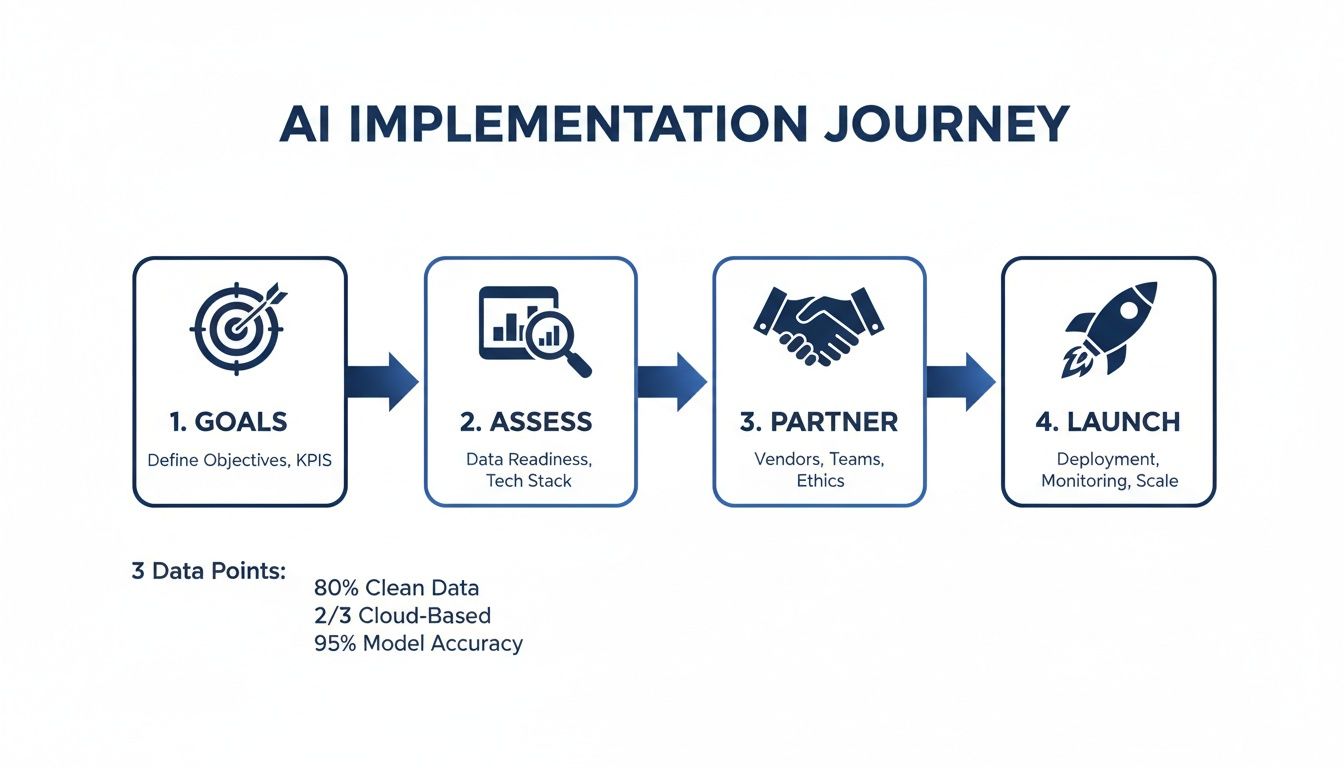
As you can see, choosing the right partner is the critical step that connects your strategy and data to a real-world, successful implementation.
Planning for Post-Launch Support and Scalability
Your AI journey doesn’t stop the day you go live. It's far from it. Machine learning models need constant care: monitoring, tuning, and retraining with new data to keep them sharp and effective. One of the most important questions you can ask a potential partner is what their post-launch support looks like.
At a minimum, solid support should include:
Performance Monitoring: Clear systems to track the accuracy and business impact of the AI models.
Ongoing Optimisation: A defined plan for regularly refining algorithms to squeeze out even better results.
Scalability Planning: A forward-looking strategy to ensure the solution can handle growth in your traffic and data without breaking a sweat.
Choosing a firm that views this as a long-term partnership is absolutely essential. To get a better sense of what this involves, exploring specialised data science and AI development services can give you a clearer picture of what a comprehensive, ongoing relationship looks like. This foresight is what ensures your investment keeps paying dividends long after the initial launch party.
Vendor Selection Checklist for AI Development Services
To help you organise your thoughts and compare potential partners, here's a practical checklist. Use it to cut through the noise and focus on what truly matters when making your decision.
| Evaluation Criteria | What to Look For | Why It Matters |
|---|---|---|
| Industry-Specific Experience | Case studies and client testimonials in ecommerce and retail. Familiarity with your specific niche (e.g., fashion, electronics). | They'll understand your customers, challenges, and data without a steep learning curve, leading to faster, more relevant solutions. |
| Technical Proficiency | Proven expertise in ML, NLP, and data science. Experience with your tech stack (e.g., Shopify, Magento, AWS, Google Cloud). | The team must have the foundational skills to build robust, scalable AI features that integrate seamlessly with your existing systems. |
| Project Management & Communication | Use of agile methodologies, clear communication channels (e.g., Slack, Jira), and a dedicated project manager. | Ensures the project stays on track, you're always in the loop, and the process is flexible enough to adapt to changes. |
| Portfolio & Past Results | Tangible metrics from past projects, such as increased conversion rates, higher AOV, or reduced support costs. | This is concrete proof they can deliver real business value, not just code. |
| Cultural Fit & Partnership Approach | Do they listen and ask insightful questions? Do they feel like collaborative partners or just order-takers? | A good cultural fit fosters trust and a true partnership, which is vital for navigating the complexities of an AI project. |
| Post-Launch Support & Scalability | A clear plan for ongoing model monitoring, maintenance, and retraining. A strategy for scaling the solution as your business grows. | AI isn't "set it and forget it." This ensures your investment continues to perform and deliver value long after the initial launch. |
Using a structured checklist like this helps you make an objective, data-driven decision rather than just going with a gut feeling or a flashy presentation. It ensures you’ve covered all your bases before committing to a partnership.
Common Questions About AI for Ecommerce
Thinking about bringing artificial intelligence into your ecommerce business? It’s natural to have questions. For most business owners, the idea is exciting but also raises practical concerns about cost, complexity, and whether it will actually work.
This section cuts through the noise and tackles the most common questions we hear every day. We'll give you clear, straightforward answers to help you feel confident about your next steps. Our goal is to show you that using AI ecommerce development services isn't some far-off dream; it's an achievable and powerful move for any business, no matter your size or technical know-how.
How Much Does It Cost to Implement AI?
This is usually the first question on everyone's mind, and the honest answer is: it really depends. There’s no single price for AI because the cost is tied directly to what you want to accomplish. It’s a bit like building a house – a standard blueprint costs much less than a completely custom-designed home with all the bells and whistles.
A simple AI-powered search plugin or a pre-built chatbot from an app marketplace might only cost you a few thousand dollars. These are great starting points for a quick win. On the other end of the scale, a fully custom recommendation engine or a predictive analytics platform built from the ground up can range from tens to hundreds of thousands of dollars.
To make things more manageable, most development partners offer a few different pricing models:
Project-Based Fees: A fixed price for a well-defined project, like building and launching a single AI feature.
Monthly Retainers: An ongoing fee for keeping your AI models optimised, retrained with new data, and fully supported after launch.
Licensing Costs: Subscription fees for using ready-made AI tools or platforms.
It’s best to think of AI as an investment in growth, not just another line item on your expense sheet. A good partner will start with a discovery phase to really understand your goals and then provide a transparent quote tailored to your needs, so you know exactly what to expect.
Can Small Businesses Benefit From AI?
Absolutely. The old idea that AI is only for giant corporations with bottomless budgets is a myth. The technology has become much more accessible, with plenty of tools designed to be affordable and effective for small and medium-sized businesses (SMBs).
The trick for an SMB is to start small with something that delivers a big impact. You don’t need to reinvent your entire operation overnight. Instead, find your biggest headache and look for a targeted AI solution to solve it.
For example, an AI chatbot can be a total game-changer for a small team. By handling the constant stream of questions about order status or product specs, it frees you and your staff up to focus on what really matters – strategy, marketing, and growing the business. This one tool can boost your efficiency and make customers happier almost instantly. An experienced partner can help you pinpoint these practical, high-value starting points.
What Kind of Data Do I Need for AI?
Data is what makes AI work, but you don’t need a perfect, massive database to get started. The kind of data you need depends entirely on what you’re trying to achieve.
Here are a few common examples:
For Product Recommendations: You’ll want historical sales data and user browsing behaviour – things like which products people view, click on, and add to their carts. This helps the AI learn what's often bought together or what appeals to similar shoppers.
For Inventory Forecasting: You'll need past sales figures, website traffic numbers, and ideally, info on seasonal trends or previous marketing campaigns. This gives the model the context it needs to predict future demand.
For Customer Segmentation: Customer purchase histories, demographic info (if you have it), and website engagement metrics are key to grouping your customers into useful segments for marketing.
Even if you think your data is a bit messy or limited, don't let that hold you back. The process almost always starts with a data audit. A good development partner will look at what you have, help you set up better ways to collect data in the future, and sometimes even use pre-trained models to get you going faster. The first step is just understanding where you stand.
How Long Until I See Results?
Just like the cost, the time it takes to see a return on your AI investment can vary. How quickly you see a tangible impact depends on the complexity of the solution and the problem it's designed to solve.
Simpler, more direct tools tend to deliver results fast. For instance, an AI-powered site search or an intelligent chatbot can improve customer engagement and boost conversions within just a few weeks of going live. The impact is often immediate because they fix common frustrations in the customer journey.
More complex systems, like those for deep personalisation or demand forecasting, need a "learning period." These models have to process enough data to fine-tune their predictions and become truly effective. You might notice positive trends within the first month, but the full, optimised impact usually becomes clear over a three-to-six-month period as the model gets smarter. The key is to set realistic expectations and track your key performance indicators (KPIs) from day one.
Ready to see how AI can elevate your ecommerce business? The team at Cleffex Digital Ltd specialises in creating custom AI solutions that drive real results. Let's connect and build your intelligent storefront together.