

Artificial intelligence in Canadian retail and ecommerce is not some far-off idea anymore. It's what's happening right now, and it's quickly becoming essential for any business that wants to keep up. We're talking about using smart systems to create truly personal shopping experiences, streamline supply chains across our massive country, and make sharp, data-backed decisions that actually connect with the diverse Canadian market. This is not just a tech upgrade; it's a fundamental shift in how we do business.
The New Reality of Canadian Retail AI

AI has officially moved out of the boardroom and onto the shop floor, and it’s completely changing how Canadian retailers operate. It’s no longer a 'nice-to-have' feature; it’s a core tool for tackling the unique challenges of our national market.
Think of AI as your most capable strategic partner. It's what helps you manage the mind-boggling logistics of a coast-to-coast operation. It’s also what gives you the power to connect with a multicultural customer base whose tastes and preferences can change in a heartbeat. The pressure to deliver hyper-personalised service and run a leaner, more efficient operation is immense, and AI is the key to meeting those demands.
Why the Sudden Urgency for AI?
This big push towards AI is not just about chasing the latest technology. It’s a direct response to real-world business pressures. Canadian retailers are up against fierce competition and need smarter ways to handle inventory, forecast demand, and keep transactions secure. The verdict from industry leaders is in, and it's crystal clear.
Recent data shows that a staggering 86% of Canadian retail executives believe generative AI is set to completely reshape the industry. On top of that, 81% feel the urgent need to implement a generative AI model in the next year, with many expecting it to boost sales ROI by as much as 20%. These numbers confirm that adopting AI for retail and ecommerce in Canada is not just a good idea; it's a strategic necessity.
Consider this guide your playbook. We'll walk through the most important applications, the regulatory hurdles you need to know about, and the concrete steps to take so your business can thrive in this new landscape.
Core Business Drivers for AI Adoption
So, what’s really lighting a fire under Canadian retailers to adopt AI? It comes down to a few key factors, each addressing a specific pain point or a golden opportunity in our market.
Hyper-Personalisation at Scale: Today’s customers expect you to know them. AI sifts through mountains of data to serve up product recommendations and marketing that feels like it was made just for them.
Operational Efficiency: From automating tasks in the warehouse to plotting the smartest delivery routes, AI is a powerhouse for cutting costs and slashing manual errors. In a country as vast as ours, that’s a game-changer.
Enhanced Customer Journeys: AI-driven chatbots can offer customers help 24/7, and intelligent search functions mean shoppers find what they're looking for instantly. It all adds up to happier, more loyal customers.
AI isn’t just about automating tasks; it’s about augmenting human intelligence. It gives your team the insights needed to make smarter, faster decisions that drive meaningful growth and create better customer outcomes.
To get a clearer picture of the tangible results, it’s worth exploring the real benefits of AI in marketing for DTC brands. Making this shift now is about preparing your business for a future where intelligent operations are the standard, not the exception.
How AI Is Really Changing Canadian Ecommerce
Let's cut through the noise and look at how AI is actually working in Canadian retail right now. This is not about some far-off future; the technology is already delivering tangible results by solving the complex, real-world problems that businesses face in our market.
From creating bespoke shopping journeys to making your supply chain smarter, AI is becoming the engine behind the next wave of ecommerce growth. These are not just minor tweaks – they are practical, high-impact applications giving savvy businesses a serious competitive edge.
This shift is happening as the market itself is booming. Between 2019 and 2025, ecommerce sales in Canada more than doubled, jumping from just under $2 billion to an estimated $4.3 billion. As noted by The Conference Board of Canada, this reflects a massive shift in how Canadians shop, with AI being a key driver in both improving customer experiences and making operations leaner.
Below, we break down some of the most crucial ways AI is already being put to work.
Creating Unique Journeys with Hyper-Personalisation
Picture an online store that feels like it was designed specifically for one customer. That’s the real magic of AI-driven hyper-personalisation. It’s so much more than just sticking a customer’s first name in an email subject line.
AI algorithms dive deep into browsing history, past purchases, and even real-time behaviour on your site. This allows them to surface product recommendations, promotions, and content that genuinely resonate with each shopper's individual tastes and needs at that very moment.
When an experience feels this relevant and tailor-made, it's not just more engaging, it directly leads to higher conversion rates and builds the kind of brand loyalty that keeps customers coming back.
Intelligent Inventory and Dynamic Pricing
Managing stock across Canada's vast and varied landscape is a huge operational headache. AI steps in here as your sharpest supply chain analyst, predicting demand with a level of accuracy that was previously impossible.
By chewing through historical sales data, seasonal trends, and even local events, predictive analytics can forecast what’s going to be popular and where. This means you get the right products to the right warehouse at the right time, cutting down on costly overstock and preventing those frustrating "out of stock" messages that lose you sales.
On top of that, AI makes dynamic pricing a reality. Algorithms constantly monitor market conditions, competitor pricing, and demand fluctuations to make smart, automatic price adjustments. This keeps you competitive while ensuring you’re not leaving money on the table.
AI isn’t just about stocking shelves; it’s about creating a responsive, self-optimising supply chain. It turns inventory management from a reactive chore into a proactive, strategic advantage for Canadian retailers.
Advanced Fraud Detection for Secure Transactions
As ecommerce sales climb, so does the risk of online fraud. AI provides a powerful and vigilant line of defence, protecting your business and your customers from bad actors.
Machine learning models can sift through thousands of data points for every single transaction in the blink of an eye. They spot the subtle patterns and anomalies that a human would miss, flagging potentially fraudulent orders before they ever get processed.
This smarter approach to security delivers clear benefits:
Reduced Chargebacks: Catching fraud early dramatically cuts down on the financial losses and administrative pain that come with chargebacks.
Increased Customer Trust: Shoppers feel safer knowing their data is protected by robust systems, which builds critical confidence in your brand.
Fewer False Positives: Modern AI is much better at telling good customers from fraudsters, meaning fewer legitimate orders are accidentally blocked.
Automating Customer Service with Bilingual Chatbots
Top-notch customer service is absolutely essential, and AI-powered chatbots are completely changing the game. Forget the clunky, frustrating bots of a few years ago; today's AI assistants understand context, tone, and what the customer actually wants.
In a bilingual country like Canada, AI chatbots can provide instant, seamless support in both English and French, 24/7. They can handle all the routine stuff: order status updates, return requests, and product questions, without missing a beat.
This frees up your human support agents to focus on the more complex and nuanced issues where a personal touch really makes a difference. By automating the simple queries, you slash response times, lower operational costs, and deliver a far better service experience. To see how this can be applied, take a look at our guide on AI-powered ecommerce solutions in Canada.
To put it all together, here's a quick summary of how these applications address specific business challenges.
Key AI Applications in Canadian Retail and Their Impact
| AI Application | Business Problem It Solves | Expected Business Impact |
|---|---|---|
| Hyper-Personalisation | Generic customer experiences leading to low engagement and conversions. | Increased conversion rates, higher average order value, and improved customer loyalty. |
| Intelligent Inventory | Inaccurate demand forecasting, leading to overstocking or stockouts. | Reduced carrying costs, fewer lost sales, and a more efficient supply chain. |
| Dynamic Pricing | Static pricing that fails to adapt to market changes, hurting margins. | Maximised profit margins, improved competitiveness, and better sales velocity. |
| Fraud Detection | High rates of fraudulent transactions and costly chargebacks. | Lowered financial losses from fraud, reduced administrative burden, and enhanced customer trust. |
| Bilingual Chatbots | High customer support volume, slow response times, and inconsistent service. | Reduced operational costs, faster 24/7 support, and improved customer satisfaction. |
As you can see, each application targets a specific, high-value area of the retail business, turning a common problem into a competitive strength.
Navigating Data Privacy and Regulations in Canada

Bringing AI into your business is more than a simple tech upgrade. It's a fundamental trust exercise with your customers and the regulators watching over them. For any business using AI for retail and ecommerce in Canada, getting a handle on our country's unique legal and ethical landscape is not just a good idea; it’s crucial for staying in business.
This means your entire AI strategy needs to be built on a solid foundation of compliance. AI runs on data, and every step of how you gather, manage, and act on that customer information is under a microscope. Nail this from day one, and you’ll not only protect your business but also build the very customer confidence you need for your AI tools to succeed.
Understanding Canada’s Core Privacy Laws
Right now, the key piece of legislation is the Personal Information Protection and Electronic Documents Act (PIPEDA). You can think of it as the foundational rulebook for how private businesses handle personal information. It covers the basics: you need to get consent, be open about how you use data, and keep it secure.
But things are changing. The proposed Consumer Privacy Protection Act (CPPA), which is part of Bill C-27, is poised to bring in much stricter rules. We're talking about tougher consent requirements and steep fines for getting it wrong. The takeaway here is clear: the law is moving toward giving Canadians more direct control over their own data.
For your AI initiatives, this has very real consequences:
Data Collection: You have to be upfront about what data you’re collecting for your AI models and exactly what you plan to do with it. No vague language.
Consent: Getting meaningful consent is everything. A customer needs to clearly understand that their browsing history will be used to generate personalised product suggestions, for example.
Data Governance: You need strong internal policies for how customer data is stored, who can access it, and how it’s protected from start to finish.
Building a Trustworthy AI Framework
Staying compliant is not just about dodging penalties; it's about building an AI programme that your customers can actually trust. Transparency is your greatest ally here. When a shopper understands why you’re using AI, to show them more relevant products or provide faster support, they’re far more likely to see the value and stay engaged.
A trustworthy AI strategy is built on clarity and consent. It’s about explaining the 'why' behind the data collection, demonstrating the value it provides to the customer, and always giving them control over their personal information.
This all points toward a focus on ethical AI. It means checking your algorithms for unintentional bias, ensuring the decisions they make are fair, and giving customers an easy way to ask questions or opt out entirely. The goal is to create an AI experience that feels genuinely helpful, not creepy or intrusive. If you're looking for more on this, our guide to AI-driven ecommerce analytics in Canada offers some great context.
And while our focus is on Canadian law, it's smart for any local retail business to understand broader personal text message privacy laws. Global standards often shape what happens here at home, especially when customer data crosses borders. At the end of the day, a successful AI programme is one that puts user privacy first, every single time.
What Do Canadian Shoppers Actually Think About AI?
Rolling out impressive AI tools is one thing, but figuring out what your customers really think about them is another ball game entirely. For any AI project to succeed in Canadian retail, it all comes down to how shoppers feel about the technology. Are they excited by the convenience it offers, or are they a bit spooked by the data collection that makes it all possible?
The real job for retailers is to make sure their tech investments actually line up with what customers want. It’s about creating AI features that feel genuinely helpful, not just another piece of intrusive or complicated tech. The sweet spot is where technology makes the shopping journey smoother without getting in the way, which is how you build real trust and keep customers coming back.
Canadians are Warming Up to AI in their Trolleys
Even if they don't call it "AI," Canadian shoppers are getting more and more used to it in their day-to-day online life. Things like smart product recommendations or search bars that seem to read your mind are pretty standard now, and they've set a new bar for what a good online experience feels like.
This growing familiarity means people are more open to AI playing a bigger role in their shopping. In fact, a recent survey found that a majority of Canadians – 51% – are willing to use AI-powered tools for personalised recommendations online. On top of that, about one in four shoppers are already using AI every week to help with their purchases, showing it’s quickly becoming a normal part of the process.
This shift is even more noticeable with younger shoppers. A whopping 15% of Canadians between 16 and 24 now turn to conversational AI like ChatGPT first for their online searches, skipping traditional search engines altogether. You can see the full picture of Canadian AI adoption in ecommerce in this detailed report.
It's All About the "Value Exchange"
At the end of the day, a customer's comfort with AI boils down to a simple idea: the value exchange. Shoppers get it, whether consciously or not, that to get a personalised experience, they need to share some data. And most are okay with that, as long as what they get in return is obviously worth it.
So, what does this trade-off look like in the real world?
Saving Time: An AI that sifts through reviews or compares specs to help a customer find the perfect item in seconds? That’s an immediate win.
Discovering Hidden Gems: When AI suggests a product a customer absolutely loves but would never have found themselves, it creates a "wow" moment that builds a stronger brand connection.
Getting a Special Deal: Personalised discounts based on past purchases make a customer feel understood and appreciated, making the data they shared feel well spent.
The modern Canadian shopper is a pragmatist. They’ll get on board with AI if it clearly makes their life easier. The trick is to make sure every single AI interaction delivers real, tangible value, proving that sharing their data leads directly to a better, more convenient way to shop.
Make it Helpful, Not Hovering
To make sure your AI efforts land well, you need to focus on solving actual customer problems. The most successful examples of AI for retail and ecommerce in Canada are the ones that feel like a seamless part of excellent customer service.
Think of it this way: a great sales assistant listens to what you need and offers helpful suggestions. A pushy one follows you around the store, making annoying comments. Your AI should always be a helpful assistant. By building your strategy on a solid understanding of what Canadian shoppers want, you can create AI features that don’t just boost sales – they earn genuine, lasting trust.
Your Roadmap for AI Implementation
Knowing that AI can help and actually putting it to work are two different things. It can feel like a massive leap, but it doesn't have to be. By breaking the journey down into clear, manageable steps, any Canadian business can turn AI theory into a practical tool for real growth.
This roadmap lays out a four-step process for a successful AI launch, guiding you from the initial "what if" stage all the way to ongoing fine-tuning.
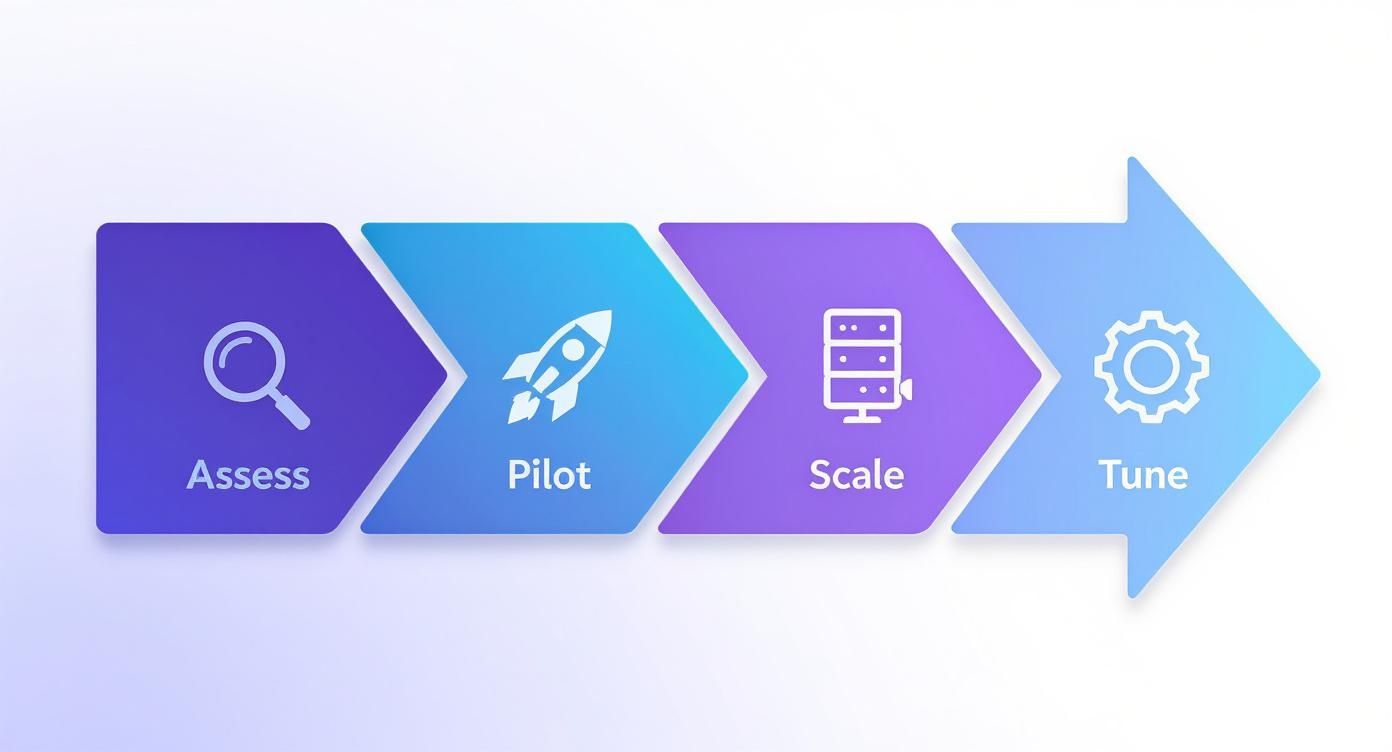
This is not just a checklist; it's a cycle. Each step builds on the last, taking your business from a rough strategy to a fully scaled and effective AI system. Let's dig into what each of these crucial stages really involves.
Phase 1: Strategy and Assessment
Before a single line of code is written or a contract is signed, you need a plan. This first phase is all about discovery – asking the right questions to make sure your AI project is set up to win from the start. This is where you connect your big-picture AI ambitions with real, on-the-ground business needs.
Start by zeroing in on your biggest operational headaches. Are you constantly battling stockouts or overstock? Is your customer personalisation falling flat? By pinpointing a specific, high-value problem, you give your AI project a clear purpose right out of the gate.
Next, it’s time for an honest look at your data, because AI is only as smart as the information it learns from. You need to get a handle on the quality, quantity, and accessibility of your data. That means asking some frank questions:
Data Readiness: Is your data clean and organised, or is it a mess?
Data Accessibility: Can you actually get the data you need from your different systems (like your CRM, e-commerce platform, and inventory software) without a huge hassle?
Data Volume: Do you have enough historical data to train an AI model that can make reliable predictions?
This assessment phase is non-negotiable. Skipping it is like building a house without checking the foundation first. A proper evaluation ensures you’re solving the right problem and have the right materials to do it.
Phase 2: Vendor Selection and Pilot Projects
With a clear strategy in hand, it's time to find the right partners and start small. Choosing a vendor is a huge decision, particularly when implementing AI for retail and ecommerce in Canada. You need a partner who understands our specific market and regulatory landscape.
Look for a team with proven experience in Canadian retail. They should be able to show you case studies from businesses like yours. Ask them tough questions about their approach to data security, how their tools integrate with other platforms, and what kind of support they offer after the launch.
Once you’ve found your partner, resist the urge to do everything at once. Start with a pilot project – a small-scale, controlled test designed to prove the AI’s value quickly and quietly. For an ecommerce site, this could mean testing a new recommendation engine on just 5% of your customers. This approach minimises risk and gives you hard numbers on ROI before you commit to a company-wide rollout.
Phase 3: Integration and Scaling
After a successful pilot, it’s time for the main event: integrating the AI solution into your core business systems. This is where the technical magic happens, connecting the AI tools to your existing platforms, whether that's Shopify, Magento, or your internal ERP system.
A smooth integration is absolutely critical. The AI should feel like a natural extension of your workflow, not a clunky afterthought. This takes close collaboration between your internal team and your AI vendor to make sure data flows correctly, and everything just works. To get a better handle on the nuts and bolts, learning more about AI-powered ecommerce development can give you some valuable context.
Once the integration is solid, you can start to scale the solution across the entire operation. This might mean activating the AI-powered inventory system across all your warehouses or turning on the personalisation engine for every single visitor to your website.
Phase 4: Measurement and Optimisation
Bringing AI into your business is not a "set it and forget it" project. The final phase is a continuous loop of measuring performance, listening to feedback, and tweaking the system to squeeze out even better results.
You'll need to establish clear Key Performance Indicators (KPIs) to define what success looks like. These could be anything from a 15% increase in conversion rates to a measurable drop in cart abandonment or a jump in your customer satisfaction scores. Reviewing this data regularly tells you what's working and where you can make improvements.
This ongoing optimisation is where AI really starts to pay dividends. As the system ingests more data, it gets smarter and more effective. By constantly refining your approach, you ensure your investment in AI delivers maximum value and keeps your business ahead of the competition.
Putting It All Together: How Cleffex Can Help
Figuring out how to bring AI into your Canadian retail or ecommerce business can feel like a huge undertaking. The path from a great idea to a fully functioning, profitable AI system has its share of technical roadblocks and strategic puzzles. That's where having a dedicated partner makes all the difference, and it’s where Cleffex steps in.
Think of us as your expert co-pilot. We take the roadmap we've laid out in this guide and help you make it a reality for your business. We’re here to connect the dots between the real-world challenges you're facing, like messy platform integrations or tricky data compliance, and the practical, effective solutions we can build for you.
AI Solutions Built for Your Business, Not Someone Else's
At Cleffex, we know that a one-size-fits-all approach just doesn't work. Your business has its own unique ambitions and a distinct relationship with its customers. That’s why we focus on creating custom AI models designed specifically for the nuances of the Canadian retail market.
Here’s where our experience becomes your advantage:
Custom Personalisation Models: We build algorithms that move past generic suggestions. Instead, we create genuinely unique shopping experiences that connect with your specific customers.
Seamless Platform Integration: Our team makes sure any new AI tools fit perfectly with the systems you already use, whether you’re on Shopify, Magento, or a completely custom setup.
Canadian Data Privacy Guidance: We’ll guide you through the ins and outs of PIPEDA and help you get ready for the CPPA. This ensures your AI strategy is built on a solid foundation of trust and compliance from day one.
Partnering with Cleffex is more than just buying a piece of technology. It’s about bringing a strategic ally into your corner who is genuinely committed to your growth. We focus on building a real partnership to deliver results you can actually measure.
Our entire approach is grounded in one simple idea: technology has to serve a clear business purpose. We don't just install tools. We make sure they're aligned with your most important goals, whether that’s boosting conversion rates, making your operations more efficient, or earning lifelong customer loyalty.
Ready to see what AI can really do for your business? The path to smarter growth starts with a conversation. Let’s talk about how we can build an AI strategy that not only solves today's problems but also sets you up for the future of Canadian retail.
Common Questions About AI in Canadian Retail
Jumping into the world of AI can feel like learning a new language. You're not alone. Here are some straightforward answers to the questions we hear most often from Canadian retail and ecommerce owners.
What’s the First Practical Step for a Small Business?
The best way to start is to pick one specific, nagging problem you want to solve. Don't try to boil the ocean. Zero in on a single high-impact area, like automating answers to your most common customer questions or using a simple tool to sharpen the product recommendations on your website.
Many ecommerce platforms like Shopify have AI apps built right in or offer easy integrations that do not require a computer science degree. By starting with a small, focused pilot project, you can see a clear return and get a feel for the technology without a huge upfront investment.
How Much Data Do I Really Need to Get Started?
This is a big one, but the answer is usually "less than you think." While massive, complex AI models need years of data, many of the most practical tools can start delivering results with a surprisingly modest amount of information.
For instance, an AI chatbot can learn from your existing FAQ page. A personalisation engine can start learning from customer behaviour the moment it's switched on. The most important thing is not volume, it's quality. A few months of clean, organised sales and customer data is often plenty to get a pilot project off the ground.
The goal isn’t to wait for perfect data. It's to start with the best data you have right now and improve it as you go. AI systems are designed to get smarter over time, so the sooner you begin, the faster they learn.
Is AI Too Expensive for a Medium-Sized Business?
Not anymore. The cost of putting AI to work in Canadian retail and ecommerce has come way down. The days when only corporate giants could afford this technology are long gone. Today, most AI solutions are offered as a subscription service (SaaS), which means you do not need a massive capital investment.
This model gives you access to powerful tools for a predictable monthly fee. When you weigh that cost against the potential upside, like a 10-15% lift in conversion rates from better personalisation or lower overheads from automation, the business case often makes itself.
How Do I Make Sure My AI Follows Canadian Privacy Laws?
This is non-negotiable. Staying compliant with laws like PIPEDA is critical. The smartest approach is what's called "privacy by design," where protecting customer data is baked into your project from day one, not bolted on as an afterthought.
Here are the core principles to live by:
Be Transparent: Tell your customers exactly what data you’re collecting and how your AI uses it. Make sure your privacy policy is clear and up-to-date.
Get Consent: You need explicit permission from customers before using their data for things like personalised marketing.
Collect Less: Only gather the data that's absolutely essential for the AI tool to do its job.
Vet Your Vendors: Partner with AI providers who truly understand Canadian regulations and can prove their own compliance.
Making privacy a cornerstone of your AI strategy is not just about following the law; it's about building lasting trust with your customers.
Your journey into AI does not have to be a solo mission. At Cleffex Digital Ltd, we specialise in creating custom AI solutions that align with the unique needs of Canadian businesses. We can help you navigate everything from technical integration to data privacy, ensuring your investment delivers real, measurable growth.
Start your retail AI transformation by booking a consultation with our experts and take the first step toward smarter, scalable growth.