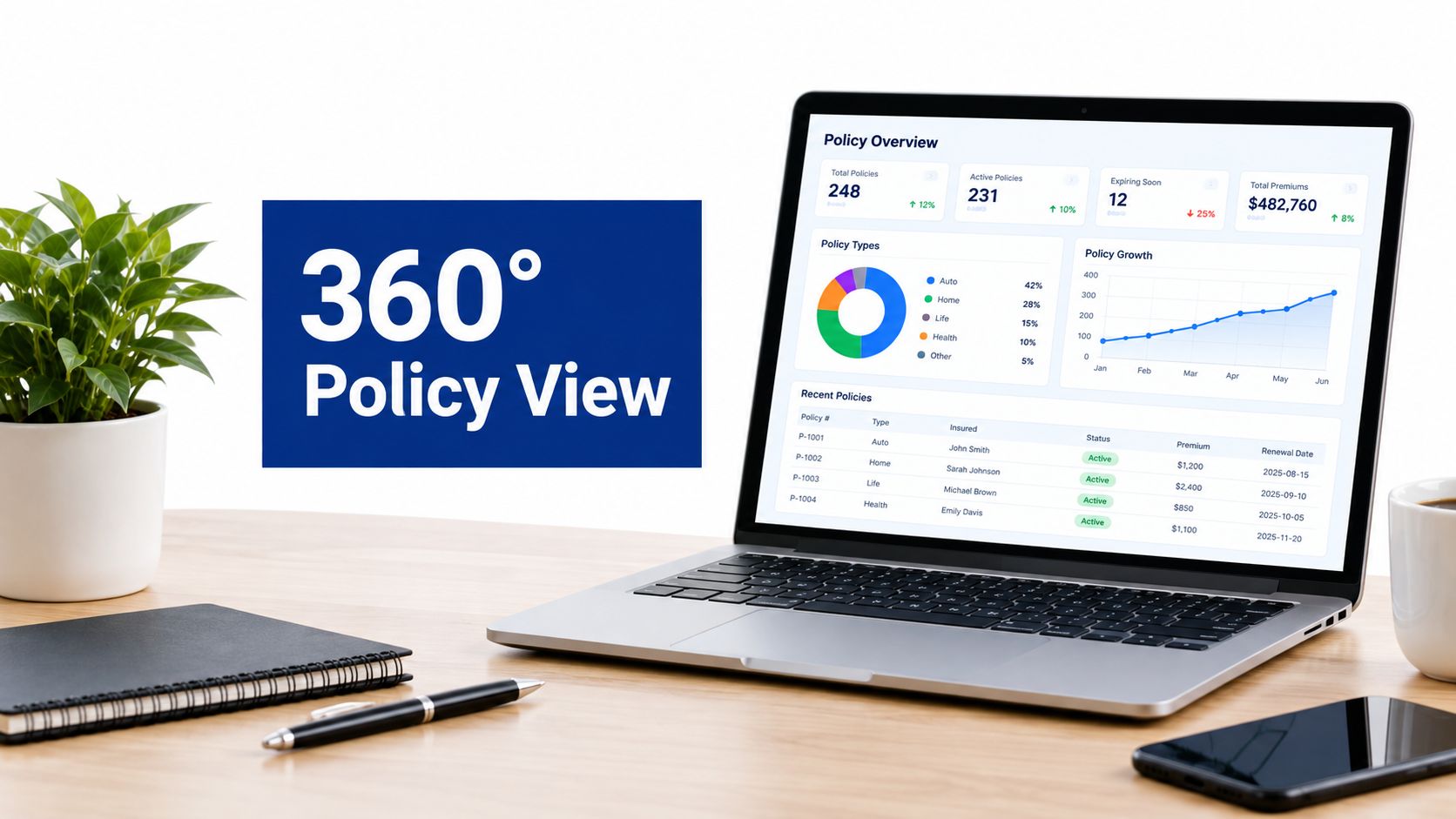


Building an insurance SaaS product means creating a cloud-based solution that drags the insurance industry into the modern age. It’s about swapping out clunky, old-school software for agile, data-smart tools that handle everything from policies and claims to billing and client relationships. Think less paperwork, more performance.
Laying Your Insurtech Groundwork
Jumping into development without a solid plan is a fast track to failure, especially in insurance. This isn't your typical SaaS playground. It's a world dominated by ancient legacy systems, thick regulatory red tape, and very specific user needs that generic software just can't touch.
Your first job is to turn a great idea into a validated market opportunity. This initial discovery work is what separates the winners from the "what ifs." It prevents costly U-turns down the road and ensures your product is built on a compliant foundation with a clear path to actually making money.
The market for this is booming. Valued at $4.8 billion, the global insurance SaaS platform market is set to explode to $19.6 billion by 2033. That’s a compound annual growth rate (CAGR) of 16.7%. The real meat of this market, nearly 68% of the revenue, is in core software like policy administration tools.
Finding Your Niche
Don't try to build a one-size-fits-all behemoth. Zero in on a specific, underserved corner of the market. Are independent agents drowning in outdated CRM and quoting tools? Maybe smaller carriers are getting crushed by manual claims processing. Or perhaps managing general agents (MGAs) are desperate for better analytics to assess risk.
Nailing down a niche lets you solve a real, painful problem with laser focus. This makes your value proposition crystal clear and your marketing strategy a whole lot simpler. You’re not just selling software; you're selling a direct solution to someone's biggest operational headache. To get a better feel for these opportunities, take a look at this detailed guide to insurtech solutions.
This initial phase is all about research, compliance, and strategy, in that order.
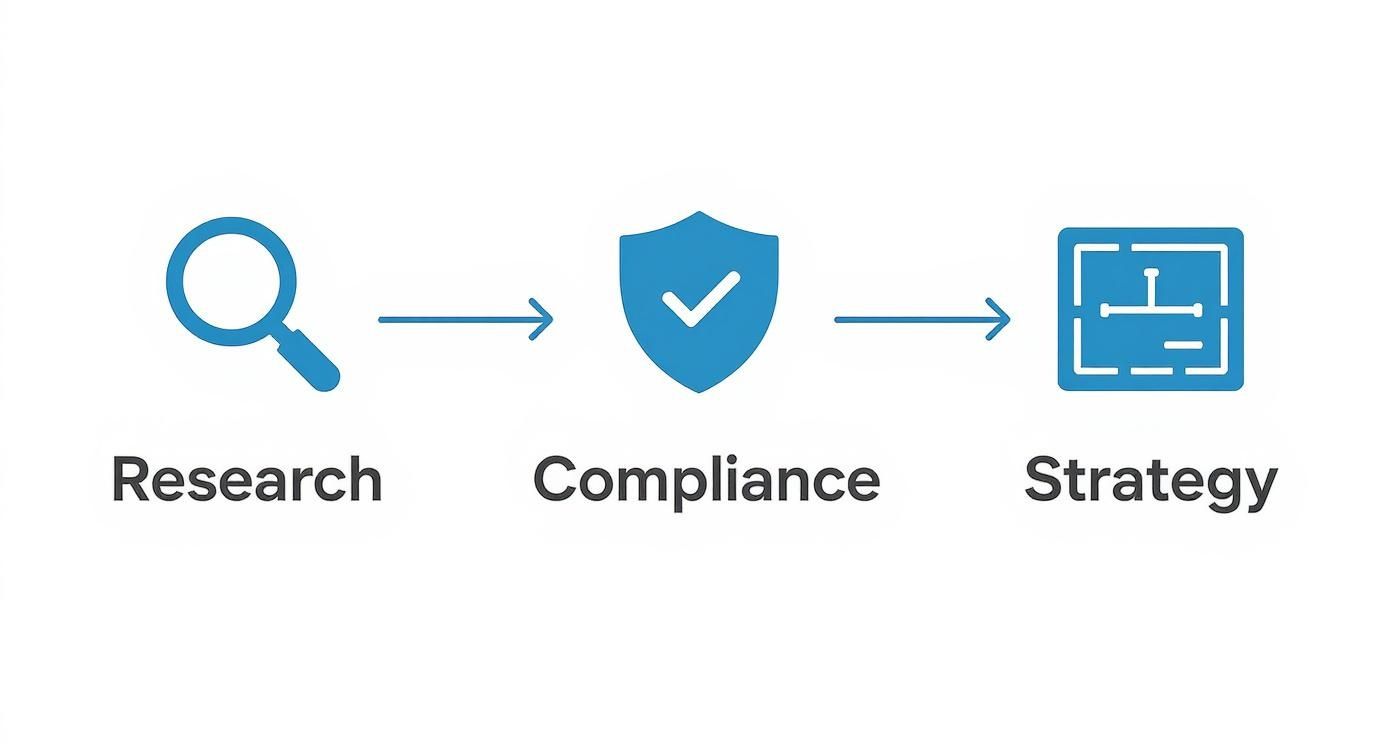
As the visual shows, you have to dig into the market and understand the rules before you start drawing up blueprints.
Before a single line of code is written, you need to validate your concept and map out your strategy. This checklist can help guide your discovery phase, ensuring you’ve covered all the critical bases.
Discovery Phase Checklist for Your Insurance SaaS
| Focus Area | Key Questions to Answer | Potential Outcome |
|---|---|---|
| Market Validation | Who is our ideal customer? What specific pain point are we solving? Is the market big enough to support our business? | A well-defined Ideal Customer Profile (ICP) and a clear value proposition. |
| Competitive Analysis | Who are the existing players? What are their strengths and weaknesses? Where are the gaps we can exploit? | A documented competitive landscape and a unique selling proposition (USP). |
| Regulatory Deep Dive | What specific data residency, privacy, and security laws apply to our niche and target regions (e.g., GDPR, HIPAA, PCI DSS)? | A comprehensive compliance roadmap integrated into the product requirements. |
| Monetization Strategy | How will we charge for this? Per-user, per-policy, tiered features, or a hybrid model? What will the market bear? | A preliminary pricing model that aligns with the value delivered and market expectations. |
| Technical Feasibility | What core features are non-negotiable for an MVP? What kind of integrations are critical for launch? | A high-level technical brief and a prioritised feature list for the Minimum Viable Product. |
Working through these questions forces you to move from assumptions to evidence-based decisions, setting a much stronger foundation for the development journey ahead.
Mapping the Regulatory Minefield
The insurance industry is a tangled web of regulations. Ignoring them isn't an option; it’s a project killer. Compliance can't be an afterthought; it has to be baked into your platform's DNA from day one.
Here are a few of the big ones you'll need to tackle:
Data Residency and Sovereignty: You have to know where customer data can legally live. Laws like GDPR in Europe or various provincial rules in Canada have strict, non-negotiable requirements.
Industry-Specific Mandates: If your platform touches health information, it must be HIPAA compliant. If you process payments, meeting PCI DSS standards is mandatory.
Security Certifications: Earning certifications like SOC 2 isn't just a badge. It’s proof of your commitment to security and a huge selling point for enterprise clients who need to trust you with their most sensitive data.
Getting ahead of compliance is a massive competitive advantage. It builds immediate trust with customers and partners and saves you from the crippling technical debt of trying to bolt on security features later.
Part of this early strategy also involves figuring out who will build this thing. Deciding between an in-house team and external partners is a major decision that impacts your budget, timeline, and access to specialised skills. This guide on software development outsourcing offers some great, practical advice for weighing your options.
With the foundational research out of the way, it's time to get to the heart of your project: defining the core features that will actually make a difference for your users. A great insurance platform isn't just a random assortment of tools. It’s a cohesive system where every part works in concert to untangle the messy, complex workflows that define the industry.
Nailing this part is about building something that becomes essential to your clients' daily operations. It's not a race to have the longest feature list. The goal is to build a core set of functions that delivers real, measurable value – making things faster, more accurate, and less of a manual grind for everyone involved.
Modern Policy Administration and Management
Let's be honest, the old-school, rigid policy management systems are a nightmare. Your platform needs to be the exact opposite, offering a fluid and intuitive Policy Administration System (PAS). This is the command centre where policies are created, managed, and evolve over their entire lifecycle.
The system has to handle everything from quoting and binding to endorsements and renewals without missing a beat. For example, a broker should be able to whip up a quote for a complex commercial property, tweak coverage limits on the fly as they talk to a client, and bind the policy – all in one smooth session. That kind of speed and flexibility is what sets a modern platform apart.
A strong PAS needs these capabilities:
Dynamic Quoting Engines: The ability to handle complex rating rules that can be updated by the business team, not just developers.
Automated Underwriting: Rule-based systems that can instantly flag or approve applications, letting human underwriters focus their expertise on the tricky cases.
Endorsement and Renewal Automation: Smart workflows that handle policy changes and renewal reminders automatically, cutting down on administrative busywork.
The real aim is to build a PAS that moulds to the business, not the other way around. A flexible system means your clients can roll out new products or expand into new territories without their software holding them back.
Streamlined Claims Management Workflows
When a customer files a claim, that’s the moment of truth. It's the most critical interaction they'll ever have with their insurance provider. A clunky, slow, or confusing claims process doesn’t just cause frustration; it shatters trust and sends customers running for the door. Your SaaS has to turn this potential disaster into a competitive advantage.
A modern claims module gives everyone a clear, end-to-end view of the entire journey. It starts with a dead-simple First Notice of Loss (FNOL) intake, whether that's through a portal, a mobile app, or an API. From that point on, the system should automatically assign tasks, organise documents, and keep all communication in one place.
Think about using AI for claims triage, for instance. An AI can instantly analyse an incoming auto claim, see that it's a simple cracked windscreen, and route it for immediate approval. That claim could be settled in minutes, not days. Our guide on tailored insurance software solutions digs deeper into how custom features like these can deliver an incredible return.
Automated Billing and Commission Modules
Insurance billing can be a tangled mess of premium collections, invoicing schedules, and dizzyingly complex commission structures. A solid billing module is a non-negotiable; it automates these headaches, ensuring accuracy and freeing up staff from hours of mind-numbing accounting work.
Your platform has to gracefully handle different billing plans, like monthly instalments or annual lump sums, and process payments seamlessly through integrated gateways. Even more critical is a flexible commission engine. This system needs to manage multi-level commission splits, track producer performance, and spit out clean, auditable statements. Picture a brokerage with a hundred agents; automating their commissions doesn't just save time, it prevents the kinds of errors that can sour relationships.
Architecting for Scale, Security, and Compliance
The technical architecture is the very skeleton of your platform. A weak one will eventually collapse under pressure, but a strong one can support massive growth, tight security, and future innovation. When you're building an insurance SaaS, getting this right from day one is critical. It's how you avoid crippling technical debt and create a product that can actually evolve with your customers' needs.
This is where you make the foundational calls that dictate whether your platform can handle ten clients or ten thousand. It’s about more than just picking a tech stack; it's about designing a system that is inherently resilient, secure, and ready for whatever the market throws at it.

Embrace a Multi-Tenant and API-First Design
For any SaaS, a multi-tenant architecture is a must-have, and for insurance, it’s simply non-negotiable. This model lets a single instance of your software serve multiple customers (or "tenants") while keeping their data completely separate and secure. Think of it like an apartment building: everyone lives under one roof, but each has their own private, locked unit.
This approach is vastly more cost-effective and scalable than spinning up a new instance for every customer. It makes updates, maintenance, and resource management so much simpler, letting you grow efficiently.
Hand-in-hand with this is an API-first design. This means you build your platform's core functions as a collection of independent services that talk to each other through APIs. This strategy turns your platform into a flexible, modular ecosystem. Need to integrate with a new broker management system or pull data from a third-party provider? With a solid API foundation, it’s a straightforward task, not a massive redevelopment project.
Building with an API-first mindset essentially future-proofs your platform. It ensures you can easily connect to new tools, partners, and data sources, creating a network effect that makes your product more valuable over time.
Choosing Your Cloud Infrastructure
The cloud provider debate often boils down to AWS, Azure, and Google Cloud. While they all have their strengths, your choice for an Insurtech platform should be driven by specific needs around security, data analytics, and compliance support.
Amazon Web Services (AWS) offers a mature, extensive suite of services and robust compliance documentation, making it a go-to choice for financial services.
Microsoft Azure is a powerhouse in hybrid cloud environments and has deep integrations with enterprise systems – a major selling point when you're targeting larger insurance carriers.
Google Cloud Platform (GCP) really shines in data analytics, machine learning, and Kubernetes. It’s a strong contender if AI-driven underwriting or claims processing is central to your offering.
Regardless of which you choose, leaning on managed services like serverless functions (e.g., AWS Lambda) and managed databases (e.g., Amazon RDS) can massively reduce your operational headaches.
Embedding Security and Compliance by Design
In the insurance world, security isn't just a feature; it's the price of admission. You simply cannot "bolt on" compliance at the end of the development cycle. It has to be woven into the fabric of your architecture from the very first line of code. This is where you tackle the hard requirements that protect sensitive customer data and your own reputation.
A huge part of this is understanding the complex web of regulations governing the industry. For a deeper dive, our guide on cybersecurity in the insurance industry provides crucial context on the threats and defensive strategies you need to have on your radar.
Key architectural decisions for security should include:
Data Encryption: All data, whether it’s sitting in a database (at rest) or moving over a network (in transit), must be encrypted using strong, industry-standard algorithms. No exceptions.
Robust Access Controls: Implement a role-based access control (RBAC) system to guarantee users can only see and touch the data they are explicitly authorised to access.
Audit Trails: Your platform absolutely must keep detailed, unchangeable logs of all significant user actions. This is crucial for security investigations and for proving compliance during audits for certifications like SOC 2 or HIPAA.
A well-designed architecture doesn’t just enable scale; it becomes a key selling point. It shows potential clients that your platform is a secure, reliable partner for their business. As you architect your insurance SaaS for top performance and compliance, it’s also wise to integrate technical SEO best practices for SaaS to ensure your platform is discoverable and technically sound from the ground up.
Navigating the Insurance Integration Ecosystem
An insurance SaaS platform, no matter how well-designed, can't exist in a bubble. Its real value, what makes it truly sticky for users, comes from how well it connects to the wider insurance and financial world. Building these connections is less about adding features and more about creating a powerful network that makes your platform indispensable.
Think of these integrations as digital handshakes. They automate tedious workflows, pull in crucial data on demand, and establish a single source of truth for your users. Without them, your platform is just another isolated tool, forcing people right back into the manual, disconnected processes you promised to solve.

Connecting to Core Insurance Services
Let's start with the basics. The most fundamental integrations are with the core players in the insurance value chain. These are the connections that drive the day-to-day business of insurance, and they're absolutely essential for any competitive product.
Insurance Carriers: Direct API links to carriers are mission-critical for real-time quoting and binding. A broker using your platform needs to pull accurate, live rates from multiple carriers without ever leaving your interface. It’s complex work, but it's a non-negotiable part of insurance SaaS development.
Broker Management Systems (BMS): Most agencies and brokerages practically live inside their BMS. Your SaaS has to play nice with these systems. That means offering robust integrations that sync everything: client data, policy info, commission statements, to eliminate painful double-entry.
Payment Processors: You need to make getting paid easy. Seamlessly integrating with gateways like Stripe or Adyen is crucial for automating premium collections, processing refunds, and managing recurring billing. This feature alone removes a massive administrative headache for your clients.
Leveraging Third-Party Data Integrations
Beyond the core players, there's a universe of valuable third-party data that can seriously level up your platform's capabilities. These integrations feed your system the information it needs for smarter, faster, and more accurate decision-making, especially in underwriting.
For example, imagine a platform built for property and casualty insurance. By integrating with geospatial data providers, an underwriter could instantly assess flood risk, wildfire exposure, or even a property's roof condition, all from within your system. This leads to far more precise pricing and risk evaluation.
Other high-value data sources include:
Vehicle History Reports: For any auto insurance platform, pulling data on a car's history is essential for accurate quoting.
Public Records Data: Accessing public records can help verify business information or property ownership details, cutting down on underwriting friction.
Weather Data APIs: If you're building for parametric insurance or trying to speed up claims, real-time weather data can automate triggers and validation.
The right integrations transform your platform from a simple system of record into an intelligent decision-making engine. They provide the context and data needed to automate complex workflows and deliver superior insights.
The surge in insurtech deal activity highlights just how important this is in shaping the future of insurance SaaS development. A mix of regulatory shifts, tech innovation, and venture capital investment is fueling transformation in the sector. You can get a better sense of how the market is changing with this in-depth look at SaaS insurance platforms.
The Integration Dilemma: Build vs. Buy
When it comes to actually creating these connections, you'll face a classic strategic choice: build each integration from scratch, or use an Integration Platform as a Service (iPaaS) like MuleSoft or Zapier?
Going the custom route offers maximum control but eats up a ton of resources. On the other hand, an iPaaS can dramatically speed things up by providing pre-built connectors and handling the underlying infrastructure. This lets you focus your engineering talent on what makes your core product unique.
From Code to Customers: Your Go-to-Market Playbook
You’ve built the engine. Now it’s time to get it on the road. Moving from the technical build to a living, breathing business is where your insurance SaaS development meets the real world. A great launch isn't about flipping a switch and hoping for the best; it's a carefully planned strategy for how you’ll enter the market, price your solution, and make sure your first customers become your biggest fans.
Don't fall into the trap of a big-bang, all-features launch. I've seen it go sideways too many times. A much savvier approach is to start with a Minimum Viable Product (MVP). This isn’t about shipping something half-baked. It’s about launching a sharp, focused version of your platform that solves one critical problem exceptionally well for a very specific audience.
This gets your product into the hands of real users fast. You start gathering feedback, validating your assumptions, and, most importantly, generating revenue months earlier than you would otherwise.
For example, imagine your grand vision is a full-suite platform for commercial property insurance. Your MVP might be laser-focused on just one thing: a lightning-fast quoting and binding process for a single, underserved line of business. All the complex claims management and intricate billing modules can wait. This strategy dramatically cuts your initial risk and cost, letting actual market demand pull your roadmap forward.
How Will You Make Money? Choosing Your Monetisation Model
Figuring out how to charge for your SaaS is one of the most pivotal decisions you'll make. Your pricing model sends a strong signal about the value you provide and directly shapes your growth. In the insurance world, a few models consistently work well, but the right one for you hinges entirely on who you're selling to and what they get out of your platform.
There's no single "correct" answer here. The goal is to align your pricing so tightly with the value your customers receive that it becomes a no-brainer for them.
Per-User Subscriptions: The classic SaaS model. A brokerage pays a predictable flat fee every month or year for each person using the platform. It's simple, straightforward, and makes revenue forecasting a breeze.
Usage-Based Billing: This one is really gaining momentum. You tie the price directly to consumption; think charging per policy managed, per claim processed, or even per API call. Clients love this because the cost scales with their business, making it feel incredibly fair.
Tiered Feature Packages: This is a popular hybrid approach. You create different subscription levels (e.g., Basic, Pro, Enterprise) with progressively more features and higher levels of support. It's a fantastic way to serve everyone from small, independent agents to massive national carriers.
To help you decide, let's lay out the common pricing strategies for an insurance SaaS and see where they shine.
Comparing Insurance SaaS Monetisation Models
Here’s a look at the most common pricing strategies, giving you a clear picture of the pros and cons of each approach.
| Model | Best For | Pros | Cons |
|---|---|---|---|
| Per-User Subscription | Platforms where individual user access is the main value driver (like a CRM for brokers). | Highly predictable revenue; simple for clients to budget and understand. | Can get pricey for large teams, which might discourage firm-wide adoption. |
| Usage-Based Billing | Products where value is directly tied to transaction volume (such as a claims processing API). | Pricing scales directly with customer value; offers a low barrier to entry for smaller clients. | Revenue can be less predictable month-to-month; can be complex to track and invoice. |
| Tiered Feature Packages | Comprehensive platforms with a wide range of features that cater to different market segments. | Provides a clear upsell path; lets you serve both small agencies and enterprise clients. | There's a risk of walling off your most valuable features behind an expensive tier. |
Choosing the right model from the start is crucial, but remember that it isn't set in stone. As your product and market mature, you can and should revisit your pricing.
Making the First Impression Count: Onboarding and Migration
Your first handful of customers is pure gold. A clunky, confusing, or frustrating onboarding experience can sour the relationship from day one and kill your early momentum. The mission is simple: make switching to your platform feel effortless. This is especially true when your clients are likely moving from legacy systems they’ve used for a decade or, worse, a chaotic mess of spreadsheets.
You absolutely need a well-oiled onboarding process. This should include:
A dedicated onboarding team or specialist to personally guide new clients through the entire setup and training process.
Crystal-clear documentation and a library of video tutorials that users can lean on whenever they need a refresher.
A bulletproof data migration plan. This is often the single biggest hurdle. You need a proven process for pulling, cleaning, and importing data from their old systems into your platform without causing chaos for their business.
Key Takeaway: Smooth onboarding and migration aren't just customer service extras; they are a core feature of your product. A client who feels supported and confident from the very beginning is far more likely to stick around and become a vocal advocate for your platform.
Finally, never underestimate the power of standout support. This is how you build an ironclad reputation in a crowded market. Insurance pros operate under immense pressure. When they hit a snag, they need fast, expert help from someone who understands their world. Investing in a responsive, knowledgeable support team isn't a cost; it's a critical part of your growth engine that builds loyalty and trust.
Common Questions About Building Insurance SaaS
Diving into insurance SaaS development brings up a lot of tough, practical questions. You need clear, straight-up answers before you sink serious time and money into a project. Let's tackle some of the most common and critical queries we hear from founders and product leaders.
What Is the Biggest Challenge in Building an Insurtech SaaS?
Honestly, the single greatest hurdle is navigating the regulatory maze. Insurance isn't like other SaaS verticals; it's intensely regulated, and the rules can change dramatically from one province or country to the next. This isn't just a legal headache; it directly impacts your architecture, data storage protocols (hello, GDPR), feature design, and security measures.
Right behind that is the nightmare of integrating with the legacy systems that still run the show at most large carriers. We're talking about old platforms with spotty documentation, outdated tech, and a frustrating lack of modern APIs. Just getting data to flow reliably can become a massive technical and operational drain. You absolutely need deep domain expertise on your team from day one to have a fighting chance.
How Long Does It Take to Build an Insurance SaaS MVP?
For a well-defined Minimum Viable Product (MVP), you should budget for 6 to 12 months. Where you land in that range really depends on how ambitious your starting point is.
Closer to 6 months: This timeline is realistic for a more focused tool. Think of something like a slick quoting engine for a single, niche insurance line, like event cancellation insurance.
Closer to 12 months: If your MVP needs to handle basic policy administration, a simple claims intake process, and a billing module, you’re looking at something closer to a year to get it built, tested, and launched.
What really stretches the timeline are things like complex core features, the number of third-party systems you need to connect with, and any heavy compliance requirements. Tackling something that needs to be HIPAA-compliant, for instance, adds a significant layer of security and audit work.
Remember, the point of an MVP isn't to build your entire dream platform. It’s to solve one critical problem incredibly well, get into the market, and start learning from real users. That feedback is gold for guiding what you build next.
Should We Build Our Own Rating Engine from Scratch?
For almost every startup out there, building a rating engine from the ground up is a massive strategic mistake. It's a huge, resource-hungry project that requires deep actuarial knowledge just to get started. On top of that, you have to manage incredibly complex business rules that are constantly changing.
The smarter move? Integrate with an established, third-party rating engine through their API. You get to plug into their specialised expertise, pre-built compliance, and a system that's already been battle-tested in the market. This one decision can shave months off your timeline and slash your initial development risk.
By offloading that highly specialised piece, you can pour your engineering resources into what really matters: creating a fantastic user experience and building the unique features that will make your platform stand out.
How Much Does It Cost to Develop an Insurance SaaS Platform?
The cost can swing wildly, but a typical MVP budget will fall somewhere between $150,000 and over $500,000 CAD. Several key factors drive that final number:
Team Size and Location: Your biggest cost will almost always be the people: the number of developers, designers, and project managers, and where in the world they're located.
Technology Stack: The tech choices you make can influence everything from licensing fees to how easy it is to find skilled developers.
Integration Complexity: Every connection to a carrier, payment gateway, or data provider adds development hours. The more you have, and the trickier they are, the more it will cost.
Security and Compliance: If you need to build a platform that's HIPAA-compliant, for example, expect the price tag to be higher. The rigorous security, auditing, and documentation simply require more work.
Starting with a tightly focused MVP is the best way to keep those initial costs in check. It ensures you’re building something the market actually wants before you go all-in with a bigger investment.
At Cleffex Digital Ltd, we specialise in turning complex business challenges into powerful, scalable software solutions. If you're ready to build an insurance platform that stands out, let's talk about how our expertise can accelerate your vision. Learn more about our custom software development services.