

You open an online shop looking for a product that fits a specific need. The search results are broad, the filters don't quite work, product descriptions leave important questions unanswered, and checkout asks you to repeat information you've already entered. The item may be right there, but the journey feels like work.
AI ecommerce solutions are changing that experience by connecting discovery, comparison, support, purchasing, and post-purchase service into one continuous journey. Instead of treating search, recommendations, chat, inventory, and checkout as separate features, retailers can use artificial intelligence to help shoppers move naturally from one decision to the next.
For Canadian businesses, this shift is already visible. Statistics Canada-linked reporting found that the share of businesses using AI to produce goods or deliver services rose from 6.1% in Q2 2024 to 19.2% in Q2 2026, roughly tripling in two years. The same Canadian data shows AI adoption is moving into practical capabilities such as analytics, text analysis, and chatbots, all of which support modern ecommerce operations.
The Evolution of Online Shopping
Online shopping used to reward customers who were willing to browse patiently. A shopper entered a keyword, scanned product pages, compared prices in separate tabs, and contacted support if the information wasn't clear. That process worked when expectations were modest. Today, customers expect an online shop to understand intent, answer questions quickly, and remember useful preferences without making the interaction feel intrusive.
Consider a customer searching for running shoes. A traditional store may return hundreds of products containing the word “running”. An intelligent store can interpret related signals such as surface, support, fit, activity, and previous browsing behaviour. It acts more like a helpful shop assistant who knows the catalogue and can narrow the choice without forcing the customer to learn the store's filing system.

The difference isn't limited to search. A shopper may see a different homepage arrangement, receive recommendations based on an active need, ask a conversational question about compatibility, and complete payment with relevant information already available. AI personalisation connects those moments so the experience feels coherent rather than assembled from unrelated tools.
Practical rule: AI should remove a decision barrier, not add another interface for customers to manage.
Canadian consumers are showing clear interest in this kind of assistance. A 2026 shopping report cited by Retail Insider found that 39% of Canadian shoppers had used an AI tool for shopping in the previous 12 months, while approximately 11% to 12% said they now begin their shopping journey with AI.
Ecommerce competition is no longer only about having a functional website. Retailers must help customers understand products, resolve uncertainty, and continue smoothly from one touchpoint to another. AI ecommerce solutions have become practical infrastructure for that expectation, especially for stores with large catalogues, complex product choices, or lean support teams.
Core Features of Intelligent Platforms
An intelligent ecommerce platform works as a connected system. Each capability contributes information to the next stage, much like a retail team where the search specialist, sales assistant, stock manager, fraud analyst, and checkout clerk share the same customer context.
Search and discovery intelligence
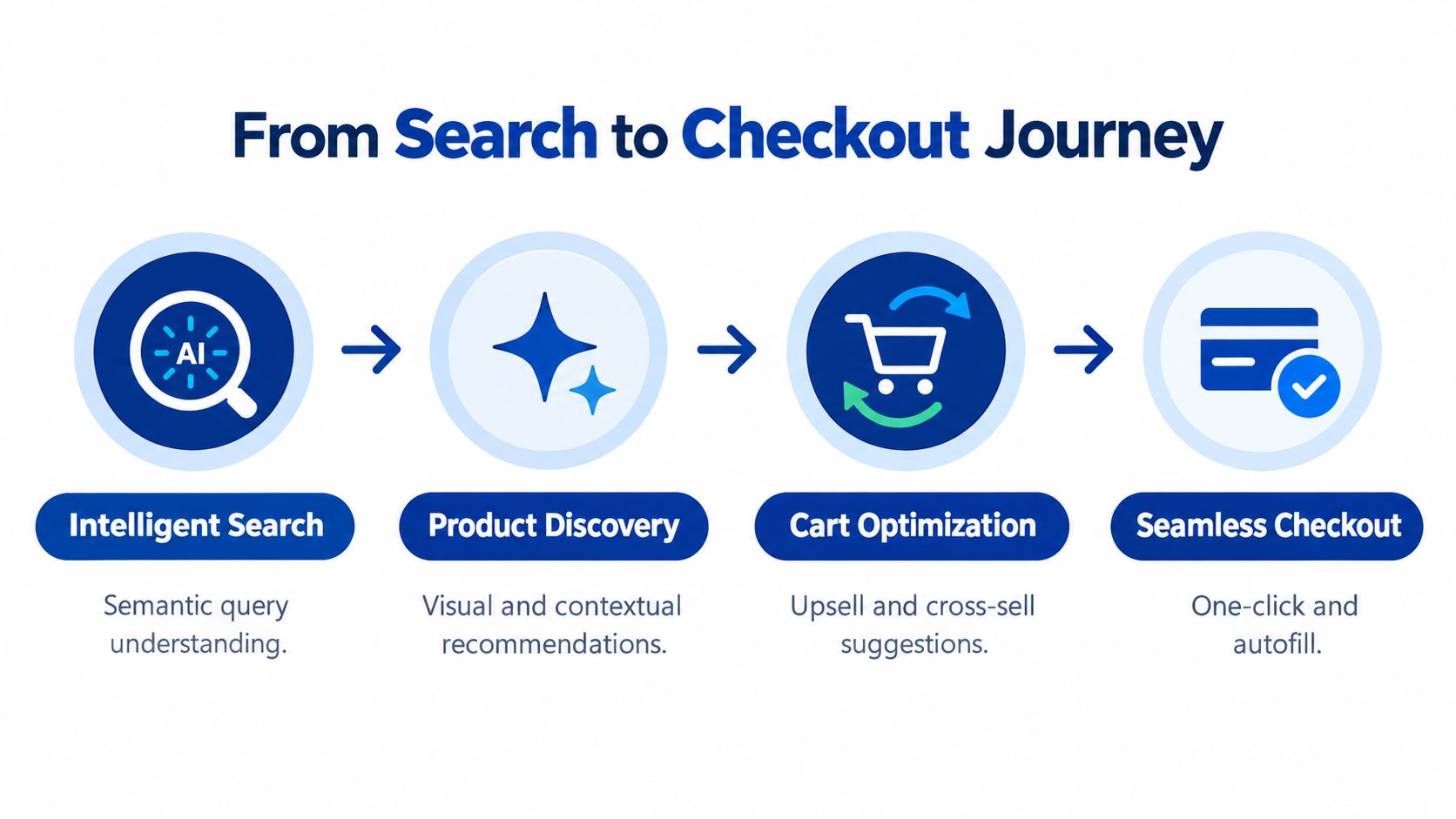
Traditional search matches words. Semantic search tries to understand meaning. A customer searching for “a waterproof jacket for cycling in cold weather” may receive products based on material, insulation, weather resistance, and intended use, even when the product title doesn't contain the exact phrase.
Visual search adds another route to discovery. A customer can upload an image or select a visual style, and the system can identify similar colours, shapes, or designs. Recommendation engines then extend the journey by showing complementary items, alternatives, and products suited to the same use case.
For a detailed explanation of how these systems support merchandising and relevance, see this guide to AI-powered product recommendations.
Personalised experiences
AI personalisation uses signals such as browsing activity, purchase history, location, device context, and declared preferences to adjust content. The result might be a more relevant homepage, a better product sort order, or a reminder about an unfinished purchase.
The retailer still needs clear consent and sensible limits. Personalisation should help the customer find the right option, rather than create opaque prices or pressure them with assumptions they can't correct.
Operational automation
Behind the storefront, ecommerce automation can classify products, identify missing attributes, forecast demand, flag unusual orders, and route support requests. A catalogue manager might use AI to detect that a product lacks information about size, compatibility, or care instructions. An operations team can then correct the gap before it creates customer questions or returns.
Inventory intelligence connects demand signals with availability. It can help teams identify items at risk of selling out, suggest replenishment priorities, or prevent recommendations for products that aren't realistically available.
Conversational commerce
A chatbot isn't useful because it can talk. It must provide accurate answers from approved product, policy, delivery, and returns information. Customer experience AI is most valuable when it handles repetitive questions while knowing when to transfer a complex issue to a human agent.
A useful assistant might compare two products, explain a warranty, or identify whether an accessory works with a particular model. Those answers reduce uncertainty at the moment it matters.
Content and campaign support
Generative AI can help teams draft product descriptions, edit images, create campaign variations, and organise merchandising content. It still needs human review because inaccurate claims can damage trust and create compliance problems.
For teams producing short-form promotional content, the ShortGenius AI ad creative tool can support video and advertisement creation as part of a broader content workflow. It should complement, rather than replace, accurate catalogue data and a clear brand voice.
The strongest platforms connect these features. Search data can inform recommendations, product questions can reveal missing content, inventory status can shape what appears in discovery, and checkout signals can improve future assistance. That connection is what turns separate AI features into a customer journey.
Understanding the Business Case
The business case for AI ecommerce solutions begins with a workflow that needs improvement. A retailer might spend hours correcting product data, answering the same compatibility question, reviewing orders, or adjusting merchandising rules. AI creates value when it reduces that repeated work without sacrificing accuracy or customer control.
Canadian adoption shows that businesses are putting attention and budget toward these capabilities. Among AI-using Canadian businesses, 36.6% used data analytics, 34.5% used text analytics, and 28.2% used virtual agents or chatbots in Q2 2026, according to Canadian AI ecommerce adoption data. These functions connect to the customer journey: data analytics can reveal where shoppers struggle, text analytics can improve catalogue language, and virtual agents can answer questions during evaluation.
Consumer behaviour adds pressure to that investment. A separate Canadian report found that 52% of Canadians had used an AI tool while shopping online, up from 39% in 2025, and 44% said they were likely to use AI to compare products or evaluate similar options. For products that require comparison, compatibility checks, or policy explanations, decision-support tools may matter more than a generic chatbot.
Metrics that deserve attention
AI does not guarantee better performance. A recommendation engine fed incomplete catalogue data can surface irrelevant products, weaken trust, and make later checkout decisions less likely. Teams therefore need measures that distinguish useful automation from activity that only appears advanced.
| Business Metric | Impact of AI |
|---|---|
| Product discovery | More relevant search results and recommendations can reduce browsing friction |
| Conversion quality | Better answers and comparisons can help customers make confident decisions |
| Average order value | Contextual complementary products can support useful cross-selling |
| Support workload | Automated handling of routine questions can leave agents more time for complex cases |
| Catalogue operations | Classification and content checks can reduce repetitive manual work |
| Inventory decisions | Demand analysis can help teams prioritise replenishment and merchandising |
| Risk management | Pattern detection can help flag suspicious orders for review |
The spending direction is also changing. A Canada spending analysis of businesses active on Float in both August 2024 and August 2026 found that monthly AI spending increased more than twelve-fold, while the share purchasing at least one AI product rose from 27% to 47%, with median annual spending reaching $92 per employee. These figures do not prove that every ecommerce project will pay off. They show why leaders should treat AI as an operational investment tied to a defined business outcome.
Start by measuring one workflow's labour and revenue impact. Record how long catalogue teams spend tagging products, how often support receives the same compatibility question, and where shoppers abandon searches because results are irrelevant. The AI ecommerce platform guide for boosting conversion provides a framework for connecting platform choices with conversion-focused priorities.
From Search to Checkout Journey
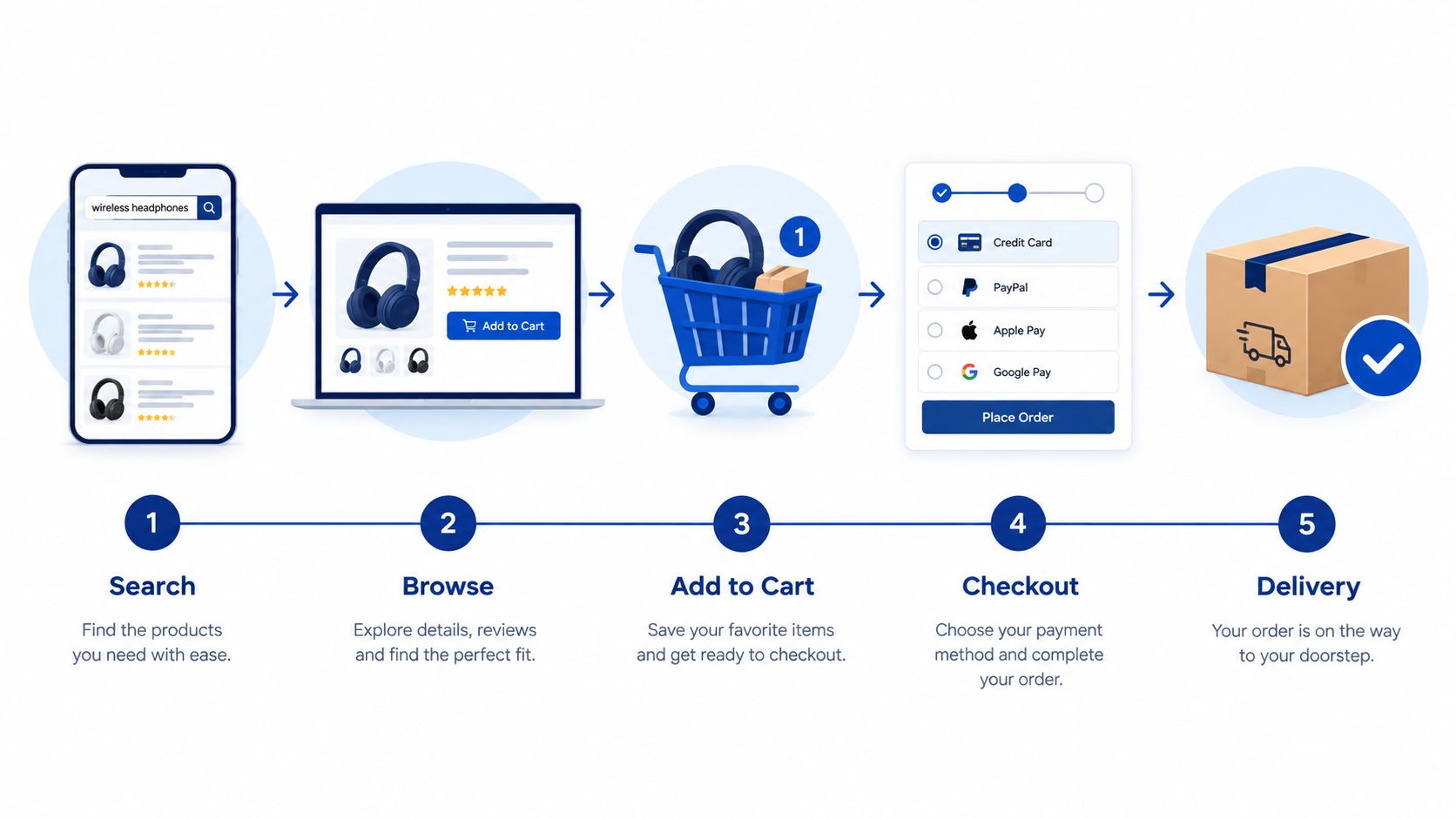
A customer might begin with “a jacket for rainy commutes,” compare unfamiliar materials, add a compatible item, and expect checkout to remember the choices made along the way. An AI ecommerce solution should connect these moments. Like a shop assistant who remembers a customer's preferences, it should carry useful context from search through payment without making assumptions the customer cannot correct.
Start with intent
Customers search by problem, use case, feature, or comparison, not only by product name. Intelligent search interprets these forms of intent and returns results with understandable reasons. Structured attributes still matter. Without them, a system can produce confident but inaccurate matches.
Visual discovery helps customers who recognise a style but lack the right words. An image or selected product can identify related options, which the system then filters by price range, availability, size, colour, and other stated preferences. Those choices should remain available as the customer continues browsing.
For teams defining requirements, this AI ecommerce search practical guide explains how search behaviour, product data, and result quality connect.
Make comparison easier
The product page should answer the question behind the click. AI can summarise differences, explain technical language, identify compatible accessories, and point out missing information. For a high-consideration purchase, a side-by-side comparison may help more than another recommendation row.
A conversational assistant can guide the decision while clearly identifying itself as software. It should state its limits, reference the relevant store policy where appropriate, and offer human support for unusual or sensitive requests. The conversation should also pass useful context to the cart, so customers do not need to repeat their requirements.
Keep the cart relevant
Cart intelligence can suggest an accessory, replacement item, or bundle when it fits the purchase. Each suggestion needs a clear reason. A camera customer may need a compatible memory card, while someone buying a replacement filter may need an exact model match. Irrelevant offers add noise and can weaken trust.
Shipping, tax, stock, and returns information should appear early enough to prevent surprises. A smooth journey gives customers the information required for a confident commitment, not just a faster route to payment.
Remove checkout friction
AI-assisted checkout can prefill approved information, detect errors before submission, and send unusual transactions for review. It can support agent-led purchasing as well, provided retailers set controls for spending limits, identity, payment permissions, refunds, and audit records.
A Canadian retail report found that 51% were open to allowing AI to manage the entire shopping process, including final checkout, once budget and brand preferences were set.
Trust is part of conversion: customers need to know what the system will do, what it can access, and how they can intervene.
Retailers can review ShipTeaser's conversion playbook and use journey analytics to locate costly friction. The same context should connect search behaviour, product comparisons, recommendations, cart decisions, and checkout controls, allowing teams to assess the experience as one continuous customer journey.
Implementation Roadmap
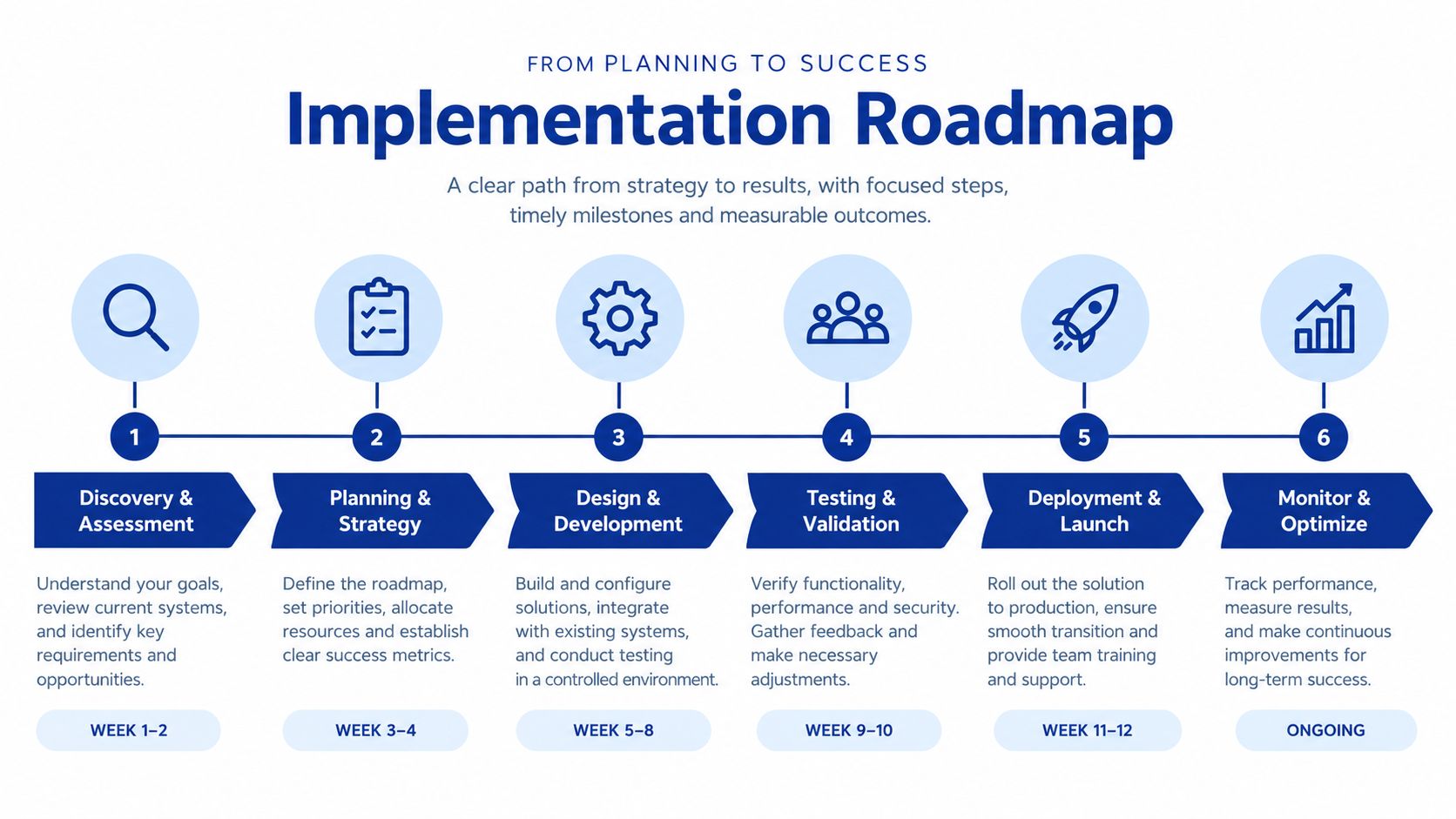
Successful implementation starts with a narrow operational problem. A retailer shouldn't begin by buying every available AI feature. It should choose a workflow where better data, faster handling, or more relevant decisions can be measured.
Establish the foundation
Audit the catalogue, customer data, order history, inventory feeds, analytics setup, and consent practices. Check whether product attributes are complete and whether systems agree about stock, price, tax, shipping, and customer identity. Poor source data will limit every downstream model.
Next, set a baseline. Record current search exits, support categories, catalogue processing time, return reasons, and checkout errors. These measures give the team a way to test whether the system improves the journey rather than adding technology.
Select and test the right components
Evaluate vendors against integration requirements, data ownership, model transparency, security, human escalation, and reporting. A Shopify retailer may begin with search or recommendation software, while a larger organisation may need APIs connecting a product information management system, customer data platform, warehouse tools, and payment services.
Run a controlled pilot with a defined catalogue area or customer journey. Review outputs for inaccurate recommendations, biased results, privacy problems, and confusing language. Human reviewers should approve high-risk content and define the conditions that trigger escalation.
Scale with governance
Once the pilot meets its agreed criteria, connect adjacent workflows. Search can feed recommendations, support questions can improve content, and order outcomes can inform future merchandising. Document who owns prompts, model changes, data access, incident response, and customer disclosures.
The investment case is strongest when each expansion has a measurable reason. Teams should also budget for monitoring, data maintenance, model evaluation, and employee training. AI isn't a set-and-forget plugin. It needs ongoing supervision because products, policies, customer expectations, and fraud patterns change.
Real-World Success Stories
A growing clothing retailer may start with a messy catalogue. Product names vary by supplier, colour labels aren't consistent, and customers struggle to find items using everyday language. An AI classification workflow can suggest standard attributes and identify missing information. A merchandising specialist reviews the suggestions before publication, so the system accelerates organisation without becoming the final authority.
A home improvement store faces a different challenge. Customers often know the project but not the exact product specification. A customer experience AI assistant can ask about the room, surface, dimensions, and intended use, then present a shortlist with compatibility notes. If the customer asks something outside the approved knowledge base, the assistant can send the conversation to a specialist instead of guessing.
An electronics retailer can connect recommendations to product compatibility. Someone viewing a laptop might receive accessories that work with that model, while the system excludes items with incompatible connectors. The value comes from understanding relationships in the catalogue, not from displaying more products.
A grocery or subscription business may use predictive tools to identify likely replenishment needs. The customer receives a reminder or a suggested basket, but can adjust the order before payment. This approach keeps convenience under the customer's control and reduces the risk of unwanted automatic purchases.
Support teams can also use AI without replacing human service. The system can summarise a customer's order history, classify the request, retrieve the relevant policy, and prepare a response for an agent. That combination improves consistency while keeping a person involved when the matter involves refunds, complaints, accessibility, or exceptional circumstances.
These examples share a principle. Retailers don't need to automate the entire shop at once. They need to connect a specific customer problem with reliable data, a suitable AI capability, and a human-owned review process.
Frequently Asked Questions
Are AI ecommerce solutions only for large retailers?
No. A smaller retailer can begin with one focused use case, such as search improvement, product content, or support triage. Cloud services and ecommerce integrations can make the initial project manageable, provided the business has clean product information and a clear measurement plan.
Do we need an in-house AI team?
Not necessarily. Internal owners still need to define goals, approve data access, review outputs, and manage customer policies. Technical partners can support integration, model selection, testing, and maintenance, while the retailer remains responsible for the customer experience.
Can AI work with an existing ecommerce platform?
Often, yes. Many solutions connect through application programming interfaces, webhooks, product feeds, or platform extensions. Before choosing a tool, check how it handles catalogue updates, inventory, tax, shipping, orders, customer consent, and human escalation.
How should we measure return on investment?
Start with a baseline for the selected workflow. Track measures such as search relevance, assisted sales, support handling time, catalogue processing effort, checkout errors, and customer satisfaction. Review quality as well as speed, because an inaccurate answer can create returns or damage trust.
What privacy controls should retailers use?
Explain what data the system uses and why. Collect only what the experience needs, offer meaningful consent choices, protect sensitive information, and give customers a way to correct or avoid automated decisions. Canadian shoppers show openness to data sharing for better recommendations, but that openness depends on responsible governance. An Omnisend survey reported that 79% of Canadian shoppers would share personal information with AI tools for better product suggestions, while 74% were open to AI taking over final transactions.
Cleffex Digital Ltd provides ecommerce development, AI integration, Shopify UX and UI design, intelligent recommendations, product content support, and customer experience tools for growing retailers. Visit Cleffex Digital Ltd to discuss a practical AI ecommerce roadmap built around your catalogue, systems, and customer journey.