

The most popular advice about an AI shopping assistant is also the least reliable: give the agent access to the catalogue, checkout and customer data, then let it purchase on the shopper's behalf. Canadian buying behaviour points elsewhere. Adoption is rising, but trust remains conditional, and shoppers show stronger interest in narrow, useful tasks than in handing over every decision.
A production-grade assistant should act less like an autonomous buyer and more like a carefully governed retail team. One agent can find deals, another can answer policy questions, and a third can compare products. Each should have limited permissions, current retail data and a clear path to human confirmation. That approach supports conversational commerce without asking customers to surrender control before they're ready.
Rethinking Autonomous Commerce and Consumer Trust
Fully autonomous purchasing is not the immediate destination for most retailers. Canadian evidence points to a narrower opportunity: an AI shopping assistant that reduces effort, explains its reasoning and requests approval before taking consequential action.
A 2026 Canadian retail report found that 51% of Canadian consumers are open to letting AI manage the entire shopping process, including final checkout, once preferences such as budget and brand are set. Yet adoption of AI shopping tools rose to 30% from 11% in the previous year, while only 19% of Canadians trust AI recommendations outright, according to Retail Insider's coverage of IBM and NRF research.
The commercial signal is interest with conditions, not blanket permission. Shoppers want help reducing search time, comparing products and finding value. They also expect to understand why an item was recommended and to retain control over the final decision. A system that treats every request as authorisation to buy will create avoidable disputes around price, suitability, substitutions and consent.
Younger shoppers are already testing these experiences. The same Canadian retail report found that 45% of Gen Z and 44% of Millennials used AI assistants while shopping, while 18% of Gen Z and 16% of Millennials were first-time users during the previous 12 months. For retailers, the interface has moved beyond novelty, but access to checkout, payment data and personal information still requires deliberate controls.
Utility earns permission
A national Canadian survey reported in 2026 found that 39% of Canadians used generative AI to guide purchasing decisions during the previous year. Usage varied by region, from 45% in Quebec and 41% in Ontario to 28% in Manitoba and Saskatchewan.
Start with a task customers already understand:
Deal hunting: Rank offers against a defined budget and show the conditions attached to each promotion.
Loyalty optimisation: Help shoppers compare points, discounts and rewards so the value is visible.
Product comparison: Translate specifications into a recommendation based on stated priorities.
Support and setup: Answer policy questions, track orders and guide installation after purchase.
These functions are easier to explain, test and govern than an agent that selects and buys without review. They also match reported Canadian demand. Interest was strongest in a deal hunter role at 39%, followed by a customer service agent at 33%, a review agent at 27%, and a personal shopper at 23%, as reported in the IBM and NRF research covered by Retail Insider.
Practical rule: Give an agent the narrowest permission that completes a useful task. Expand its authority only after customers understand its recommendations and approve the outcome.
Trust needs visible reasoning
Recommendation quality depends on evidence and controls, not only model fluency. A Canadian survey found that 28% of respondents said AI suggested a purchase they later regretted, even though 57% of users said AI helps them save money and 80% said it helps them compare options better. The same survey was reported in the Canadian generative AI purchasing coverage linked above.
A trustworthy assistant should show the products considered, identify the constraints it applied, surface current price and availability information, and let shoppers correct mistaken assumptions. For higher-value purchases, require confirmation before any order action. Keep the assistant's permissions separate from its conversational ability, especially where regional privacy laws govern personal data, consent and automated decisions.
The assistant can recommend confidently when its evidence is strong. When information is incomplete, it should ask a focused question or transfer the interaction to a person. Constrained autonomy earns adoption more reliably than a promise that the system will make every shopping decision alone.
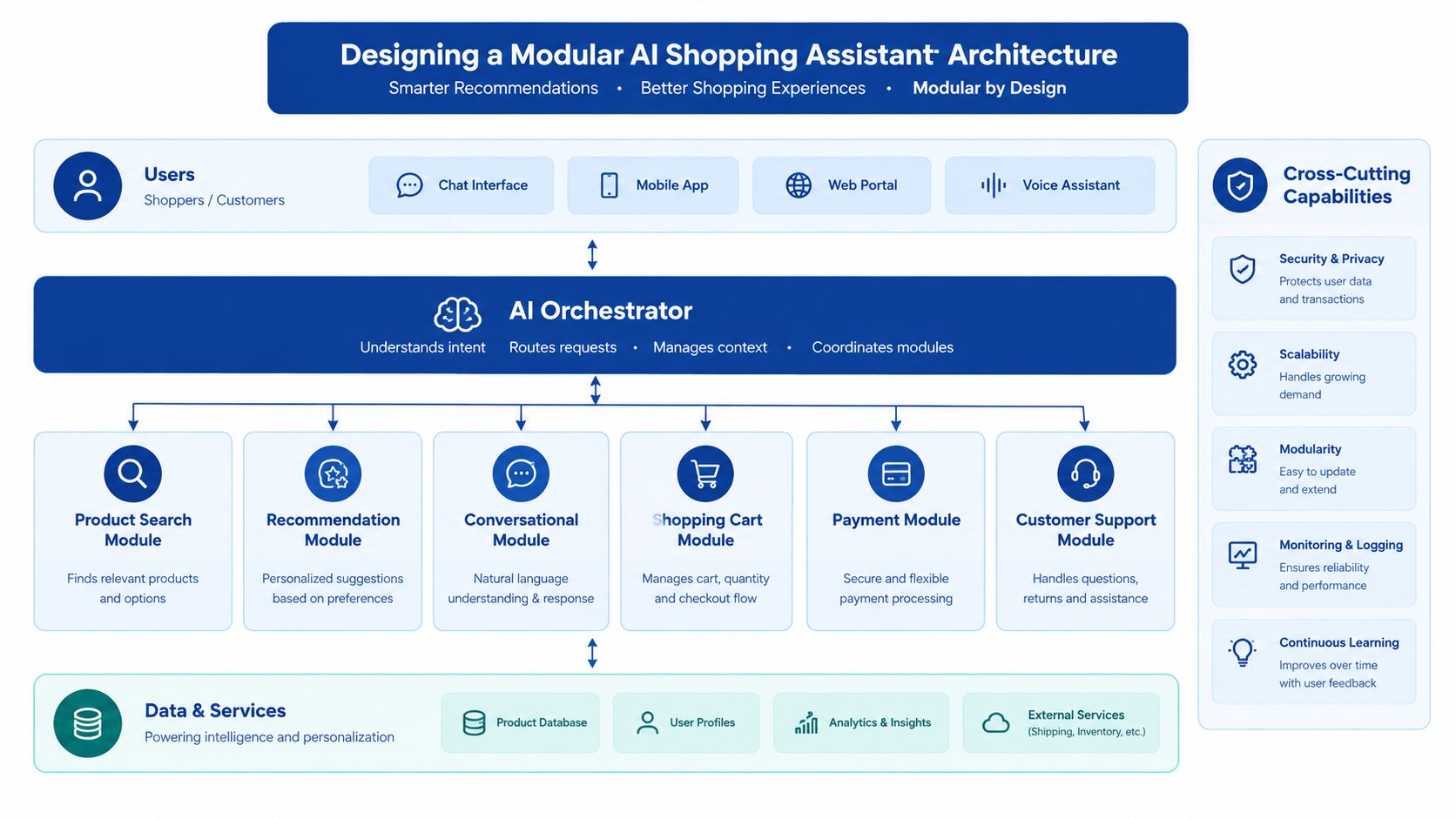
Designing a Modular AI Shopping Assistant Architecture
A reliable ecommerce chatbot needs more than a language model and a prompt. It needs an orchestration layer that can interpret the request, call approved tools, retrieve structured information, apply business rules and return an explanation that matches the evidence.
A modular design keeps those responsibilities separate:
Intent and conversation layer: Interprets natural language, maintains the immediate dialogue context and identifies missing information.
Product-comparison agent: Maps needs to catalogue attributes, compares suitable products and explains trade-offs.
Price and offer agent: Checks current prices, promotions, loyalty conditions and budget constraints.
Policy and support agent: Retrieves approved answers for delivery, returns, warranties, exchanges and order status.
Action layer: Performs only permitted operations, such as adding an item to a basket or creating a support request.
Governance layer: Applies consent, access controls, confidence thresholds, logging and escalation rules.
Retrieval must outrank improvisation
A retrieval-augmented generation, or RAG, flow should fetch product facts from a controlled index before the model writes its response. The index should contain structured fields for product type, compatibility, size, material, price, promotion rules, delivery eligibility and stock status. The model can then explain retrieved results, but it shouldn't invent a specification that isn't present in the source record.
Inventory-aware prompting is equally important. The assistant needs a current availability response before presenting an item as purchasable. If stock is uncertain, the interface should label that uncertainty and offer alternatives rather than making a confident promise.
Confidence gating turns that principle into a system behaviour:
High confidence: Present grounded recommendations and permitted next steps.
Moderate confidence: Explain the assumption and ask the shopper to confirm it.
Low confidence: Avoid a recommendation, request more detail or route the conversation to support.
The most useful architecture often resembles a set of small services rather than one general-purpose agent. Narrow permissions reduce the blast radius of an error, simplify evaluation and make it easier for product, merchandising and support teams to own their respective data.
For teams designing guidance inside digital products, AI assistants for in-product UX offer useful context on how assistants can support users without overwhelming the interface. For the commerce search layer itself, teams can also consult this practical guide to AI ecommerce search before selecting retrieval and ranking components.
Evaluating Build Versus Buy for Ecommerce Chatbots
Buying an off-the-shelf chatbot can put a conversational interface in front of shoppers quickly. It can also leave the business with rigid workflows, limited access to proprietary data and a brand voice that feels detached from the storefront. Custom AI shopping assistant development offers deeper control, but the organisation owns orchestration, integration, evaluation, security and ongoing maintenance.
The right decision depends on where differentiation lives. If the business only needs common policy answers and basic product discovery, a SaaS product may be sensible. If the assistant must understand specialist products, loyalty rules, regional pricing, complex compatibility or a distinctive Shopify experience, custom or hybrid development usually deserves serious consideration.
Build vs Buy Decision Matrix
| Factor | Custom Development | Off-the-Shelf SaaS |
|---|---|---|
| Deployment speed | Slower, because the team designs integrations and workflows | Faster, using pre-built components |
| Initial investment | Higher engineering and implementation effort | Lower upfront commitment, subject to subscription and usage terms |
| Brand voice | Precisely controlled through prompts, policies and interface design | Usually configurable within vendor limits |
| Proprietary data | Direct control over catalogue, CRM, loyalty and support sources | Depends on connectors, permissions and export options |
| Shopify UX | Can be integrated deeply into search, product pages, basket and account areas | Often constrained by the vendor's widgets and extension model |
| Governance | The business defines permissions, retention and escalation | The vendor's controls must be assessed and supplemented |
| Long-term flexibility | High, if the team maintains the platform properly | Dependent on the vendor's roadmap and APIs |
| Operational burden | Owned by the retailer or its delivery partner | Shared with the vendor, but integration issues remain the retailer's responsibility |
The hybrid path is usually the practical one
A hybrid model keeps commodity capabilities outside the core build while reserving internal effort for differentiated workflows. A retailer might buy search infrastructure and model access, then build its own offer-ranking logic, loyalty tools, approval screens and support hand-offs.
Review the vendor's data boundaries before signing. Ask how product and customer information is stored, whether language models can be selected, how tool calls are restricted, what logs are available and how pricing changes as conversation volume grows. A specialist AI chatbot agency can help assess these questions, but the retailer still needs clear ownership of product data and operating rules.
A custom build becomes more defensible when the assistant is part of the competitive experience rather than a support add-on. It can use first-party product relationships, recognise brand-specific terminology and coordinate actions that a generic widget cannot safely perform.
For a broader evaluation of retail chatbot patterns, use this guide to AI chatbots for ecommerce and retail. It helps distinguish a conversational layer from an operational assistant that can retrieve, compare and act.
Executing the Implementation and Integration Roadmap
Implementation should begin with data, not the chat window. A polished interface can't compensate for missing attributes, stale prices or inconsistent product identifiers. Before selecting a model, inventory the catalogue, pricing service, promotion engine, stock feeds, order system, CRM, loyalty platform and support knowledge base.
A practical delivery sequence
1. Define one bounded customer job: Start with a task such as product comparison, deal finding or order-status support. Write down what the assistant may answer, what it may do and when it must escalate.
2. Prepare the catalogue: Normalise names, categories, variants, specifications and compatibility relationships. Give each product a stable identifier and define how the system handles discontinued, substituted and temporarily unavailable items.
3. Create retrieval contracts: Each tool should return structured fields, timestamps and error states. A price tool should return the applicable price and conditions. An inventory tool should distinguish available, unavailable and unknown rather than returning a vague text response.
4. Add privacy gates before personalisation: Ask for consent when the experience needs account, purchase or loyalty data. Keep anonymous product discovery available where possible, and avoid collecting information that doesn't contribute to the stated task.
5. Integrate with Shopify without replacing the native checkout: Embed the assistant in search, product and basket contexts, but keep established checkout controls visible. Use dynamic layouts for recommendation cards, comparison tables and alternative products, rather than presenting every response as a paragraph.
6. Introduce human confirmation: Require explicit approval before high-value purchases, irreversible account actions, address changes or loyalty redemptions. Preserve the conversation transcript when escalating so customers don't need to repeat their requirements.
7. Test with real failure modes: Include out-of-stock products, conflicting promotions, incomplete product data, ambiguous sizing, returns exceptions and customers who change their minds. Evaluate factuality, tool selection, escalation quality and the clarity of explanations.
8. Roll out in controlled stages: Start with a limited audience or a narrow category. Review conversations with merchandising, customer service, legal and engineering teams, then adjust retrieval, permissions and interface copy before expanding.
Deployment principle: Treat every tool call as a business transaction, not as a casual extension of the model. Validate inputs, authorise the action and record the result.
This roadmap also gives Shopify UX/UI teams a useful boundary. Personalisation should make the storefront easier to use, not hide essential information behind a conversation. A shopper should still see price, availability, delivery conditions and the route to a human agent without having to ask the assistant to reveal them.
Navigating Privacy and Compliance in Conversational Commerce
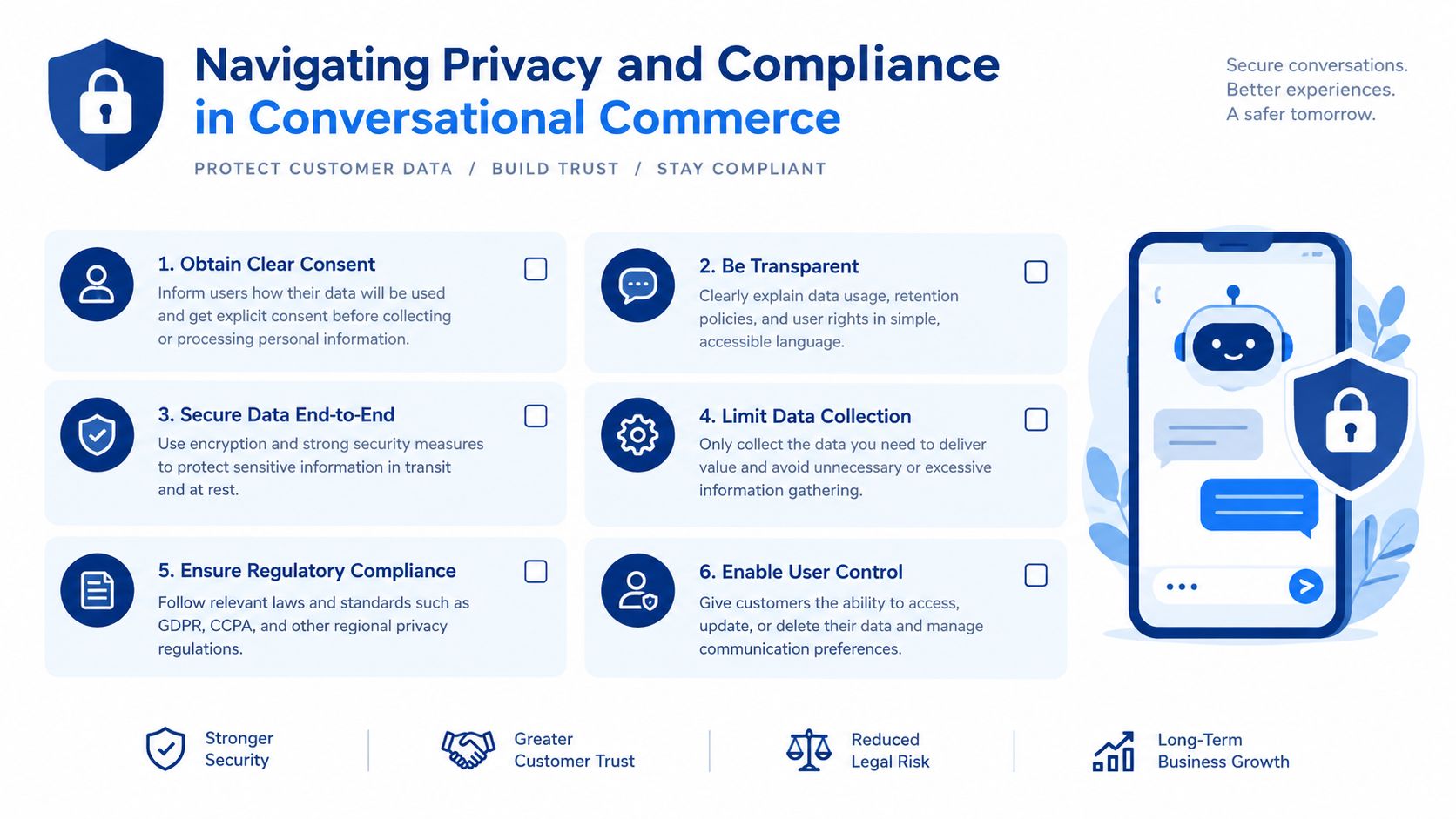
Privacy rules shape the architecture of a conversational commerce system. The Office of the Privacy Commissioner of Canada says organisations using or developing generative AI should make tools explainable, be transparent about how information is used and the privacy risks involved, limit sharing of personal or confidential information, and apply privacy by design.
PIPEDA remains relevant when a private-sector business uses an AI system. The obligations don't disappear because a third-party model processes the interaction. Customer names, emails, purchase history and loyalty information still need appropriate collection, use, disclosure and protection.
Convert guidance into system controls
The Canadian government's AI privacy guidance says an AI help application should collect only information necessary for its function. It also advises against gathering details such as location or device information unless they're essential, reusing conversation data for secondary purposes without an appropriate basis, and retaining information indefinitely.
That translates into concrete engineering choices:
Minimise by default: Separate anonymous browsing from authenticated account assistance.
Ask at the point of need: Request loyalty or order information only when that task requires it.
Set retention periods: Define default deletion rules for transcripts, tool logs and temporary preference data.
Separate purposes: Don't reuse shopping conversations to train unrelated systems or create new profiles.
Explain recommendations: Show which preferences, catalogue fields or promotion rules influenced the result.
Restrict access: Give agents and staff access only to the fields and actions required for their role.
Consent should be visible, specific and revocable. Canadian Tire's CeeTee buying assistant provides a practical pattern, using customer consent and anonymising information supplied or collected during interactions so it can ground the model.
Teams should monitor more than conversion. Track unsupported answers, personal-data exposure attempts, failed deletion requests, unauthorised tool calls and escalation outcomes. For founders assessing how the brand appears across conversational surfaces, AI visibility analytics for founders provides a useful perspective on measuring presence and response quality without treating visibility as a substitute for privacy controls.
Measuring ROI Across Diverse Industry Use Cases
An AI shopping assistant earns its place by improving a defined workflow, not by adding a chat icon. Set KPIs around the job it performs. Retail teams may track recommendation acceptance, basket progression, repeat purchase and loyalty engagement. Automotive teams may prioritise qualified enquiries and completed appointments.
Automotive
A dealership assistant can ask about vehicle type, budget, usage and timing, then match the enquiry with available stock. It can answer specification questions, request permission for follow-up and schedule a test drive. Negotiation and complex finance discussions should remain with a sales adviser.
Useful measures include:
Lead quality: Whether conversations produce complete, actionable enquiries.
Appointment completion: Whether scheduled test drives take place.
Response workload: Whether sales staff spend less time answering repetitive stock questions.
Handoff quality: Whether the adviser receives the customer's preferences and relevant conversation context.
The assistant must verify stock before presenting a vehicle as available. It should also avoid improvising finance terms or making claims outside approved dealership policy. These controls protect trust while keeping the agent useful.
Healthcare and life sciences
Healthcare deployments need a narrower operating boundary. An assistant can support intake, explain approved product information, route requests to the right service and identify situations requiring immediate human attention. It should not diagnose, invent clinical guidance or retain sensitive details without a defined purpose and governance review.
Measure completed intake fields, routing accuracy, escalation accuracy, staff review time and unanswered questions. Together, these indicators show whether the assistant reduces administrative work without encouraging unsafe self-service.
Retail and loyalty
Retail assistants can compare products, identify promotions, explain loyalty options and support setup after purchase. Visa's analysis found that Canadian consumers show interest in optimising loyalty points and receiving faster customer-service answers.
Track margin-aware offer acceptance, loyalty engagement, repeat purchases, support deflection, returns and post-purchase completion. A sale is not a complete success if the recommendation creates confusion, a preventable return or an avoidable support contact.
For product-ranking and recommendation workflows, teams can use AI-powered product recommendations to connect conversational discovery with catalogue and merchandising outcomes. The same measurement discipline should apply across industries: define the task, set boundaries for agent actions and compare business results with review effort, escalation quality and customer trust.
Frequently Asked Questions About AI Shopping Assistants
What should the assistant do when a product goes out of stock?
It should verify inventory before presenting the item as available. If the status changes during the conversation, explain the change, show comparable products that meet the original constraints and offer a notification or human hand-off if the business supports it. Never hide an unavailable item to preserve the flow.
Can a legacy CRM work with a modern generative AI model?
Yes, but use an integration layer rather than giving the model direct database access. Expose narrow services for customer lookup, consent status, order history and support-case creation, then return only the fields required for the current task. This lets the CRM remain the system of record while the assistant uses controlled, auditable tools.
How do teams add new product lines without causing the assistant to forget older ones?
Update the retrieval index and product schemas first. Preserve stable identifiers, version catalogue content, test old and new categories together, and keep business rules outside the model where possible. You generally don't need to retrain the foundation model for every catalogue update. Fresh retrieval data, evaluation sets and carefully governed prompts are safer ways to maintain accuracy.
Should an AI shopping assistant complete checkout?
Only when the customer has clearly granted that permission, and the system can verify price, stock, delivery, identity and payment conditions. For most deployments, a confirmation screen before final purchase is the more defensible starting point. It aligns autonomy with evidence and gives the customer a final chance to correct an incorrect assumption.
What does ongoing maintenance involve?
Review conversations, failed retrievals, tool errors, escalations and customer corrections. Refresh product data, test policy changes, audit permissions and measure outcomes by use case. A capable assistant is an operating product, not a campaign that can be launched once and ignored.
Cleffex Digital Ltd develops AI-powered ecommerce chatbots, product recommendation systems and Shopify experiences that can answer product questions, guide checkout, support returns and track orders. Visit Cleffex Digital Ltd to discuss a modular AI shopping assistant built around your catalogue, integrations, privacy requirements and customer-service workflows.