

A Toronto payments team has a fraud model that looks excellent in a sandbox. The data is clean, the demonstrations are convincing, and the model flags suspicious activity quickly. Then production arrives. Transaction events arrive through inconsistent channels, investigators need an explanation for every alert, infrastructure teams question where the data is hosted, and an OSFI review exposes gaps in lineage and access controls.
That situation is common because AI-ready FinTech infrastructure isn't just a cloud account with a model attached. It must support trustworthy data, repeatable deployments, controlled access, explainable decisions, resilient payment flows, and evidence that a regulator or auditor can follow. Canada's financial sector is investing heavily in AI, but production maturity remains uneven. A Canadian financial-sector survey found that 86% of institutions are investing in generative AI, while fewer than 10% have deployed it at scale.
The practical work is therefore clear: choose the right data substrate, operationalise models with MLOps, embed governance early, size compute realistically, and measure ROI before committing to a large architecture. This guide treats those jobs as one system design problem, grounded in Canadian payments modernisation, OSFI expectations, sovereign compute, and the realities of regulated delivery.
Why Most FinTech AI Pilots Never Reach Production
A fraud pilot can show strong results while the platform underneath remains unfit for production. The test may use a curated dataset, fixed formats, light traffic, and manual review. Live operations add delayed events, duplicate records, changing customer behaviour, outages, model drift, privacy constraints, and investigators who need to understand each alert.
That gap usually reflects incomplete system design rather than weak data science. A fraud model can produce a useful score, but the surrounding services must capture the transaction, enrich it with approved data, return a decision within the required latency, record the outcome, route exceptions to an investigator, and support rollback when behaviour changes.
Canada's payment infrastructure makes these requirements material. Payments Canada reported 22.5 billion retail payment transactions in 2024, totalling $12.2 trillion in its published annual volume data. A design that performs well on a small test set may fail at national transaction volumes, across inconsistent channels and broader data variation.
Five production questions to answer early
Can the data substrate be trusted?
Define canonical schemas, ownership, quality checks, event timestamps, and lineage before undocumented transformations become dependencies.
Can the model be operated?
Provide training, deployment, monitoring, versioning, rollback, and incident processes. A notebook is not a service.
Can the decision be governed?
Keep a model register, approval record, input lineage, validation evidence, and an explanation path for affected customers or investigators.
Can compute match the workload?
Separate experimentation, batch analytics, training, and low-latency inference. Their cost, residency, availability, and scaling requirements differ.
Can the business measure value?
Agree on operational and financial outcomes before selecting infrastructure. A model metric alone will not justify ongoing spend.
Practical rule: If a team cannot reproduce a prediction, explain its inputs, and identify the person or service that acted on it, the feature is not production-ready.
The federal Directive on Automated Decision-Making has required algorithmic impact assessments before production use of automated decision systems since its compliance deadline of 1 April 2020. That requirement reflects a broader Canadian delivery constraint. Governance must shape data access, audit trails, human review, and approval workflows from the first useful experiment, alongside OSFI guidance, sovereign compute decisions, Real-Time Rail planning, and the practical constraints of regulated delivery.
What AI-Ready FinTech Infrastructure Requires
A fraud model can score a transaction in a development environment and still fail in production. AI-ready FinTech infrastructure connects data, models, controls, security, and business systems so predictions remain reproducible, auditable, explainable, and usable under Canadian operating constraints.
The five layers of readiness
Data engineering foundation: Event streams capture transaction and operational changes. A lakehouse or governed combination of warehouse and object storage keeps raw and curated financial data available for analytics and machine learning. Canonical schemas stop fraud, credit, and compliance teams from assigning different meanings to the same field, including fields used in Data Collection Modernization and future Real-Time Rail integrations.
MLOps backbone: Training pipelines, model registries, automated tests, deployment controls, monitoring, and rollback turn a model into an operational service. Teams should be able to identify the approved version, reproduce its inputs and outputs, and restore a known-good release when performance or dependencies change.
Model governance: Data lineage, validation records, bias testing, model inventory, approval workflows, and ongoing monitoring give risk teams evidence to challenge outputs. OSFI's expectations apply to internally developed models and relevant third-party components, so vendor APIs and outsourced services need documented controls and test evidence.
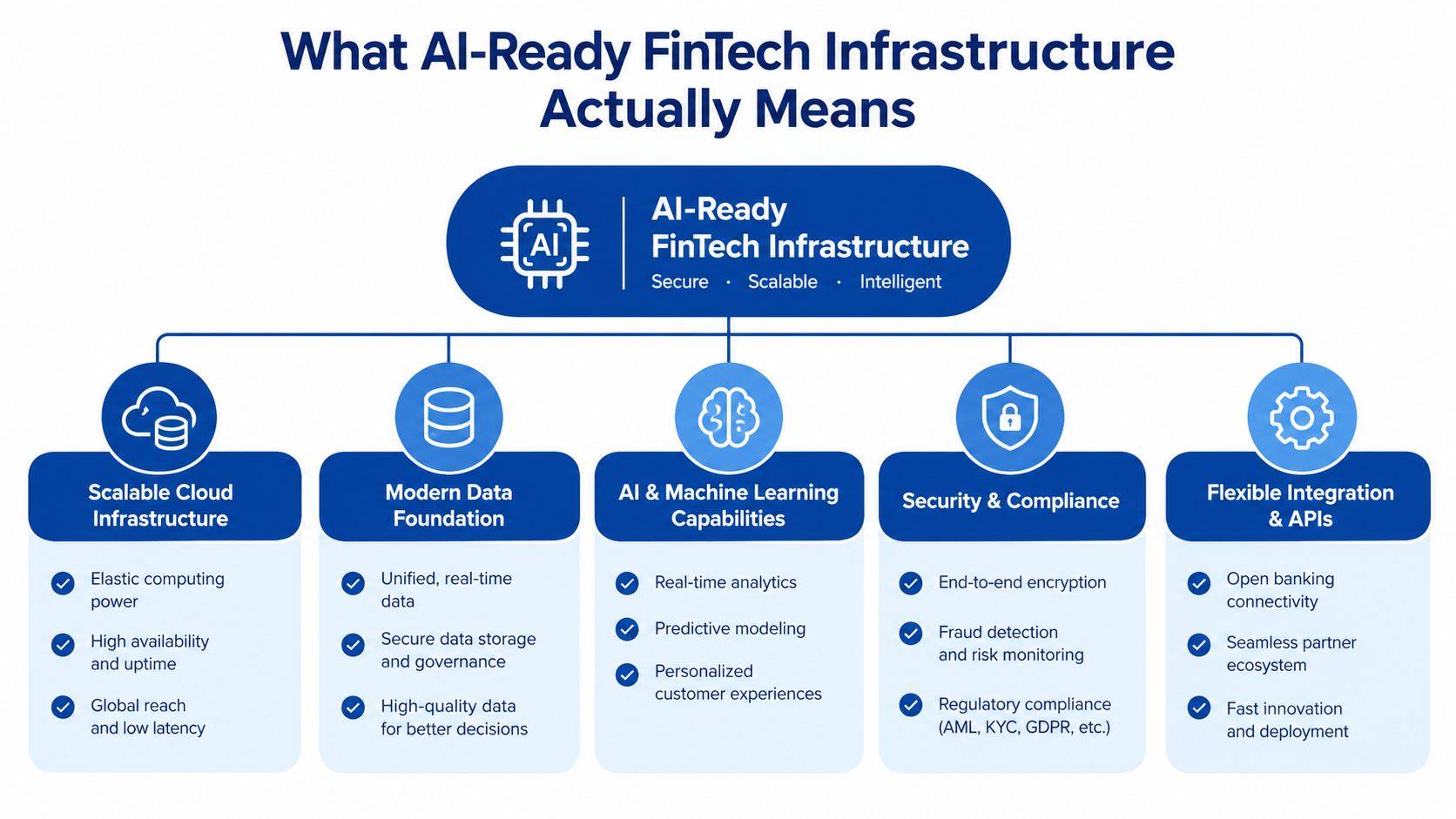
Security layer: OSFI's AI risks and opportunities report points institutions toward standardised data formats, consolidated data across silos, and zero-trust architecture with continuous authentication, least-privilege access, and micro-segmentation. Encryption, key management, secrets control, and data-residency decisions must cover experimentation, training, deployment, and retirement.
API surface: Secure APIs expose predictions to mobile applications, partner platforms, operations tools, and ISO 20022 payment channels. Each interface should enforce identity, authorisation, schema validation, rate controls, and audit logging instead of giving callers direct model access.
Teams modernising legacy applications can use this overview of modernising business software for growth when older systems restrict data access or controlled service integration.
The dependency chain matters. A feature store cannot correct unreliable source events, and a model registry cannot compensate for weak access controls. AI-readiness is a property of the whole system, not a single tool.
Core Architecture Patterns That Hold Up Under Load
Canadian FinTech teams usually assess four architecture patterns, but none deserves automatic adoption. The right choice depends on the business decision, latency requirement, number of models, control objective, and ability to operate the platform.
A lakehouse combines raw and curated data so the same governed substrate can support financial data analytics, reporting, feature engineering, and model training. It earns its cost when teams need historical transaction context and repeatable transformations. An SME with one narrow model may use a simpler warehouse and object store instead. The enterprise threshold arrives when duplicated pipelines create conflicting definitions across risk, finance, and product teams.
A feature store centralises engineered features such as transaction velocity, account age, merchant behaviour, or repayment patterns. It helps prevent training-serving skew, where a feature is calculated one way during training and another way in production. For a single underwriting model, it may be unnecessary overhead. Once a team operates five-plus models, the reuse and consistency benefits can justify it.
Real-time streaming uses tools such as Kafka, Flink, or Pulsar to process events continuously. It becomes essential for low-latency fraud decisions and Payments Canada's Real-Time Rail, particularly as ISO 20022 message flows increase the importance of structured, interoperable payment data. It's premature for monthly reporting that doesn't require immediate action.
Zero-trust architecture applies identity-based access, mutual TLS, policy enforcement, and least privilege at every model call. It can feel expensive for a small internal prototype, but regulated data and third-party model services make service-level controls important before external exposure.
| Architecture Pattern | Best Fit Workload | SME Threshold | Enterprise Threshold |
|---|---|---|---|
| Lakehouse | Historical analytics, BI, model training | Multiple governed data sources | Shared data foundation across business lines |
| Feature store | Reusable online and offline model features | Five-plus production models | Many models sharing risk and customer signals |
| Real-time streaming | Fraud, anomaly detection, RTR and ISO 20022 flows | Immediate decisions justify operational burden | National-scale payment and event processing |
| Zero trust | Protected APIs, model services and sensitive data | Any externally exposed service | Distributed, multi-team and third-party environments |
For a broader architectural comparison, review enterprise application architecture patterns before selecting components. The rule remains simple: choose the cheapest pattern that still meets the OSFI control objective and the business latency requirement.
Compliance, Privacy and Governance by Design
Canadian compliance requirements become much easier to operate when they are translated into technical controls. The mistake is to appoint a compliance owner after the model has already shaped data flows, vendor dependencies, and customer decisions.
For federally regulated banks, insurers, and other institutions, OSFI expectations directly influence technology design. Guideline B-13 makes technology and cyber risk management an infrastructure concern. Guideline E-23 sets model-risk expectations, including data governance, model inventories, independent validation, ongoing monitoring, and Board-level oversight. FinTechs serving those institutions may not carry identical obligations, but their contracts and integration reviews often require equivalent evidence.
Turn obligations into controls
The federal Directive on Automated Decision-Making requires impact assessment for covered automated decisions. Build a human-review hook, decision explanation, testing record, and change approval into the workflow. PIPEDA and Quebec's Law 25 require privacy teams to consider collection, use, access, retention, and disclosure, so data minimisation and residency pinning should be architectural settings rather than manual exceptions.
Payments Canada's Data Collection Modernization initiative runs from May 2023 to April 2028, with its new data collection platform expected to go live in autumn 2026. The programme is designed to improve data quality, modernise collection, and provide a single submission channel for OSFI-regulated data. FinTech teams should therefore preserve structured fields, source lineage, submission history, and validation evidence instead of relying on report-specific spreadsheets.
| Regulation / Standard | Scope | Infrastructure Design Implication |
|---|---|---|
| OSFI Guideline B-13 | Technology and cyber risk for federally regulated institutions | Resilience controls, incident records, access governance and third-party oversight |
| OSFI Guideline E-23 | Model-risk management | Model register, validation evidence, data standards and continuous monitoring |
| Directive on Automated Decision-Making | Covered federal automated decisions | Impact assessments, explanations, human review and auditable change control |
| PIPEDA | Personal information handled in commercial activities | Purpose limitation, retention policies, access control and privacy assessments |
| Quebec Law 25 | Privacy obligations applicable in Quebec | Privacy governance, transparency, control over personal information and documented processes |
| Data Collection Modernization | OSFI-related supervisory data collection | Standardised data models, high-quality submissions and traceable reporting flows |
An SME doesn't need a full GRC department to start. Create a model register, dataset catalogue, lightweight privacy impact assessment template, quarterly access reviews, and an incident runbook. Teams working through these controls can also consult the FinTech compliance solutions guide when mapping compliance workflows to software architecture.
For a practical privacy reference, the FigTrig privacy overview can help teams review the basic questions that should accompany data collection and processing decisions. Governance by design reduces rework when payment standards, supervisory reporting, or rail requirements become stricter.
Compute Access and the Sovereign AI Reality
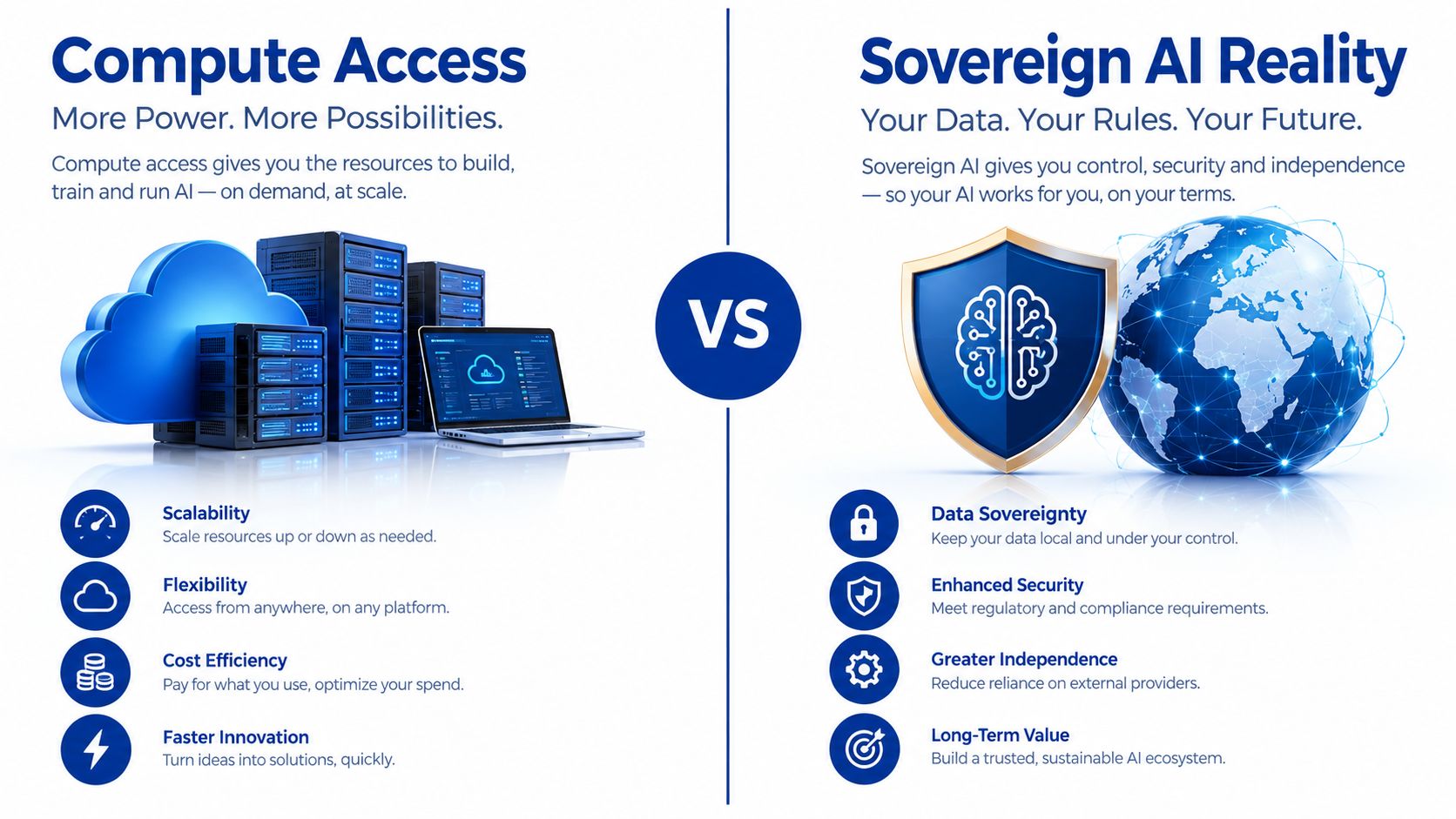
Compute is now a build-versus-buy decision for Canadian FinTechs, not merely an infrastructure budget line. Training on resident financial data, serving latency-sensitive decisions, and satisfying institutional outsourcing reviews all raise questions about where workloads run and who controls the underlying capacity.
Since 2024, Canada's federal government has committed more than C$2 billion towards sovereign AI compute and cloud infrastructure. The package includes C$1 billion for public supercomputing systems, C$700 million for Canadian-led renewable-powered AI data centres, and C$300 million for an AI Compute Access Fund aimed at SMEs.
Canada's longer-term strategy also includes 850 megawatts of sovereign-compute partnerships by 2030, scaling towards 2.3 gigawatts, a public supercomputer by 2031, and $700 million in affordable compute for smaller firms, according to RBC's sovereign AI analysis. These figures describe projected capacity and future infrastructure, not compute that every FinTech can access immediately.
A practical decision frame
Sovereign or domestic capacity makes sense when training uses sensitive Canadian data, a financial institution requires residency assurances, inference latency affects a payment decision, or the vendor exit path matters to the risk committee.
Hyperscaler capacity may be sufficient for non-sensitive prototyping, synthetic or de-identified experiments, and batch financial data analytics. The trade-off is not just price. Teams should assess GPU availability, queue times, regional resilience, contractual controls, portability, and the cost of moving data and models later.
Sovereign capacity is finite, and prioritisation may favour academic and critical-sector users. An SME should therefore design a portable architecture, apply early for relevant access, and avoid assuming that public capacity will remove the need for commercial cloud planning.
Real-World Use Cases for SMEs and Enterprises
A Canadian SME payments platform can start with a narrow fraud decision: should a transaction receive additional review before the approved workflow continues? That boundary keeps the first production release measurable and gives operations a defined fallback.
The model can consume transaction events, account history, merchant context, device signals, and investigator outcomes. As more models reach production, a feature store can retain shared calculations, while streaming services deliver current events. False positives should enter an operations queue instead of blocking legitimate customers. Each alert should preserve the model version, feature values, explanation, reviewer action, and eventual outcome.
Controls determine whether the feature can operate under review. Restrict dataset access, apply documented retention rules to personal information, and require approval, monitoring, and rollback before deployment. An SME can begin with a narrow model register and human review, then automate selected steps as operating volume increases.
Enterprise payment enrichment
An enterprise bank or insurer preparing for ISO 20022 and Canada's Real-Time Rail faces a broader integration problem. Payments Canada completed the technical build of its real-time payment system in Q3 2025 and entered user acceptance, performance, security, and operational-readiness testing in 2026. Because existing payment systems already clear and settle more than CA$411 billion every business day, AI-enabled components need high-throughput event processing, low-latency validation, and resilient fraud and exception controls.
The enterprise lakehouse supplies governed historical context. Streaming services can enrich ISO 20022 messages and send them to fraud or routing models. Model governance records versions, validation, approvals, and post-deployment performance. The ledger and payment execution services should remain deterministic, with AI producing recommendations or risk signals inside a controlled boundary.
Teams assessing automation can compare these boundaries with how Truespeak approaches automation, particularly when recommendations must connect to approved workflows.
A repeatable implementation sequence is:
Define the decision: Specify who acts, which evidence they need, and what happens if the model is unavailable.
Instrument the current process: Record inputs, timings, exceptions, approvals, and outcomes before changing workflow behaviour.
Layer infrastructure: Add governed data, deployment automation, monitoring, and model services around the existing control boundary.
Test operational failure: Check degraded inputs, delayed events, rejected messages, manual fallback, and rollback before expanding the use case.
KPIs and ROI That Justify the Investment
Architecture should follow measurement, not the other way around. Before signing a cloud or compute contract, connect each model metric to a business outcome and assign an owner for the resulting dashboard.
Four model-level measures are particularly useful:
Precision: Shows how often flagged events are relevant. In fraud operations, higher precision can reduce wasted analyst attention and customer friction.
Recall: Shows how many relevant events the system identifies. A lower recall may leave investigators without enough coverage, even when precision looks strong.
Drift rate: Indicates whether input behaviour or model performance is changing. The result should influence retraining, review, and escalation cadence.
p99 latency: Measures the slowest typical production responses. This matters when a fraud or payment decision must fit within a real-time processing window.
Use a simple financial expression:
Annualised loss avoided minus run-rate infrastructure cost = operating value.
The calculation should include analyst time, manual investigation, avoidable losses, service costs, model operations, storage, monitoring, and the cost of governance work. Don't treat a favourable offline metric as ROI until it changes a controlled business process.
| Model KPI | Business Outcome | Typical Target | Infra Implication |
|---|---|---|---|
| Precision | Fewer irrelevant alerts and less review effort | Set from acceptable operational workload | Feature quality, threshold testing and case-management integration |
| Recall | Broader coverage of relevant risk events | Set from risk appetite and missed-event tolerance | Historical labels, event completeness and retraining capability |
| Drift rate | Timely detection of changing behaviour | Establish a baseline and escalation rule | Monitoring, data-quality checks and scheduled evaluation |
| p99 latency | Reliable placement within a real-time decision flow | Set from the payment workflow requirement | Streaming, inference capacity, caching and graceful fallback |
Planning estimates must be validated against the workload and vendor terms. The proposed benchmarks in this framework are roughly C$25,000 to C$80,000 per month for an SME-grade lakehouse plus feature store on Canadian sovereign capacity, and C$250,000 to C$600,000 monthly for an enterprise footprint covering training, inference, and dedicated MLOps. These are planning benchmarks, not verified market prices, so finance teams should obtain current quotes before approval.
Lock the dashboard, cost-attribution model, and executive sponsor before committing to the first cloud contract.
A Phased Roadmap From Pilot to Production
A disciplined roadmap keeps the team from building infrastructure for an undefined future. The four phases below can be planned across roughly twelve months, but the actual duration depends on data quality, approval cycles, integration complexity, and the risk of the chosen use case.
Assess
Inventory data lineage, OSFI obligations, privacy constraints, third-party dependencies, target decisions, and existing operational controls. Complete the assessment in four weeks with a documented AI-readiness scorecard. The scorecard should show which data sources are trusted, which gaps block production, and who owns each remediation.
Pilot
Choose one high-value use case, commonly fraud scoring, and run it behind a shadow deployment on sovereign compute where the data and review requirements justify it. Plan for eight to ten weeks to test data contracts, feature calculation, latency, explanations, monitoring, and investigator feedback without allowing the model to make unsupervised financial decisions.
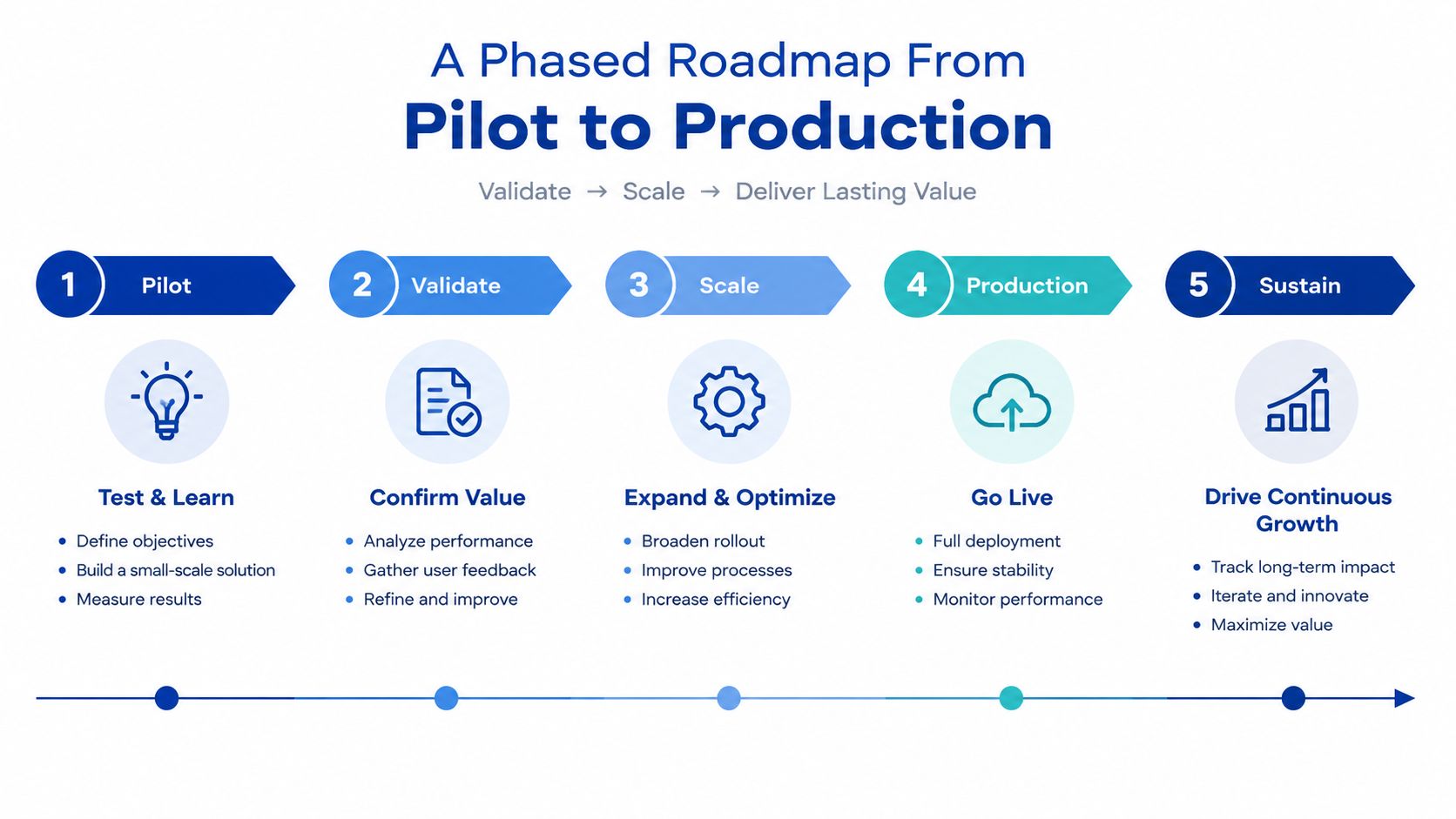
Productionise
Harden MLOps, complete model-risk review under OSFI expectations, connect the output to existing APIs and operational queues, and document fallback behaviour. Allow ten weeks for deployment controls, independent validation, security review, incident runbooks, and production sign-off.
Scale
Add feature reuse, expand to a second use case such as claims triage, and submit an application to the AI Compute Access Fund if the organisation qualifies. Scaling should follow evidence from the first deployment, not enthusiasm for adding more models.
Use a technology roadmap template to record dependencies, owners, decision gates, and funding assumptions. Before the planning meeting ends, confirm five items:
Data contracts: Named owners, schemas, quality rules, and change notifications.
Model register: Purpose, risk classification, version, validation status, and retirement trigger.
Incident runbooks: Model outage, drift, data-quality failure, security event, and rollback procedures.
Cost attribution: Compute, storage, monitoring, support, and governance mapped to the use case.
Executive sign-off: A sponsor who owns the business outcome and accepts the operating model.
Cleffex Digital Ltd provides custom FinTech software development, banking API integration, secure financial platform architecture, and AI-enabled workflow engineering for Canadian teams. Visit Cleffex Digital Ltd to discuss a production-focused infrastructure plan that connects data, compliance, payment integrations, and model operations.