

Canadian healthcare is no longer treating digital delivery as an experiment. Statistics Canada now tracks digital health use as a formal health-system indicator across the country, including whether providers send and receive patient clinical information electronically, and whether they trust the safe storage and appropriate use of that information. For HealthTech platform engineering, that changes the brief. The job isn't to ship another app; it's to build the shared rails that let clinical teams, product teams, and compliance teams move data safely, predictably, and at scale.
What HealthTech Platform Engineering Actually Means
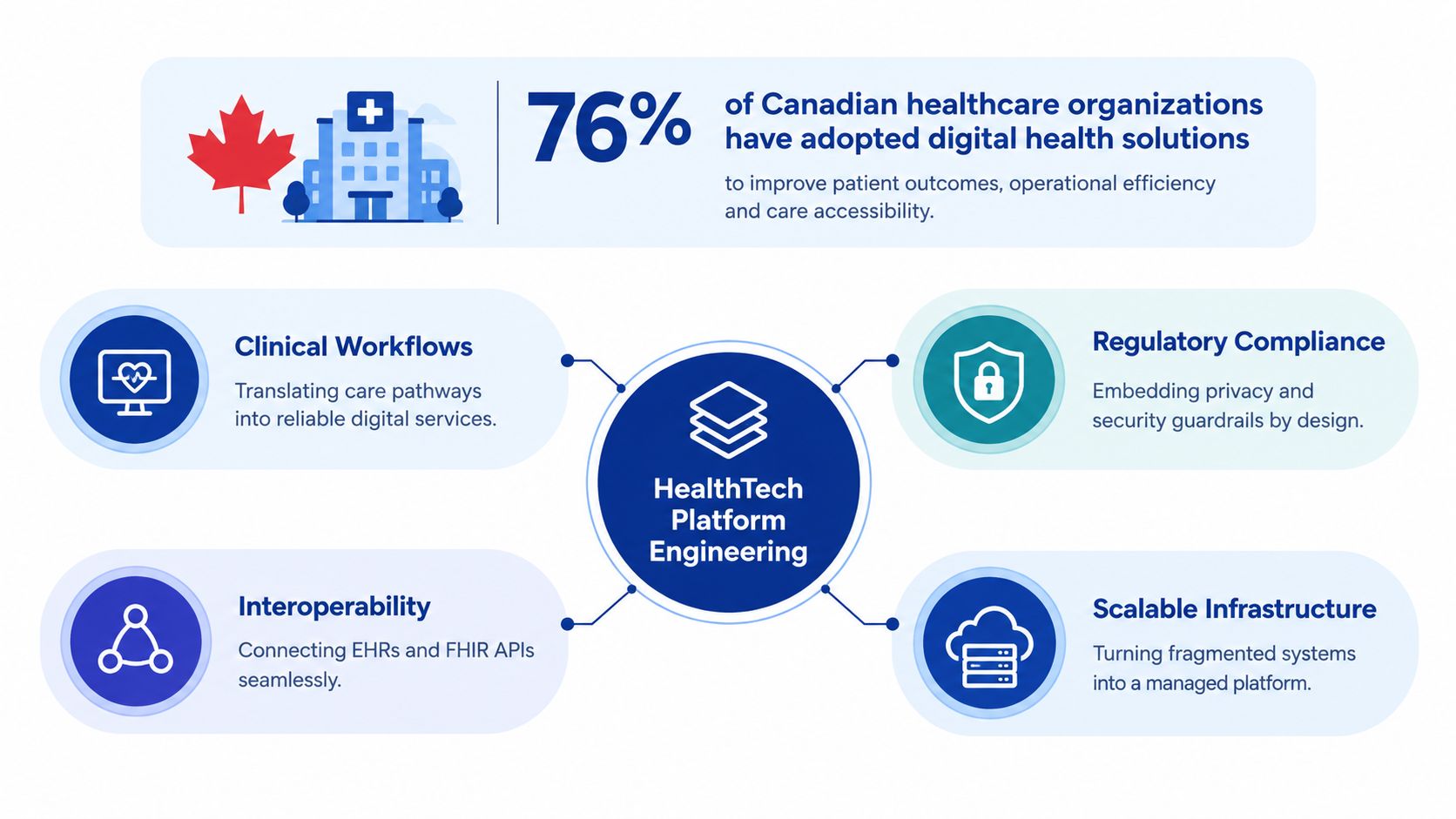
Canadian digital care has already crossed the point where “digital” is just a front-end label. During COVID-19, virtual primary care visits in Canada jumped from 4% to 60% at the onset of the pandemic, a 15-fold increase. That kind of jump doesn't just create demand for more screens. It creates demand for healthcare software architecture that can handle patient identity, clinical workflows, referral routing, records exchange, and operational oversight without falling apart the moment usage grows.
HealthTech platform engineering is the discipline of turning that complexity into reusable software infrastructure. Instead of each product team building its own login flow, audit trail, data mapper, and integration logic, the platform team creates shared services that everyone can use. The result is a managed internal platform with golden paths, secure defaults, and operational guarantees.
From one-off projects to paved roads
Traditional healthcare software delivery often behaves like a series of isolated projects. One team builds a clinic intake form, another builds a referral tool, and a third adds remote monitoring. Each team solves the same hard problems again, which creates duplicated security work, inconsistent consent handling, and brittle integrations.
Platform thinking changes that. The platform team builds the paved road, meaning the approved path for shipping safely. Product teams still own the user experience and care workflow, but they inherit shared identity, logging, data exchange, and deployment patterns instead of reinventing them.
Practical rule: If a healthcare feature handles identity, patient data, or clinical messaging more than once, it probably belongs in the platform layer.
Why the internal platform layer matters
A general software team can often get away with quick custom fixes. A healthcare platform can't. Canada's health system now treats digital reliability, interoperability, and provider confidence in secure electronic information handling as measurable system capabilities. That means platform engineering has to cover more than speed. It has to make unsafe shortcuts hard to take.
The useful mental model is this. Product teams ship features. Platform teams reduce the cost of shipping features safely. In healthcare, that also means reducing clinician burden, because every brittle workflow eventually lands back on a nurse, coordinator, or physician who just wants the system to work.
Why Enterprise-Readiness Is Now the Baseline
Enterprise-readiness in Canadian healthtech used to be a premium selling point. Now it's the entry fee. Interoperability is moving from preference to obligation, privacy expectations are tightening, and the operational cost of fragile point solutions keeps showing up in audits, support queues, and delayed integrations.
The clearest signal is policy. The federal Connected Care push and the proposed Connected Care for Canadians Act are steering platforms towards secure, interoperable exchange, while privacy regulators are pushing organisations away from fax and unencrypted email and towards encrypted email, secure patient portals, electronic referrals, and electronic prescribing. For engineering teams, that means transport, identity, consent, and audit logging can't be afterthoughts.
What buyers now expect
Hospital procurement, insurer review, and public-sector vendor assessment all tend to ask the same questions in different words. Can this system integrate cleanly? Can it prove who accessed what? Can it survive an incident? Can we trust it with regulated data? Those questions map to platform mechanics, not marketing language.
A helpful external reference for teams dealing with regulated document exchange is HIPAA-compliant document sharing, because it shows how privacy-aware sharing patterns translate into practical controls. The broader lesson applies in Canada too. Enterprise-readiness is really the combination of security, interoperability, and evidence that your platform can absorb real operational load.
| Baseline enterprise-readiness pressures in Canadian healthtech | Typical Engineering Implication |
|---|---|
| Interoperability mandates | Build shared APIs, standardised data contracts, and durable integration layers |
| Privacy and security scrutiny | Add audit logging, access controls, and encryption by default |
| Fragile legacy workflows | Support migration paths, not just greenfield redesign |
| Cross-organisation exchange | Design for identity, consent, and transport policies as platform services |
Why skipping the foundations gets expensive
Teams that postpone these basics usually pay later in rewrites and stalled rollouts. A point solution may satisfy a single workflow, but once a hospital wants the same data in another system, the hidden integration debt appears. If the platform doesn't already support standard exchange, traceability, and clear responsibility boundaries, every new customer becomes a custom implementation.
Enterprise-readiness is therefore a risk and velocity decision. The more repeatable your controls are, the faster your product teams can ship. The more ad hoc your controls are, the slower every release becomes.
Architecture and Platform Patterns That Hold Up
A healthcare platform needs more than a stack of services. It needs layers that solve different problems, because mixing data handling, exchange logic, and controls is what makes platforms brittle. The most durable healthcare platform development work separates those responsibilities so each layer can change without forcing a rewrite in the others.
Data architecture with boundaries
The first design choice is where protected health information lives and who can reach it. PHI segregation keeps regulated data apart from non-sensitive operational data, which limits the blast radius when a service misbehaves. De-identification pipelines then let analytics and product testing run without exposing patient identity. A lakehouse pattern can support operational reporting and curated clinical datasets, but only if access rules and data quality checks are enforced at the same layer.
A master patient index often becomes the quietest critical service in the platform. If patient identities do not reconcile across systems, routing, matching, and reporting all become unreliable. The practical goal is consistency before convenience, so downstream services can trust the record they receive.
Interoperability and semantic alignment
Canada's pan-Canadian interoperability work is anchored in the Canadian Core Data for Interoperability, CACDI, which defines standard health data elements and value sets so systems can exchange information through a shared semantic model rather than bespoke mappings. That matters because the platform should reduce integration debt, not create a fresh translation layer for every customer.
At the implementation level, teams usually support a mix of HL7 v2 ingestion for legacy feeds and FHIR R4 APIs for modern exchange. Terminology services matter too, because clinical meaning sits in codes as much as in payloads. Systems often need support for SNOMED CT and LOINC, plus alignment with IHE profiles where a specific exchange pattern is already established. For a fuller treatment of enterprise platform requirements, see enterprise healthtech platform development.
Security and compliance as runtime features
Security is runtime design, not a policy document.
Zero-trust networking: Limits which services can talk to each other, then verify that policy at the network boundary.
Workload identity: Replaces static service credentials with identities tied to the running workload.
Secrets management: Keeps keys and tokens out of code, local files, and ad hoc configuration.
Tenant isolation: Enforces separation in data, network, and identity layers, not only in the UI.
Compliance follows from the same structure. Audit logging, consent management, and break-glass access should produce verifiable immutable trails. If a clinician overrides a restriction, the system needs to record who did it, what changed, when it happened, and why. That is a compliance control, and it is also the record that lets operations trust the platform when something goes wrong.
The architecture should make the safe path the easiest path. If developers have to fight the platform to stay compliant, the platform has already failed.
Team and Operating Models for Healthcare Platforms
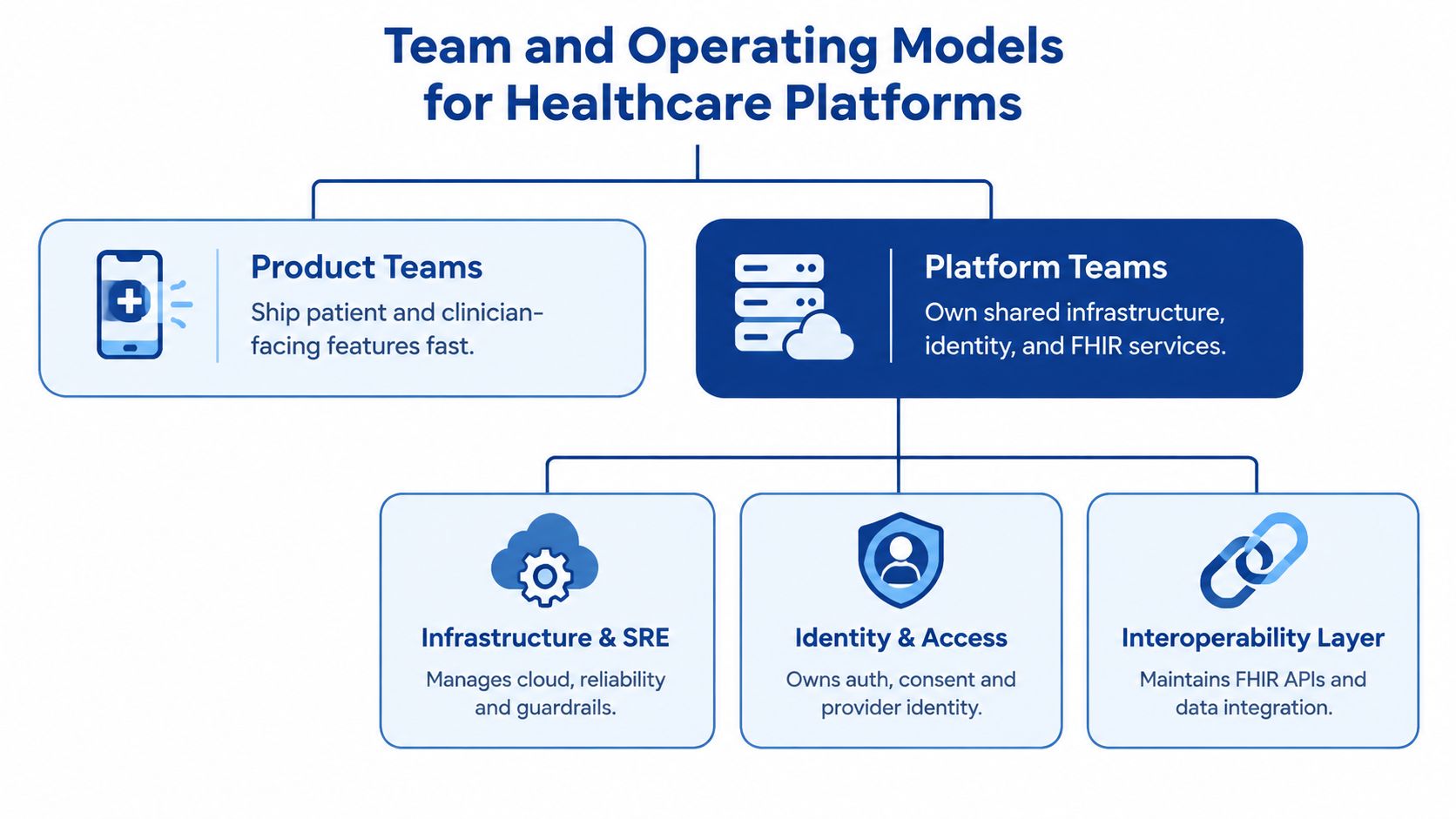
The cleanest healthcare organisations split responsibility by type of work, not by organisational politics. Product teams own patient-facing or clinician-facing features. Platform teams own the shared infrastructure, identity services, FHIR pipelines, deployment patterns, and guardrails that other teams reuse. That split keeps every squad from rebuilding the same governance logic.
The most practical model uses three layers of ownership. Stream-aligned teams move close to the clinical workflow. An enabling platform team provides shared services. A compliance or governance function sets rules, reviews exceptions, and validates that the platform's controls work in production.
Who owns what
Product teams should own feature behaviour and data contracts for the workflows they ship. If a clinic team designs a patient intake process, that team owns the clinical logic, event sequencing, and the downstream data shape. The platform team owns the shared authentication, FHIR services, and deployment scaffolding the workflow depends on.
Infrastructure and SRE sit underneath the platform team and manage cloud reliability, service limits, and operational guardrails. Identity and access should own provider identity, patient access, and consent flows. The interoperability layer should maintain the integrations, canonical mappings, and API policies that let systems talk to one another consistently.
Where clinical and security specialists fit
Clinical informatics doesn't belong as a rubber stamp at the end. It belongs near the workflow design, where staff can point out mismatches between system logic and actual care practice. Security engineering should help define trust boundaries, service authentication, and incident playbooks before code goes live. SRE should help teams define availability expectations and recovery routines, so support isn't improvising under pressure.
If you're comparing implementation partners, Cleffex Digital Ltd provides healthcare software integration work for North American healthtech teams, including HL7 FHIR integration, DICOM-aware connectivity, and regulated platform delivery. That sort of support matters when internal teams need help turning governance into working services rather than slide decks.
Choosing your software development team structure is worth reading if your organisation is still deciding where product ownership ends, and platform ownership begins.
Use Cases Across Insurers, Clinics, and Startups
A healthcare platform looks different depending on who's using it, but the engineering logic stays recognisable. The main difference is scale, not principle. An insurer needs data intake and authorisation workflows. A clinic needs system-to-system continuity. A startup needs enough platform discipline to launch without hiring an oversized internal ops function.
An insurer rebuilding shared services
An insurer usually starts with claims ingestion, prior-authorisation APIs, and member portals. The pressure here is volume plus traceability. If claims arrive from multiple partners, the platform has to normalise them, preserve the source context, and surface status changes in a way members and care teams can understand.
A shared platform pays off. Instead of each line of business building its own document routing and authorisation logic, the insurer can centralise identity, audit, and exchange patterns. That reduces duplication and makes new workflows easier to add without rewriting the compliance layer each time.
A clinic connecting the EHR to remote care
A clinic's pain is different. Staff need patient intake to connect with the EHR, not sit beside it, and remote monitoring data has to arrive in a format clinicians can trust. HL7 and FHIR interoperability become day-to-day concerns, because the workflow breaks if scheduling, intake, observations, and chart updates don't move together.
This is also where design has to respect clinician time. If the platform adds manual reconciliation work, the “integration” becomes a new admin burden. The better path is to map local workflow steps to shared services, so clinicians keep their existing rhythm, while the platform handles routing and record exchange in the background.
A startup trying to stay lean
A startup launching virtual care needs the smallest viable platform that still respects Canadian privacy expectations. That usually means managed cloud services, a thin internal developer platform, and very disciplined defaults around identity, logging, and data retention. The goal isn't to build a huge platform team on day one; it's to avoid creating a product that can't survive enterprise conversations later.
For teams dealing with regulated digital signatures and workflow approvals, Closer Innovation Labs Corp.'s healthcare eSign is a relevant example of how a focused workflow tool can sit inside a larger platform strategy. The important part is still the same, though. The platform has to support secure exchange, clear ownership, and auditability from the start.
| Platform Priorities by Organisation Type | Top Platform Priorities | Compliance Focus | Team Model |
|---|---|---|---|
| Insurer | Claims intake, shared authorisation services, member portals | Audit trails, access controls, secure exchange | Strong platform team with governance support |
| Clinic | EHR integration, remote monitoring, clinician workflows | Consent, identity, traceability | Product teams backed by interoperability specialists |
| Startup | Managed cloud, lean internal platform, rapid deployment | Privacy-by-design, secure defaults | Small product team with light platform support |
Implementation and Migration Roadmap
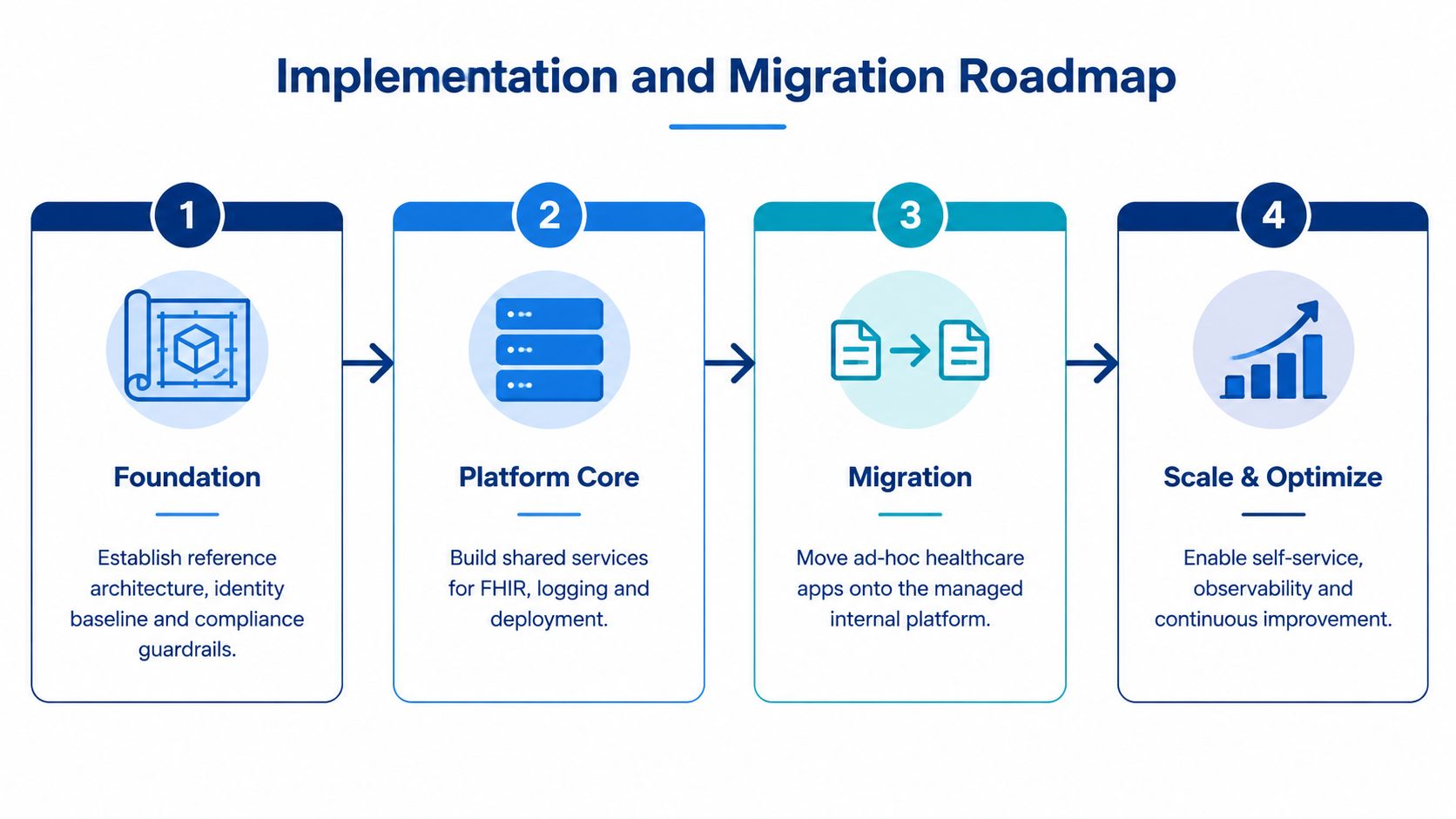
A platform migration works best when it starts with control points, not with flashy new features. The first move is to define a reference architecture that everyone can see and challenge. That should include identity, logging, environments, data handling rules, and the boundary between regulated and non-regulated services.
A staged path that avoids chaos
Stage one establishes the baseline. Teams agree on the architecture, define identity rules, and put compliance guardrails in writing and in code. Stage two adds shared services such as an FHIR gateway, secrets management, and CI/CD templates so new work can move through approved paths.
Stage three moves the first product team onto the platform. That team should be close enough to the core workflow to surface real integration pain, but small enough that the platform can still adapt. Stage four broadens coverage, adds service-level objectives, and retires brittle legacy systems once the new path proves stable.
Migration rule: Don't migrate everything at once. Move one real workflow, prove the controls, then codify the pattern.
What to validate at each step
Change management matters as much as code. Clinician feedback should be gathered early, because a technically clean migration can still fail if it slows down care. Data migration needs validation against source systems, especially where records span multiple clinical contexts or vendors.
The internal links between the platform and old systems are often where migrations break. A practical guide on modernising this layer is healthcare platform modernisation, because it focuses on the sequencing and control points rather than just the end state.
The most useful migration question isn't “Can we move fast?” It's “Can we keep moving after the first product ships?” If the answer depends on heroic effort, the platform still isn't ready.
Metrics and ROI for Enterprise-Ready HealthTech
A healthcare platform should be judged on more than uptime. The right metrics show whether engineering decisions are making delivery safer and faster at the same time. That means separating platform health metrics from business impact metrics, then connecting both to compliance and clinical workflow outcomes.
What to measure on the platform side
Useful platform metrics include deployment frequency, mean time to recover, API p95 latency, and schema migration success rate. Those numbers tell you whether the platform is easy to change and resilient when something goes wrong. They also show whether shared services are helping teams ship or slowing them down.
Compliance metrics belong in the same dashboard, not a separate shelf. Audit pass rates and PHI access review completion are safety controls, but they also show whether the platform's guardrails are working. If those reviews are consistently incomplete, the organisation is carrying hidden operational risk.
What to measure on the business side
Business metrics should connect to care delivery and product adoption. That includes time-to-market for new care programmes, claims adjudication cycle time, clinician minutes saved per encounter, and patient portal activation. Those are the numbers that make ROI visible to leadership without hiding the engineering work underneath them.
A good North Star is value shipped per quarter per regulated workflow. That metric forces teams to ask whether the platform is helping them deliver approved work faster. It also discourages vanity reporting around traffic or raw feature counts, which don't tell you much in regulated environments.
| Platform Metric | Business Outcome | Typical ROI Signal |
|---|---|---|
| Deployment frequency | Faster release cycles | New workflows reach users sooner |
| Mean time to recover | Lower operational disruption | Fewer prolonged service incidents |
| API p95 latency | Better integration performance | Smoother clinician and member experience |
| Schema migration success rate | Safer platform change | Less rework and fewer failed releases |
| Audit pass rates | Lower compliance risk | Stronger vendor and procurement confidence |
| PHI access review completion | Better access governance | Reduced exposure and cleaner audits |
The strongest ROI story links three things: revenue enablement, risk reduction, and clinician experience. If the platform helps a care programme launch sooner, reduces audit friction, and removes manual work from staff, leadership can justify continued investment. That's the language enterprise buyers understand.
Cleffex Digital Ltd helps healthcare teams design secure software architecture, connect EHRs and FHIR-based systems, and build platforms that can stand up to enterprise review. If you're planning healthcare software integration or a broader platform modernisation effort, visit Cleffex Digital Ltd to see how their team approaches regulated product delivery in practice.