


Canada's embedded finance market is already moving from niche experimentation to core platform strategy. One estimate puts it at US$4.69 billion in 2024 and projects US$9.48 billion by 2029. Another 2024 estimate is more aggressive, at US$4.28 billion with a US$13.01 billion by 2029 forecast. The gap reflects different modelling assumptions, but both point in the same direction: software teams in Canada need to treat financial features as part of product architecture, not a side experiment.
Why Embedded Finance Development Matters Now
Embedded finance is no longer just a checkout feature or a payment button. It is a distribution model shift, where financial services become native functions inside software products, not separate destinations customers have to leave to use. That shift is visible across payments, lending, and insurance, and it is why platform teams now treat embedded finance development as product strategy, not just integration work.
The market signal is already strong
Canada's market estimates show how quickly the category is maturing, but the operational clue is even stronger. Businesses that own a customer workflow can also own the financial moment inside that workflow, which is where banks used to capture value by default. SaaS platforms, marketplaces, and vertical software vendors now build financial features into the places where invoices are issued, jobs are assigned, claims are filed, or inventory is reconciled.
Practical rule: if the customer already trusts your platform for a daily workflow, the financial layer should feel like part of that workflow, not a redirect to a separate banking product.
That creates the moat. Once users depend on your platform for cash flow visibility, payment completion, or credit access, switching becomes painful because the financial logic is tied to their operations. The platform also gets a better shot at margin capture, because it can earn from the financial layer rather than only from software access.
Timing matters because the stack is finally usable
This timing is different from earlier waves of fintech outsourcing. Mature partner infrastructure, clearer supervision, and customer habits shaped by smooth digital experiences have shortened what used to be long build cycles. The practical result is that teams no longer need to choose between “be a software company” and “be a financial product company”; they can be both if the architecture is disciplined.
| Embedded Finance Market Growth Drivers | Impact on Development Teams |
|---|---|
| Platform-led commerce | Requires financial features to sit inside existing workflows |
| Customer expectations for smooth checkout and payouts | Pushes teams towards embedded payments and instant fund movement |
| Regulatory scrutiny | Forces compliance into the architecture, not the launch checklist |
| Partner infrastructure maturity | Reduces time to launch, but increases dependency management |
| Cross-sell opportunities across lending, insurance, and treasury | Encourages modular product design from the start |
A useful internal reference point for engineering teams is Cleffex's fintech API development roadmap for CTOs, which fits well with the fact that APIs alone do not solve the problem. They only work when product, compliance, and operations are designed together.
Designing a Modular Embedded Finance Architecture
The most reliable embedded finance builds are modular from the start. A production-grade stack usually needs separate services for payment orchestration, identity and KYC, double-entry ledgering, compliance event logging, and product modules for lending or insurance. If those layers are fused into one codebase, every regulatory change becomes a rebuild, and every partner swap turns into a migration project.
Build the rails as services, not as shortcuts
The first architectural rule is simple: keep the money movement layer separate from the customer experience layer. An API gateway can abstract the underlying BaaS provider, card processor, or sponsor bank so the business logic doesn't depend on one vendor's interface. That gives teams freedom to replace one partner without rewriting the entire product.
The second rule is to maintain an immutable audit trail. Regulatory exams are easier when every state change, approval, reversal, and fund movement is logged in a way that cannot be edited after the fact. That's not just an accounting preference; it's a control surface for disputes, compliance reviews, and partner trust.
Design for geography, not just features
Canada adds a data and jurisdiction problem that many teams underestimate. Transaction data may need to live in a defined region, and some records will need controlled replication patterns if the platform expands across provinces or into other markets. Quebec can introduce different privacy and consent expectations than Ontario, and expansion into the US adds another layer of complexity, so the stack has to be flexible enough to handle different data and disclosure rules.
The architecture that survives launch is the one that can absorb a new rule without breaking the ledger.
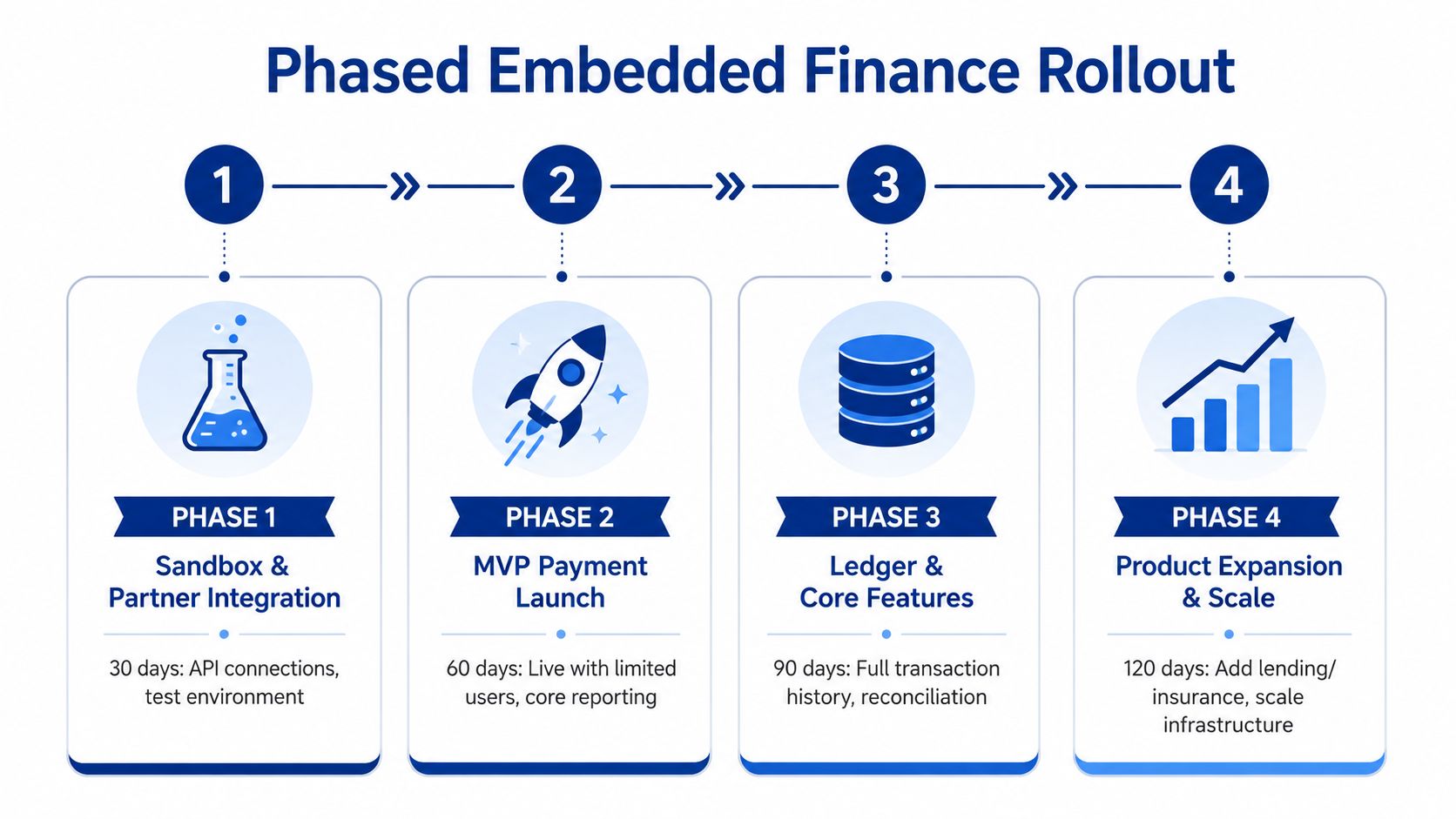
A phased launch often works best. Start with payments, add wallet functionality once the ledger and compliance hooks are stable, then layer lending or insurance behind the same orchestration layer. That sequence lets product teams prove demand without rebuilding the foundation every time a new module goes live.
For teams comparing delivery patterns, Cleffex's fintech software development partner guide is a sensible companion read because it frames implementation as an operating model, not just a technical stack.
Choosing Between Building and Partnering for Financial Rails
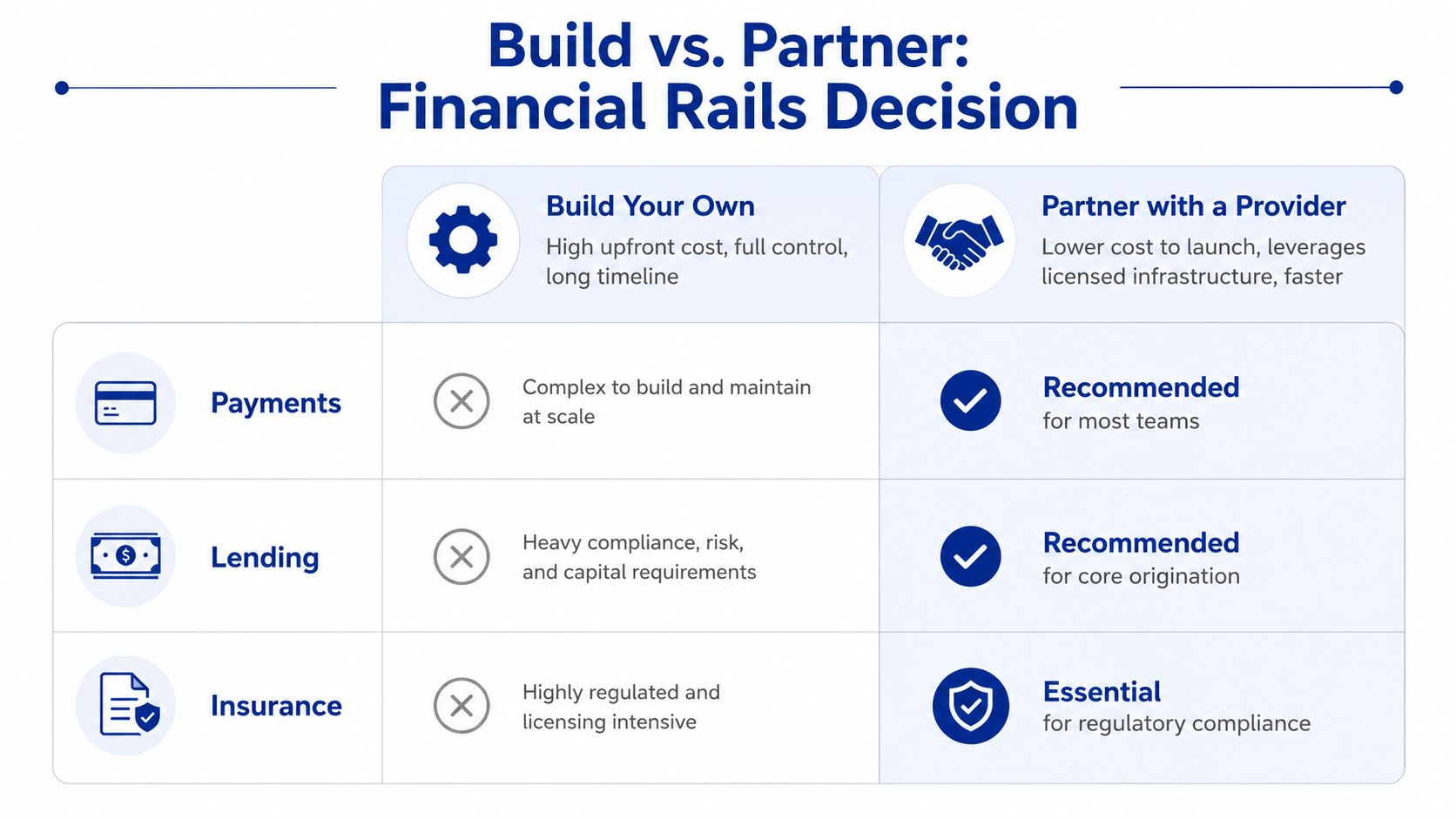
The build-versus-partner decision changes by product type. Payments, lending, and insurance don't carry the same licensing burden, the same pace of delivery, or the same tolerance for operational mistakes. Teams that treat them as interchangeable usually overbuild in one place and underprepare in another.
Payments usually favour partnership first
Embedded payments should begin with a licensed processor or banking partner. Direct bank relationships and card network certifications add serious operational burden, and the compliance work can stretch delivery far beyond the product team's ideal timetable. The trade-off is obvious: partnering reduces control over margin and customisation, but it gets a compliant payment path into production sooner.
Lending and insurance raise the bar further
Lending is more complicated because regulated lending often requires provincial permissions, and that makes one national launch less straightforward than many product teams expect. White-label lending-as-a-service can be a practical entry point when the platform wants to test demand before building a proprietary underwriting engine. Insurance is even more sensitive, since embedded insurance generally depends on licensed brokers or MGAs and tends to be managed under provincial administration.
A good external reference on issuer-bank dependency is BroLabel's card issuer bank overview, which is useful context when teams are evaluating how much regulated infrastructure they want to own.
Use clear decision criteria
The best choice usually comes down to a small set of questions:
Time-to-market pressure: If launch speed matters more than deep customisation, partner.
Compliance capability: If you do not have experienced regulatory ops, don't pretend the gap is temporary.
Capital requirements: If licensing and oversight add too much fixed cost, partnership is the safer path.
Margin strategy: If financial products are central to your long-term economics, build the orchestration layer even if you partner for regulated rails.
A hybrid approach often works best. Teams partner for the regulated rails and build the customer experience, decisioning logic, and orchestration layer themselves. That keeps the product differentiated without forcing the company to own every supervised function on day one.
Navigating the Regulatory Stack Before Writing Code
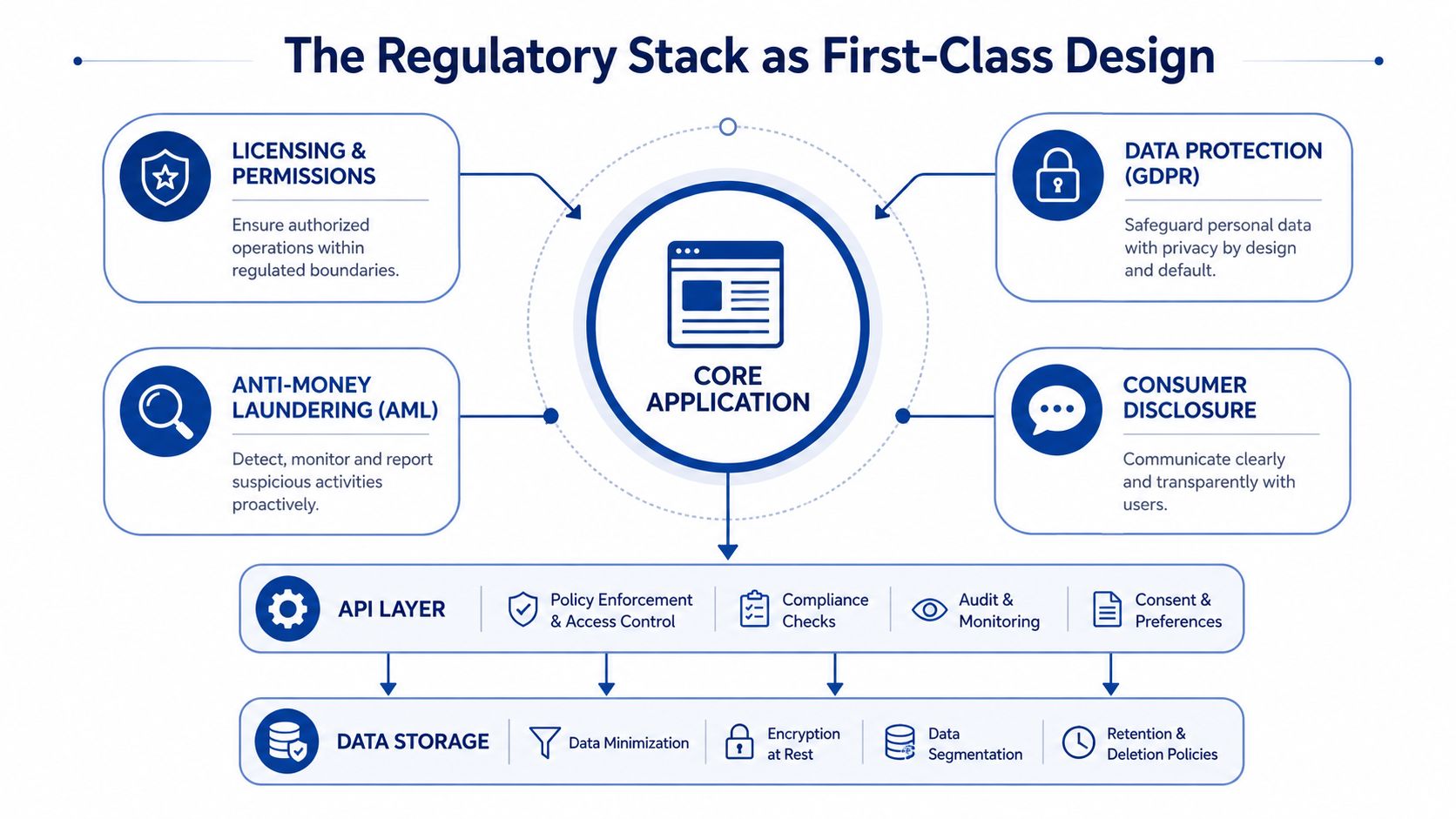
Most embedded finance failures aren't caused by weak APIs. They happen because compliance was added after the architecture was already set, which forces teams to retrofit controls into systems that were never designed for them. In Canada, the regulatory stack is large enough that it needs to be mapped before the first sprint starts.
Map the rules to the system
The Retail Payment Activities Act creates a federal supervision model for payment service providers, and the operational risk and safeguarding obligations came into force on September 8, 2025. Under that regime, payment flows need registration awareness, safeguarding logic, and reporting capabilities built into the product, not bolted on later.
FINTRAC obligations also matter when money services activities are involved, which means the same embedded flow can trigger multiple supervisory tracks at once. Provincial lending and insurance rules add another layer, and bank-partner arrangements bring their own oversight expectations. Canadian guidance also points out that fintech payments firms may need to account for AML, privacy, and consumer rules beyond payments supervision, which is why a single “fintech API” mindset is too narrow for production systems.
Turn compliance into technical requirements
A clean way to design is to translate each regulatory area into a system capability.
Licensing and permissions become partner approval workflows, legal entity checks, and province-specific product gating.
AML requirements become transaction monitoring, escalation states, and evidence retention.
Privacy obligations become data segregation, consent records, and access controls.
Consumer disclosure becomes versioned disclosure rendering, receipt generation, and immutable snapshots.
Audit requirements become tamper-evident logs and reconciliation reports.
Multi-jurisdiction design gets real when a team wants to serve Quebec alongside other provinces; consent handling and data storage choices may need to differ from the default build. That's a technical problem as much as a legal one.
Practical rule: if legal cannot explain the licence boundary in a few sentences, engineering should not code the flow yet.
Phased Implementation Sequence for Embedded Finance Products
Embedded finance programs fail most often at the seams, not the launch announcement. Reconciliation breaks when ledger events and sponsor-bank records arrive in different orders, idempotency gaps turn retries into duplicate postings, and settlement timing mismatches create balances that look correct in one system and wrong in another. Incremental rollout with explicit control gates is the pattern that survives production.
Start with a compliance-ready core
The first release should prove that the platform can record every movement cleanly, support KYC or KYB checks, and keep a ledger that finance and operations teams can reconcile without hand edits. That control plane matters because it exposes mismatches before customer funds are involved. It also gives the sponsor bank, processor, or other partner a clear view of how the system treats each transaction state.
Add orchestration, then product layers
Once the core is stable, the next layer is orchestration, routing, retries, and error handling that behave consistently across sandbox and production. Feature flags help here, because they let teams expose one payment path or wallet flow while keeping the rest sealed off. If the retry logic is not idempotent, the same request can post twice under load. That is the kind of defect that passes a demo and fails in live traffic.
Keep the rollout narrow at first
A narrow production scope gives operations teams room to watch settlement behaviour, notice breaks in record matching, and confirm that reporting closes on time. The question is not whether to move carefully; it is whether the release controls can detect failure before customers do.
The recurring failure modes are predictable. Teams underbuild incident response, so technical outages do not map cleanly to notification duties or partner escalation paths. They also miss settlement cutoffs, especially when funds move across systems with different processing windows. Those timing gaps create disputes even when the business logic looks correct.
Canadian and North American launches add another layer, because province-level variation, partner oversight, and privacy obligations can all change the operational path. Incremental rollout with explicit control gates is the only approach that keeps those differences visible while the product expands.
Where Real ROI Emerges in Canadian Embedded Finance
Consumer wallets and flashy card launches get attention, but Canadian embedded finance usually pays back in quieter places. B2B workflows, treasury operations, and back-office payment flows create more dependable returns because friction there directly affects working capital and operating costs. The practical gain is not novelty. It is removing delay where businesses already lose time and money.
The highest-value use cases are operational
Embedded lending at the invoice point of use can reduce working-capital strain for SMB platforms. Embedded treasury management helps franchise networks and multi-entity operators keep cash in the right places without manual transfers. Real-time payment initiation can also cut reconciliation work for marketplace operators, because funds move closer to the transaction moment.
The rail choice matters. Open banking read and write access, the Real-Time Rail, and stablecoin-enabled settlement each change speed, data visibility, and control in different ways. The product decision should follow the workflow, because ROI shows up where money movement is tied to operational throughput. For a practical view of how account access and payment connectivity fit into that design, see Canada's open banking guide.
| Embedded Finance ROI by Use Case | Primary Rail | Revenue Driver | Break-Even Consideration |
|---|---|---|---|
| Invoice-linked lending | Open banking data and payment rails | Interest, origination, or platform fee | Needs enough repeat borrowing to justify compliance and underwriting effort |
| Marketplace payouts | Real-time payment initiation | Service fees and operational efficiency | Works best when payout volume is steady and reconciliation costs are visible |
| Treasury management | Account connectivity and payment orchestration | Retention and higher platform stickiness | Stronger fit when the platform manages multiple entities or locations |
| Embedded insurance | Partner-led policy issuance | Referral or distribution margin | Requires enough transaction context to make the offer relevant |
The stronger return often sits in workflows that already carry operational pain. B2B payments, treasury movement, and reconciliation-heavy flows can justify embedded finance sooner than consumer-facing features, because the savings are easier to measure and the speed gains change how the business runs. The test is whether partner fees, compliance work, and support overhead still leave room for margin. If a use case only works at very large scale, it is a weak first module.
Testing and Rolling Out Your Embedded Finance Platform
Launch failures in embedded finance usually hide in the seams. Code can pass unit tests and still fail when settlement timing shifts, retry logic duplicates a payment, or partner APIs return partial success in production. The testing strategy has to reflect that reality, not just the happy path.
Test money movement like a systems problem
Sandbox validation is the first layer, but it isn't enough by itself. Synthetic transaction generation helps confirm that the ledger balances under different states, reversals, and partial failures. Chaos testing is also worth doing on the payment rail, because the platform needs to know how it behaves during network partitions and partner timeouts.
A launch-ready team also runs compliance dry runs before go-live. FINTRAC reporting paths should be exercised, data flow should be checked against privacy obligations, and any provincial disclosure language should be validated in the exact customer journey where it appears. That's the difference between a demo and a release.
Roll out by geography and by feature
A narrow launch reduces confusion when something breaks. Start with one province, keep transaction volumes limited with feature flags, and use shadow-mode processing to compare your records with the sponsor bank's records before moving to full traffic. That gives operations, legal, and engineering a shared view of what is happening in the system.
The last thing teams need is a vague incident plan. If a payment queue stalls or a partner outage blocks settlement, the response playbook should say who triages, who informs the partner, who checks regulatory obligations, and who owns customer communications. That clarity matters more than a polished roadmap slide.
Cleffex Digital Ltd works on embedded finance projects across embedded payments, lending, insurance, and payouts, with implementation support that can include architecture scoping, API integration, and compliance-aware delivery planning. If you're building a financial product into a software platform and need a practical partner to shape the stack, visit Cleffex Digital Ltd and review how the team approaches compliant product development in Canada and beyond.