

You're running a claims operation that was designed for another era. A storm hits, adjusters open cases in a core system that processes work in batches, underwriters wait for rules buried in old code, and brokers re-enter the same customer information across multiple portals. Customers experience delays. Finance sees avoidable leakage. Technology teams spend their time keeping yesterday's architecture alive.
That's the starting point for InsurTech modernisation in Canada. It isn't a cosmetic digital refresh or a race to replace every platform at once. It's the controlled separation of workloads, data, and business rules so an insurer can modernise claims, underwriting, billing, and customer service without putting regulated operations at unnecessary risk.
Canadian insurers have already moved beyond digital experimentation. In 2022, 75.1% of enterprises in finance and insurance had adopted at least one advanced technology, compared with 62.1% across all Canadian enterprises, according to Statistics Canada's enterprise technology survey. The question now is more demanding: which modernisation choices improve operating performance, customer experience, and control?
The Insurance Stack Most Carriers Are Still Running
A Canadian property and casualty carrier can have a modern website and still operate an antiquated insurance stack underneath. Claims may run on a mainframe originally implemented in the 1990s. Nightly batch jobs move reserve, payment, and policy data between systems, delaying settlement decisions for days. Underwriting rules sit inside COBOL, so a product or pricing change requires months of analysis, testing, and release coordination.
The broker experience exposes the problem quickly. To issue one auto policy, a broker may rekey customer and vehicle data across three separate portals because the policy administration system, rating engine, and document service don't share a reliable transaction layer. Each manual hand-off creates another opportunity for a typo, a coverage mismatch, or premium leakage.
Practical rule: If employees must copy data between systems to complete a routine policy or claim, the insurer has an integration problem, not a training problem.
The cost of leaving the estate untouched
The financial impact appears in places executives often treat as separate issues:
Renewals suffer when brokers and policyholders wait for answers that competitors can provide faster.
Reporting becomes fragile when regulatory submissions depend on manual extracts and reconciliation.
Engineering capacity disappears into patches for code that few people fully understand.
Claims queues expand during storm seasons because the core cannot scale with demand.
Finance teams reconcile manually between policy administration records, payment systems, and general ledgers.
Canadian broker modernisation was already widespread but uneven by 2016. Adoption of nine key technologies rose 12 percentage points year over year to 69%, while mobile-optimised websites increased from 39% in 2015 to 53% in 2016, and eDocs use rose from 52% to 70%, according to Insurance Canada's reporting on brokerage technology adoption. Yet 11% of brokerages still had no website, which illustrates the market reality: progress can coexist with serious capability gaps.
Stop treating the stack as one block
Insurtech modernisation starts by identifying workloads rather than labelling the entire estate “legacy”. Claims intake, policy servicing, billing, document generation, underwriting decisioning, and customer identity may have different risk profiles and release needs.
That distinction creates a safer path. An insurer can modernise first-notice-of-loss intake, expose policy data through APIs, or introduce a new workflow service while the system of record continues to handle regulated transactions. The legacy core remains, but its footprint shrinks as modern services take responsibility for discrete workloads.
What Insurtech Modernisation Actually Means
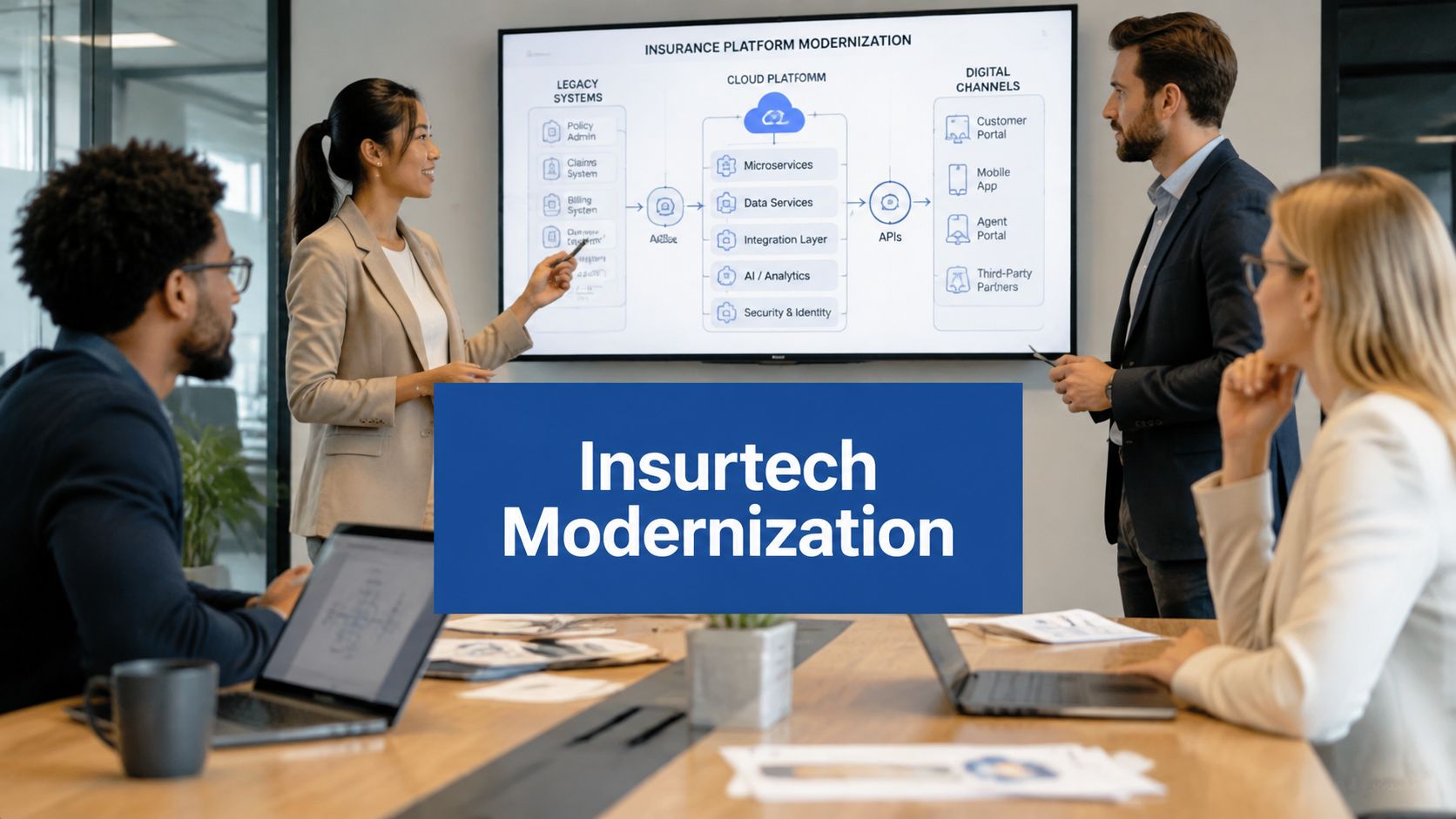
InsurTech modernisation means replacing, rewiring, or repackaging legacy insurance systems into modular components that can evolve independently. It can involve a new cloud service, an API façade around an existing system, a microservice for claims routing, or a redesigned data platform. The architecture matters, but the operating model matters just as much.
A mobile app connected to an unchanged mainframe isn't modernisation by itself. It may improve the front door while leaving policy changes, claims adjudication, billing, and customer data trapped behind the same slow processes. Real insurance software modernisation reaches the policy administration core, billing engine, claims platform, and underlying data layer.
Four reasons the old stack survives
Regulatory and financial logic has accumulated over decades: Insurance systems often contain reserve calculations, product rules, reporting transformations, and exception handling that evolved through repeated regulatory and business changes. Removing a component without understanding those dependencies can change financial outcomes or create reporting exposure.
The integration network is wider than the core: Broker management systems, managing general agents, payment providers, healthcare networks, repair networks, salvage vendors, and document services may all depend on established interfaces. The visible application is only one part of the operating chain.
Specialist knowledge is concentrated: Senior staff may understand why a particular batch job runs in a particular sequence, even when the rationale isn't documented. Replacing the platform without capturing that knowledge creates a parity risk.
Consolidation creates inherited complexity: Canadian insurers often operate multiple generations of systems because platforms were built or acquired across different eras. KPMG's analysis of legacy systems in insurance identifies this inherited complexity as a central reason staged modernisation is more practical than a full rip-and-replace.
Modernisation is an operating model
The target isn't a single “modern platform”. It's a set of clear domain boundaries, reliable APIs, portable workloads, and accountable product teams. Product, engineering, actuarial, claims, and compliance specialists need to work from shared service-level objectives, not hand off requirements through a long project chain.
Canadian insurers are already using a hybrid pattern. Stable core systems retain regulated or high-risk workloads, while cloud AI supports suitable non-sensitive use cases.
Why Legacy Insurance Systems Are So Hard to Replace
Legacy insurance systems persist because they contain business value as well as technical debt. A policy administration platform may be difficult to change, but it also carries years of tested behaviour. A replacement project must preserve that behaviour while introducing a different data model, integration pattern, release process, and control framework.
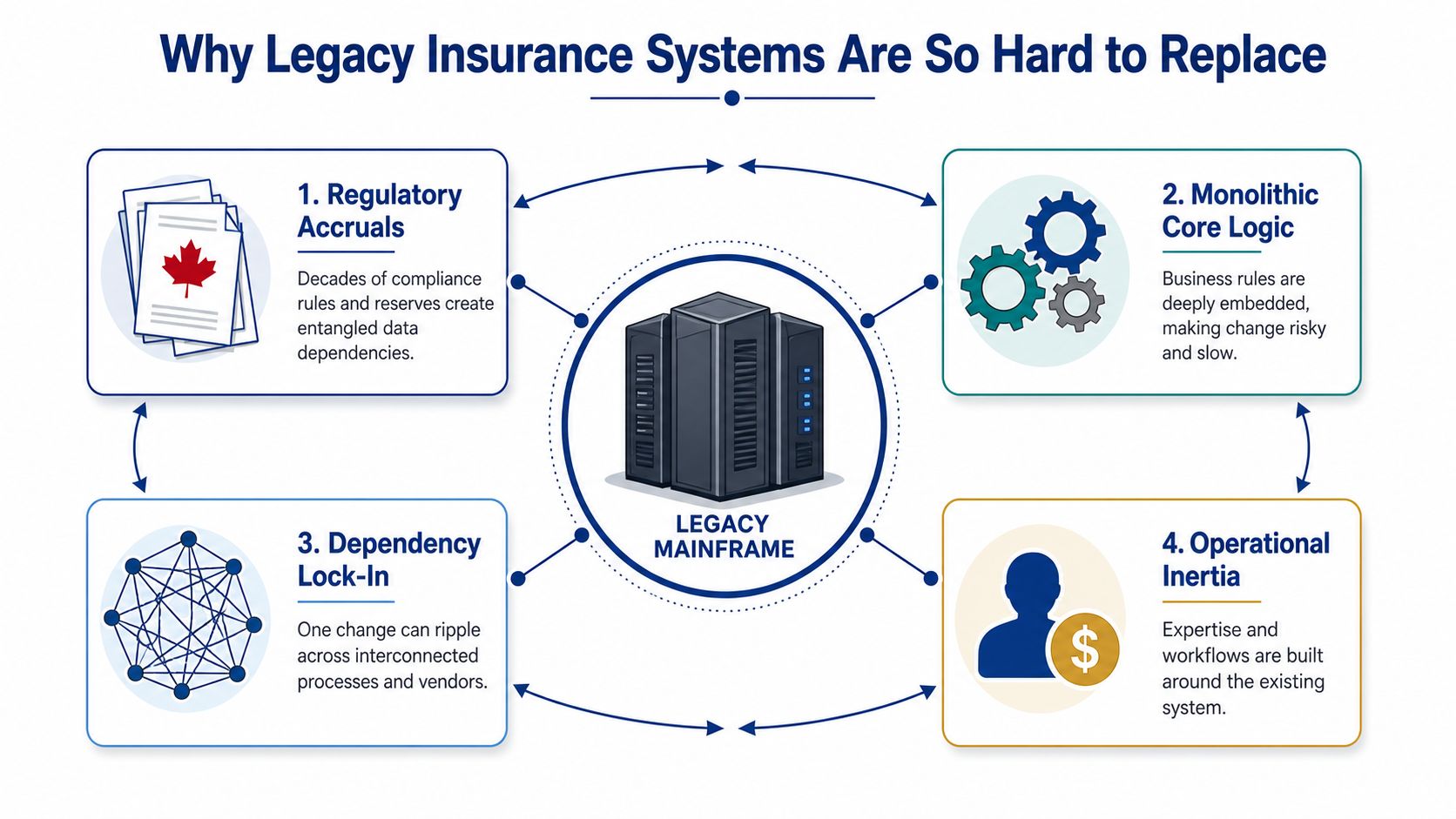
Four structural barriers
The first barrier is regulatory accrual. Rules for reserves, reporting, product treatment, and customer communications are rarely stored in one neat specification. They're distributed across database structures, application logic, operational procedures, and downstream reports. A replacement must prove that critical outputs remain correct.
The second is integration density. A change to policy status can affect billing, claims eligibility, broker notifications, finance posting, and renewal processing. The insurer isn't migrating an application in isolation. It's changing a network of commercial commitments.
The third is knowledge concentration. Mainframe developers, legacy-language specialists, and database administrators often hold practical knowledge that never reached formal documentation. A modernisation programme that ignores this human dependency will discover gaps during testing or production support.
The fourth is consolidation. Acquisitions leave carriers with systems that were never designed to share data or processes. The result is an aggregate estate, not a single legacy platform. That's why a workload-by-workload approach generally creates better control than a multi-year replacement programme that attempts to solve every inherited inconsistency simultaneously.
The customer and operating gap
The sector's digital maturity doesn't automatically translate into customer delight. Canadian insurers improved their Net Promoter Score from -12 in 2022 to -5, according to Ipsos findings reported by Insurance Business Canada. That movement is positive, but it doesn't justify treating a new front end as proof that transformation is complete.
For a CFO, the practical question is whether modernisation reduces rework, improves premium collection, shortens claims handling, and allows each underwriter or adjuster to handle more valuable work. Digital maturity is useful only when it changes those operating outcomes.
A modern interface cannot compensate for a slow decision engine, fragmented data, or a claims process that still depends on overnight batches.
The Business Case for Insurance Software Modernisation
The business case shouldn't begin with a promise of lower technology spend. Legacy platforms can be inexpensive to run in isolation, but expensive to change, integrate, test, secure, and staff. The stronger argument is higher operating capacity, faster product response, better control, and a customer experience that brokers and policyholders can trust.
Canadian market data supports that interpretation. In finance and insurance, AI use is concentrated in data analytics at 41%, speech or voice recognition at 35%, and machine learning at 31%. The most common organisational changes include workflow redesign at 40%, staff training for AI at 39%, and purchasing cloud services or storage at 26%, as reported by Insurance Business Canada.
Those figures point to a straightforward conclusion. Insurers won't capture value from models that sit outside daily operations. Analytics must reach underwriting workbenches, claims queues, broker submissions, and service processes.
Build the case around operating outcomes
A credible investment case should connect architecture to measures finance already understands:
Loss-ratio improvement: Better data and underwriting support can help teams identify risk earlier and apply rules more consistently.
Expense-ratio compression: Workflow automation reduces manual handling, duplicate entry, and avoidable reconciliation.
Time to quote: API-connected data and reusable decision services reduce waiting between submission, enrichment, rating, and referral.
Straight-through processing: Clean eligibility rules and reliable integration allow suitable transactions to move without unnecessary human intervention.
Premium leakage control: Reconciled policy, billing, and finance data makes discrepancies easier to detect and resolve.
Claims cycle time: Digital-first notice of loss, document extraction, and triage can route straightforward cases away from congested manual queues.
Do not invent a baseline or target before measuring the current process. Establish the volume, hand-offs, exception rate, cycle time, and cost of each workload, then model the value of changing it.
A CFO view of the operating model
| Metric | Legacy Stack (Baseline) | Modernised Stack (Target) |
|---|---|---|
| Quote turnaround | Dependent on batch processing and manual rekeying | Connected data enrichment and near-real-time decision routing |
| Claims handling | Queue-based work with repeated hand-offs | Event-driven triage and visible exception management |
| Product change | Coupled releases across core modules | Domain services with controlled, independent releases |
| Data quality | Reconciliation after transactions move | Shared definitions, validation, and traceable events |
| Engineering capacity | Maintenance-heavy and specialist-dependent | Product delivery supported by platform engineering |
| Customer experience | Delayed answers and inconsistent channels | Consistent servicing across broker, web, and contact centre |
The investment boosts revenue capacity when underwriters spend less time gathering data and more time assessing complex risk. It also gives the organisation a defensible experience advantage over direct-to-consumer entrants without pretending that human distribution has become irrelevant. Canadian individual life insurance new annualised premium reached a record $2.3 billion in 2025, according to LIMRA reporting cited by Insurance Business Canada. Technology investment is coinciding with growth, not merely replacing human advice.
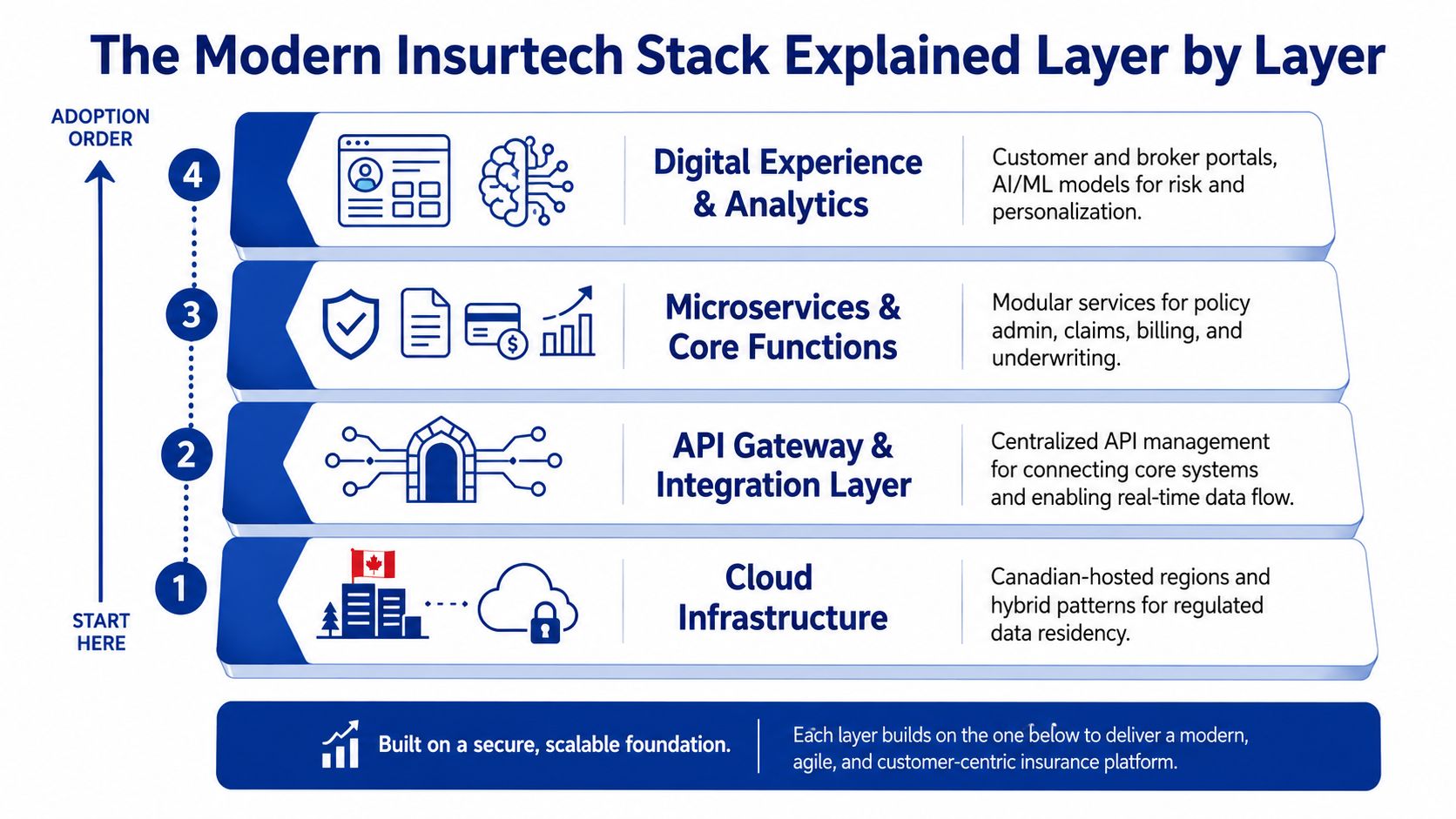
The Modern Insurtech Stack Explained Layer by Layer
A modern stack should be adopted in layers, with each layer creating a dependable foundation for the next. Start with control and connectivity. Add modular business services once data can move safely. Scale AI only after the insurer can govern the data, decisions, and exceptions it produces.
Establish the foundation
Cloud infrastructure provides the operating base, but Canadian insurers shouldn't treat cloud as automatic permission to move every workload. Use Canadian-hosted regions where required by policy or risk appetite, classify data before migration, and retain a hybrid pattern for sensitive personally identifiable information or tightly controlled core transactions.
The foundation also needs identity and access management, secrets management, encryption, audit logging, vulnerability management, and recovery controls. These aren't add-ons. They're evidence that the insurer can explain who accessed data, what changed, and how the service will recover.
Make integration explicit
An API gateway should govern how brokers, MGAs, portals, and internal services access core capabilities. Event streaming can publish policy, payment, and claim events without forcing every consumer to connect directly to a database.
Many modernisation programmes either gain control or recreate the old mess in a new environment. Define ownership, version interfaces, monitor failed messages, and document data contracts. For practical patterns, review this guide to insurtech integration.
Modularise core functions
Policy administration, billing, claims, and underwriting don't need to become microservices on the same day. Extract the workload that creates the clearest operational value, then place it behind a stable interface. A claims triage service may be a better first candidate than a complete policy replacement because it can improve routing while preserving the authoritative record.
Add data and experience
A lakehouse or governed analytical platform can support claims analytics, fraud detection, underwriting models, and a usable customer view. Master data management should resolve identity and policy relationships, not just collect more records.
The experience layer includes broker portals, adjuster tools, mobile-first customer journeys, and service automation. Apply consent, transparency, and accessibility requirements to each channel. B.C.’s market conduct framework emphasises clear customer treatment, while the B.C. Financial Services Authority's insurer code applies to authorised insurers that adopted compliance requirements by 1 April 2024.
A Practical Roadmap for Insurance Digital Transformation
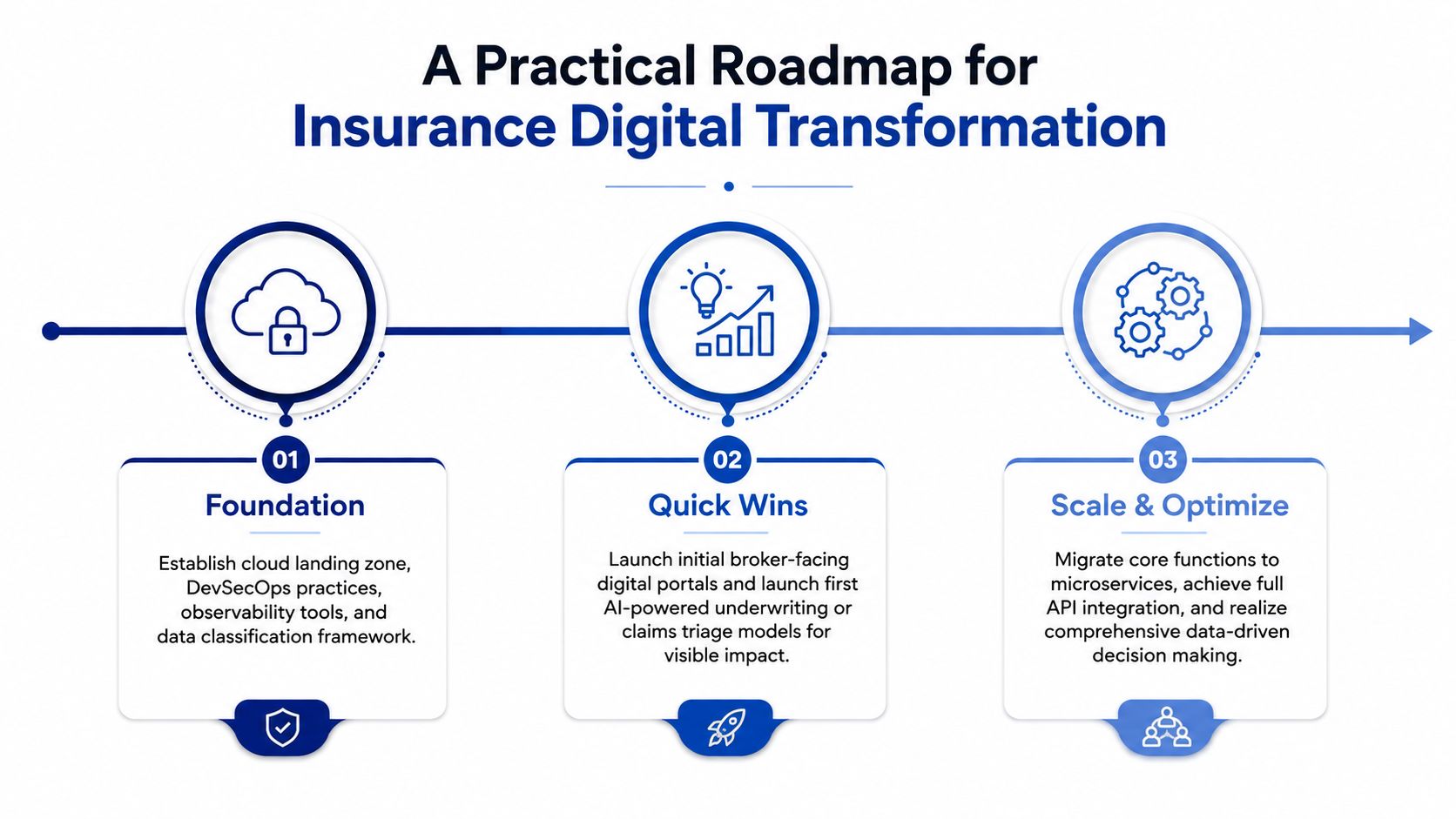
The safest roadmap is organised around outcomes, not a giant replacement date. Each phase should have a duration estimate, a dependency that must be satisfied, and a kill-criterion that forces the team to reset when evidence turns negative. Avoid false precision in the business case, but don't accept a programme with no measurable gates.
Foundation outcome
The foundation phase establishes a cloud landing zone, DevSecOps controls, observability, data classification, access policies, and recovery design. It may run for several months, depending on the estate and regulatory review requirements. The next phase is gated by usable environment controls, a reliable inventory of workloads, and an agreed privacy impact assessment approach.
Reset the plan if the team cannot identify data owners, cannot trace a critical transaction, or treats security review as a final approval step. No portal or AI pilot will compensate for that weakness.
Quick wins with visible value
Prioritise workloads that reduce friction without changing the most sensitive policy logic. Suitable candidates include a broker portal rebuild, digital-first notice of loss, document automation, or contact-centre IVR replacement. A claims intake service can also support early triage if human review remains accountable for significant decisions.
These initiatives should demonstrate that the organisation can release safely, monitor service quality, manage broker-channel change, and complete privacy reviews. If the first release needs repeated manual reconciliation or creates unexplained data differences, stop and repair the integration design before adding scope.
Platform rebuild and AI scale
Once the interfaces and controls work, modernise policy, billing, and claims services in carefully selected slices. Use a strangler-fig migration, where new services take over defined capabilities while the mainframe continues to run what hasn't been replaced.
Only then scale underwriting models, fraud detection, document intelligence, and service assistants. The federal privacy direction is becoming operationally demanding. Proposed rules would require privacy management programmes, breach reporting where a breach creates a real risk of significant harm, and explanations for automated decisions with legal or similarly significant effects, as described by Insurance Business Canada's legal analysis.
For architectural planning, this enterprise application modernisation strategy provides a useful decision framework.
Choosing a Partner and Managing the Risks
Build, buy, and augment suit different workloads. Choose according to the capability being modernised, the control the insurer must retain, and the evidence required for Canadian privacy and regulatory oversight.
| Dimension | Build In-House | Buy Vendor Product | Augment with Cleffex |
|---|---|---|---|
| Workload fit | Best for distinctive capabilities and proprietary rules | Best for standardised functions with a mature market | Best when the insurer needs specialist capacity around its own architecture |
| Control | High control, with internal delivery responsibility | Product roadmap and configuration constraints | Shared delivery with insurer ownership of decisions and outcomes |
| Regulatory exposure | Internal team carries design and assurance work | Vendor controls may reduce effort, but require validation | Added engineering capacity can work within insurer governance and controls |
| Speed | Limited by internal skills and competing priorities | Faster where integration is straightforward | Faster access to custom development, cloud, AI, and team extension capability |
| Exit options | Internal knowledge remains available, if retained | Migration away can be difficult | Contractual handover, documentation, and modular architecture should preserve options |
Buy a mature product for a well-understood commodity capability, provided its integrations, audit trails, privacy controls, and Canadian operating requirements are clear. Build internally when the function differentiates the insurer and the team can support it beyond launch. Augment when internal leaders own the architecture and decisions but need specialist capacity to run parallel workstreams.
That last model often fits carriers modernising several workloads at once. External specialists can support cloud foundations, integration, custom development, AI engineering, and platform delivery, while the insurer retains accountability for customer outcomes, broker processes, data handling, and regulatory evidence.
Cleffex Digital Ltd offers custom software development, cloud services, AI engineering, and team augmentation for incremental insurance platform modernisation. Treat it as one option in the augment category and apply the same procurement standard used for every partner. Use this procurement checklist for finding an insurance IT development partner to structure the review.
Score the partner before signing
Require evidence in five areas:
Domain depth: Can the team explain policy, billing, claims, underwriting, and broker workflows without relying on generic technology language?
Canadian compliance experience: Can it support privacy impact assessments, auditability, provincial expectations, and documented handling of personal information?
IP ownership: Who owns interfaces, code, documentation, models, and deployment assets?
Delivery transparency: Will the insurer see the backlog, architecture decisions, test results, risks, and incidents?
Exit quality: Does the contract require documentation, knowledge transfer, source access where appropriate, and transition support?
Manage risk through both architecture and contract terms. Define interface ownership and portability requirements before implementation to limit vendor lock-in. Require reconciliation and parity testing for migrated workloads. Set outcome gates that stop scope growth when controls or service results fall short. Record compliance decisions, approvals, and exceptions so accountability does not disappear between the insurer and its suppliers.
Use paired delivery and planned knowledge transfer to reduce dependence on individual contractors. Confirm who responds to incidents, who owns recovery decisions, and how the partner supports broker and customer communications when a release affects service.
During the first 90 days, establish baselines for cycle times, manual hand-offs, data defects, failed integrations, release frequency, recovery readiness, and user adoption. Governance becomes credible when executives can see operational movement, not just completed project tasks.
Frequently Asked Questions About Insurtech Modernisation
How long does modernisation take?
A claims-portal modernisation may take around nine months, while a full core replacement can take three years or more. Treat those as scope patterns, not promises. Integration count, data quality, regulatory exposure, testing depth, and the number of products determine the actual timeline.
What will it cost?
Cost follows workload scope and integration complexity more than seat licensing. A contained portal or workflow service has a different economic profile from replacing policy administration, billing, claims, and data services across several lines of business. Demand a cost model tied to capabilities, environments, migration waves, testing, support, and exit requirements.
Should we build, buy, or augment?
Buy standard capabilities when the product fits your processes and provides credible integration and control evidence. Build distinctive decisioning or experience capabilities when they create strategic differentiation. Augment when internal teams understand the business but lack the capacity or specialist engineering skills to run parallel modernisation tracks.
How do we reduce the main risks?
Map dependencies and business rules before migration. Reconcile source and target data, run critical workloads in parallel, test exception paths, involve compliance early, and define recovery objectives before production cutover. Stop a release when the team can't explain a material difference between legacy and modern behaviour.
Why use a Canadian partner?
Canadian insurers must account for federal privacy expectations, provincial privacy codes, market conduct requirements, and OSFI-related governance realities. A localised partner can design for those constraints from the beginning rather than retrofit them after an otherwise generic global implementation has already created exposure.
Cleffex Digital Ltd supports insurers with custom development, cloud architecture, AI engineering, and team augmentation for staged InsurTech modernisation. Visit Cleffex Digital Ltd to discuss the workload you should modernise first, the controls it requires, and the path to reducing dependence on your legacy core.