


Healthcare platform scalability means a system can grow from a single clinic to a province‑wide network while keeping patients safe, data secure, and integrations working reliably.
What Healthcare Platform Scalability Really Means

Scalability in healthcare works a lot like a clinic expanding from a single waiting room to dozens across a province. As patient volume, device telemetry, EHR integrations, and analytics requests climb, the platform must expand capacity without disrupting clinical workflows or compliance controls.
Ultimately, this means managing sudden peaks in concurrent clinicians and patients while keeping latency low and audit trails intact.
Key Components That Define Scalability
Core definition: A platform's ability to increase throughput, storage, and integration depth while preserving clinical safety and regulatory compliance.
Primary goal: Maintain consistent clinical outcomes and system behaviour as load, data, and integration complexity increase.
Biggest risk: A failure under load that compromises patient safety, data privacy, or interoperability.
Quick takeaway: Scalability is not just about traffic and storage; it’s about preserving clinical safety, security, and interoperability under variable load.
For a foundational understanding of how cloud environments contribute to scaling, explore Cloudvara's cloud scalability guide. This resource explains the elasticity and capacity planning principles that underpin many healthcare cloud strategies.
Why Healthcare Scaling Is Different
Healthcare introduces constraints that ordinary SaaS platforms rarely face. Regulatory frameworks like HIPAA, PHIPA, and GDPR, alongside regional data residency rules, demand much stricter data partitioning and auditability. Furthermore, clinical latency sensitivity means certain operations must stay near real-time. Even a slow prescription flow can directly impact patient care.
Practical implications:
Data partitioning by region or tenant to meet residency and legal requirements.
Strong identity and consent models to control exactly who sees protected health information (PHI).
Observability and audit logs that hold up during major scale events.
How This Guide Helps You
Architecture patterns previewed later: Microservices, multi-tenant vs single-tenant models, API gateways, and data partitioning.
Cloud strategies covered: Weighing auto-scaling, serverless, and container orchestration against strict compliance needs.
Cost and migration trade-offs: Balancing the need for high availability with FinOps discipline.
Example to visualise the stakes: A single outage at scale can disrupt thousands of appointments and draw regulator attention. The platform must scale predictably to prevent exactly this scenario.
Unique Constraints That Shape Healthcare Scaling
Scaling a healthcare platform feels a lot like running a hospital elevator. You are moving critical patients, staff, and equipment, and the system simply cannot pause during an emergency. When that elevator stops, lives and licences hang in the balance.
That reality is exactly why downtime and sluggish responses are unacceptable in clinical settings. It also explains why architectural conservatism almost always wins over risky optimisation.
Protecting protected health information (PHI) goes far beyond basic encryption. It dictates how data flows, how backups are handled, and what telemetry you can collect. Regional regulations like PHIPA, HIPAA, and GDPR layer on strict residency and consent requirements.
These rules force you to implement data partitioning and rigorous access controls. Ultimately, you have to treat legal boundaries as a core part of your capacity planning.
Then there is the tight coupling created by interoperability. Connecting with EHRs, labs, and medical devices means your platform does not operate in a vacuum. Take a lab feed integration, for instance.
You have to preserve exact timing and data fidelity, so clinicians receive results within critical clinical windows. Because of this, API reliability and version management are not optional extras; they are absolute necessities.
Clinical workflows are also incredibly latency-sensitive. A delayed medication order can have direct, severe consequences for a patient. Performance targets for these critical paths are often measured in tens to hundreds of milliseconds.
This reality pushes architects toward local caching, edge processing, and regional failover. It steers them away from centralised, high-latency services that simply cannot keep up.
Full auditability and traceability are non-negotiable in this space. Audit logs must withstand high throughput and remain queryable for years, which directly impacts your storage tiering and retention policies. Most healthcare platforms require immutable logs and tamper-evident chains to satisfy these strict demands.
The operational reality forces some cautious trade-offs. A single major outage can harm patients and trigger immediate regulatory action. This is why teams willingly accept higher costs for better isolation or redundancy.
Conservative patterns are standard practice here. Read replicas, multi-region failover, and strict circuit breakers are common because patient safety will always outweigh marginal cost savings.
Architecture Constraints That Follow
Data Partitioning Strategies: Split data by region, tenant, or sensitivity level. This isolates risk, satisfies data residency rules, and keeps query performance predictable.
Identity and Consent Models: Combine RBAC and ABAC with consent tokens to enforce exactly who sees what and when. This drastically reduces the blast radius during a breach.
Latency Mitigations: Use edge caches and asynchronous background processing for non-urgent analytics. Keep your synchronous paths minimal and highly optimised.
Checklist to Pressure-Test Your Platform Before Production
Is PHI segmented by legal region and tenant?
Can critical paths meet clinical latency SLAs under peak load?
Are audit logs immutable, searchable, and retained per regulations?
Do integrations fail safely without blocking care workflows?
Is disaster recovery tested for both data integrity and clinical continuity?
Real-World Implications and Practical Steps
Start with regulatory mapping and bake it directly into your capacity plans.
Treat integrations as first-class features, complete with rigorous contract testing.
Design your observability stack to serve both performance monitoring and compliance audits.
Learn more about practical governance and data controls in our guide on healthcare data governance.
Architecture Patterns That Scale Safely
Choosing the right architecture is about more than just technology; it’s about building a foundation that can grow without compromising patient safety or data security. Think of a microservices architecture like a modern hospital. Each department – radiology, pharmacy, billing, scheduling – operates as an independent unit with its own specialised staff and equipment. Yet, they all connect to a central system for patient records and hospital-wide security, ensuring everything is tracked and auditable.
This approach lets each service evolve at its own pace. The pharmacy can update its inventory system without disrupting the radiology department’s imaging software. Meanwhile, a central identity and audit layer acts as the hospital's security desk, enforcing policies and maintaining a clear record of who accessed what, when.
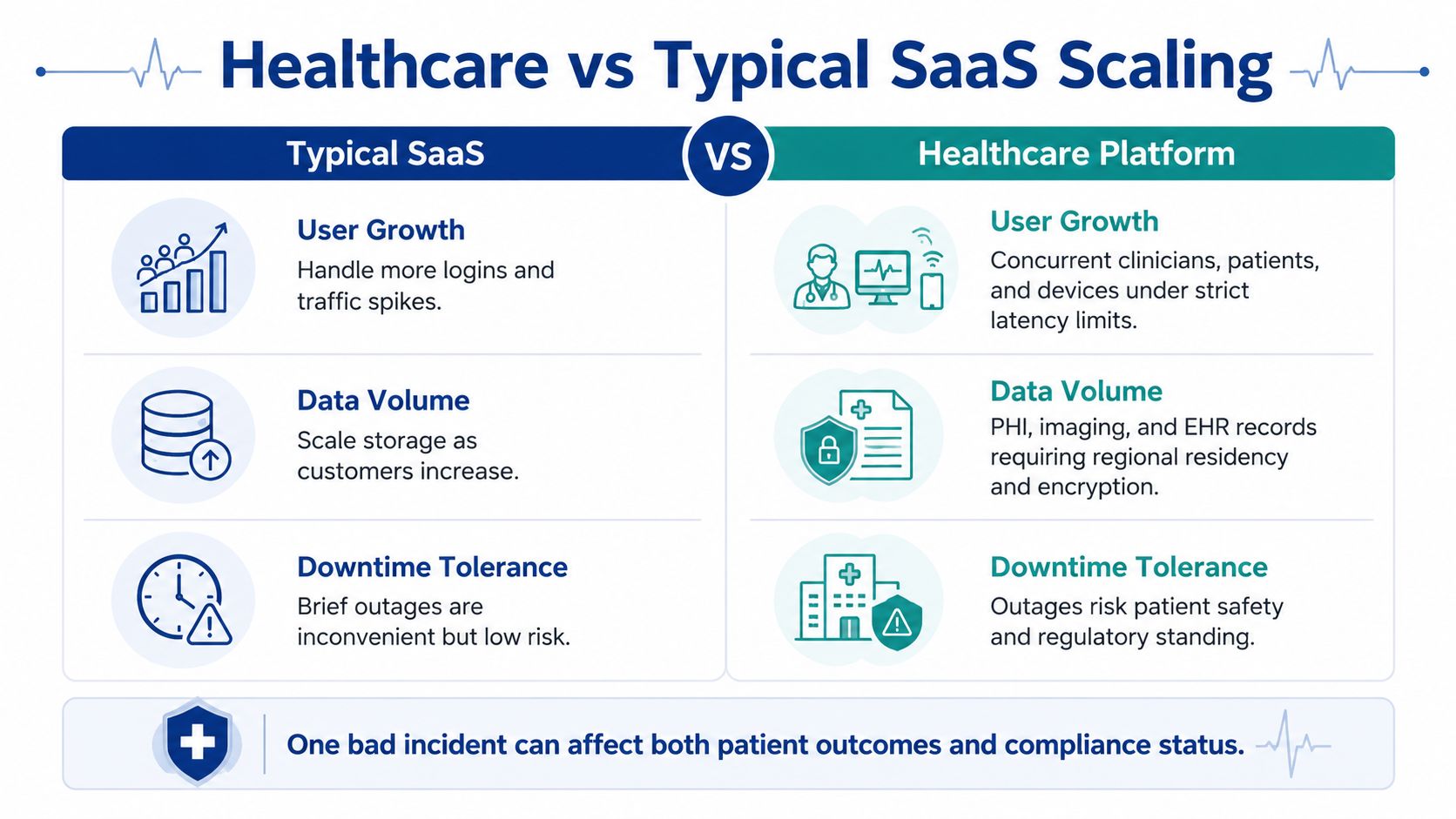
As this visual makes clear, scaling in healthcare isn't just about handling more users like in typical SaaS. It's a delicate balance between managing concurrent clinician loads, processing massive volumes of PHI and imaging files, and maintaining near-zero downtime. These unique pressures fundamentally shape your architecture and operational choices.
Microservices Versus Modular Monoliths
The two most common starting points are microservices and modular monoliths. Microservices break down your platform into small, independently deployable services. This design is fantastic for reducing the "blast radius" of a failure and allowing you to scale specific parts of your system, like an imaging ingestion service, without scaling everything else.
On the other hand, a modular monolith groups different functions into modules within a single, deployable application. It’s simpler to operate and often has lower latency between modules since they all live in the same place. For a small clinic, a modular monolith offers a lower-cost, lower-complexity solution. In contrast, a large multi-provincial hospital network will almost certainly need microservices to handle the independent scaling demands of its various departments.
Key Benefits of Microservices:
Fine-grained scaling for resource-intensive "hotspots" like imaging or analytics queues.
Independent updates, allowing clinical and financial modules to evolve on different schedules.
Simplified service-level auditing, making it easier to track and secure data flows.
Key Benefits of Modular Monoliths:
Simpler deployment and easier-to-manage transactional consistency.
Lower operational cost, especially for smaller teams without dedicated DevOps resources.
Fewer failure points associated with complex distributed systems.
Tenant Models and Compliance Trade-offs
Another critical decision is how you house your customers' data. A single-tenant model gives each client their own dedicated infrastructure, whether physical or virtual. This complete isolation dramatically simplifies proving compliance and eliminates the risk of one tenant's issues affecting another.
A multi-tenant platform is far more cost-efficient, allowing you to serve many clients from a shared infrastructure. This speeds up onboarding but demands incredibly strict logical data isolation, per-tenant encryption keys, and rock-solid audit trails to prove that no data ever crosses tenant boundaries.
The choice between the deep isolation of a single-tenant model and the cost-efficiency of a multi-tenant one is often the single most important decision you'll make. It influences nearly every other architectural choice that follows.
Making the right choice depends entirely on your specific use case, risk tolerance, and customer base.
Comparing Architecture Choices for Healthcare Platforms
This table breaks down how these different architectural patterns fit into common healthcare scenarios.
| Pattern | Best Fit | Compliance Trade-off | Scaling Strength |
|---|---|---|---|
| Modular Monolith | Single clinics, speciality practices | Easier to certify; less isolation complexity. | Moderate vertical scaling. |
| Microservices | Multi-site hospital networks, large payers | Requires robust identity and audit layers to prove isolation. | High horizontal scaling. |
| Single-Tenant Cloud | Regulated public sector providers, large health systems | Strong, provable isolation but at a higher cost per tenant. | Predictable, isolated scaling. |
| Multi-Tenant SaaS | Small clinics, networks of private practices | Needs complex tenancy controls and consent models. | Cost-efficient scaling, but requires strict logical isolation. |
Ultimately, the best pattern aligns your technical capabilities with your business needs and regulatory obligations.
Data Partitioning and API Gateways
As you scale, you can't just throw all your data into one giant database. Data partitioning: splitting data by region, tenant, or data sensitivity, is essential. This strategy helps you adhere to data residency laws (like keeping Canadian patient data within Canada) and keeps database queries fast and predictable.
To manage the traffic flowing to these different data stores and services, you need an API gateway. Think of it as the central reception desk for your entire platform. It handles all incoming requests, centralising crucial functions like authentication, rate limiting, and routing traffic to the correct downstream service. This creates a secure and organised entry point, preventing unauthorised access and ensuring smooth operation.
A great practical tip is to combine regional data partitions with a global metadata index. This allows for fast, system-wide lookups without ever moving sensitive PHI across borders, giving you the best of both worlds.
Practical Patterns for Healthcare Buyers
If you're evaluating or building a healthcare platform, here are three core principles to guide your architecture:
Start with Identity and Audit: Build these as foundational, centralised services before you start splitting features into microservices. Security can't be an afterthought.
Use Microservices for High-Variance Workloads: Isolate functions with unpredictable or heavy loads, like medical imaging or batch analytics, into their own services so they can scale independently.
Match Tenancy to Risk: Opt for single-tenant architecture for high-risk, heavily regulated workloads. Use multi-tenant models for more standardised, lower-risk clinical workflows where cost-efficiency is a priority.
By making these decisions deliberately, you set your platform up for safe, compliant growth from day one.
For a deeper dive into operational patterns and platform design, see our guide on healthcare platform engineering solutions.
Cloud Strategies, Auto-Scaling, and Cost Control

Picture a hospital heating system that detects an incoming cold snap and begins warming wings before patients arrive. Predictive rules convert weather signals into thermostat actions; reactive controls fire up extra boilers when temperature drops faster than forecast. Healthcare platforms work the same way: predictive autoscaling reads trends and signals to pre-warm capacity, while reactive autoscaling kicks in when clinical demand spikes without warning.
The right autoscaling approach depends on the workload. Serverless functions handle bursty, short-lived tasks like HL7 message transforms or FHIR validation well, since they scale to zero and perform billing based on execution. Container orchestration with Kubernetes suits long-running services such as imaging ingestion, where pod autoscaling, node pools, and taints keep latency-sensitive traffic pinned to fast nodes. Managed databases with read replicas and multi-AZ failover protect transaction-heavy paths like claims processing or medication orders.
Key Cloud Patterns That Matter
Multi-region failover with regional read/write separation helps meet data residency requirements and cuts latency for clinicians working across geographies.
API gateways centralise authentication, rate limiting, and routing so scaling out services doesn't create new attack surfaces.
Data partitioning by tenant or geography limits blast radius and keeps queries responsive as the platform grows.
Practical insight: Pairing predictive and reactive scaling reduces perceived latency and protects clinical workflows when demand swings unpredictably.
Strategies without proper tagging, monitoring, and cost allocation tend to blow through budgets fast. Solid FinOps depends on consistent resource tagging, deploy-time quota controls, and usage-aware autoscaling policies. In large healthcare deployments, AI-driven autoscaling has trimmed infrastructure spend by right-sizing instance types and shutting down idle capacity, redirecting savings toward clinical features.
Steps to implement disciplined autoscaling:
Define clinical SLAs for critical paths and map them directly to scaling policies.
Tag every resource for cost visibility and clear ownership.
Build predictive rules for known seasonal events and train models on historical traffic patterns.
Operational and Cost Controls
Monitor performance and spend with unified telemetry so you can correlate latency spikes with cost changes.
Use reserved capacity for steady-state workloads and burstable autoscaling for seasonal peaks.
Run chaos tests to verify failover and autoscaling behaviour under simulated clinical surges.
Real-world example: If you're planning a 2026 migration, take note from industry experience; many cloud projects stumble without a clear modernisation plan. To ensure your healthcare platform makes effective use of cloud resources, it helps to understand what successful cloud modernisation looks like in practice. See Software Modernisation Intelligence insights.
Quick Checklist for Buyers
Are critical clinical paths backed by regional failover and low-latency nodes?
Do autoscaling policies map to clinical SLAs rather than just CPU thresholds?
Is FinOps embedded into operations with tagging, budgets, and cost-aware deployment gates?
Scaling well comes down to the hospital-heater mentality: warming capacity before demand hits, combined with strict cost and governance practices so both performance and budgets remain under control.
Testing, Validation, and Real-World Examples
Scaling a healthcare platform only proves its worth when it holds up during the moments that matter most. Testing works like a fire drill for technology; rehearsing failures exposes weak points before any patient feels the impact. That kind of preparation makes clinical risk something you can actually see and manage.
Load testing checks whether your system can handle realistic clinical peaks. Picture a regional clinic network during a flu surge: you'd simulate that exact scenario and measure end-to-end latency across prescription, appointment, and lab result workflows. The results tell you whether critical paths meet clinical SLAs and exactly where autoscaling needs to kick in.
Chaos engineering takes things further by rehearsing actual failures. You deliberately introduce network latency, take nodes offline, or degrade database performance while watching how patient-impacting workflows respond. This confirms whether your graceful degradation strategies – circuit breakers, local caching, prioritised queues – actually work when things go sideways. The result is far less clinical disruption when real incidents hit.
Key insight
Fire-drill style rehearsals uncover operational gaps that traditional QA simply misses. Skipping those rehearsals can mean delayed care or misrouted PHI; outcomes nobody in healthcare can afford.
Test Types and Why They Matter
Load Tests
Synthetic users and replayed traffic help you find latency cliffs and throughput limits. Connect those metrics directly to patient outcomes like appointment completion time and lab turnaround.Performance Budgets
Set maximum acceptable times for critical operations; say, medication orders under 200 ms. Enforce those budgets in your CI pipeline and trigger alerts the moment regressions appear.Security and Compliance Tests
Include PHI-specific scenarios: role escalation attempts, consent revocation flows, and cross-region data access checks. Make sure audit trails stay intact even under heavy load.Chaos and Disaster Recovery Drills
Run regional failover tests, database split-brain scenarios, and API gateway failures to verify clinical continuity holds up.
Practical Validation Roadmap
Build synthetic datasets and user personas that mirror real clinical roles.
Establish baseline latency and throughput for critical paths during both normal and peak loads.
Run progressive stress tests until you find the breaking point.
Inject failures and confirm that fallback behaviours keep patient workflows intact.
Automate all of these tests in your CI/CD pipeline to catch regressions before they reach production.
Case Examples and Outcomes
Telehealth Platform Surge
A telehealth provider hit latency cliffs during a winter surge. Load testing with real call patterns uncovered an imaging ingestion bottleneck and synchronous logging that was blocking request threads. Switching to asynchronous logging and scaling the media ingestion microservice eliminated the cliff entirely. Average call setup time dropped by 60%, and visit completion rates improved noticeably.
Hospital Network Diagnostic Gains
A multi-site hospital brought lab feeds and triage workflows onto a shared platform. By implementing performance budgets and running chaos drills, the team cut end-to-end diagnostic delays by 25%. That improvement correlated with measurable drops in 30-day readmission rates for certain conditions.
Comparing Test Focuses
| Test Type | Primary Goal | Clinical Impact |
|---|---|---|
| Load Testing | Find capacity limits | Prevent appointment and prescription delays |
| Chaos Engineering | Validate failovers | Maintain care continuity under failure |
| Security Testing | Prove PHI protection at scale | Avoid breaches and regulatory penalties |
| Performance Budgets | Control regressions | Keep critical workflows within SLAs |
Practical Tips for Buyers
Map tests to clinical outcomes like readmission rates and care coordination metrics.
Ask vendors to show reproducible load and chaos test results; not just promises.
Embed testing into release gates so scalability becomes a continuous property, not a one-time checkbox.
Testing is the final safety net that turns architecture into reliable clinical service.
Migration Roadmap and Common Misconceptions
Every successful healthcare migration starts the same way: with a thorough discovery phase. Before touching a single server, map out how data moves across your sites, where integrations connect, and which regulatory requirements apply at each step. Document exactly where protected health information resides, which regional laws govern it, and which clinical workflows can't tolerate delays. This exercise ties legal risk directly to technical decisions and gives your team a clear priority framework for what moves first.
Once discovery wraps up, run a pilot using a small but representative slice of real production traffic. Synthetic patient records and replayed EHR connections let you test latency and audit trails without putting actual care at risk. The goal here is to surface problems early, before they affect clinicians or patients, and to prove your compliance controls hold up under realistic conditions.
After the pilot validates your approach, roll out in controlled waves by department or region. A phased migration keeps the blast radius small and gives your team room to learn. You'll tune autoscaling thresholds, adjust caching strategies, and refine failover behaviour without worrying about widespread clinical disruption.
Scaling to multiple sites means turning what you learned into codified practices. Write runbooks that capture pilot lessons. Define autoscaling policies tied to clinical SLAs, not just CPU spikes. Establish region-aware data partitioning and explicit tenant isolation rules. This is where ad hoc fixes become repeatable, documented processes that any engineer on the team can follow.
Moving from a small clinic to a multi-site network is like navigating from a small boat to a cruise ship. You must redesign charts, bridges, and crew roles; adding engines alone won't keep you on course.
Common Misconceptions That Derail Migrations
Buying more servers equals scaling: Throwing hardware at a performance problem might buy you time, but it doesn't fix the underlying architecture. True scalability usually means redesigning critical paths and partitioning data so no single bottleneck can take down the system.
A compliance stamp guarantees scalability: HIPAA or PHIPA attestation confirms your controls at a specific moment. It says nothing about how your platform performs when concurrency spikes or when complex integrations start competing for resources.
One architecture fits all: Multi-tenant setups save money but introduce tenancy management overhead that grows with each new customer. Single-tenant isolation simplifies certification and compliance but raises per-customer costs. The right choice depends on your specific mix of tenants, regulations, and growth plans.
Practical Checklist for Migration Ready
Complete discovery and compliance mapping with stakeholder and legal sign-off.
Define clinical SLAs and map them directly to autoscaling and failover rules.
Build a pilot that includes real integrations and synthetic load testing.
Run chaos drills and compliance tests during both pilot and rollout phases.
Create migration playbooks and implement FinOps tagging for cost visibility.
Warning Signs a Platform Is Not Ready to Scale
Critical paths lack measurable SLAs or proper observability tooling.
Audit logs become slow or unusable under moderate load.
Integration failures block care workflows instead of degrading gracefully.
Autoscaling decisions rely solely on CPU or memory metrics rather than clinical SLAs.
Questions to Ask a Software Partner Before Sign-Off
How do you map clinical SLAs to scaling policies?
Can you demonstrate region-aware data partitioning and tenant isolation?
Do you run reproducible load and chaos tests against production-like data?
How do you prove audit log immutability and retention at scale?
Learn practical steps and a playbook for healthcare cloud migrations in our guide on Healthcare Cloud Migration Practical Playbook.
Frequently Asked Questions
What makes healthcare platform scalability harder than other regulated industries?
Healthcare sits at a tricky intersection: strict regional privacy rules, clinical latency demands, and deep integrations with EHRs and medical devices all collide. Scaling here means preserving PHI residency, hitting sub-200 ms critical-path SLAs, and maintaining end-to-end auditability simultaneously. The practical fix? Lean hard on data partitioning, immutable logging, and local caching to protect safety as you grow.
How do I choose multi-tenant versus single-tenant deployment?
It really comes down to your clients' risk tolerance and compliance burden. Single-tenant makes sense when public-sector contracts or provable isolation requirements are non-negotiable; yes, it costs more, but it slashes certification headaches. For broad SMB adoption where economics matter, multi-tenant with per-tenant encryption keys and strict logical separation strikes the right balance. Match tenancy to your regulatory scope and appetite for operational complexity.
When is microservices overkill for healthcare platforms?
Microservices bring genuine operational overhead, so they're not always the answer. If you're serving single clinics or narrow clinical scopes, a modular monolith delivers predictable latency and simpler audits without the distributed systems tax. Microservices earn their keep when workloads vary wildly; think imaging alongside real-time analytics, or when independent release cycles are essential for your delivery cadence.
How do I estimate cost savings from elastic cloud infrastructure?
Start by modelling steady-state against peak usage: reserved capacity for your baseline, autoscaling for spikes. Measure historical traffic patterns; seasonal surges like flu season are your best teacher, and simulate with predictive rules. In large deployments, AI-driven autoscaling can trim waste by 20–40%. Tie those savings directly to reduced ops burden and reallocated feature budget.
Practical recommendation
Map clinical SLAs directly to scaling policies, run reproducible load and chaos tests, and let tenancy risk- not hype – drive your architecture choice.
For migration help and technical assessments, contact Cleffex Digital Ltd today.