

Most health leaders already know the pattern. A patient sees a family doctor, a specialist, and a hospital team, yet each group works from a different slice of the record. The result is familiar: duplicated tests, conflicting instructions, and staff who spend too much time chasing context instead of making decisions.
An intelligent healthcare ecosystem is the practical answer to that mess, but only when it is built as a governed system, not a collection of disconnected tools. Canada is moving in that direction through its Pan-Canadian Health Data Strategy, the related federal workstreams launched in 2023, and the $4 billion investment over 2023 to 2028 for a Canada Health Transfer supplement and bilateral agreements to improve access, digital tools, and workforce capacity (KPMG report on Canada's intelligent healthcare direction). The point is not to buy more software. The point is to make data, governance, and care coordination work across provincial systems, hospitals, clinics, and remote settings.
What Makes Healthcare Ecosystems Intelligent
A common failure in care delivery looks ordinary on the surface. A patient moves through three appointments in a week, and each clinician sees only part of the story. One note says the medication was adjusted, another says symptoms worsened, and a third sits in a different system altogether. Staff then spend time reconciling records, checking for duplication, and deciding which version of the truth to trust.
Intelligent healthcare ecosystems change that model by connecting electronic health records, connected devices, patient-reported inputs, and care coordination workflows so information is interpreted in context rather than as isolated events. The system can combine wearable data, EHR data, and patient-reported measures to support real-time personalisation, automated check-ins, alerts, and referral routing, which is the kind of joined-up flow Canada needs across primary care, hospitals, and remote monitoring. Practical deployments often depend on connected-device programs like IoT solutions for healthcare and patient care, because the ecosystem only becomes useful when device data reaches the right workflow at the right time.
From digitised records to coordinated action
Digitising charts is not the same as making care intelligent. A scanned form or a basic portal still leaves clinicians doing the hard work of interpretation. An intelligent ecosystem shifts that burden into the platform by making relevant information available at the point where a decision has to be made.
Practical rule: if the workflow still depends on someone manually re-entering data between systems, the ecosystem is not intelligent yet.
That distinction matters for governance too. If you are formalising clinical oversight, risk management frameworks for healthcare are a useful reference point because technology choices and clinical risk need to be managed together, not in separate silos. The same logic applies to connected devices. If the monitoring layer sits outside the rest of the record, alerts become noise instead of action.
The difference is in how the ecosystem behaves under pressure. A mature setup does more than collect data; it routes the right signal to the right person, with enough context to act and enough governance to know when not to act. Without that data strategy and stakeholder alignment, the tools remain fragments, and fragmentation is what intelligent healthcare is meant to fix.
The shift is toward predictive, adaptive care delivery. That does not mean every patient needs an AI model in every encounter. It means the ecosystem can surface risk earlier, coordinate across teams, and support decisions before a problem becomes a crisis.
Core Architecture and Technical Components
A hospital can buy a polished dashboard and still end up with disconnected workflows, delayed alerts, and staff who do work the platform should have handled. An intelligent healthcare ecosystem only performs well when the underlying architecture moves clean data, applies governance consistently, and gives each stakeholder the right level of context at the point of action.
The architecture usually has five layers.
Data ingestion brings in EHR feeds, wearables, lab systems, imaging platforms, and patient-reported measures.
Processing and analytics turn those inputs into signals that clinicians and operational teams can use.
Interoperability governs how data moves between systems through standards such as FHIR, HL7, and TEFCA.
Cloud and edge infrastructure determines where data is processed and how reliably it travels.
The user layer is where patients and clinicians experience the result through workflows that either reduce friction or add to it.
Why the integration layer matters more than the dashboard
Vendor demos often focus on screen design. The harder question is how the system handles handoffs between ingestion, analytics, and action. If that path is weak, clinicians still jump between tools, reconcile mismatched records, and chase down context that should already be in front of them. A strong integration layer makes the ecosystem behave like one coordinated service instead of a set of disconnected interfaces.
SMART on FHIR shows how that coordination works in practice. It combines FHIR APIs with OAuth 2.0 and OpenID Connect so applications can access EHR data through standard login and authorisation workflows (LoginRadius on SMART on FHIR). That matters in real hospital environments because clinicians rarely work in one neatly separated application. They need tools that open in context, respect permissions, and return useful output without forcing another round of manual entry.
Governance sits inside the integration layer, not beside it. If identity rules, consent logic, and data access policies are inconsistent across systems, the best interface in the world will still create risk. That is why many teams now build from a healthcare data fabric blueprint that treats data lineage, policy enforcement, and interoperability as part of the same design, not separate projects.
Edge and cloud are not opposing camps
For privacy-sensitive healthcare streams, the strongest pattern is often hybrid edge-cloud, not a fully centralised cloud model. The JISEM study found that hybrid edge-cloud pipelines delivered the lowest ingestion latency and fastest fault recovery while maintaining high throughput as data volumes grew, which is relevant for intermittent rural connectivity and for clinical streams that cannot tolerate delay (JISEM hybrid edge-cloud study).
The trade-off is straightforward. Edge processing helps when latency, connectivity, or resilience matter. Cloud centralisation can be enough when data can wait, and the workflow is less time-sensitive. The mistake is choosing an architecture because it matches a vendor preference instead of the clinical use case. In practice, the right split often depends on which decisions need to happen locally, which need enterprise visibility, and which require auditability across sites.
Data residency, observability, and failure handling also need to be designed up front. If alerts must continue during a network outage, the edge layer has to store, filter, and forward signals safely. If governance teams need a full audit trail, the cloud layer has to preserve traceability across every handoff. That is where many deployments weaken, because teams buy infrastructure before they define who owns the data, who can act on it, and what happens when systems disagree.
The weakest layer sets the ceiling for the whole system. If interoperability is poor, analytics stall. If governance is vague, adoption stalls. If the user layer is awkward, clinicians route around the platform.
Measurable Benefits Across Stakeholder Groups
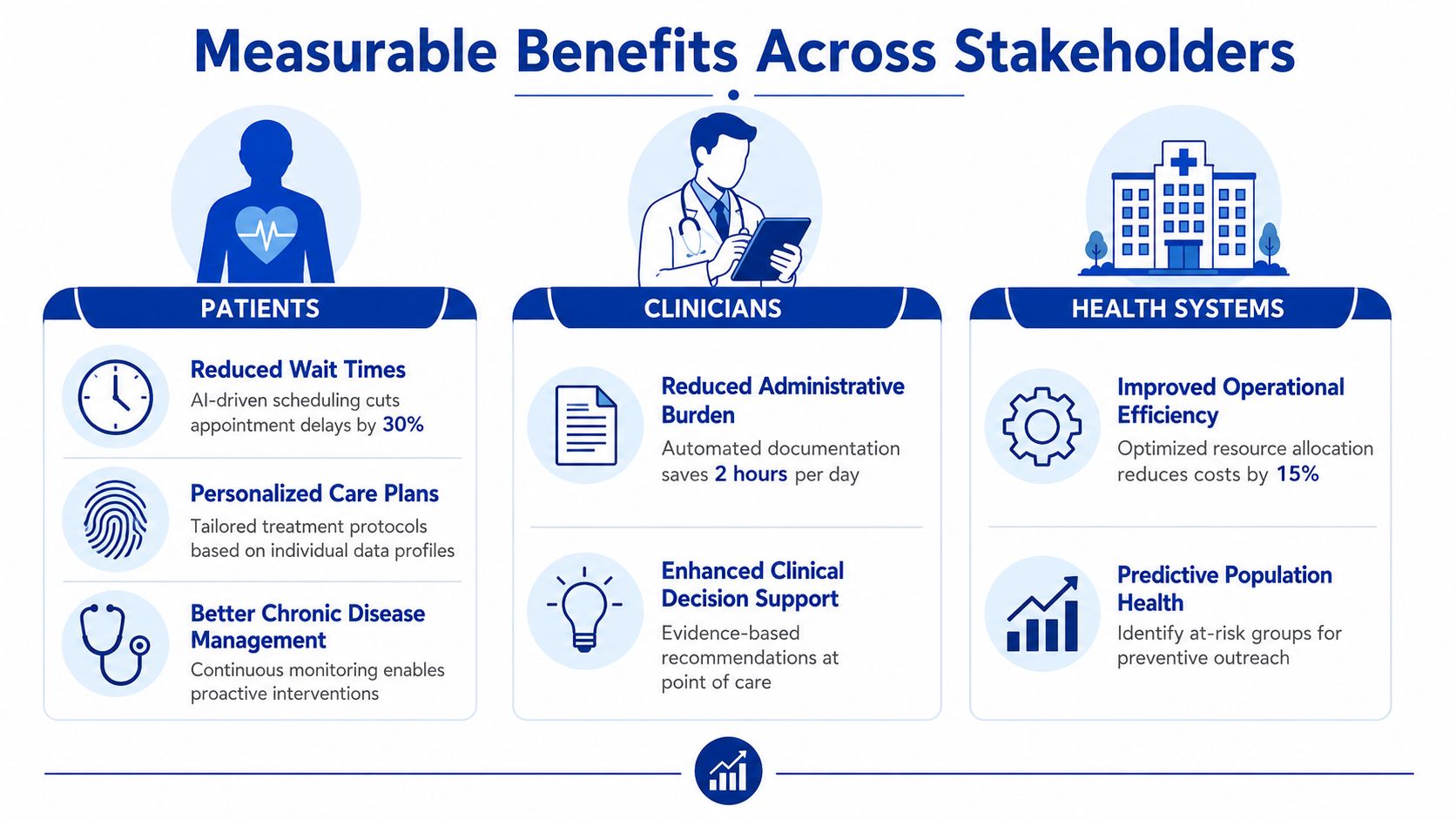
The value becomes clearer once the conversation stops being abstract and starts with the people who live with the consequences. Patients want care that is coordinated and timely. Clinicians want fewer interruptions and better context. Administrators want a system that is easier to run and govern. Payers want confidence that the data can support population insights and value-based arrangements.
Patients and clinicians
For patients, the main benefit is not a polished app. It is fewer gaps in care, more relevant follow-up, and a better chance that chronic conditions are managed before they escalate. Intelligent ecosystems matter most where monitoring continues outside the hospital, because they can combine device data, symptom reporting, and care-team routing instead of leaving each source in its own silo.
For clinicians, the benefit shows up in workflow relief. When data arrives in context, the care team spends less time hunting for notes and more time making decisions. The JMIR ecosystem model shows how continuous sensing and communications can support automated check-ins, alerts, and referral routing. That kind of support matters because it reduces the number of handoffs that break down in daily practice.
The practical test is simple. If the system adds alerts without clearing away noise, clinicians will ignore it. If it fits the way teams already triage and document care, it can reduce friction instead of adding another screen to manage.
A separate benefit is that intelligent tools can support earlier intervention when they are tied to real workflows. The strongest use cases are the ones that help staff see risk sooner, route tasks faster, and keep the record aligned across settings. For a useful overview of how these capabilities show up in care delivery, see this practical guide to AI benefits in healthcare.
Administrators and payers
Administrators usually care about operational control first. That means better coordination across departments, fewer manual handoffs, and a clearer governance model for who owns which data. In Canada, that is not just an IT question, because the publicly funded system has to coordinate across multiple provincial environments rather than a single payer platform.
Payers look at the same ecosystem through a different lens. They want population-level visibility, support for value-based care, and stronger detection of avoidable spend. The hard truth is that those goals depend on data quality and trust. Analytics cannot repair a weak operating model, and dashboards do not fix inconsistent data definitions.
The Canadian policy context matters here too. The federal government's $4 billion investment over 2023 to 2028 is meant to help provinces and territories improve access, expand digital tools, and strengthen workforce capacity, which gives health leaders a financing base for broader ecosystem change instead of isolated pilots (KPMG report on Canada's intelligent healthcare direction).
Governance is where many programmes separate success from noise. If leaders cannot agree on data ownership, escalation paths, and the rules for acting on shared information, the technology may still run, but the organisation will not. The same applies to interoperability. A platform that cannot exchange information cleanly across sites will create new work for staff, even if the interface looks modern.
Business case rule: if a use case does not reduce friction for staff, improve coordination, or strengthen governance, it will not survive long enough to create value.
The core challenge lies in readiness. Intelligent healthcare ecosystems can improve care, but only when the organisation has the data strategy and stakeholder alignment to absorb them without creating another layer of fragmentation.
Implementation Roadmap and Critical Milestones
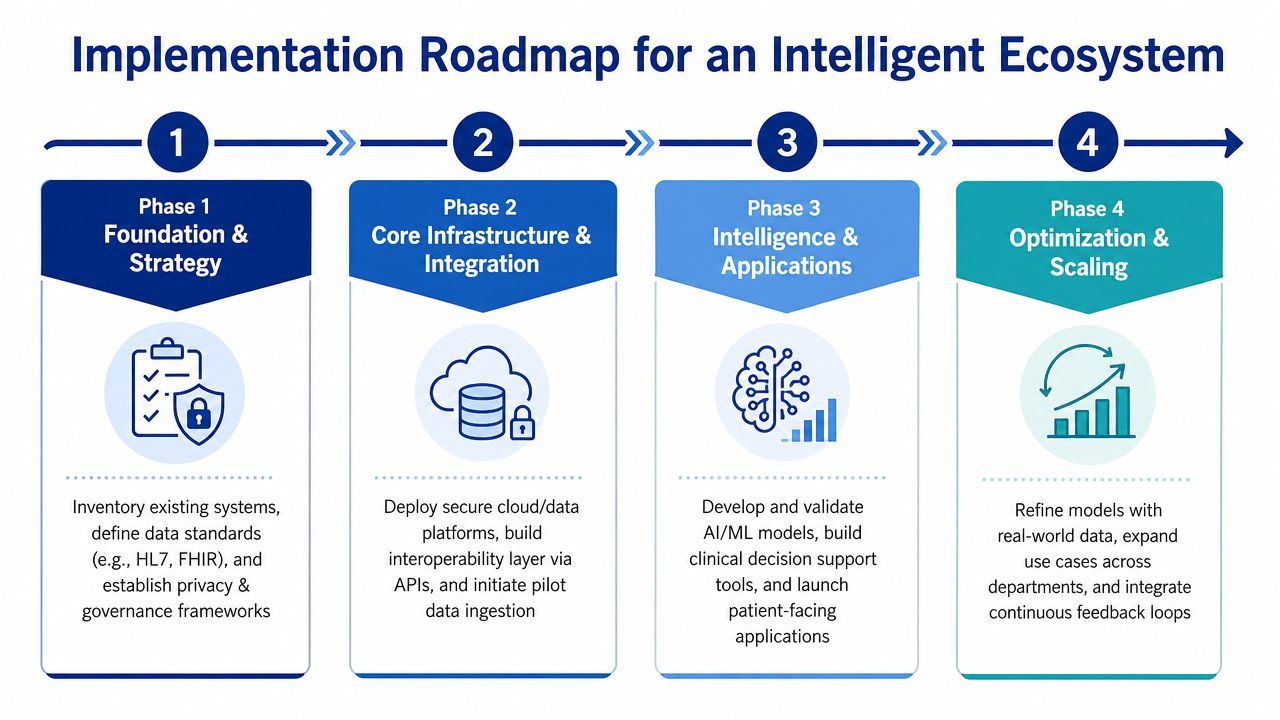
Most programmes fail because teams try to move from idea to AI model before they have the operational base in place. A better sequence is boring at first and much more effective later. Start with governance, then integration, then intelligence, then scale.
Phase 1 to Phase 2
Phase 1, data strategy and governance, begins with a full inventory of systems, data owners, and clinical workflows. The deliverables should include a common data dictionary, privacy framework, decision rights, and a shortlist of use cases that matter to frontline teams. If leadership cannot agree on ownership and escalation paths, stop there. The programme is not ready.
Phase 2, integration and interoperability, is where APIs, EHR connectivity, device onboarding, and data pipelines come together. Standards like FHIR matter most, because they reduce custom work and make integration more repeatable (LoginRadius on SMART on FHIR). At this stage, the go or no-go decision should depend on whether data can move securely across the selected workflows without manual intervention.
Phase 3 to Phase 4
Phase 3, intelligence and applications, is where AI and analytics enter the picture. But the models must be tied to a live workflow, otherwise they become a science project. A pilot that does not have a named clinical owner and an escalation path should not proceed.
Phase 4, optimisation and scaling, is where either discipline is proven, or chaos is created. This is the point for performance monitoring, feedback loops, and expansion to adjacent departments. It is also where change management becomes visible. If users have already started working around the system, scaling will only make the problem larger.
A good milestone review asks four questions. Did the data arrive cleanly? Did clinicians use it? Did the workflow improve? Did governance stay intact? If the answer to any of those is no, pause the rollout and fix the process before you add more complexity.
Why the sequencing protects you
The most common mistake is starting with the most visible layer, usually the AI demo or patient app. That feels productive but often creates technical debt quickly. A staged roadmap keeps the organisation from confusing excitement with readiness.
The Canadian context adds another reason to sequence carefully. Health delivery is provincial, so local ownership and shared value propositions matter more than a one-size-fits-all platform. Ecosystem research also stresses that systems scale only after they reach critical mass and strong partner alignment, which is another reason to avoid scattered pilots with no operating model.
Technology Stack Selection and Vendor Evaluation
Choosing a stack is less about picking the biggest brand and more about matching architecture to operating reality. A tertiary academic centre, a rural network, and a community clinic chain do not need the same setup. They also do not carry the same tolerance for latency, integration cost, or vendor dependency.
Architecture choices that actually matter
Cloud-native works well when you need rapid deployment, standardised operations, and strong elastic scaling. It is often simpler to manage centrally, especially for organisations with mature IT governance.
Hybrid edge-cloud fits better when local resilience, privacy-sensitive data streams, or intermittent connectivity are central concerns. The hybrid approach is often the safer choice for distributed Canadian care settings, because it can process some data close to the source while still using cloud services for broader analytics.
A second choice is monolithic vs microservices. Monoliths can be easier to stabilise early, but they become hard to change when workflows evolve. Microservices are more flexible, but they demand stronger DevOps discipline and clearer API governance. That trade-off matters in healthcare, where change windows are limited, and downtime is expensive.
The third choice is proprietary vs open-source. Proprietary platforms can shorten procurement and provide vendor support, but they may also deepen lock-in. Open-source components can improve transparency and flexibility, but they require internal capability to run and govern them safely. In Canadian healthcare, that governance burden often matters more than the licensing model.
| Criteria | Cloud-Native | Hybrid Edge-Cloud |
|---|---|---|
| Latency | Strong for central analytics, weaker when every event must travel back and forth | Strong for local processing and time-sensitive workflows |
| Resilience | Depends heavily on network uptime | Better fault tolerance when connectivity is inconsistent |
| Privacy sensitivity | Good with strong controls, but data often moves further from source | Better fit when some processing should stay local |
| Integration complexity | Simpler for organisations standardising on one platform | Higher upfront design effort, but more adaptable in distributed care |
| Operational fit | Strong for central IT teams | Strong for multi-site and rural workflows |
What to ask vendors
Ask how their platform handles FHIR, SMART on FHIR, identity, audit logs, and workflow launch in context. Ask what happens when the internet is slow or unavailable. Ask how they support PIPEDA-aligned privacy controls, role-based access, and clinical accountability. Those questions reveal whether a vendor understands healthcare, or just knows how to sell software.
You should also assess whether the provider is offering a platform, a set of services, or both. In some cases, a partner like Cleffex Digital Ltd may be useful for integration-heavy healthcare builds, especially where custom software, cloud work, and workflow automation have to be aligned in one delivery model. The value is not the label. It is whether the team can execute safely in a regulated environment.
Common Pitfalls and How to Avoid Them
The most expensive mistakes usually look avoidable in hindsight. They start with enthusiasm, then move into assumptions, then end with rework. In healthcare, that rework shows up as clinician frustration, delayed launches, and governance reviews that never quite close.
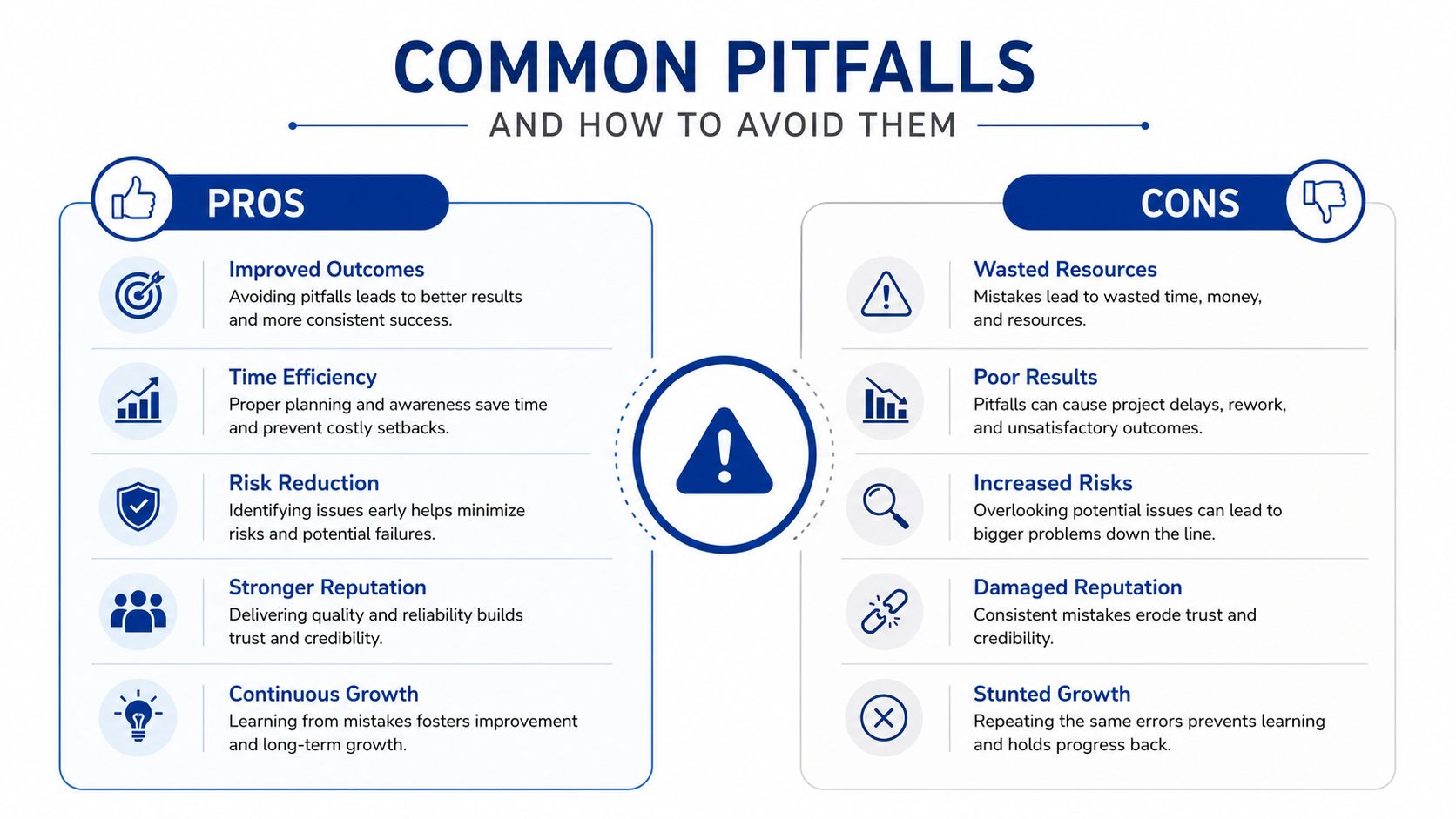
The five failure modes that show up again and again
Poor data quality is the first one. If source systems disagree, analytics will too. The fix is not a prettier dashboard; it is cleansing, normalisation, and validation rules before the pilot expands.
Weak change management comes next. Clinicians do not resist improvement; they resist extra work that doesn't help them. If you do not involve frontline users early, they will route around the system, and your adoption numbers will tell the story.
Privacy and compliance shortcuts create a different kind of pain. Teams often underestimate how many approvals, access controls, and audit trails are needed once data begins moving between systems. The best defence is to treat governance as design work, not paperwork.
Practical lesson: if a vendor says governance can be handled later, assume later will be expensive.
Interoperability gaps are a classic trap. Teams buy software that looks integrated in the demo but requires custom work when it meets the actual EHR environment. FHIR helps, but only if the implementation is disciplined and the interfaces are mapped upfront.
Unrealistic AI expectations are the last one. Models do not fix bad workflows, and they do not stay useful without monitoring. Recent research on AI in low-resource settings makes the broader point clearly: success depends on interoperable standards, bias auditing, explainability, sustainable financing, and local technical capacity, not just model deployment.
There is also a governance gap specific to Canada. Current ecosystem research still gives limited Canada-specific evidence on how standards like FHIR and TEFCA translate into measurable access, cost, and quality gains across regions, which is a reminder that the operating model matters as much as the toolset.
The organisations that recover usually do one thing well. They pause, simplify the scope, and rebuild the governance model before they scale again.
Getting Started with Your Intelligent Healthcare Initiative
Start small, but not vaguely. The first 90 days should focus on getting decision-makers aligned, identifying one high-value workflow, and confirming the data and governance basics are in place. If that sounds less exciting than a broad AI transformation pitch, that's because it is more likely to work.
Use this checklist:
Align stakeholders early: Bring clinical, privacy, operations, IT, and procurement into one planning session.
Map the current state: Identify where data lives, where it breaks, and who owns each handoff.
Shortlist vendors against workflow needs: Ask for FHIR support, auditability, identity controls, and connectivity details.
Design one pilot: Choose a use case with a clear owner and a simple path to measurable adoption.
Define success before launch: Decide what improvement looks like in workflow, governance, and user experience.
Ask vendors direct questions. How do they support interoperability in mixed EHR environments? How do they handle rural connectivity and offline risk? What evidence do they have that clinicians can use the system without extra admin burden? If the answers stay at the level of marketing language, keep looking.
Funding doesn't have to come only from operating budgets. Canada's current federal direction and bilateral funding mechanisms create a more favourable environment for digital-health investment than many teams assume, especially when the case is tied to access, workforce support, and interoperability (KPMG report on Canada's intelligent healthcare direction).
If you're planning an intelligent healthcare ecosystem and need help turning governance, interoperability, and AI into something your teams can run, Cleffex Digital Ltd develops secure healthcare software, integration layers, and AI-enabled workflows. They work on the practical side of digital transformation, from connected systems to implementation support, so you can move from fragmented tools to a governed ecosystem with less risk.