

A lot of healthcare founders and digital leaders are in the same spot right now. The product vision is clear. You can see the workflow that should exist, whether that's virtual care, patient intake, referral management, remote monitoring, claims automation, or a cleaner layer on top of fragmented clinical systems. What isn't clear is how to get from a promising concept to a product that a clinic, hospital, or payer will buy.
That gap is where most projects get stuck. Not because the team can't design screens or ship code, but because healthcare software has different failure modes than ordinary SaaS. A missed edge case can become a compliance issue. A weak integration strategy can kill adoption. An architecture shortcut can slow procurement for months.
That's why healthcare SaaS engineering services matter. The engineering decisions you make early shape your regulatory posture, your sales cycle, your hosting model, your integration roadmap, and your cost to scale.
The Innovator's Dilemma in Digital Health
A typical scenario looks like this. A startup wants to improve chronic care follow-up. A clinic group wants to replace phone-heavy scheduling. A health services company wants to launch a data product that sits across multiple providers. On paper, each idea sounds straightforward. In practice, each one runs into the same hard questions.
Can the platform handle protected data correctly?
Will it integrate with existing EHR workflows?
Can it survive procurement review?
Will clinicians use it without adding more clicks?
Can the business scale without rewriting the platform a year later?
Those questions arrive early, often before the first release.
Big market, narrow room for mistakes
There's a real opportunity here. In North America, healthcare software-as-a-service accounted for 45.39% of global revenue in 2024, and the global market was valued at USD 25.13 billion that year, with a projection of USD 74.74 billion by 2030 according to Grand View Research's healthcare SaaS market analysis.
That market size tells decision-makers something important. Buyers are already spending. They're not asking whether cloud-delivered healthcare software is real. They're asking whether your product is secure, interoperable, supportable, and worth the operational change.
Most healthtech products don't fail because the idea is weak. They fail because the delivery model doesn't match the buying reality of healthcare.
Why normal SaaS habits break down
In a generic B2B app, teams can often launch quickly, collect feedback, and tidy up architecture later. In healthcare, that sequence can become expensive. If your audit logs are incomplete, if permissions are too coarse, or if patient data flows through the wrong services, fixing it later means rework across code, infrastructure, security documentation, and customer contracts.
A few patterns show up repeatedly:
Fast MVP, slow enterprise sale: The app works, but the vendor can't answer security questionnaires with confidence.
Polished front end, weak workflow fit: Patients may like the experience, but staff still have to duplicate work in an EHR.
Feature-rich build, brittle platform: Growth exposes poor tenancy boundaries, weak observability, or fragile integrations.
The real decision isn't build or buy
The core decision is whether you'll treat healthcare engineering as a specialist discipline from day one. That doesn't mean overbuilding. It means making the right choices in the right order.
If you're building in digital health, standard software delivery isn't enough. You need an engineering model that treats regulation, resilience, and adoption as core product requirements, not follow-up tasks for after launch.
Defining Healthcare SaaS Engineering Services
Healthcare SaaS engineering isn't just software development with extra paperwork. It's a specialised discipline that combines product engineering, cloud architecture, data governance, security controls, interoperability, and workflow design for regulated environments.
A useful analogy is this. Building a normal SaaS platform is like constructing an office building. Building healthcare SaaS is like constructing a hospital. Both are buildings. Only one needs specialised systems, stricter operating rules, fault tolerance, controlled access, and careful coordination between many critical functions.
What the discipline actually includes
By 2025, more than 90,000 healthcare organisations had adopted SaaS solutions, and cloud platforms were managing more than 1.6 billion patient records, according to SNS Insider's healthcare SaaS market report. That scale changes the engineering brief. You're not building a simple portal. You're building a platform that may hold sensitive longitudinal data, handle permissions across roles, and connect to systems outside your control.
Three disciplines sit underneath competent healthcare SaaS engineering services.
Platform engineering for regulated cloud delivery
The platform has to work as a product and as an operating environment. That means tenancy boundaries, deployment pipelines, secrets management, monitoring, backup strategies, and controlled release processes all need to be designed deliberately.
A healthcare product often has to answer questions such as:
Where data lives: Region, residency, and transfer rules affect infrastructure design.
Who can access what: Clinicians, admins, patients, support staff, and third parties rarely need the same permissions.
How updates are controlled: Fast release cycles are useful, but risky without rollback and validation.
Data integrity and interoperability
Healthcare data can't be treated like generic business records. Systems have to preserve context, ownership, timing, and traceability. A lab value, medication list, referral status, eligibility record, or care plan item can trigger real-world decisions. If data is delayed, transformed badly, or attached to the wrong workflow, the product loses trust quickly.
Workflow engineering, not just feature engineering
A lot of software teams focus on screens and endpoints. In healthcare, the deeper challenge is workflow fit. A product succeeds when it reduces re-entry, shortens handoffs, clarifies responsibility, and fits the day clinicians and admins already have.
A feature is only valuable if it removes work from the care pathway instead of shifting work to another person.
What clients should expect from the service
The right healthcare SaaS engineering services should cover more than coding capacity. They should shape decisions about architecture, compliance evidence, release strategy, integration sequencing, and operational readiness.
That usually includes:
Discovery tied to risk: Defining not only what to build, but which assumptions could block procurement or adoption.
Architecture tied to buyer expectations: Choosing deployment and security models that support real sales conversations.
Delivery tied to operations: Building software that can be updated, monitored, and defended after launch.
If your vendor only talks about velocity, they're missing the point. In healthcare, the product isn't finished when the app works. It's finished when the organisation can trust it.
The Foundation Compliance and Security by Design
Compliance-by-design is one of the few engineering choices that pays off in every direction. It lowers rework, shortens diligence cycles, improves trust in procurement, and reduces the chance that your team has to retrofit basic controls into a live product.

The Canadian context makes this more demanding, not less. Teams may need to satisfy federal obligations and then map controls to provincial requirements such as Ontario's PHIPA, Alberta's public-sector expectations, or Quebec's Law 25. For products that also touch US or EU markets, the scope broadens again.
What compliance-by-design looks like in code and infrastructure
A strong baseline starts with cloud architecture that assumes sensitive data, controlled access, and auditability from day one. That often means auto-scaling infrastructure on AWS or Azure, container orchestration with Kubernetes, encryption for data at rest using AES-256, encryption in transit using TLS 1.3, and support for Business Associate Agreement readiness where needed.
Those controls matter, but they're only part of the story. Teams also need identity design, role-based permissions, audit logging, incident response plans, and a documented control model that non-engineers can understand.
If your legal, security, and procurement reviewers can't trace how the platform handles access, logging, breach response, and data location, you'll feel that pain later in the sales cycle.
The business case for doing this early
There's a direct operational upside. When vendors integrate FHIR and HL7, interoperability improves by 40%. Canadian providers using those SaaS models report 35% faster feature adoption and a 25% reduction in capital expenditures, while SOC 2 certification and multi-factor authentication achieve 99% compliance adherence under frameworks such as Ontario's PHIPA.
The key point isn't the numbers alone. It's what they represent. Better interoperability reduces manual workarounds. Faster feature adoption means customers can use what you ship. Lower capital burden supports the cloud business case. Higher compliance adherence makes procurement less adversarial.
Practical rule: If a control is important enough to mention in a sales conversation, it's important enough to design into the product before the first serious rollout.
Security controls that buyers actually care about
A useful review lens is to separate security theatre from buyer-relevant controls. These usually matter most:
Access control design: Fine-grained permissions, least-privilege defaults, and strong authentication.
Auditability: Logs that show who accessed what, when, and through which workflow.
Data protection: Encryption at rest and in transit, secure key handling, and environment separation.
Vendor readiness: Clear documentation for cloud responsibilities, subprocessors, and incident handling.
For teams working across jurisdictions, a practical reference like this Essential GDPR guide for digital teams helps translate privacy principles into implementation checkpoints. For a more engineering-centred view of building controls into delivery, this write-up on compliance-driven software development is also useful.
What doesn't work
Three shortcuts cause trouble repeatedly:
Treating compliance as legal-only work. The legal team can define obligations, but engineering has to implement them.
Adding security at release time. By then, the data model and service boundaries may already be wrong.
Relying on generic cloud claims. Buyers want evidence of your controls, not broad statements that the cloud provider is secure.
In healthcare, compliance isn't a drag on product momentum. Done properly, it protects momentum.
Architecting a Modern and Interoperable Health Platform
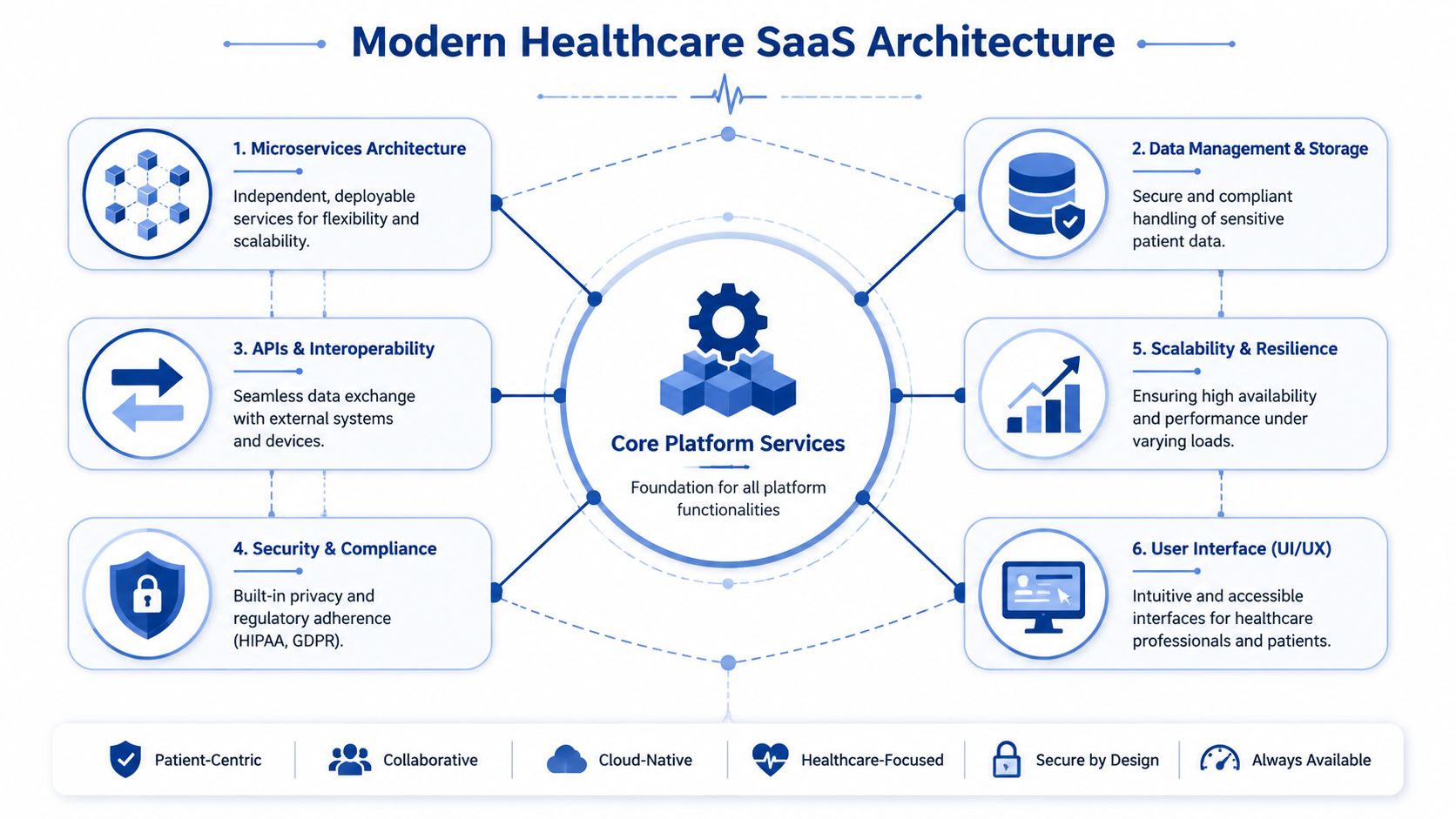
Architecture decisions have commercial consequences. A monolith might ship faster for a narrow first release. A microservices approach might support cleaner scaling, independent deployments, and better separation of sensitive functions. Neither is automatically right. The right choice depends on product scope, integration complexity, team maturity, and the buyer environments you expect to support.
This is the picture most decision-makers need in plain terms.
When microservices help and when they don't
Technical implementations that use microservices, Docker containerisation, and API gateways show a clear business impact. AI-driven predictive care delivered through this kind of architecture can reduce hospital readmission rates by 15–20%, and Canadian startups using this approach report 30% faster product iteration cycles.
That doesn't mean every healthcare SaaS product should start with twenty services. Early-stage teams often hurt themselves by over-fragmenting too soon. More services mean more deployment complexity, more observability work, and more operational overhead.
A simple way to consider it:
| Architecture choice | Works well when | Creates risk when |
|---|---|---|
| Modular monolith | Product scope is still forming, team is small, workflows are tightly connected | The codebase grows without clear boundaries |
| Microservices | Product spans distinct domains such as scheduling, messaging, analytics, identity, and integrations | The team lacks DevOps maturity or service ownership |
| Hybrid approach | You want one core application with a few isolated services for high-risk or high-scale components | Boundaries stay vague and the system becomes harder to reason about |
The minimum modern stack for healthcare SaaS
Most healthcare SaaS engineering services today revolve around a stack that balances portability, resilience, and integration readiness.
Compute and orchestration
Containers let teams package services predictably. Docker is common for local and CI environments, while Kubernetes helps manage scaling, deployment, and recovery across cloud infrastructure. This becomes more valuable when workloads differ sharply. A messaging service, a patient app backend, and a reporting job don't all scale the same way.
APIs and external communication
APIs are the connective tissue of the platform. They expose data and workflows to patient apps, internal admin tools, partner systems, diagnostics, billing systems, and EHR integrations. In healthcare, API design has to support more than usability. It has to support traceability, versioning, and safe change management.
Data services
Healthcare platforms often need more than one storage pattern. Transactional records, event streams, document storage, and analytics workloads rarely belong in one undifferentiated database strategy. Good architecture separates operational data from reporting concerns early enough to avoid painful rewrites later.
Interoperability is an architectural concern, not an interface concern
A lot of teams think interoperability starts when they build the first integration. It starts earlier than that. If your internal data model can't map cleanly to standards-based resources, every downstream integration becomes more expensive.
That's why FHIR matters beyond compliance language. It influences how you model patients, practitioners, appointments, observations, encounters, and consent boundaries. The same applies to HL7 in environments where legacy exchange still matters.
If your internal model ignores healthcare standards at the start, your integration budget grows every quarter.
For organisations planning larger ecosystem products, this overview of enterprise healthtech platform development is a useful companion because it frames architecture as a platform decision, not just an app decision.
What strong architecture buys the business
The strategic value of good architecture is straightforward:
Faster market entry: You can release a focused product without painting yourself into a corner.
Safer scaling: Sensitive workflows can be isolated and hardened without freezing the whole roadmap.
Easier partnerships: External systems can connect through stable interfaces rather than custom workarounds.
Better change management: Teams can ship improvements without risking unrelated clinical workflows.
The architecture discussion shouldn't be abstract. It should answer a business question. What operating model will let this healthcare product win, survive diligence, and evolve without constant rework?
Ensuring Quality, Reliability, and Performance
Healthcare software doesn't get judged only on features. It gets judged on whether it behaves well on an ordinary Tuesday morning when staff are logging in, forms are being submitted, integrations are syncing, and someone needs the system right now.
That's why quality, reliability, and performance engineering need to be part of delivery from the start, not a hardening phase bolted on near launch.

Reliability comes from process, not hope
Teams usually know they need testing. What they often underestimate is how many types of testing healthcare platforms need in parallel.
A practical baseline includes:
Unit and service tests: To catch regressions in core business logic.
Integration tests: To validate APIs, external connectors, and message flows.
End-to-end tests: To cover critical user journeys such as intake, booking, messaging, or document submission.
Security testing: To check authentication flows, authorisation boundaries, session handling, and common abuse paths.
Performance and load testing: To verify behaviour under realistic spikes, background jobs, and concurrent usage.
The point isn't to automate everything. It's to automate the failure points that would be expensive or dangerous to miss manually.
DevOps is part of product quality
A lot of business teams hear DevOps and think “deployment automation”. In healthcare, it's broader than that. It's the discipline that turns software delivery into a controlled, observable process.
That usually means CI/CD pipelines, environment parity, infrastructure as code, secrets management, release approvals for higher-risk workflows, rollback mechanisms, and monitoring that tells you what broke before a customer sends a screenshot.
Teams using performance monitoring tools such as Prometheus and Grafana, paired with load testing, can maintain 99.9% uptime under heavy workloads in this engineering model. That matters for products deployed across many sites because uptime isn't just a technical metric. It affects contract confidence, staff trust, and customer expansion.
What to test before you scale
One of the most common mistakes is testing only the happy path. Healthcare operations are full of exceptions, retries, partial failures, and role-based differences.
Here are the scenarios worth forcing early:
A downstream integration is delayed: Does the app queue, fail visibly, or lose state without notification?
A user's permissions change mid-workflow: Does access update safely?
A document upload fails halfway through: Can the user recover without duplicate records?
A deployment introduces schema changes: Can you roll back without corrupting data?
Traffic spikes around a predictable event: Does the system degrade gracefully?
Production reliability starts with intentionally breaking the platform in staging until the team understands how it fails.
Performance is a workflow issue
Slow software does more than annoy users. In healthcare, latency changes behaviour. Staff open duplicate tabs. Patients refresh forms. Admins revert to phone and email. Support tickets rise. Data consistency gets harder. Adoption slips for reasons that look like “change resistance” but are often just poor system response.
That's why teams should define performance budgets for key workflows, monitor them continuously, and review them alongside release planning. A fast dashboard doesn't matter much if appointment booking or referral intake stalls under load.
The strongest healthcare SaaS engineering services don't treat QA as a gate at the end. They use testing, observability, and release discipline to protect the business every week the product is live.
The Critical Path Integration with EHRs and Ecosystems
A healthcare product can have excellent UX, strong security, and a polished brand. If it doesn't fit the systems people already use, adoption will stall. In most healthcare environments, that means integration is not an enhancement. It is a core product feature.
Many roadmaps go wrong; teams budget for “the app” and treat interoperability as phase two. Buyers don't see it that way. They judge the product by whether it reduces duplicate entries, brings context into the workflow, and moves information between systems without creating new manual work.
Why EHR integration is hard
EHR integration looks simple from the outside. Connect to the record system, fetch data, write updates, and move on. However, the work is messier.
Different systems support different standards and versions. Some offer modern APIs. Others still depend on older message patterns. Authentication models vary. Available fields vary. Customer configuration varies. Even when two organisations use the same EHR brand, their local implementation may behave differently.
The technical challenge is only one layer. There are also governance questions:
Which system is the source of truth?
Which writings are allowed, and by whom?
What happens when data conflicts?
How should errors surface to users?
Which workflow belongs in your product versus the EHR?
Integration strategy should follow product strategy
The right path depends on the product category.
A patient engagement app might only need scheduling, demographics, messaging context, and selected clinical data. A care coordination platform may need referrals, encounters, tasks, notes, and event triggers. A revenue or operational product could depend on eligibility, claims, coding, and billing status.
That's why an integration roadmap should be prioritised by workflow value, not by how impressive the connector list looks in a pitch deck.
What usually works
Start with one high-value workflow: Booking, referral intake, discharge follow-up, prior authorisation, or another concrete use case.
Map handoff points: Identify where staff currently re-enter data or switch systems.
Design for partial connectivity: Some customers will support richer integrations than others.
Use standards where possible: FHIR and HL7 reduce custom mapping effort over time, even if they don't remove it.
What usually fails
Building custom one-offs for every customer: The roadmap becomes a service business disguised as a product.
Promising write-back too early: Read access is simpler than safe transactional updates.
Ignoring support burden: Every connector needs monitoring, version handling, and incident ownership.
The strongest health products don't integrate with everything first. They integrate deeply where the workflow pain is highest.
Interoperability as a market advantage
A well-designed integration layer changes the economics of the business. It lowers onboarding friction, strengthens retention, and creates a more defensible product. Once your software becomes part of how appointments move, data appears in context, or teams coordinate care, replacement gets harder.
For organisations evaluating standards-led connection strategies, this guide to FHIR integration services in healthcare interoperability is a practical reference point.
If you want user adoption, build integration into the product definition itself. Don't leave it to the backlog.
Choosing Your Engineering Partner: A Practical Checklist
The selection process usually becomes real after the first hard question from a buyer, security reviewer, or implementation stakeholder. They are not asking whether your team can ship features. They are asking who owns risk, who can explain the architecture, and who will still be there when an integration breaks during rollout.
That is why partner selection has a direct business impact. The right team shortens procurement, reduces rework, and gives leadership clearer cost and delivery signals. The wrong team can produce working software that still stalls in security review, misses workflow requirements, or becomes too expensive to support.
In Canada, that often means testing whether a vendor can speak clearly about provincial privacy obligations, data residency decisions, auditability, and operating procedures. A polished delivery deck is not enough. Buyers need a documented control model, clear technical ownership, and evidence that the team can defend its choices under review.
Engagement model changes the risk profile
Commercial structure affects delivery quality more than many buyers expect.
Fixed price works when the scope is narrow, interfaces are known, and the approval path is stable. Healthcare products rarely stay that tidy. Integration details surface late, compliance feedback changes priorities, and customer workflows force product decisions that were not obvious in discovery.
A dedicated team model usually fits better when you are building a product, not commissioning a one-off application. It gives room to refine architecture, adjust controls, and stage releases without renegotiating every meaningful change. Staff augmentation can work if you already have strong internal product management and technical leadership. If you do not, adding developers alone will not solve decision latency or ownership gaps.
Some firms, including Cleffex Digital Lltd, position their work around regulated software delivery across cloud, AI, and healthcare use cases. That can be useful context, but the decision should still come down to how the team answers practical operating questions.
Healthcare SaaS Engineering Vendor Checklist
| Evaluation Criterion | Why It Matters to the Business | Key Questions to Ask |
|---|---|---|
| Compliance model | Weak controls slow procurement and create avoidable legal review | Can you show a documented model for access control, audit logging, data residency, retention, and incident response? |
| Security implementation | Security design affects buyer trust, cyber risk, and insurance posture | How do you handle encryption, identity, MFA, secrets management, and separation between environments? |
| Healthcare workflow knowledge | Products fail commercially when they disrupt care operations or admin flow | Who on your team has built for clinics, hospitals, payers, or care operations, and what workflow constraints did they handle? |
| Interoperability experience | Integration complexity drives onboarding cost and time to revenue | What have you shipped with FHIR, HL7, API gateways, and EHR integration patterns? |
| Architecture judgment | Overbuilding raises cost. Underbuilding creates migration pain later | How do you choose between a modular monolith and microservices, and what business conditions would change that decision? |
| QA and release discipline | Release quality affects support load, customer confidence, and patient-facing risk | What testing do you run beyond feature QA, including integration, regression, security, and performance testing? |
| DevOps and observability | Post-launch stability depends on how fast issues are detected and contained | How do you monitor services, manage alerts, roll back releases, and investigate incidents across environments? |
| Documentation quality | Documentation reduces approval delays and protects continuity | What architecture, runbook, API, and control documentation do you produce during delivery? |
| Team continuity | Staff churn increases onboarding cost and weakens design consistency | Who will do the work day to day, and how often does that delivery team change? |
| Post-launch support | SaaS revenue depends on operational ownership after go-live | What support model do you offer when integrations fail, usage patterns shift, or compliance questions arise after launch? |
What strong partners do differently
Strong healthcare engineering partners answer in specifics. They can explain why they would postpone a write-back integration, where they expect compliance review to slow delivery, and which parts of the system need tighter operational controls from day one. They also explain cost trade-offs plainly. For example, I would rather hear a partner recommend a modular monolith for the first release, with clear boundaries for future extraction, than watch a team force microservices into a product that has not proven demand yet.
That kind of judgment protects the business. It keeps the focus on the parts of the platform that affect adoption, approval, and reliability.
Red flags worth acting on
Some warning signs are consistent across projects.
They stay at the buzzword level: Generic cloud language without operational detail usually signals a thin healthcare delivery experience.
They cannot explain trade-offs: Good partners will tell you what they would delay, simplify, or refuse to build early.
They avoid compliance specifics: A team working in healthcare should be able to discuss privacy controls and review expectations in concrete terms.
They treat every project as a win: Mature teams can describe where delivery got harder than expected and what they changed in response.
They separate build and support too sharply: In healthcare SaaS, design decisions affect incident response, audit readiness, and long-term maintenance.
A good partner makes hard decisions easier to evaluate. If the answers sound polished but do not clarify risk, cost, ownership, and next-step consequences, keep interviewing.
Building the Future of Healthcare Together
The companies that win in digital health usually aren't the ones with the longest feature list. They're the ones that make sound engineering decisions early and keep tying those decisions back to business outcomes.
That means building with compliance-by-design, so procurement and trust don't become late-stage blockers. It means choosing architecture based on workflow, scale, and integration reality rather than fashion. It means treating quality, observability, and EHR connectivity as product fundamentals. It also means choosing partners who can document, explain, and defend the platform as it grows.
Healthcare SaaS engineering services sit at that intersection. They connect technical implementation to speed of launch, buyer confidence, supportability, and long-term scalability.
The path is demanding, but it isn't mysterious. If the product strategy is clear, the control model is documented, and the architecture reflects actual healthcare workflows, the project becomes far more manageable. That's when software stops being a risky initiative and starts becoming a reliable business asset.
If you're planning a healthcare platform and need a team that can align product goals with cloud architecture, compliance requirements, interoperability, and long-term support, Cleffex Digital Ltd is one option to evaluate. The right conversation should start with your workflow, risk profile, and deployment constraints, then move into architecture and delivery choices that fit the market you want to serve.