

You're probably dealing with some version of the same problem I see across Canadian healthcare organisations. One system runs scheduling. Another holds chart data. Imagine living somewhere else. Virtual care was added quickly. Reporting sits in spreadsheets or a warehouse nobody fully trusts. Every department wants less friction, but every new tool seems to create one more integration point to maintain.
That's where healthcare software consulting in Canada becomes useful. Not as generic IT support, and not as a vendor pitch for one more platform, but as a disciplined way to connect clinical reality, regulatory obligations, and the software decisions that hold up in production. In Canada, that work is harder than many buyers expect because the environment is federated, legacy-heavy, and shaped by provincial operating models.
The organisations that get this right usually stop asking, “Which software should we buy?” and start asking, “How will this fit our workflows, our privacy obligations, and our data-sharing model across sites?” That's the better question.
Defining Healthcare Software Consulting in the Canadian Context
Healthcare software consulting in Canada is best understood as digital health architecture. The consultant's job isn't just to recommend software. It's about designing how systems, people, data, and compliance requirements will work together in a real care environment.

A clinic manager usually feels this need before they can name it. Booking is fragmented. Patient communications are inconsistent. Staff are re-entering data. A hospital team sees it at a different scale. Legacy HIS components don't exchange data cleanly with imaging, analytics, or new digital front doors. The symptoms differ. The underlying issue is the same. Technology decisions were made in pieces, but care delivery happens as one system.
What Consultants Actually Do
A strong healthcare software consultant sits between clinical teams, operations leaders, vendors, security teams, and developers. That role usually includes:
Workflow translation. Turning how clinicians, schedulers, lab staff, and administrators work into system requirements.
Integration planning. Deciding how EMR, EHR, RIS, PACS, patient portals, and reporting tools should exchange data without piling on brittle custom interfaces.
Compliance interpretation. Helping teams make practical choices that align with privacy, consent, retention, and audit needs.
Delivery oversight. Keeping projects grounded in rollout realities like training, cutover sequencing, support readiness, and change fatigue.
The difference from general IT support matters. General IT can keep devices, networks, and basic systems running. Healthcare software consulting deals with care pathways, clinical risk, data quality, and interoperability consequences.
Why the Canadian Context Changes the Job
Canada's healthcare SaaS market is structurally driven by cloud delivery and subscription deployment, which means consulting success increasingly depends on secure multi-tenant architecture, API-based integration, and low-ops deployment patterns suitable for hospitals and clinics, as noted in this Canada healthcare SaaS market analysis. That changes what “good implementation” looks like. It isn't enough to install software and hand over admin credentials. The architecture has to support secure access, manageable integrations, and sustainable operations across multiple sites and teams.
Practical rule: If a consulting partner can't explain how your workflows, integrations, and governance will look after go-live, they're probably selling implementation labour, not healthcare transformation.
Accessibility belongs in that definition, too. Digital health systems fail when patients and staff can't reliably use them. If your project includes portals, intake forms, booking flows, or virtual care touchpoints, the importance of healthcare accessibility should be part of the requirements from day one, not patched in after complaints arrive.
For organisations trying to separate broad advisory work from specialist delivery, this overview of what an IT consultancy service is is a useful baseline. In healthcare, the bar is higher because software choices affect care continuity, staff workload, and patient trust.
Navigating Canada’s Unique Health Tech Landscape
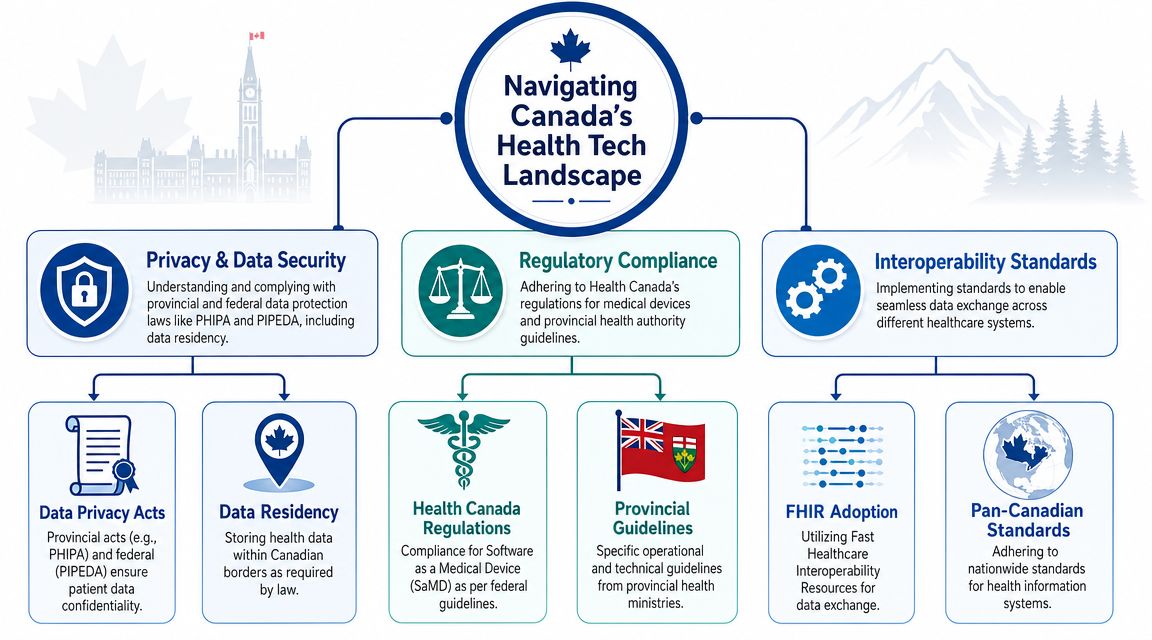
The Canadian health tech environment punishes one-size-fits-all thinking. A platform that works in a private-sector workflow elsewhere can fail fast in Canada if it ignores provincial privacy rules, local hosting expectations, or the way data moves between hospitals, clinics, labs, and community providers.
Privacy Law Isn’t One Layer
Most buyers know the acronyms. Fewer appreciate the delivery impact. In practice, privacy in Canadian healthcare software projects means you're often working across multiple accountability zones at once. Federal rules matter. Provincial legislation matters. Local health authority interpretation matters. Contract language matters. So do operational controls like role-based access, audit trails, consent handling, and breach response.
That's why privacy can't sit at the end of a project as a review step. It has to shape architecture choices early. If your team waits until procurement is complete to ask where data will reside, how users will be provisioned, or what gets logged, the expensive rework starts immediately.
A useful test in vendor meetings is simple: ask them how they handle access segregation, secondary use of data, and cross-organisational data exchange. Generalists usually answer in product terms. Experienced healthcare consultants answer in governance and workflow terms.
Interoperability Is the Real Battleground
In Canada, most digital health pain doesn't come from a total lack of systems. It comes from systems that exist but don't work together cleanly.
IHE Canada notes that interoperability challenges persist and that standards such as DICOM and HL7 evolved specifically to coordinate health information exchange, which matters as organisations face pressure to reuse data efficiently and automate workflows instead of adding isolated software tools, as discussed by IHE Canada on interoperability standards. That's the practical centre of healthcare software consulting in Canada.
What That Means During Delivery
A good consultant doesn't start with “we'll connect everything.” That's how teams create expensive integration debt. The better sequence is usually:
Map the systems of record. Decide which platform owns demographics, orders, appointments, documents, imaging references, and reporting outputs.
Define exchange priorities. Identify which data flows remove friction or reduce risk first.
Choose standards deliberately. Use HL7, FHIR, and DICOM where they fit, but don't pretend every legacy product supports modern exchange patterns well.
Control interface sprawl. Every custom point integration creates future maintenance costs.
Interoperability work succeeds when the organisation chooses a target operating model first. It fails when every department negotiates its own exception.
Security sits inside all of this, not beside it. In healthcare, security architecture affects uptime, vendor access, patching windows, mobile use, and even the feasibility of remote care. That's one reason many Canadian organisations tie software planning directly to broader digital health transformation in Canada rather than treating integration as a side project.
Why Federated Delivery Changes Software Decisions
Canadian healthcare is organised in a way that often splits procurement, governance, and delivery authority. A regional group may approve one thing, a site may operate another, and a partner organisation may need access without sharing the same infrastructure. Consultants who've worked in this environment don't promise elegance where the operating model won't support it. They design around reality.
That usually means choosing a phased interoperability roadmap over a big-bang replacement. It means documenting exceptions clearly. It means planning for hybrid environments where old and new tools coexist longer than anyone wants. And it means treating data-sharing agreements as implementation-critical, not legal paperwork to finish later.
Core Service Offerings and Engagement Models
When buyers search for healthcare software consulting in Canada, they often lump very different services together. That creates confusion in scoping and budget conversations. A serious healthcare consulting engagement usually falls into a few clear buckets.
Strategy, Architecture, and Modernisation
Some organisations need direction before they need code. These engagements focus on current-state assessment, target architecture, privacy and security design, data flow mapping, cloud readiness, and vendor selection support. This is common when a hospital group has too many overlapping systems or when a clinic network is trying to unify booking, communications, and reporting.
Modernisation work is more hands-on. It can include replacing ageing portals, reworking integration layers, cleaning up interface logic, rebuilding legacy reporting environments, or moving brittle on-premise workflows toward more manageable cloud-based delivery.
Build, Integrate, and Support
Other engagements are implementation-heavy. These typically include:
Custom application development for scheduling, patient intake, referral workflows, remote monitoring, internal clinical tools, or administrative automation.
Integration services across EMR, lab, imaging, billing, and analytics systems.
Virtual care enablement with attention to identity, privacy, consent, and workflow fit.
Data platform works for reporting, interoperability layers, operational dashboards, and AI-readiness.
Some organisations also need specialist partners with strong data plumbing capability. If the core issue is fragmented pipelines, poor warehouse design, or inconsistent data movement, reviewing examples of expert data engineering consultancies can help buyers understand the depth of engineering required behind healthcare analytics and interoperability programmes.
How Organisations Usually Engage Consultants
The engagement model matters as much as the technical scope. The wrong commercial structure can undermine an otherwise sound project.
| Engagement Model | Best For | Pricing Structure | Key Advantage |
|---|---|---|---|
| Fixed-price project | Well-defined implementations with clear scope and acceptance criteria | Agreed project fee | Predictable budgeting |
| Time and materials | Complex work where requirements will evolve during discovery and delivery | Billing based on time spent and team composition | Flexibility when priorities shift |
| Dedicated team augmentation | Organisations that need embedded product, engineering, or integration capacity | Monthly or periodic team cost | Faster execution without full internal hiring |
| Retainer or managed advisory | Ongoing optimisation, governance, architecture oversight, or long-term roadmap support | Recurring fee | Continuity across multiple initiatives |
What Tends To Work and What Doesn’t
Fixed-price works when the scope is mature, dependencies are known, and the organisation can make decisions quickly. It usually struggles in healthcare integration programmes where hidden interface behaviour, legacy constraints, and workflow exceptions emerge late.
Time and materials work better when discovery is part of the core work. It gives teams room to solve the right problem, not just the originally documented one. The trade-off is that leadership needs stronger governance, clearer checkpoints, and tolerance for some ambiguity.
Dedicated teams make sense when your internal product owner is strong, and your roadmap extends beyond a one-off implementation. Retainers work well for health systems that need architectural continuity, security oversight, and recurring support across several projects instead of one launch.
If your project depends on unknown legacy interfaces, multiple stakeholder groups, and changing provincial requirements, rigid commercial structures usually create false certainty.
A practical note on vendors. Some firms handle only advisory work. Others build and support software too. Cleffex Digital Ltd, for example, is a Canada-based option for custom software and healthcare-focused delivery when an organisation needs both consulting and implementation capacity. That distinction matters because strategy without delivery ownership often leaves internal teams carrying the hardest work alone.
Calculating the ROI of Healthcare Software Consulting
The ROI case for healthcare software consulting isn't just about spending less on technology. In Canadian healthcare, the stronger argument is usually that poor architecture costs more over time in staff effort, patient friction, reporting delays, and repeated integration work.
Where the Return Actually Shows Up
Leadership teams often ask for a simple before-and-after savings figure. In practice, the return is usually distributed across operations and care delivery.
Look for value in areas such as:
Administrative load. Fewer duplicate entries, fewer manual handoffs, less reconciliation work.
Clinical efficiency. Better access to the right information in the right workflow.
Risk reduction. Fewer privacy workarounds, cleaner auditability, and less dependence on informal processes.
Future readiness. New tools can be added without rebuilding every interface from scratch.
Some of these gains are easy to measure. Some aren't. That doesn't make the softer outcomes less important. If staff stop maintaining parallel spreadsheets, if referrals move with fewer calls, or if virtual care becomes workable instead of awkward, that has organisational value even when it doesn't fit neatly into a finance template.
Cost Drivers You Should Expect
Consulting costs rise with complexity, not with branding. The biggest pricing drivers are usually the number of systems involved, the condition of the current environment, the amount of custom integration required, security and privacy obligations, internal stakeholder availability, and whether the project includes training and post-launch support.
A buyer should be wary of proposals that price a healthcare modernisation effort as if it were a standard business app rollout. In healthcare, hidden work often sits in workflow analysis, interface testing, cutover planning, user acceptance, and remediation after edge cases appear.
Why the Market Signal Matters
The broader demand pattern supports the business case. The North American healthcare IT consulting market is valued at over USD 19 billion in 2024 and is projected to grow at a 12.38% CAGR, indicating sustained demand tied to modernisation, digital transformation, and compliance, according to this North American healthcare IT consulting market forecast. That doesn't prove any one project will succeed, but it does show this isn't niche spending. Organisations across the region are treating consulting as part of core transformation work.
A Better Way To Frame ROI Internally
When I help teams frame the investment, I usually push them away from “software replacement” language and toward operational outcomes. Ask:
Are staff spending time compensating for system gaps?
Are data handoffs introducing delay or risk?
Will the proposed architecture make the next project easier, or add another silo?
Does the engagement leave the organisation with reusable capability?
That last point matters. Good healthcare software consulting doesn't just solve today's problem. It leaves behind cleaner interfaces, clearer governance, stronger documentation, and a delivery model your team can build on.
Your Checklist for Selecting the Right Partner in Canada
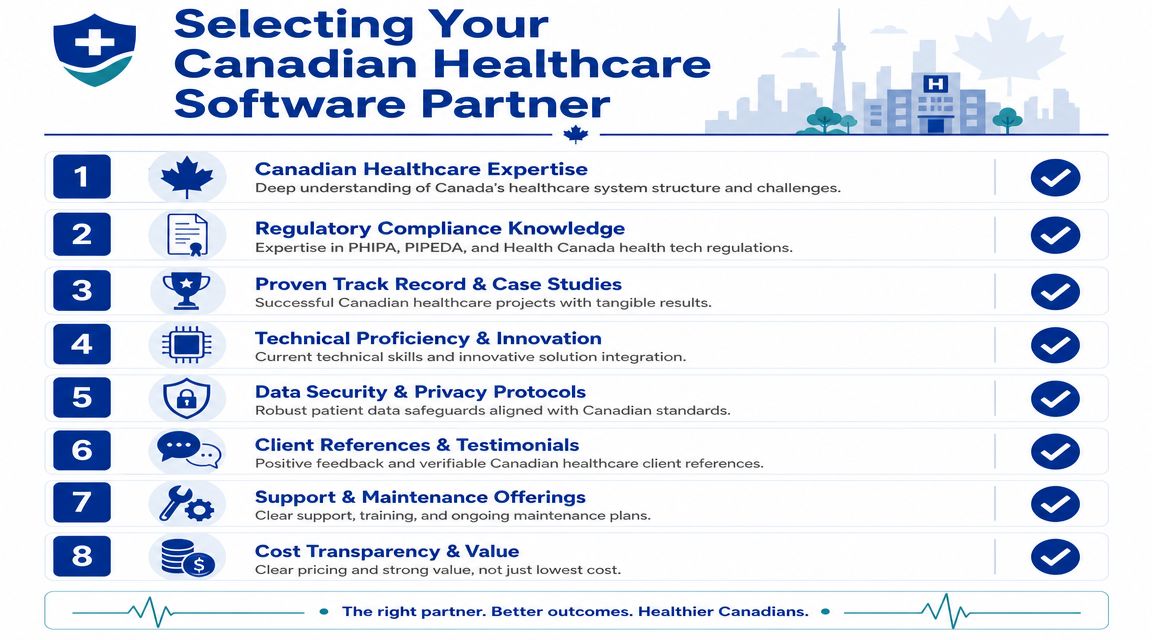
Choosing a healthcare consulting partner in Canada is less about polished proposals and more about whether the firm understands how Canadian healthcare operates under pressure. You need evidence that they can handle interoperability, privacy, rollout constraints, and uneven technical maturity across sites.
What To Verify Before You Shortlist Anyone
Canada already has significant specialist capacity. CGI says it has 500 health IT professionals nationally, and the Pan-Canadian Health Data Strategy argues for federal leadership with annual funding on the order of $1B to build a world-class health data system, which signals sustained national focus on health data modernisation, as outlined by CGI Canada healthcare and the Pan-Canadian context. That means buyers shouldn't settle for firms that only know generic software delivery.
Use a checklist that forces specificity:
Canadian healthcare experience. Ask which provinces, provider settings, or health system contexts they've worked in.
Interoperability depth. Ask how they decide between point integrations, middleware, and standards-based architecture.
Privacy fluency. Ask how privacy requirements shape design decisions, not just policy documents.
Cloud and hosting judgment. Ask where they recommend cloud, where they don't, and why.
Change management discipline. Ask who handles training design, adoption support, and cutover planning.
Support model. Ask what happens after launch when workflows break, users resist changes, or data quality issues emerge.
Questions That Separate Specialists From Generalists
The fastest way to test depth is to ask operational questions, not brand questions.
Try these:
How do you handle integration in mixed legacy environments?
A weak answer jumps to tools. A strong answer starts with system-of-record decisions, message flows, and failure handling.What do you do when provincial or local governance slows decisions?
Experienced firms will talk about phased approvals, design checkpoints, and dependency management.How do you approach remote or low-resource environments?
This is a major differentiator in Canada. A practical partner talks about bandwidth constraints, offline contingencies, staff training, and workflow simplification.What artefacts do you leave behind?
You want interface documentation, architecture decisions, runbooks, training material, and governance notes, not just deployed code.
A credible partner can explain what tends to go wrong in Canadian healthcare projects before you tell them your pain points.
Signals That the Fit Is Wrong
Some warning signs show up early:
They treat privacy as legal review only
They promise straightforward interoperability without discussing legacy constraints
They can't explain deployment in rural or multi-site environments
They focus on features more than workflows
They avoid post-launch accountability
If your organisation is also evaluating who can support broader organisational change, not only technical delivery, this guide to choosing a digital transformation partner is worth reviewing alongside your technical assessment.
The best partner won't always be the cheapest, the largest, or the most polished in procurement. It will be the one that shows disciplined thinking about Canadian delivery realities and can prove it with specific answers.
Success Stories from Canadian Healthcare Innovators
The most useful examples in healthcare software consulting in Canada aren't dramatic rescues. They're controlled improvements where teams chose the right scope, respected operational constraints, and solved the problem they actually had.

A Rural Clinic Network That Stopped Treating Telehealth as a Feature
A multi-site primary care group serving rural communities had already adopted virtual visits, but the service wasn't dependable. Appointments were hard to coordinate, clinicians used inconsistent workarounds, and patients regularly needed phone-based backup because bandwidth and device readiness varied by location.
The turning point wasn't a new telehealth product. It was redesigning the operating model around real constraints. The consulting team simplified appointment flows, reduced the number of steps patients had to complete before visits, created fallback protocols for low-connectivity scenarios, and trained staff on triage rules for what should stay virtual and what should move in person.
That aligns with a recent scoping review on telehealth in rural and remote primary care, which found that successful telehealth depends heavily on adequate connectivity, digital infrastructure, staff training, and workflow design, while common concerns include limits on physical examination, privacy and security, heavier clinic workloads, and weaker provider-patient relationships, as described in this review of telehealth in rural and remote care.
The lesson was straightforward. In remote care settings, deployment risk sits in workflow and readiness as much as in software.
A Hospital Network That Tackled Integration Debt First
A larger hospital environment had a different problem. Over time, it had accumulated reporting tools, imaging workflows, and departmental interfaces that technically functioned but didn't support clean cross-system use. Data moved, but not in a way that gave operations or clinical teams a coherent picture.
Instead of launching another analytics programme immediately, the consulting engagement started with an architecture cleanup. The team identified duplicate data paths, clarified which systems owned which data, and retired interfaces that existed only because earlier decisions had never been revisited. Imaging and clinical records weren't forced into a perfect future-state model on day one. They were connected through a staged plan that reduced ambiguity first.
Complex hospital projects usually improve after the team removes unnecessary integration paths. Not after it adds another platform.
That approach worked because it respected a truth many organisations resist. You can't build trustworthy reporting or AI features on top of unresolved ownership and exchange problems. The visible deliverable may be a dashboard, portal, or interoperability layer. The core achievement is reducing the system confusion beneath it.
Both stories point to the same pattern. Smaller organisations need consulting that adapts technology to delivery realities. Larger ones need consulting that reduces architectural disorder before chasing innovation goals. In both cases, the value comes from disciplined design choices, not feature volume.
Begin Your Digital Transformation With Cleffex
Canadian healthcare organisations don't need more generic digital advice. They need partners who can work inside a federated system, deal with legacy constraints, and design software that respects privacy, interoperability, and operational pressure at the same time.
That's the thread running through every successful engagement. The work isn't only about choosing a platform. It's about defining system ownership, reducing integration debt, supporting staff adoption, and making sure new digital tools fit the realities of Canadian care delivery. When those pieces are missing, even good software struggles. When they're handled well, organisations create a foundation they can keep building on.
There's also a broader shift underway in how teams think about transformation. Many organisations aren't just modernising records, scheduling, and reporting. They're preparing for better automation, smarter analytics, and AI-supported workflows. For teams thinking ahead on that path, this perspective on accelerating AI-driven transformation is a useful complement to the more immediate interoperability and delivery concerns discussed here.
Cleffex Digital Ltd fits into that conversation as a Canada-based software development company focused on solving business challenges through agile delivery and custom software. For healthcare and life sciences teams, that kind of partner is relevant when the need goes beyond strategy and into secure implementation, integration, and product development. The practical question isn't whether to modernise. It's whether your organisation has a partner that can translate complexity into an operating system your teams can practically use.
If you're evaluating healthcare software consulting in Canada, start with your architecture, your workflows, and your data-sharing model. The right partner will help you connect those pieces into a system that supports care instead of complicating it.
If your organisation is planning a healthcare platform, modernising legacy systems, or trying to solve interoperability problems across clinics, hospitals, and digital tools, Cleffex Digital Ltd can help you map the delivery approach, define the right architecture, and build secure custom solutions that fit Canadian healthcare realities.