

At its heart, the Internet of Things (IoT) in healthcare is about connecting the dots, linking patients, practitioners, and medical equipment through a network of smart sensors and devices. This constant flow of information is fundamentally changing the nature of care. We're moving away from a reactive model that only addresses sickness and toward a proactive one that keeps people healthy.
This creates a system that is more efficient, highly personalised, and ultimately more effective for everyone involved.
The Future of Patient Care Is Connected

Think of it like giving the healthcare system its own central nervous system, a digital network that connects patients to their care teams in real time. Instead of relying on periodic check-ups to get a snapshot of a patient's health, providers get a continuous, dynamic view. This allows for much earlier interventions and truly personalised treatment plans.
This isn't just a simple technology upgrade. It marks a foundational change in how we approach health and wellness. For clinics, hospitals, and health-tech startups across Canada, connected devices are the key to building a more resilient and responsive healthcare model, one focused on maintaining wellness, not just treating illness.
Responding to Modern Healthcare Challenges
The need for smarter healthcare is becoming more urgent, especially with pressures like Canada's ageing population and the rise of chronic diseases. IoT offers a practical response by making care more accessible and efficient. For example, remote patient monitoring helps seniors live independently for longer, all while their care team keeps a watchful eye on their health data from afar.
This proactive approach doesn't just improve patient outcomes; it also brings major efficiencies to healthcare facilities. The key benefits are clear:
Enhanced Patient Safety: Continuous monitoring can alert staff to potential issues, like a sudden change in vitals, long before they become critical.
Improved Operational Efficiency: Automating data collection and tracking hospital assets reduces manual work, freeing up staff to focus on patient care.
Better Chronic Disease Management: Real-time data helps patients and their doctors manage long-term conditions far more effectively, which leads to fewer hospitalisations.
The growth in this space is impossible to ignore, and it was certainly accelerated by needs that came into sharp focus during the COVID-19 pandemic. In Canada, the IoT device management market alone was projected to hit USD 74.9 million by 2025 and is on track to reach USD 215.1 million by 2034. You can explore more data on Canadian IoT market trends and see how this approach improves outcomes for chronic diseases by 20-30%.
Here is the rewritten section, designed to sound completely human-written and natural, following all the specified requirements.
Where IoT Is Actually Working in Healthcare Today
Let's move past the buzz and look at where the Internet of Things is making a real impact on the ground. These aren't futuristic concepts; they're practical tools solving some of the oldest and most stubborn problems in healthcare. From a major urban hospital centre to a patient’s living room, connected devices are already changing how care is delivered.
We’ll focus on three core areas where clinics and hospitals are seeing a clear return. Each one is a great example of how this technology boosts efficiency, improves safety, and genuinely helps patients.
Remote Patient Monitoring: Keeping Patients Safe at Home
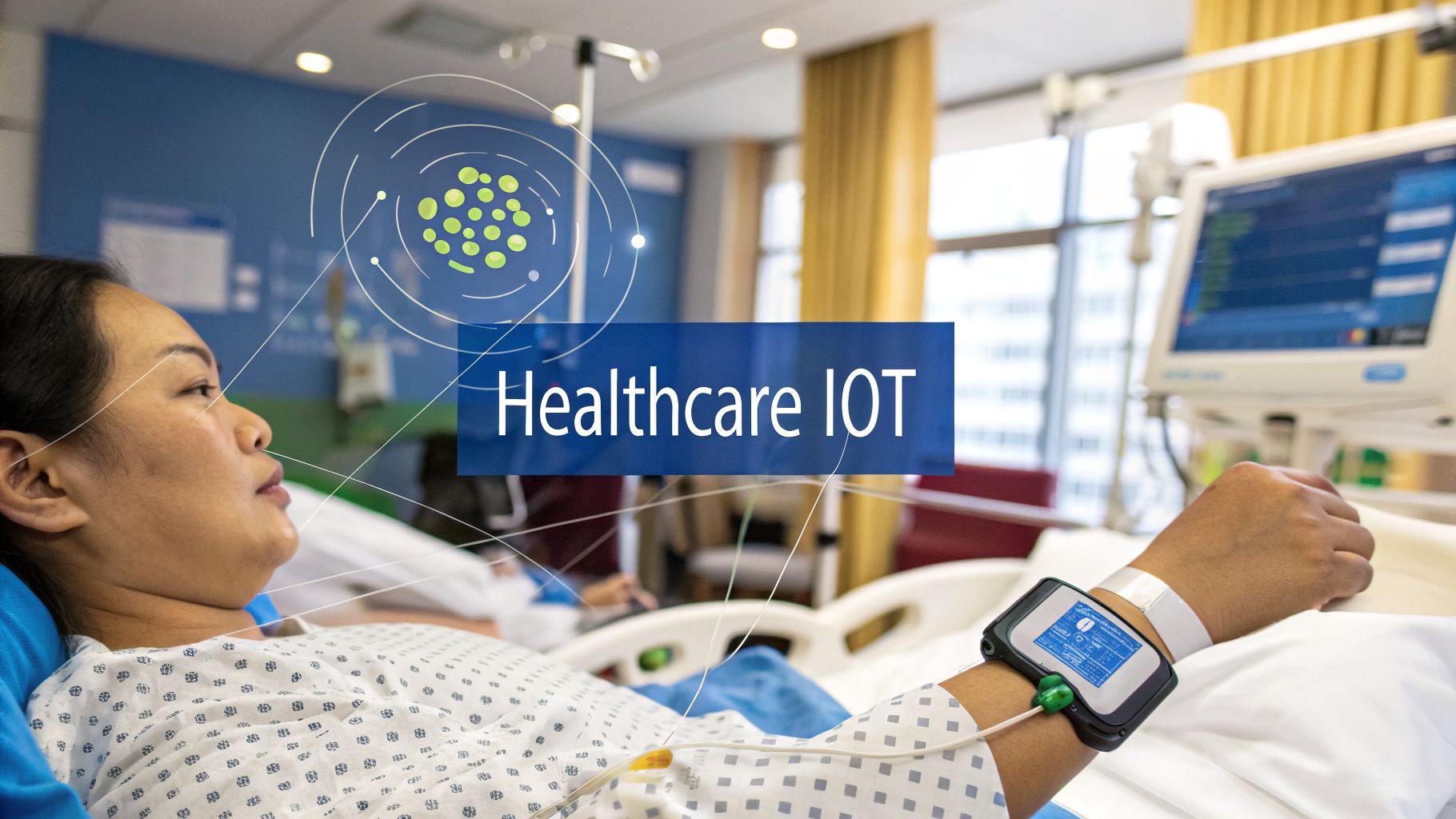
One of the biggest hurdles in healthcare has always been managing a patient's condition after they've left the clinic. Remote Patient Monitoring (RPM) is fundamentally changing this dynamic. Think about someone recovering from heart surgery or trying to control their diabetes. Instead of waiting for their next appointment, their care team gets a continuous, real-time look at their health.
This is all done with simple, non-intrusive devices that patients can easily use at home:
Smart Blood Pressure Cuffs: These can send daily readings automatically, helping doctors spot dangerous trends like hypertension long before a crisis occurs.
Connected Glucose Meters: Give both the patient and their endocrinologist an up-to-the-minute view of blood sugar, allowing for quick, precise adjustments to diet or insulin.
Wearable ECG Monitors: Can flag an irregular heartbeat the moment it happens, triggering an alert for immediate medical review.
This constant connection is more than just convenient; it’s a crucial safety net. It allows doctors to step in early and make proactive changes to treatment, which has been shown to dramatically cut down on costly and stressful hospital readmissions. For the patient, it means better quality of life and greater independence. For the system, it means freeing up beds for those who need them most.
Smart Asset and Personnel Tracking
Hospitals are incredibly complex environments, and you'd be surprised how much time staff waste just looking for things. Infusion pumps, wheelchairs, portable ultrasound machines, this vital equipment seems to vanish when it's needed most. This is a perfect problem for IoT to solve with asset and personnel tracking.
It works like an indoor GPS for the hospital. Small, low-power tags are attached to equipment, and staff can instantly pinpoint any item on a tablet or central dashboard. The impact of this seemingly simple change is enormous.
A nurse who might have spent 15 minutes searching for an available IV pump can now find one in under a minute. When you multiply that across hundreds of staff members over thousands of shifts, you’re reclaiming a massive amount of clinical time that goes straight back into patient care.
The same idea applies to people. IoT badges can provide an anonymised, real-time picture of how staff are distributed throughout a department. Administrators can spot bottlenecks, shift resources during busy periods, and find specialists like an on-call surgeon in seconds during an emergency. The whole environment becomes more organised, responsive, and far less chaotic.
Environment Monitoring for Safety and Compliance
Many of the most valuable assets in a hospital are also the most fragile. Vaccines, blood products, lab samples, and many medications must be stored within a very specific temperature and humidity range. If they deviate, they can be rendered useless. For years, this was monitored with clipboards and manual checks, a system just begging for human error.
IoT-powered sensors automate this entire process. Small wireless sensors placed inside medical fridges, freezers, and storage rooms provide 24/7 monitoring without anyone having to lift a finger.
The system doesn’t just log the data for compliance reports. Its most important job is to send instant alerts via text or email the second conditions drift out of the safe zone. If a freezer door is left open, staff get a notification long before thousands of dollars in sensitive biologics are compromised. This automated watchfulness guarantees regulatory compliance, prevents staggering financial losses, and, most importantly, protects the patients who depend on those materials from being unsafe.
How a Healthcare IoT System Actually Works
To really get a feel for what IoT can do in healthcare, it’s helpful to peek under the hood. While the tech itself can get complicated, the whole system is built on four logical layers. I like to think of it as a journey: raw data gets collected, sent on its way, processed into something meaningful, and finally delivered as a clear health insight.
Each layer has a specific job, and they all work in concert to move information smoothly from a patient or a piece of equipment right to the clinician who needs it. Let's walk through how it all connects.
The Sensor and Device Layer
It all starts here, at the very source. This first layer is the physical hardware, the sensors and devices that directly interact with a patient or the hospital environment. These are your front-line data collectors, capturing the tiny but crucial details that paint a picture of someone’s health or the status of medical gear.
These devices can take many forms, each built for a specific task:
Wearable Biosensors: Think smartwatches tracking heart rate, skin patches monitoring glucose, or small clips measuring blood oxygen saturation.
Stationary Medical Devices: This could be an internet-connected blood pressure cuff at a patient's home, a smart scale, or even hospital infusion pumps that report their status.
Environmental Sensors: These are the small monitors you might place in a medical fridge to ensure vaccines stay at the right temperature, or on a wheelchair to track its location and use.
The only job of this layer is to turn a physical event, like a heartbeat, a temperature fluctuation, or a machine’s movement, into a digital signal. This is the raw material that fuels the entire IoT system.
The Connectivity Layer
Once the data is captured, it needs a way to get from the device to a central point for analysis. That’s the job of the connectivity layer, which is basically the system's transport network. Picking the right connectivity option is a big decision, and it always comes down to the specific use case. You have to balance factors like range, how much power the device uses, and the volume of data being sent.
It’s a bit like choosing a delivery service. A small, local package might just need a bike courier (Bluetooth), while a large, cross-country shipment needs a transport truck (Cellular).
Choosing the Right Connectivity for Your Healthcare IoT Solution
| Connectivity Type | Range | Power Consumption | Data Rate | Best For |
|---|---|---|---|---|
| Bluetooth/BLE | Short (10-100m) | Very Low | Low | Connecting a patient’s wearable sensor to their smartphone; in-room device communication. |
| Wi-Fi | Medium (50-100m) | Medium-High | High | Transmitting large files like medical images within a hospital; high-bandwidth patient monitors. |
| Cellular (4G/5G) | Wide (kilometres) | High | High | Remote patient monitoring in homes without Wi-Fi; tracking mobile assets across a large campus or city. |
| LoRaWAN/LPWAN | Very Wide (kilometres) | Very Low | Very Low | Tracking non-critical assets like wheelchairs or IV poles over a large hospital campus; simple environmental sensors. |
This layer’s sole purpose is to get the data where it needs to go, securely and without fail.
The Data Processing Layer
After the data arrives, it’s still just a jumble of raw numbers. The processing layer is where this stream of information gets sorted, cleaned up, and prepared for real analysis. This work can happen in two main places: at the “edge” or in the “cloud.”
Edge processing happens close to the data source, either right on the device or on a nearby piece of hardware called a gateway. It’s perfect for time-sensitive tasks that demand an instant response, like a fall detection sensor that needs to trigger an alert immediately.
Cloud processing, on the other hand, is when data is sent to powerful remote servers for heavy-duty analysis. This is where you can analyse massive datasets from thousands of patients to spot public health trends, predict disease outbreaks, or train AI models to become even smarter.
The Application Layer
This final layer is the one that people, doctors, nurses, or patients actually see and use. It takes all that processed, meaningful data and presents it on a dashboard, in a report, or as an alert on a smartphone app. This is where the magic happens, turning raw data into intelligence you can act on.
A critical function here is connecting with the hospital’s core systems. To learn more about this, you can explore the benefits and challenges of EHR integration. This link ensures that IoT data doesn't live in a silo; instead, it flows right into a patient’s official health record. That gives clinicians a complete, 360-degree view of their patients’ health without having to juggle multiple programs. The application layer is what truly closes the loop, bridging the gap between sophisticated technology and better patient care.
This diagram helps visualise how different IoT applications fit together, from monitoring patients to tracking assets.

This kind of layered structure is how you build a truly comprehensive smart health ecosystem, piece by piece.
Inside the Modern Smart Hospital

While specific IoT tools are powerful on their own, the real magic happens when they’re woven together to create a "smart hospital." This isn't just about adding new gadgets; it's about creating a truly interconnected environment that’s safer, more efficient, and built entirely around the patient’s journey. Think of it as the ultimate expression of IoT in a healthcare setting.
A smart hospital functions less like a building and more like a single, responsive organism. It has a digital nervous system that connects every piece of equipment, every staff member, and every department. Information flows intelligently, automating routine work and giving staff the real-time insights they need to make better, faster decisions.
Optimising Patient Flow and Bed Management
One of the biggest headaches in any hospital is the constant shuffle of patients. The delays between one patient being discharged, a room being cleaned, and the next patient being admitted cause bottlenecks that can grind an entire facility to a halt. This is where a smart hospital’s connected systems really prove their worth.
Let’s walk through a common scenario. A doctor clears a patient for discharge and updates their status in the Electronic Health Record (EHR). In a traditional hospital, this might kick off a series of phone calls and manual alerts. In a smart hospital, it triggers an instant, automated sequence:
Housekeeping gets an immediate notification that the room is ready for turnover, including any special cleaning protocols.
The central bed management system updates automatically, flagging the bed as "pending cleaning" so admissions staff can plan ahead.
The pharmacy is prepped to prepare the patient's take-home prescriptions, ensuring they’re ready for pickup without a long wait.
This seamless coordination dramatically cuts down room turnover times. Instead of people chasing people, the system does the heavy lifting. The result? Incoming patients spend less time in waiting rooms, emergency departments are less crowded with admitted patients waiting for a bed, and the whole experience is far less stressful for everyone involved.
The impact here is undeniable. Canada's smart hospitals market, valued at US$ 2.14 billion in 2024, is expected to surge to US$ 12.76 billion by 2033. Facilities that integrate IoT solutions in healthcare for asset tracking and patient flow see operational costs drop by 15-20%. In Toronto, major hospitals using IoT sensors to monitor over 10,000 beds have already cut patient wait times by an impressive 30% with dynamic bed allocation. You can learn more about the growth of Canada's smart hospitals market from recent industry data.
Predictive Maintenance for Critical Equipment
Hospital equipment like MRI machines and CT scanners is both incredibly expensive and essential. When one goes down unexpectedly, it’s not just an inconvenience; it can delay critical diagnoses, force dozens of appointments to be rescheduled, and cost the hospital a fortune in lost revenue.
Smart hospitals are shifting from reactive repairs to predictive maintenance. By embedding IoT sensors in this vital machinery, they can constantly monitor performance indicators like temperature, vibration, and energy use. This data streams to an analytics platform that looks for the tiny, subtle signs of an impending problem.
For example, the system might detect a minor increase in the vibration of an MRI’s cooling pump, a classic sign of a bearing starting to wear out. This triggers an alert for the maintenance team, allowing them to schedule a repair during planned downtime instead of waiting for a catastrophic failure. This proactive approach keeps equipment running and ready for the patients who depend on it.
Connecting Innovations to Tangible Outcomes
At the end of the day, a smart hospital isn’t about flashy technology; it's about achieving measurable results. Building this kind of integrated system takes careful planning, often starting with a solid foundation like custom hospital management software development.
The benefits are clear and direct:
Reduced Operational Costs: Automated workflows and predictive maintenance cut down on labour costs, emergency repair bills, and lost revenue from equipment downtime.
Higher Staff Morale: When you eliminate tedious work like hunting for a wheelchair or making endless calls to check on a room’s status, staff can focus on what they do best: patient care.
Superior Patient Care: Ultimately, every improvement in efficiency and safety makes its way to the patient. Faster admissions, shorter waits, and the confidence that equipment is always ready lead directly to better health outcomes and higher satisfaction.
Securing Patient Data in a Connected World

Let's be direct: every time we add a new device to a healthcare network, we're creating another potential doorway for a cyberattack. This incredible connectivity brings with it an immense responsibility. For IoT solutions in healthcare, that responsibility centres squarely on protecting sensitive patient information with absolute rigour. Trust is the currency of healthcare, and a single security breach can destroy it in an instant.
Every connected device, from a patient's remote heart monitor to a hospital's smart infusion pump, is a touchpoint for deeply personal and legally protected data. Here in Canada, that means unwavering compliance with privacy laws like the Personal Information Protection and Electronic Documents Act (PIPEDA). This isn't just a box to tick; it's the fundamental groundwork for any successful IoT strategy in healthcare.
Building a Digital Fortress Around Patient Data
I like to think of a security strategy as a digital fortress. It’s not enough to have one tall, strong wall. You need multiple, overlapping layers of defence to truly be effective. A solid security framework is built on several pillars, each designed to guard patient data at every point in its journey.
A huge part of this is understanding what a data breach entails and how to prevent one, because you simply can't leave patient privacy to chance. The best defence always begins with the assumption that threats are already out there, looking for a way in.
Your security is only as strong as its weakest link. For healthcare IoT, this means every single sensor, gateway, network connection, and cloud database must be secured. A comprehensive approach leaves no room for assumptions.
This multi-layered defence is what ultimately builds a system that both clinicians and patients can rely on. If you want to dive deeper, you can explore our guide on the importance of cybersecurity in the healthcare industry.
Essential Security Measures for Healthcare IoT
To bring that digital fortress to life, your organisation needs to put specific, non-negotiable security controls in place. These technical measures work in concert to build a resilient shield against a wide array of cyber threats.
End-to-End Data Encryption: Think of this as putting data into a locked safe before you send it anywhere. Information must be encrypted both in transit (while moving from a sensor to the cloud) and at rest (when stored in a database). This makes the data completely unreadable to anyone without the key, rendering it useless even if it’s intercepted.
Secure Device Authentication: Not just anyone can walk into your fortress. Every device must prove its identity before it can join your network. Using unique digital certificates ensures that only authorised and validated devices can connect, effectively slamming the door on rogue hardware.
Continuous Network Monitoring: Security isn't a one-and-done job; it's a 24/7 watch. You need automated tools that constantly scan network traffic for unusual or suspicious behaviour. These systems can spot anomalies in real-time, giving your security team a crucial head start to neutralise a threat before it becomes a full-blown crisis.
By embedding these core security principles into your strategy, you can adopt powerful IoT solutions in healthcare with confidence. This proactive approach doesn't just satisfy regulations like PIPEDA; it builds the foundation of trust that assures patients their most private information is safe.
Here is the rewritten section:
Your Roadmap to Implementing Healthcare IoT
Bringing new technology into a healthcare setting can seem daunting, but adopting IoT solutions in healthcare is more manageable than you might think. The most successful organisations don't try to do everything at once. They follow a simple, proven path: think big, start small, and prove your value every step of the way.
This approach minimises risk, builds crucial buy-in from your teams, and turns your first project into a solid foundation for future innovation. Let’s walk through the four stages of a successful IoT implementation.
Stage 1: Start With a High-Impact Problem
Your first move has nothing to do with technology. It’s about finding a single, nagging problem inside your organisation that is crying out for a solution. Don't try to boil the ocean. Instead, pinpoint one specific, measurable issue where a connected device could make a real, tangible difference.
Often, the best places to start are where you see obvious inefficiencies or compliance headaches:
Asset Management: How much time do nurses waste looking for essential equipment like IV pumps or wheelchairs? This is a classic, high-return starting point.
Compliance: Is someone on your team still manually logging refrigerator temperatures for vaccines or lab samples? This is a perfect task for automation.
Patient Readmissions: Do you see high readmission rates for a specific patient group, such as those with congestive heart failure? Remote monitoring could be the answer.
By choosing a focused problem with a clear success metric (e.g., "cut equipment search time by 50%"), you create the perfect, low-risk test case.
Stage 2: Run a Focused Pilot Project
Once you have your problem in sight, it's time to run a small-scale pilot project. A pilot is your chance to test the IoT solution in a controlled, real-world setting. It allows you to gather data and prove the technology's value without the pressure of a massive, facility-wide rollout.
For instance, if you chose asset tracking, you wouldn't tag every piece of equipment in the hospital. Instead, you might tag just 20 high-value, frequently used devices in one department, like the emergency room. Over a couple of months, you can track how often the devices are used, how quickly they're found, and what the staff thinks. This tight scope makes it easy to manage, measure, and fix any issues that pop up.
Stage 3: Measure Key Metrics and Build the Business Case
A successful pilot gives you something incredibly valuable: data. And that data is what you’ll use to get the green light for a larger investment. While the pilot is running, you need to be obsessive about tracking the key performance indicators (KPIs) you identified back in stage one.
The point of a pilot isn’t just to see if the tech works; it’s to build an undeniable business case. If you can prove that automated temperature monitoring saved $10,000 in potential vaccine spoilage in just three months, you have a story that finance leaders will listen to.
Collect both the numbers (cost savings, hours saved) and the stories (less stress for nurses, improved morale). Combining hard data with the human impact creates a compelling narrative that wins over both financial decision-makers and clinical leaders.
Stage 4: Scale and Integrate Thoughtfully
With a successful pilot and a rock-solid business case, you’re ready for the final stage: scaling up. This means expanding the project, whether it's to other departments or across your entire organisation. It also means thinking about how this new IoT solution will integrate with your core systems, like your Electronic Health Record (EHR).
This is where choosing the right partner is absolutely critical. You need a vendor with a proven track record in healthcare, a firm grasp of Canadian compliance rules like PIPEDA, and a platform that can grow with you. A great partner won't just sell you hardware; they’ll help you plan for scale, navigate tricky integrations, and ensure your IoT solutions in healthcare continue to deliver value for years to come.
Answering Your Questions About IoT in Healthcare
When organisations start looking into connected health technology, a lot of practical questions pop up. It’s completely normal. Let's walk through some of the most common ones we hear from clinics and hospitals.
What Kind of ROI Can We Realistically Expect?
That's the big question, isn't it? The return on investment (ROI) really depends on what you’re trying to achieve, but the results are often clear and surprisingly fast.
Take asset tracking, for example. We've seen hospitals cut the time staff spend hunting for equipment, like infusion pumps or wheelchairs, by over 80%. When you factor in that reclaimed time and the reduced cost of replacing "lost" gear, many see a full return on their investment in just 12 to 18 months.
For remote patient monitoring, the ROI comes from a different angle. It's about reducing costly hospital readmissions and improving how chronic conditions are managed, which lowers the long-term cost of care. The best way to pin down your specific ROI is to start with a focused pilot project.
Is This Technology Affordable for a Small Clinic?
Yes, absolutely. You don't need a massive, hospital-wide system to get started. The key for smaller practices is to begin with targeted, affordable IoT solutions in healthcare that solve a single, nagging problem.
A perfect starting point is automated temperature monitoring for refrigerators storing vaccines and medications. This simple fix gets rid of manual logging, prevents expensive spoilage, and pays for itself very quickly. Another great option is to offer basic remote monitoring for a small group of patients using off-the-shelf wearables, often through a subscription service to keep upfront costs low.
The most effective strategy for any organisation, large or small, is to start with a clear, high-impact use case. This allows you to demonstrate value quickly and build momentum for future projects. As you plan your implementation strategy, you can explore specific offerings like the Splash Access IoT Solution to see what’s possible.
How Does IoT Actually Connect With Our EHR System?
This is a critical piece of the puzzle, but integration is more straightforward than many people think. Modern IoT platforms are built from the ground up to communicate with Electronic Health Record (EHR) systems using well-established data standards.
Think of it like a secure bridge. This connection is usually made using Application Programming Interfaces (APIs), which allow patient data from IoT devices, like daily blood pressure readings or glucose levels, to flow directly and securely into their chart. This gives clinicians a complete, real-time picture of a patient's health right within the EHR, creating a much more unified and efficient workflow.
At Cleffex, we specialise in developing secure, compliant, and scalable software that powers the next generation of healthcare. If you're ready to solve your biggest operational challenges with technology, let's build the solution together. Learn more about our custom software development services.