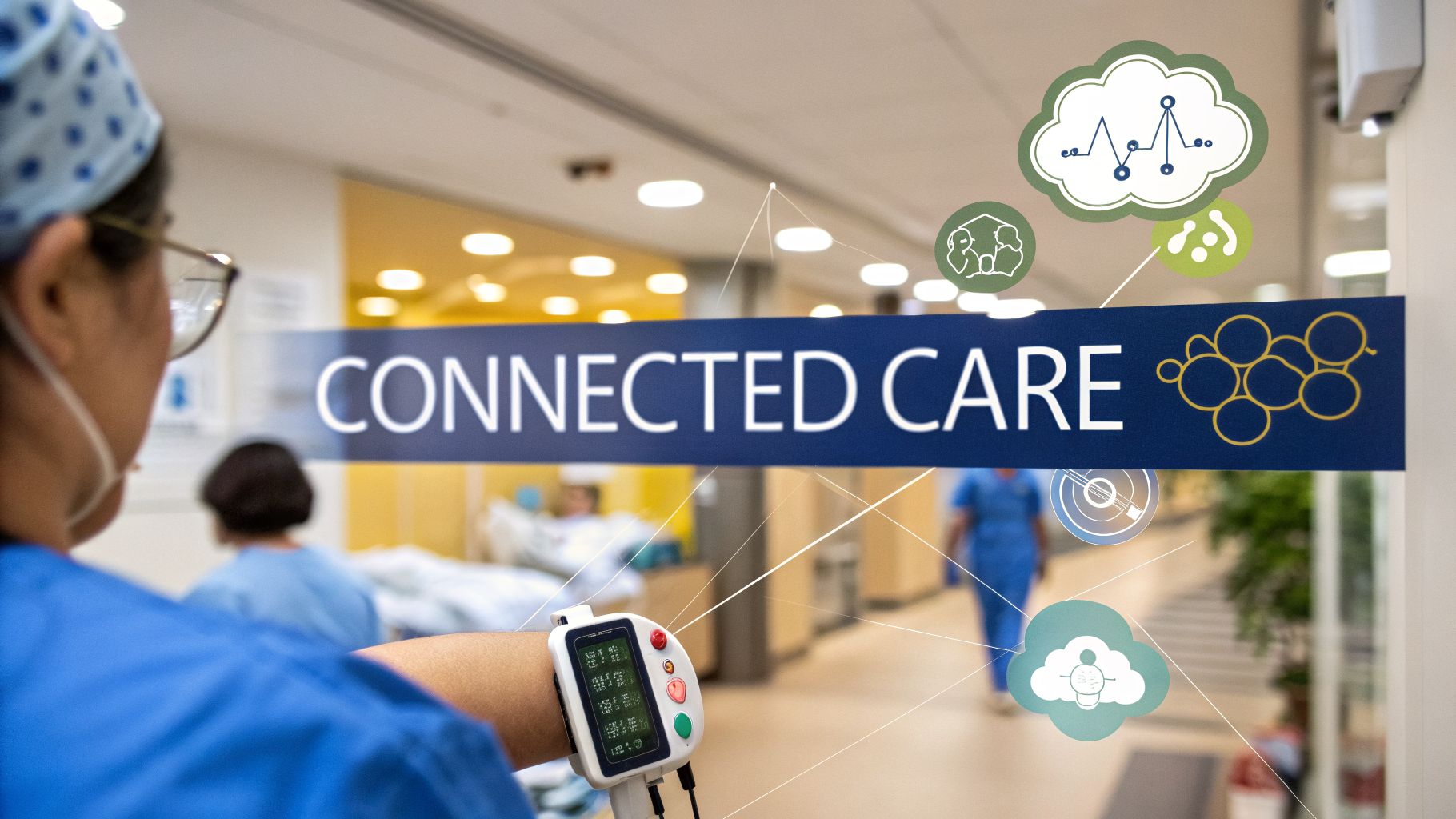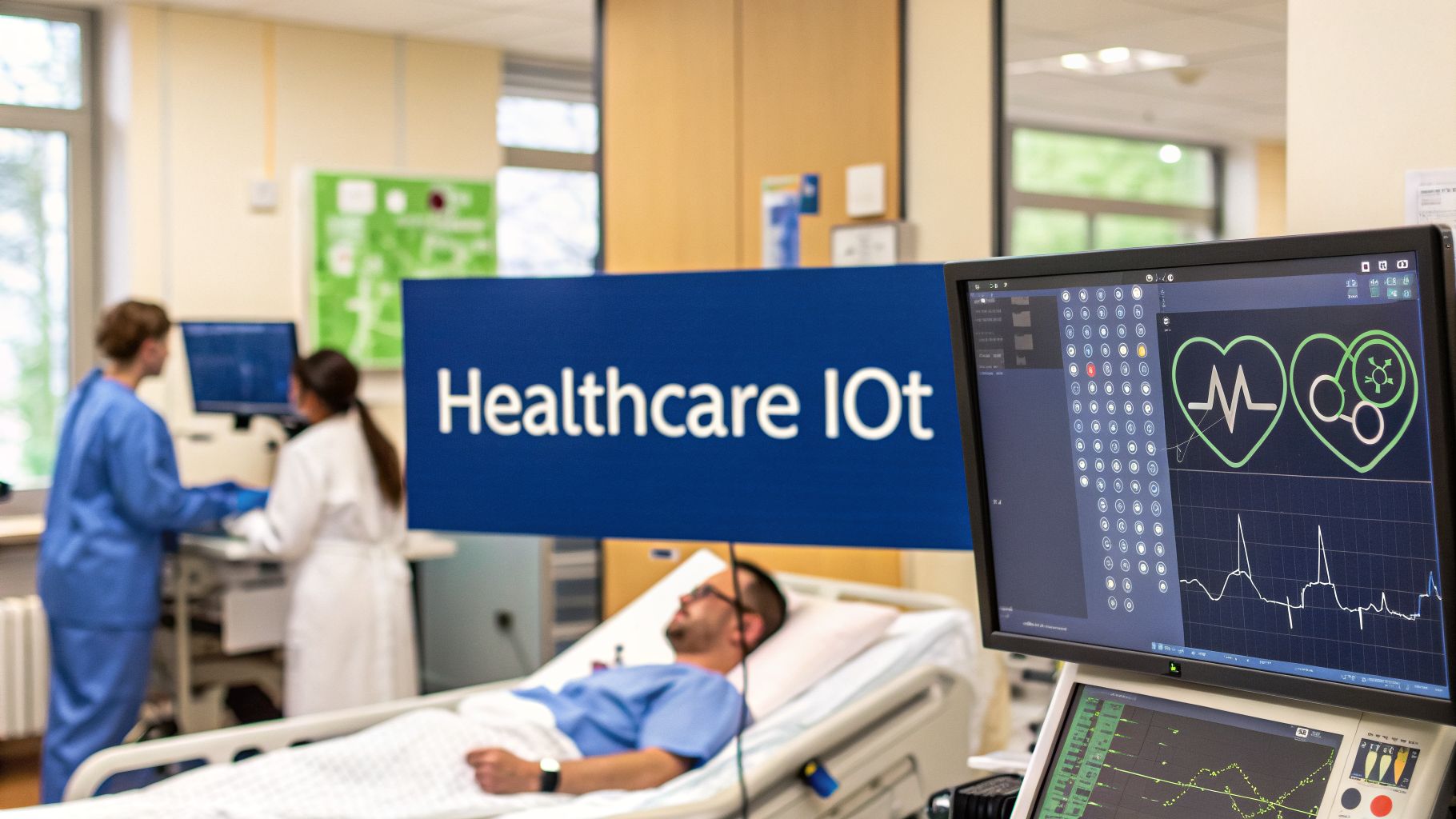


At its core, a healthcare IoT solution is a network of connected medical devices, sensors, and equipment that gather and share health data in real time. It's about turning standard medical tools into smart, data-gathering assets. The goal? To enable proactive patient monitoring, automate routine tasks, and give clinicians the data they need to make better, faster decisions.
The New Nervous System of Modern Healthcare
Think of your hospital or clinic as a human body. In this picture, healthcare IoT is the body’s central nervous system. Smart sensors and connected devices act like nerve endings, constantly collecting vital information from every patient room, lab, and operating theatre.
This stream of data flows securely to a central “brain”, often a cloud platform, where it’s analysed to guide intelligent, on-the-spot decisions. This is the simple but powerful idea behind healthcare IoT solutions.
This isn't just a futuristic concept; it’s a practical technology already tackling some of healthcare's toughest problems. From managing an ageing population with chronic illnesses to getting a handle on rising operational costs, connected health is paving the way for a more proactive, predictive, and personalised approach to care.
From Reactive to Proactive Care
For decades, healthcare has been fundamentally reactive, responding to health problems only after they appear. IoT flips that model on its head, shifting the focus to prevention and early intervention. For instance, a wearable sensor can pick up an irregular heart rhythm and instantly alert a patient's care team, long before it becomes a critical cardiac event. This ability to act first is a cornerstone of the digital transformation of healthcare, where data gives clinicians the power to be proactive.
The foundation of this "new nervous system" relies on robust underlying infrastructure. This is true whether building a private clinic's network or designing a modern NHS network infrastructure for public health systems.
Driving Growth and Efficiency in Canadian Hospitals
The adoption of these technologies is not just a trend; it's a market that's growing incredibly fast. In Canada, the smart hospitals market is expected to jump from US$2.54 billion in 2026 to a massive US$12.76 billion by 2033. This growth is being driven by IoT-powered innovations that are completely changing how hospitals run. Ontario is a great example, with major health networks using IoT command centres to predict patient admission surges and cut down on readmissions.
This boom is directly linked to the push for value-based care. Real-time IoT monitoring helps healthcare facilities:
Reduce costly medical errors
Save money by automating manual tasks
Optimise bed turnover and staff workloads
For clinics, hospitals, and startups alike, getting to grips with healthcare IoT is no longer optional. It's the key to delivering better patient care, running a more efficient operation, and building a stronger, more resilient healthcare system for everyone. The real-world applications we'll explore next show just how powerful this technology can be.
So, what’s really going on inside a healthcare IoT solution? When you strip away the jargon, it's a straightforward process that turns raw data from a patient into a decisive clinical action.
Think of it as a four-step relay race. Each part of the system has a specific job: to gather information, pass it along securely, make sense of it, and finally, deliver it to the right person so they can act. It’s this seamless handoff that transforms a simple sensor reading into a life-saving intervention. Let's walk through how this all comes together.
The Four Essential Layers
At its core, every healthcare IoT architecture is built on four functional layers. Each layer builds upon the last, creating a chain of events that starts with a patient and ends with a smarter care decision.
To help visualise this, here’s a breakdown of the core components that make up a typical healthcare IoT ecosystem.
Core Components of a Healthcare IoT Ecosystem
| Component Layer | Function (What It Does) | Examples in a Hospital Setting |
|---|---|---|
| 1. The Collectors | Gathers raw physiological or environmental data directly from the patient or their surroundings. | Smartwatches tracking ECG, continuous glucose monitors (CGMs), smart beds monitoring vitals, and connected inhalers. |
| 2. The Messengers | Securely transmit the collected data from the sensor to a central processing platform. | Bluetooth LE connecting a wearable to a phone, Wi-Fi for in-hospital devices, 5G for remote patient monitoring. |
| 3. The Interpreters | Processes, stores, and analyses incoming data streams to identify patterns, trends, and anomalies. | A cloud platform running AI to predict cardiac events, and an edge server tracking equipment location in real-time. |
| 4. The Decision-Makers | Presents actionable insights to clinicians or patients through a user-friendly interface. | An alert on a nurse's mobile device, a dashboard in a command centre, a report in an electronic health record (EHR). |
These four layers work in concert to create a complete, end-to-end solution. Now, let’s take a closer look at the specific role each one plays.
Layer 1: The Collectors (Sensors And Devices)
Everything starts here, at the very edge of the network, with the Collectors. These are the smart medical devices and sensors, the system’s eyes and ears. Their entire purpose is to capture a specific piece of information, whether it’s a patient’s heart rate or the temperature of a vaccine fridge.
You’ll find these collectors in all shapes and sizes, including:
Wearable Sensors: Devices like smartwatches or patches that constantly track vitals like ECG, blood oxygen, and activity levels.
Continuous Glucose Monitors (CGMs): Tiny sensors that give people with diabetes a real-time view of their blood sugar, eliminating the need for constant finger pricks.
Smart Beds: Hospital beds that can monitor a patient’s movement and vitals to help prevent falls and pressure sores before they happen.
Connected Inhalers: Smart devices that track medication usage, ensuring patients with asthma or COPD stick to their treatment plans.
This simple diagram shows the fundamental flow: data is gathered by a sensor, sent across a network, and used to make a clinical decision.

Once a sensor collects that piece of data, it can't just sit there. It needs a secure and reliable way to get to the next stage.
Layer 2: The Messengers (Connectivity)
After a collector captures a data point, it hands it off to the Messengers. This is the connectivity layer, the secure data highway that transports information from the device to a central processing hub. The technology used here is never one-size-fits-all; it’s chosen based on what the specific situation demands, balancing range, battery life, and data volume.
Some of the most common connectivity options include:
Bluetooth Low Energy (BLE): Perfect for short-range tasks, like a heart rate monitor sending data to a patient's smartphone.
Wi-Fi: The go-to for in-facility devices like smart infusion pumps and vital sign monitors that need a stable connection to the hospital’s network.
Cellular (4G/5G): Absolutely critical for remote patient monitoring, enabling devices in a patient’s home to send data directly to a clinician in the cloud.
The reliability of this communication layer is non-negotiable. It has to be robust and secure enough to handle sensitive patient information without failure or security breaches. For any organisation building these systems, engaging with professional IoT services is a key step in developing a network that can scale safely.
Layer 3: The Interpreters (Data Processing and Analytics)
Once the data completes its journey across the network, it arrives at the Interpreters. This is the brain of the operation, a powerful cloud or edge computing platform where raw data becomes medical intelligence. A single blood pressure reading is just a number; thousands of them over several weeks reveal a trend. This is where that transformation happens.
Here, advanced software and algorithms get to work. Machine learning models might sift through ECG streams to flag early signs of a cardiac event, or an analytics engine might track the location of every IV pump in the hospital to streamline workflow for nurses. This is where the real "smarts" of the system reside.
Layer 4: The Decision-Makers (The Application Layer)
Finally, the processed, meaningful data is handed to the Decision-Makers. This is the application layer, the point where technology and human expertise intersect. It’s the user interface where clinicians or even patients can see and act on the insights the system has generated.
This could be a real-time dashboard in a hospital’s command centre, a critical alert pushed to a nurse’s smartphone, or a detailed report that automatically populates a patient's electronic health record (EHR). This is the final, crucial step that empowers care teams to make faster, more informed decisions that directly improve patient outcomes.
Improving Patient Outcomes With IoT Applications

While the technology itself is impressive, the real story of healthcare IoT solutions is how they directly change patients' lives. This isn't just about collecting data; it's about turning that stream of information into better health, greater independence, and genuine peace of mind.
These applications effectively erase the line between the hospital and the home, transforming everyday spaces into extensions of the clinical care setting. Let’s look at a few real-world scenarios that show how profoundly these tools are reshaping the patient experience.
Empowering Patients Beyond Hospital Walls
One of the most powerful applications is Remote Patient Monitoring (RPM). Picture a patient named David, who's managing a chronic heart condition. In the past, his care was a series of appointments, leaving long, unmonitored gaps where anything could happen.
Now, with RPM, David wears a simple smartwatch that keeps a constant eye on his heart rate, blood pressure, and ECG. That data flows securely to his cardiology team in real-time. If the system flags a worrying arrhythmia, a nurse is automatically alerted and can jump on a video call with David to see what’s going on.
This proactive connection keeps patients feeling secure and supported right from their own homes. In fact, studies show that RPM can cut hospital readmissions for conditions like heart failure by an incredible 50%.
This constant link gives David the confidence to go about his life, knowing his care team is always there in the background. It's a fundamental move away from reactive "sick care" and toward truly preventive healthcare.
Enhancing Care With Smart Devices
The innovation doesn't stop with monitoring. A whole host of smart devices are giving both patients and providers a much clearer picture of health and more control over treatment.
Continuous Glucose Monitors (CGMs): For the millions of people living with diabetes, CGMs have been nothing short of life-changing. A tiny sensor provides a continuous feed of blood sugar data to a smartphone, finally ending the era of constant, painful finger pricks. This allows patients and their doctors to see exactly how diet, exercise, and medication influence glucose levels, enabling far tighter control over the condition.
Smart Pills and Medication Adherence: Simply forgetting to take medication is a huge barrier to effective treatment, particularly for elderly patients or those on complex regimens. Ingestible sensors, often called "smart pills," can solve this. Once swallowed, a tiny sensor sends a signal to a patch on the skin, which then confirms to an app that the dose was taken. This ensures patients stick to their treatment plan, which is critical for success.
Wearable ECG and Heart Monitoring: Today’s smartwatches have become surprisingly powerful personal health devices. They can run an ECG on demand, detect irregular heart rhythms like atrial fibrillation (AFib), and flag unusual heart rates. To really grasp what these devices can and can’t do, it’s worth hearing from the experts. You can find a fantastic deep dive in the ultimate cardiologist’s guide to the smartwatch ECG.
Creating Safer Environments Inside the Hospital
IoT isn't just for care at a distance; it also makes the hospital itself a safer, more intelligent environment. Within the busy walls of a facility, these solutions act as a digital safety net for everyone.
For instance, Real-Time Location Systems (RTLS) use small tags to track patients who might be at risk of wandering, like those with dementia. If a patient strays into a restricted area, the nursing station gets an immediate alert, allowing staff to respond in seconds.
In the Intensive Care Unit (ICU), smart monitors are doing more than just displaying vitals. They now use AI to analyse trends in a patient’s data, spotting the subtle signs of deterioration, like the onset of sepsis, hours before a human might. This early warning gives care teams a crucial head start, often making the difference between a full recovery and a critical incident.
Each of these applications shares a common goal: using technology to deliver a more personalised, proactive, and patient-centred model of care. The result is a win-win, where patients feel more in control of their health and providers can achieve far better clinical outcomes.
Boosting Clinic and Hospital Efficiency With IoT

While the focus is often on patients, healthcare IoT solutions are just as powerful for tackling the business of running a medical facility. For hospital administrators and clinic managers, this technology turns daily operational headaches into clear, data-driven opportunities for improvement. It’s about making the entire facility run smarter, not just harder.
Think about the time nurses lose hunting for an available IV pump or wheelchair. It’s a frustratingly common scenario, and those minutes add up to countless lost hours every week. With IoT-powered asset tracking, that problem vanishes. Staff get a real-time map showing the location of every critical piece of equipment.
This operational focus is where IoT demonstrates its worth far beyond the patient’s bedside; it shows up directly on the balance sheet. By solving these practical, everyday challenges, these solutions help clinics and hospitals become safer, more efficient, and more profitable.
Eliminating Waste and Protecting Assets
One of the most immediate pay-offs from implementing healthcare IoT is the ability to monitor and safeguard valuable physical assets. This is about more than just finding lost equipment; it's about automating vital checks and preventing expensive failures before they ever happen.
A perfect example of this is environmental monitoring. Temperature-sensitive materials like vaccines, blood products, and lab samples demand constant attention. The old way, manually logging refrigerator temperatures, is not only a drain on staff time but also ripe for human error. A single mistake can result in thousands of dollars in spoiled supplies.
IoT sensors completely automate this process. They provide 24/7 monitoring and fire off instant alerts if temperatures drift outside a safe range, preventing massive losses and ensuring regulatory compliance without anyone lifting a finger.
Then there's predictive maintenance for high-value equipment like MRI or CT scanners. When one of these machines goes down unexpectedly, it causes a cascade of cancelled appointments, lost revenue, and major care disruptions. IoT sensors can keep a close watch on a machine’s performance, tracking subtle shifts in vibration, temperature, or energy consumption.
By analysing this data, the system can predict when a part is likely to fail, allowing maintenance to be scheduled proactively during off-hours. This approach changes maintenance from a reactive firefight into a planned, efficient process.
Optimising Staff and Patient Flow
Perhaps the most sophisticated use of operational IoT is in creating a "smart hospital" command centre. Think of it as the facility's nerve centre, where data from every corner of the hospital flows together to create a single, real-time view of everything that's happening.
This command centre pulls in data from all kinds of IoT sources to:
Track patient flow: Follow patient journeys from admission to discharge, instantly spotting bottlenecks in the emergency department, imaging, or elsewhere.
Optimise bed management: Get an accurate, up-to-the-minute status of every bed, which helps speed up turnover and slash wait times for new patients.
Improve staff allocation: See exactly where nurses and other staff are needed most, letting managers move resources dynamically based on real-time patient loads.
This level of insight gives administrators the ability to manage their facility with incredible precision. Instead of relying on old data or gut feelings, they can make decisions based on what’s happening right now. Integrating this data into a single platform is a key part of how this works, a concept we explore further in our guide on hospital materials management software.
By making sense of operational data, healthcare IoT helps turn the hospital itself into a smart, responsive environment. This not only leads to major cost savings but also frees up clinical staff to spend less time on logistics and more time where it truly matters, with their patients.
Building Trust Through Security and Compliance
When you’re dealing with something as personal as health data, trust is everything. For any healthcare IoT solution to get off the ground, patients, doctors, and hospital administrators all need to feel certain that sensitive information is locked down and private. It’s a huge challenge; how do you protect potentially thousands of connected devices from cyber threats while also safeguarding protected health information (PHI)?
This isn't just a box to check at the end of a project; it's the very foundation. A startling analysis found that nearly 73% of all connected IoT devices are vulnerable to cyberattacks. That number makes a rock-solid security framework non-negotiable. Building that trust means going far beyond basic security and creating layers of defence designed specifically for the unique, high-stakes world of healthcare.
The answer isn't a single piece of software, but an ongoing, disciplined strategy. It’s about creating a secure ecosystem where every sensor, every network connection, and every bit of data is protected from start to finish.
Fortifying the Digital Walls
Securing a healthcare IoT network is a lot like defending a modern fortress. You need strong walls (encryption), vigilant guards (access controls), and a clear plan for when things go wrong. The sheer number and variety of devices, from simple wearable sensors to complex MRI machines, create a massive target for attackers, demanding a truly comprehensive approach.
Here are some of the key best practices we see in successful deployments:
End-to-End Encryption: This is non-negotiable. All data must be encrypted, both while it's travelling from a sensor to the network (in transit) and when it's sitting on a server or in the cloud (at rest). If data is intercepted, it’s just unreadable gibberish to anyone without the key.
Network Segmentation: Your IoT devices should never be on the same network as your core hospital systems, like the Electronic Health Record (EHR). By creating a separate, isolated network for these devices, you can contain a potential breach and stop it from spreading to your most critical systems.
Disciplined Device Management: Every new device plugged into the network is another potential doorway for an attacker. You need a strict protocol for patching and updating firmware to close known security holes. This includes a plan for the device's entire life, from the moment it's turned on to when it's eventually retired.
A strong security posture isn't just about fending off attacks; it’s a direct reflection of your commitment to patient safety. Trust is built when patients feel confident that their most personal information is being handled with the highest degree of care.
Navigating the Regulatory Maze
Beyond the technical side, you have a legal and ethical duty to comply with data privacy laws. In Canada, the main piece of legislation is the Personal Information Protection and Electronic Documents Act (PIPEDA). For healthcare providers, this means being completely transparent with patients about what data you’re collecting and exactly how you plan to use it.
Similar rules exist all over the world, like GDPR in Europe and HIPAA in the United States. While the details vary, they all revolve around one core idea: people should have control over their own data. For any healthcare IoT solutions project, this means you must:
Ensure Data Portability: Patients have a right to get a copy of the data their devices generate and to share it as they see fit.
Maintain Strict Privacy Controls: You have to strike a delicate balance between making data accessible for care and protecting patient privacy, especially when personal and medical information are combined.
Implement Role-Based Access Control (RBAC): Only authorised staff should be able to see patient data, and their access should be restricted to the absolute minimum they need to do their jobs.
Ultimately, strong security and diligent compliance aren’t roadblocks to innovation. They are the very bedrock that allows successful, trustworthy, and effective healthcare IoT solutions to be built. They are what turn a simple network of devices into a system that both patients and providers can truly depend on.
A Practical Roadmap for Implementing IoT Solutions
Bringing healthcare IoT solutions into your facility can seem like a monumental task. The trick is to avoid trying to do everything at once. A much smarter approach is to follow a phased roadmap that breaks the project down into manageable, logical steps. This way, you build momentum, get your staff on board, and prove the value of the investment as you go.
Think of it less as a giant leap of faith and more as a series of deliberate steps. Each stage builds on the last, de-risking the entire project and making sure the technology you adopt actually solves problems your organisation is facing today. The goal is to evolve from a small, focused pilot to a fully scaled and optimised system.
Phase 1: Strategy and Assessment
Before you even think about buying a sensor, you need a solid plan. This first phase is all about asking sharp, specific questions. What, exactly, are you trying to fix? Are you hoping to lower readmission rates for congestive heart failure patients? Or maybe you just want to stop wasting hours searching for misplaced IV pumps?
Pick an initial project that promises high impact and low complexity. For instance, monitoring the temperature of refrigerators holding sensitive medications is a perfect starting point. It’s a contained problem with a straightforward and easily calculated return on investment, a much safer bet than a sprawling remote patient monitoring program for your very first project.
The most important thing is to define what success looks like right from the start. A good pilot isn’t just about the technology working; it’s about hitting a specific, predetermined clinical or operational target.
Phase 2: Vendor and Technology Selection
Once you know what your pilot project will be, it's time to pick your partners and the tech you'll use. This goes far beyond comparing feature lists and price tags. You need a partner who genuinely understands the unique pressures of healthcare, especially when it comes to security, regulatory compliance, and the realities of clinical workflows. If a vendor can only talk about their devices without discussing how they'll integrate into your daily operations, that’s a major red flag.
Choosing a technology partner is a long-term commitment. You're not just buying a piece of hardware; you're building a relationship that will be fundamental to your digital health projects for years to come.
As you start talking to potential vendors, it’s helpful to have a clear checklist. Here are the most important criteria to weigh when making your decision.
Key Criteria for Selecting an IoT Vendor
| Evaluation Criterion | Why It Matters | What to Look For |
|---|---|---|
| Proven Healthcare Experience | Healthcare is not like other industries. You need a partner who has been in the trenches and understands clinical environments. | Ask for real-world case studies from hospitals or clinics similar to yours. Don't be afraid to ask for references. |
| Security & Compliance Expertise | A data breach could be catastrophic. Your vendor must be an expert in protecting patient information and meeting all regulations. | Look for deep knowledge of PIPEDA, robust data encryption methods (both in transit and at rest), and secure device management protocols. |
| Integration Capabilities | If the IoT data can't get into your main systems, it creates isolated data silos and manual work for your staff. | The vendor must demonstrate a clear, proven path for integrating with your EHR and other critical software. Ask for technical details. |
| Scalability | The solution you choose for a small pilot needs to be able to grow with you. | Ensure the architecture is designed to scale. You don't want to get locked into a system that can't expand across the entire organisation. |
By using a structured evaluation like this, you ensure you're choosing a true partner, not just a supplier.
Phase 3: Integration and Deployment
With your strategy and partner locked in, the real work begins. This phase is all about the technical heavy lifting: integrating the new IoT system with your existing infrastructure. A top priority is making sure it talks to your Electronic Health Record (EHR). The goal here is a seamless flow of information. Data from a patient's smart device should appear in their chart automatically, with no one having to type it in by hand.
This is also the moment where staff training is critical. A successful rollout means getting your clinical teams genuinely interested in the new tools. You need to show them how this technology makes their jobs easier and solves a real frustration, not just adds another task to their already busy day. When the pilot project fixes a genuine pain point, your team will become its biggest advocates.
Phase 4: Scaling and Optimisation
A successful pilot isn’t the end of the road; it’s the starting point. This final phase is about taking what you learned and expanding the solution to other departments or for new uses. By now, you've demonstrated the ROI, smoothed out any technical issues, and gathered invaluable feedback from the people using the system every day.
This cycle of Deploy > Measure > Learn is how you build a powerful, facility-wide IoT strategy. You can confidently grow from monitoring a few refrigerators to full-scale asset tracking, or expand a small RPM pilot for one condition into a comprehensive chronic care management program. This phased approach turns what seems like an intimidating project into an achievable and incredibly valuable journey.
Frequently Asked Questions About Healthcare IoT
Getting into connected health brings up a lot of questions, whether you're running a clinic, managing a hospital's IT department, or launching a startup. We hear them all the time. Here are some straightforward answers to the most common queries we see when it comes to implementing healthcare IoT solutions.
We aim to cut through the noise and give you the practical insights you need to feel confident about bringing this technology into your organisation.
What Is the Best First Step for a Small Clinic To Start Using IoT?
The biggest mistake is trying to do too much at once. For a small clinic, the best starting point is to pinpoint your single biggest operational headache that technology could realistically solve.
Start with a focused pilot project. For example, you could track your most expensive portable equipment to prevent loss or monitor a small group of patients with chronic conditions remotely. This small-scale approach proves the value and ROI, gets your staff comfortable with the new workflow, and teaches you valuable lessons before you commit to a larger investment. Finding a development partner who can build a custom solution that’s designed to scale is crucial; it ensures your pilot project has a future.
How Do You Ensure Patient Data From IoT Devices Is Secure?
Securing patient data from IoT devices isn't about a single fix; you need to tackle it from multiple angles. It all starts with choosing devices that were designed with security in mind right from the beginning.
The absolute rule is that all data must be encrypted, both while it's being sent over a network (in transit) and when it's sitting on a server (at rest). You also have to secure your network itself. A common and effective practice is to put all IoT devices on a separate, isolated network to contain any potential threats.
On top of that, regular security audits and a strict process for keeping device software updated are non-negotiable. And, of course, every part of the system must comply with privacy laws like PIPEDA in Canada. Don't even consider working with a technology partner who can't prove they have deep expertise in building secure, compliant healthcare software.
Can New Healthcare IoT Solutions Integrate With Our Existing EHR System?
Yes, they can, but this integration needs to be a core part of your plan from day one, not an afterthought. Most modern IoT platforms are built for interoperability, using standard protocols like FHIR (Fast Healthcare Interoperability Resources) to talk to other systems.
The whole point is to have the data from your IoT devices flow directly and automatically into the patient’s file in your Electronic Health Record (EHR). This gives your clinicians a full, real-time picture of a patient's health. When you're choosing a vendor, you have to ask for proof of their experience integrating with major EHR systems. This step is critical to avoid creating isolated data pools and making sure the new technology actually simplifies your clinical workflows, rather than complicating them.
Ready to transform your operations with secure, scalable software? Cleffex Digital Ltd builds custom healthcare solutions that solve real-world challenges. Discover how we can help you innovate with confidence.