


A clinic signs its first outcome-based contract and celebrates too early. The dashboard shows visits, claims and completed documentation, but the payer wants answers about readmissions, complications, patient-reported outcomes and total cost. The clinical director opens the EHR, billing system and analytics platform, then discovers that each one describes a different patient journey.
That moment is becoming familiar across Canada. Virtual visits represented approximately 10–20% of Canadian healthcare visits in 2019, rose to about 60% by April 2020, and fell to roughly 40% by August 2020 as in-person services resumed, according to Health Canada's virtual-care policy framework. The lesson isn't that more digital care automatically creates more value. It's that healthcare organisations need reliable measurement, connected workflows and clear accountability before technology can support value-based contracts.
A cash register tells you what was billed. A scoreboard tells you whether the team is winning. Value-based care technology must function as the scoreboard, not as another cash register with a modern interface.
Why the Old Software Stack Stops Working
A clinic can sign an outcome-based contract and still lack the evidence to manage it. The EHR stores clinical notes, the billing system records reimbursable activity, the patient portal handles communication, and the analytics tool reports selected fields. Each system may perform its assigned task. Together, they often cannot answer the operational question: did the patient get better at a defensible cost?
The gaps appear quickly when a clinic changes from fee-for-service to outcome-based payment:
Patient identity: The same person may have different identifiers across the clinic, hospital, and payer.
Episode definition: Teams may disagree about when a treatment pathway begins and ends.
Outcome ownership: No one may own the definition of a successful recovery, controlled condition, or closed care gap.
Cost attribution: Staff can see individual services without seeing the total cost of a patient episode.
Consent provenance: Teams may not know whether permission to share information remains valid across organisations or jurisdictions.
Follow-up visibility: A virtual consultation can be recorded without showing whether the patient later visited an emergency department.
Virtual-care adoption makes these weaknesses visible. Health Canada's policy framework reports that physicians delivered nearly one-third of their services virtually in 2020. The average share of family-physician consultations delivered virtually ranged from 27% to 57% across Ontario, Manitoba, Saskatchewan, Alberta, and British Columbia between March 2020 and June 2021. Rapid adoption did not create consistent value because organisations still lacked shared definitions, connected records, and reliable follow-up.
Practical rule: If two systems cannot agree on the patient, episode, outcome, and cost, the organisation is not ready to automate value-based payment decisions.
A modernisation programme must therefore connect data pipelines with governance and accountable operating processes. This guide to healthcare platform modernisation outlines the platform work required to support that operating model. The platform matters, but measurement discipline determines whether its outputs deserve trust.
What Value-Based Care Technology Means
Value-based care technology combines data, software, and workflows to help providers and payers measure outcomes, patient experience, and cost for each patient. It then turns those measurements into better care decisions and payment decisions.
The shift changes what organisations must observe. Fee-for-service systems count visits, procedures, and claims. Value-based programmes must connect those activities to meaningful outcomes, the full care pathway, avoidable cost, and access to appropriate support. If the underlying records are fragmented or definitions differ between organisations, a platform can produce precise-looking reports that no one should trust.
The technology typically includes six connected building blocks:
Interoperable clinical data: EHRs, hospital records, laboratory results, imaging, pharmacy data, and claims need consistent identifiers and usable exchange formats.
Healthcare analytics and risk stratification: Analytics helps teams identify care gaps, prioritise high-risk patients, and compare outcomes after accounting for patient complexity.
Care coordination platforms: Care-management software assigns tasks, records outreach, tracks referrals, and gives multidisciplinary teams a shared view of each pathway.
Remote patient monitoring: Devices and remote workflows extend observation beyond the clinic when alerts connect to a defined clinical response.
Patient engagement tools: Portals, secure messaging, telephone workflows, and video support communication, education, and follow-up.
Payment and revenue-cycle technology: Contract rules, quality measures, attribution, and financial reporting must connect with the clinical episode instead of remaining in a separate finance silo.
These components work like an orchestra. Interoperability supplies the score, analytics interprets performance, care coordination keeps participants aligned, and patient engagement brings the patient into the process. A technically impressive tool cannot improve results when systems use different definitions, timelines, or accountability rules.
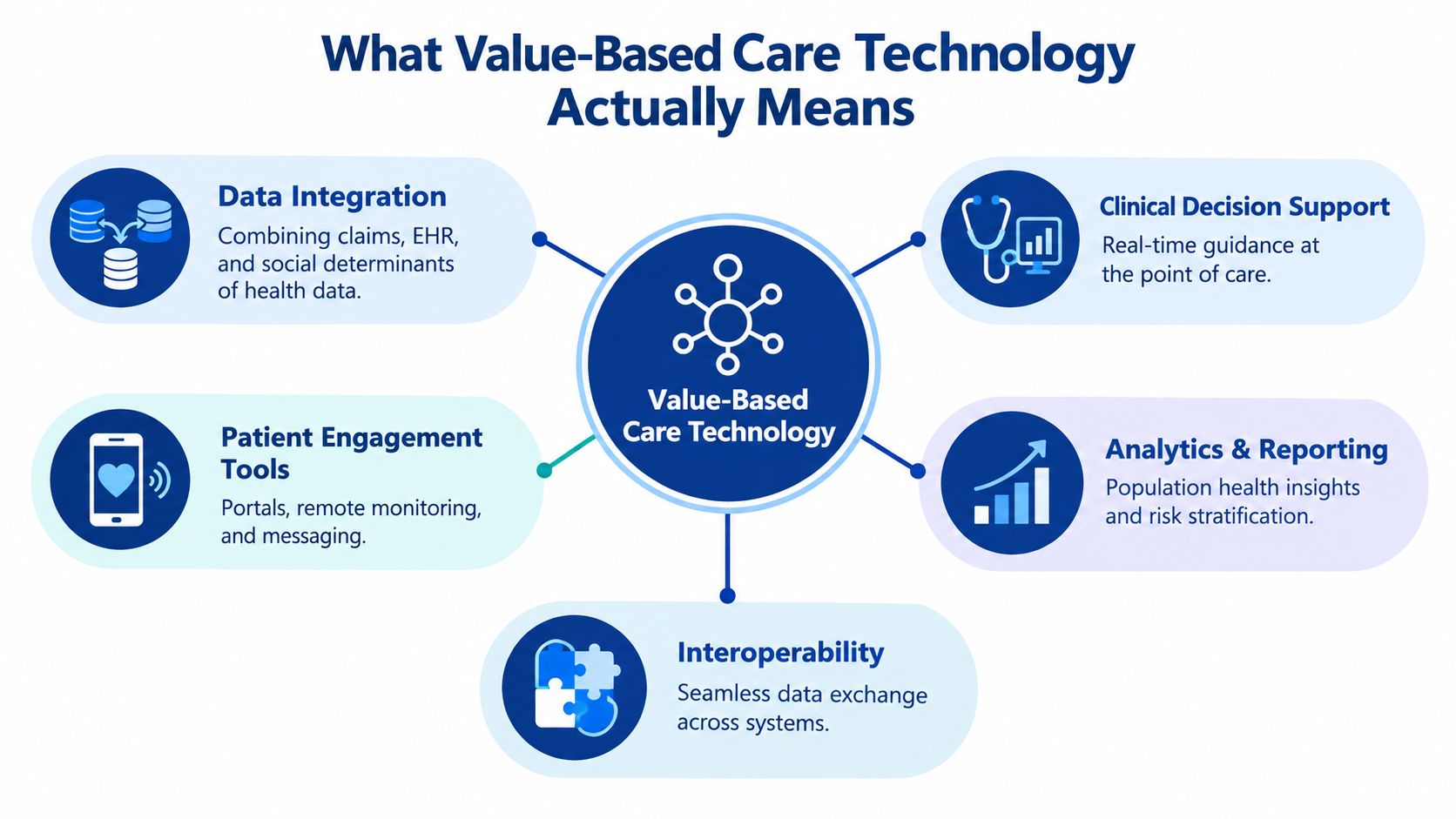
The terms value-based healthcare software and care management software overlap, but they describe different scopes. Value-based healthcare software covers measurement, payment, attribution, and performance management. Care management software concentrates on the workflows that coordinate services for individual patients and populations.
The product is not the dashboard. Its value lies in producing dependable answers: which patients need help, what happened after an intervention, who owns the next action, and whether the outcome justified the resources used. Build measurement and governance first, then select the platform that can support them.
Six Core Components Compared Side by Side
Buyers often select components in the wrong order. They purchase a polished analytics layer before fixing data exchange, deploy remote monitoring before defining escalation responsibility or launch care coordination without a reliable risk model. That sequence creates activity without dependable evidence.
| Component | Problem It Solves | Typical Owner | Most Common Failure Mode | Integration Risk to Flag |
|---|---|---|---|---|
| Interoperability | Fragmented records and inconsistent patient information | Chief information officer, integration team | Data arrives late, incomplete or with conflicting meanings | Unsupported standards, weak identity matching and unclear consent handling |
| Analytics and risk stratification | Teams can't prioritise patients or compare outcomes | Population-health, quality or actuarial team | Models rely on incomplete data or unexamined assumptions | Missing clinical context, poor provenance and no risk-adjustment audit trail |
| Care coordination | Multiple professionals work from separate task lists | Clinical operations or care-management leader | Referrals and follow-ups have no clear owner | Duplicate documentation, disconnected queues and limited role controls |
| Remote monitoring | Care teams lack visibility between appointments | Clinical programme owner | Alerts create workload without a response protocol | Device integration, alert latency and liability at handoff |
| Patient engagement | Patients miss education, follow-up or self-management support | Patient-experience or clinical team | The design assumes reliable broadband, smartphones and digital confidence | Channel fragmentation, accessibility limitations and consent gaps |
| Payment technology | Contracts don't connect financial incentives to measured outcomes | Finance, payer operations or contracting team | Measures are disputed or easy to game | Attribution rules, claims reconciliation and changes to contract definitions |
The ordering principle is straightforward. Analytics is only as trustworthy as the data it receives. Care coordination is only reliable when risk and responsibility are visible. Remote monitoring is unsafe when the system can't show who reviewed an alert and what happened next.
A buyer assessing behavioural-health or developmental-care workflows can also use this ABA data collection software guide as a practical reminder that structured collection, clear ownership and usable reporting matter as much as the interface.
The missing component is often governance. Someone must define the episode, approve the measure, document exclusions, reconcile conflicting records and explain how the result was calculated. Without that work, the table's most advanced component becomes an attractive reporting layer over disputed evidence.
Benefits and KPIs for Providers and Payers
Providers and payers want value, but they carry different operational risks. A provider needs to improve care without creating unmanageable documentation or unpredictable revenue. A payer needs to control total cost while ensuring that measurement doesn't encourage providers to avoid complex patients.
The provider view
A provider executive dashboard should prioritise three questions:
Are outcomes improving after risk adjustment?
Track avoidable admissions, complications, functional outcomes or condition-specific measures according to the programme.
Are care gaps closing?
Measure whether identified patients received the intervention, follow-up or referral they needed.
Is the operating model sustainable?
Monitor documentation burden, care-team workload and revenue performance against the contract.
The temptation is to celebrate virtual-visit volume, completed assessments or messages sent. Those indicators show activity, not value. Statistics Canada found that 24% of Canadian healthcare workers had provided some services virtually since March 2020 in fall 2021. Among those providers, 87% used telephone care, 47% used video and 26% used email, text messaging or instant messaging, with overlapping use because providers could select multiple channels. The Statistics Canada report on virtual-care experiences also found that 40.3% of virtual-care users were satisfied and 40.5% were very satisfied with their most recent virtual appointment.
Those figures support channel flexibility, not a mandate to maximise video. A provider should measure whether the chosen channel produced continuity, safe follow-up and an appropriate clinical outcome.
The payer view
Payers need a parallel scorecard:
Per-member cost for a defined population or episode: Use a consistent denominator and document what is included.
Risk-adjusted outcome performance: Compare providers fairly while preserving an audit trail for the adjustment.
Equity and access: Show whether outcomes differ by geography, age, language, disability or connectivity.
For practical context on supporting patients outside traditional appointments, chronic disease management at home illustrates why care models must connect clinical support to the patient's actual living environment.
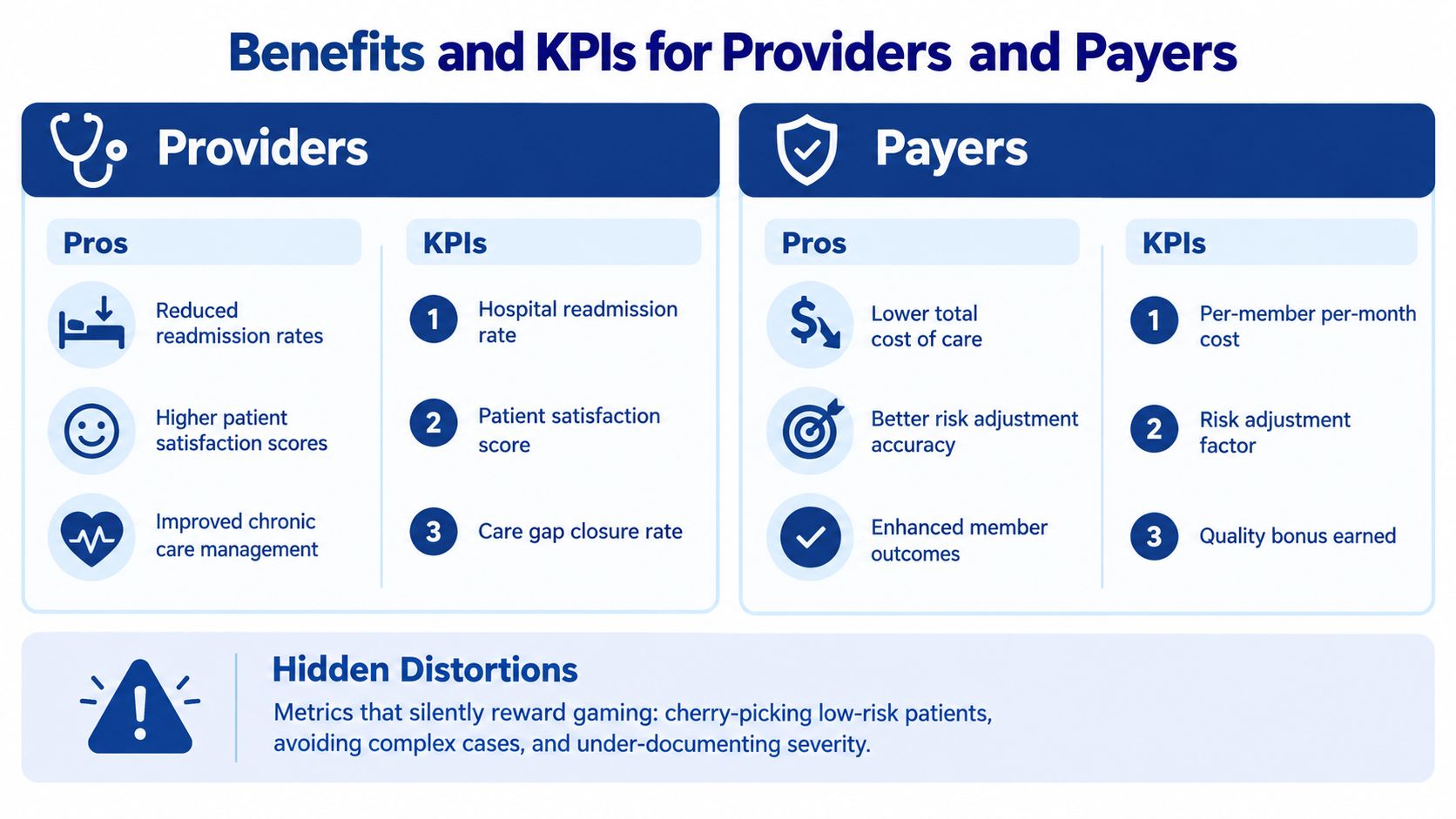
Both sides should share patient-reported experience, clinical outcomes, access and downstream utilisation. The Canadian Institute for Health Information's modern healthcare operations perspective is useful here because operational performance and clinical value cannot be separated when staff must act on incomplete or delayed information.
The warning is clear: every metric can be gamed. Providers may avoid complex cases if severity isn't documented accurately. Payers may narrow access if cost is measured without outcomes. Audit trails, transparent definitions and equity-adjusted reporting are the controls that keep the scorecard honest.
Implementation Roadmap and the Risks That Derail It
A credible implementation follows four phases. Each phase has a different failure mode, and buying software doesn't remove any of them.
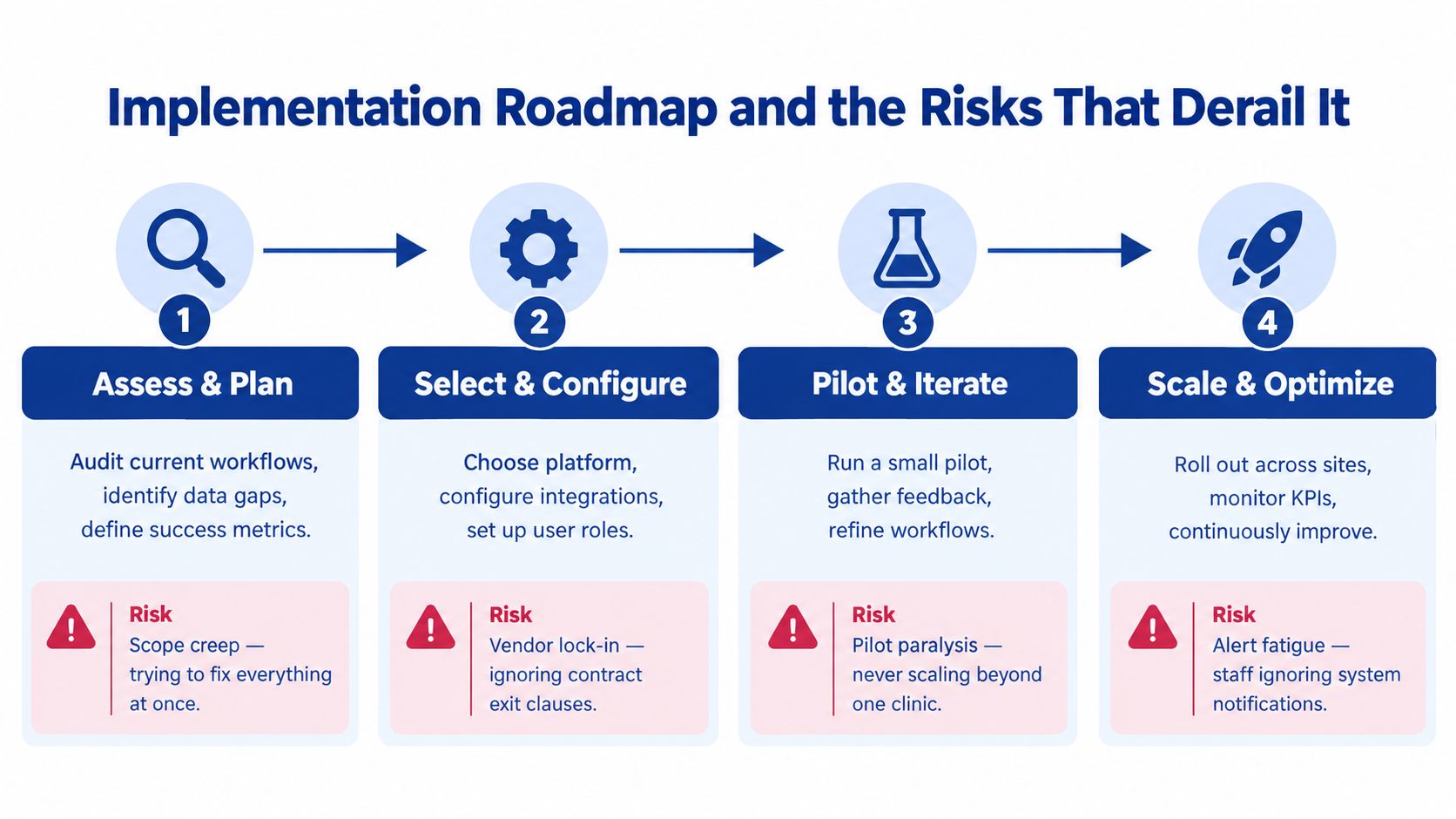
Phase One: Assess and govern
Start with data discovery, workflow mapping and measure definitions. A mid-sized Canadian clinic network introducing remote monitoring for heart failure should define the episode, eligible population, escalation rules, consent path and outcome measures before selecting a vendor.
The central risk is governance failure. Who owns the definition of deterioration? Which source wins when medication data conflicts? How will the organisation record provenance and consent across care settings? Equity must enter here, through channel availability and subgroup benchmarks, not as a late compliance exercise.
Phase Two: Configure and align
Select the platform, configure integrations, map user roles and align the contract with the data the system can produce. The clinic network should test hospital feeds, device data, appointment records and payer attribution before expanding the programme.
The main risk is integration debt. A vendor may demonstrate a successful connection in a controlled environment while leaving the buyer responsible for identity matching, exception handling and ongoing interface monitoring. The practical standards and workflow choices described in this healthcare data integration guide should be treated as procurement criteria, not post-launch repairs.
Phase Three: Pilot and iterate
Run a bounded pilot with a defined clinical team, patient group and escalation path. Review alert quality, staff workload, patient access and follow-up completion. Don't ask whether the platform has been used. Ask whether the pathway produced safe, measurable action.
The danger is change-management fatigue. A pilot that creates duplicate documentation or floods clinicians with low-value alerts will lose trust quickly.
Phase Four: Scale and re-contract
Scale only after the organisation can explain its denominators, exceptions, outcomes and costs. Continue monitoring exchange quality, episode completeness, patient experience and equity as the programme expands.
The final risk is metric drift. Contracts change, clinical pathways change and source systems change. A measure that was valid at launch may become unreliable if definitions, codes or data availability shift. Reconciliation and periodic re-contracting belong in the operating model from the start.
The Equity Question Most Platforms Ignore
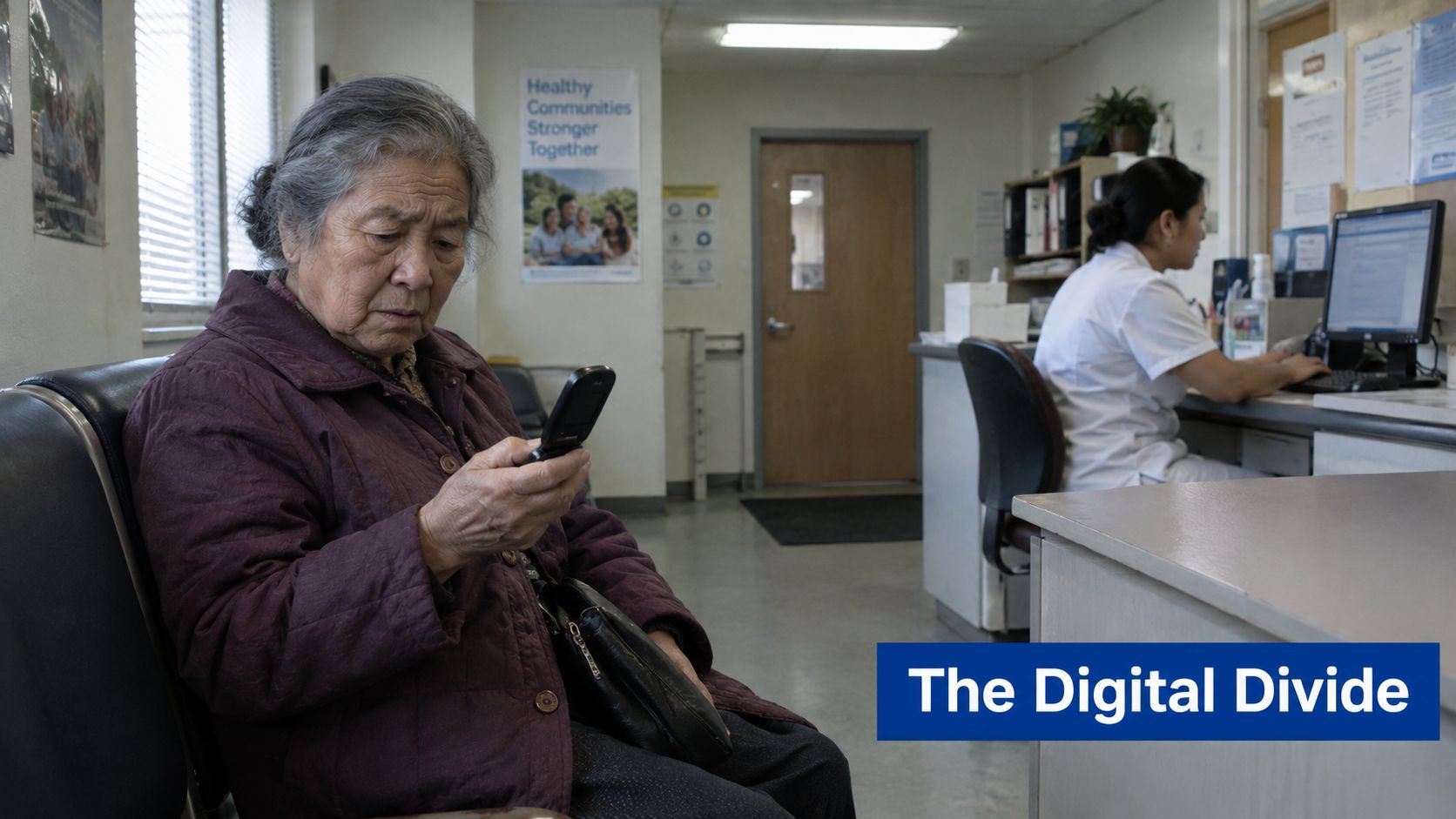
A value-based care stack that works only for digitally connected, urban, English-speaking patients isn't a value-based stack. It reallocates advantage towards the people most able to use the technology and can make the organisation appear successful while harder-to-reach patients disappear from the denominator.
Canadian health-technology assessments identify geographic disparities, fragmented data, privacy concerns and limited internet access as continuing barriers. Older adults, rural and remote communities, Indigenous populations and people with limited digital confidence may need telephone, low-bandwidth, in-person or community-health-worker pathways. An app-only design can produce elegant engagement data while leaving the patients with the greatest barriers underserved.
Buyers should require two practical controls:
Disaggregated reporting: Show uptake and outcomes by geography, age, language, disability, Indigenous identity where appropriate and governed, and connectivity status.
Closed-loop escalation: Record whether a virtual encounter led to referral, follow-up, diagnostic completion or urgent assessment when needed.
The downstream risk isn't theoretical. A population-based study of 548,955 Canadian decedents across Alberta, British Columbia, Newfoundland and Labrador, and Ontario found that virtual care near the end of life during the pandemic was associated with higher emergency-department use and hospitalisations in most provinces. In Alberta, adjusted rates were 60% higher for emergency-department use and 59% higher for hospitalisation, according to the PLOS ONE study on virtual care and end-of-life outcomes.
That evidence does not mean virtual care is unsafe. It means value must be measured by pathway, escalation and patient group. A hybrid model with phone access and human follow-up may outperform a complex app if it reaches the people who need care most.
Choosing a Software Partner and Partnering with Cleffex
Put these questions in every serious RFP:
How does the platform preserve data provenance from source to measure?
Which interoperability and content standards does it support?
How are risk-adjusted outcomes calculated and reviewed?
Can users inspect the audit trail behind a KPI?
How are equity, access and subgroup outcomes measured?
What happens when the contract ends, or the organisation changes vendors?
How does consent travel across organisations and jurisdictions?
What will the partner commit to in writing regarding security, exchange reliability, support and data ownership?
Canada's interoperability direction makes these questions operational, not theoretical. The Pan-Canadian Interoperability Roadmap is designed to help health information follow patients across providers, care settings and jurisdictions while remaining private and secure. The Government of Canada's proposed Connected Care for Canadians legislation would require digital-health information-technology companies to adopt common standards and enable protected information exchange, as described in Health Canada's 2024 announcement.
A capable partner should help build a FHIR-based integration layer, an episode ledger and observability controls for rejected transactions, delayed interfaces, authentication failures and incomplete records. The Canadian Institute for Health Information's guidance on digital-health innovation also makes the semantic point: a system can be online while required fields are missing, codes are invalid or clinical meanings change between systems.
Cleffex Digital Ltd can support this work through healthcare integrations, custom software and AI-enabled solutions that connect data exchange to measurable operating workflows. A partner can build the backbone that makes a value-based contract auditable, but it can't repair an undefined clinical model or an unfair payment rule.
Demand transparent definitions, tested integrations, subgroup reporting and an exit plan. Walk away from dashboards that hide provenance, predictive models without clinical accountability and pilots with no route to scale.
Cleffex Digital Ltd helps healthcare organisations build secure integrations, custom platforms and observability workflows that make value-based care technology measurable in practice. Visit Cleffex Digital Ltd to discuss how to connect your systems, define reliable outcome data and turn a critical HealthTech workflow into an auditable care operation.