

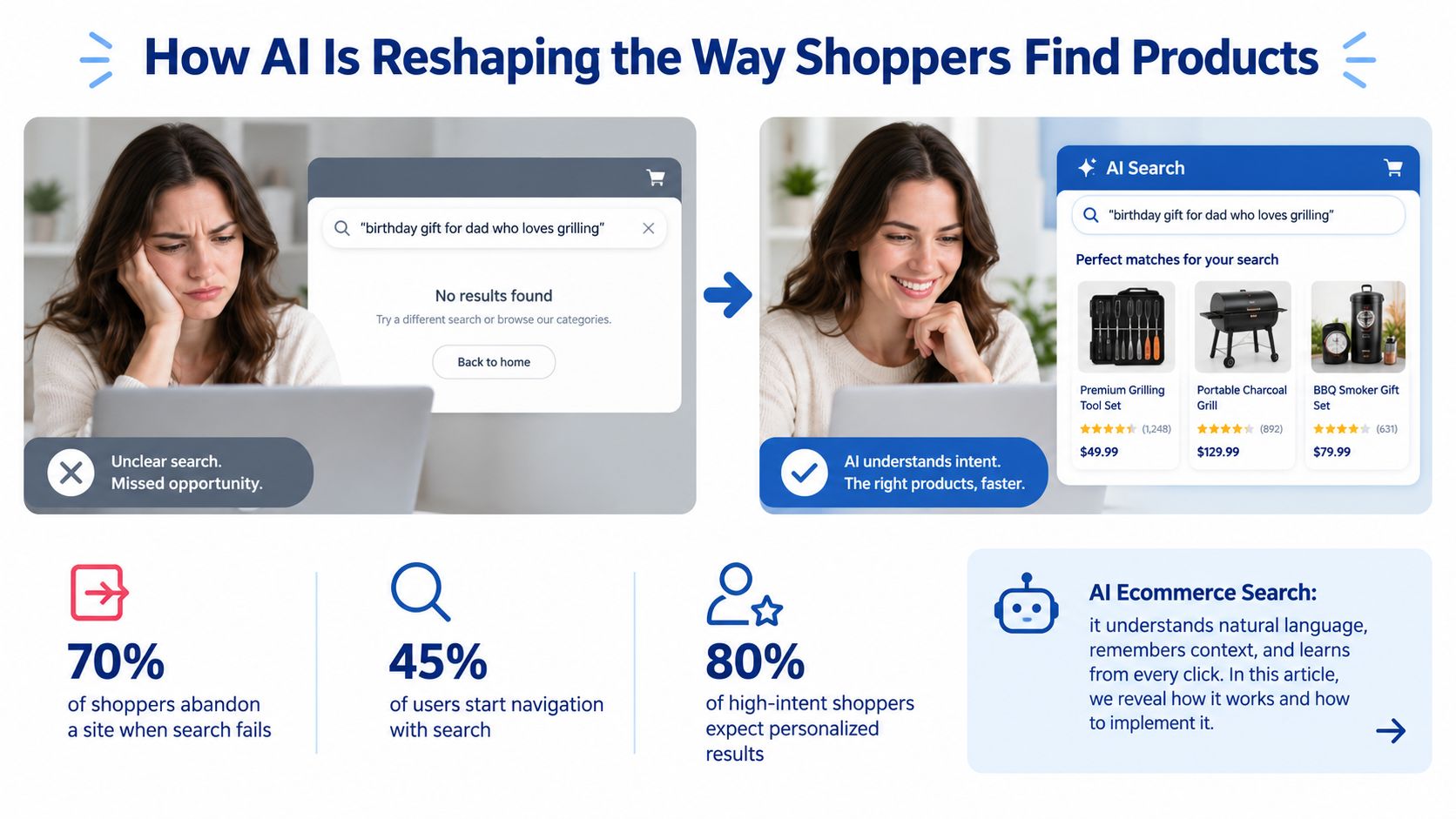
A shopper searches for “a birthday gift for dad who loves grilling”. Your store has excellent products, but the search box only understands exact catalogue terms. The shopper sees irrelevant results, tries once more, and leaves. That old experience is becoming commercially risky in Canada, where more than one in four shoppers now use AI to help make purchase decisions, and AI represents 13% of product discovery according to the Retail Council of Canada and Caddle shopper study.
AI ecommerce search changes product discovery from a matching exercise into an interpretation service. It can understand intent, connect related language, use catalogue context, and rank products according to what a shopper is trying to achieve. It can also influence discovery before a shopper reaches your website, through chatbot referrals and conversational shopping tools.
This guide explains what happens behind the search bar, which business metrics matter, how to choose between SaaS and custom development, and how a small team can introduce intelligent product discovery without replacing its entire commerce stack.
How AI Is Reshaping the Way Shoppers Find Products
Traditional search expects shoppers to speak the catalogue's language. A customer types “waterproof coat for cycling”, while the product title says “all-weather commuter jacket”. Exact keyword matching may miss the connection, even though the product is a strong fit.
AI ecommerce search looks for meaning as well as words. It combines keyword retrieval with machine learning signals such as semantic similarity, shopper behaviour, and personalisation. The result is a discovery layer that can interpret natural-language requests rather than treating every query as a fixed string.
The Canadian market shows why this matters beyond user experience. Shopify reported that referral sessions from AI chatbots to Shopify storefronts grew more than eight times year over year in its Q1 2026 commerce data, as described in its AI search insights for merchants. AI search is therefore both an on-site retrieval upgrade and an external acquisition channel.
A shopper may discover your product through an AI assistant, arrive on a product page, use your site search to refine the choice, and then compare variants or accessories. Each stage depends on accurate product data and clear signals about relevance.
The practical shift for merchants
A useful way to think about the change is:
Old model: The shopper adapts to your product names.
AI product search: Your system interprets the shopper's language.
External discovery: AI tools decide which products and retailers deserve a mention.
Operational requirement: Your catalogue must be readable by people and machines.
The same Canadian research found that 73% of AI shoppers rate AI as helpful for purchase decisions, while 88% say customer reviews improve AI recommendation accuracy. Product descriptions, reviews, attributes, stock information, and policies all contribute to the information an AI system can use.
Practical rule: Treat product content as search infrastructure, not just marketing copy.
Merchants can begin with a focused improvement rather than a full replatform. An audit of failed searches, product attributes, synonyms, and availability often reveals where relevance breaks. Teams exploring recommendations can also review AI-powered product recommendations to understand how search and recommendation experiences work together.
What AI Ecommerce Search Actually Does Under the Hood
Think of an AI search system as a librarian who works across a very large, constantly changing catalogue. The librarian first organises every item, then interprets the visitor's question, remembers useful context, and recommends the most suitable options.
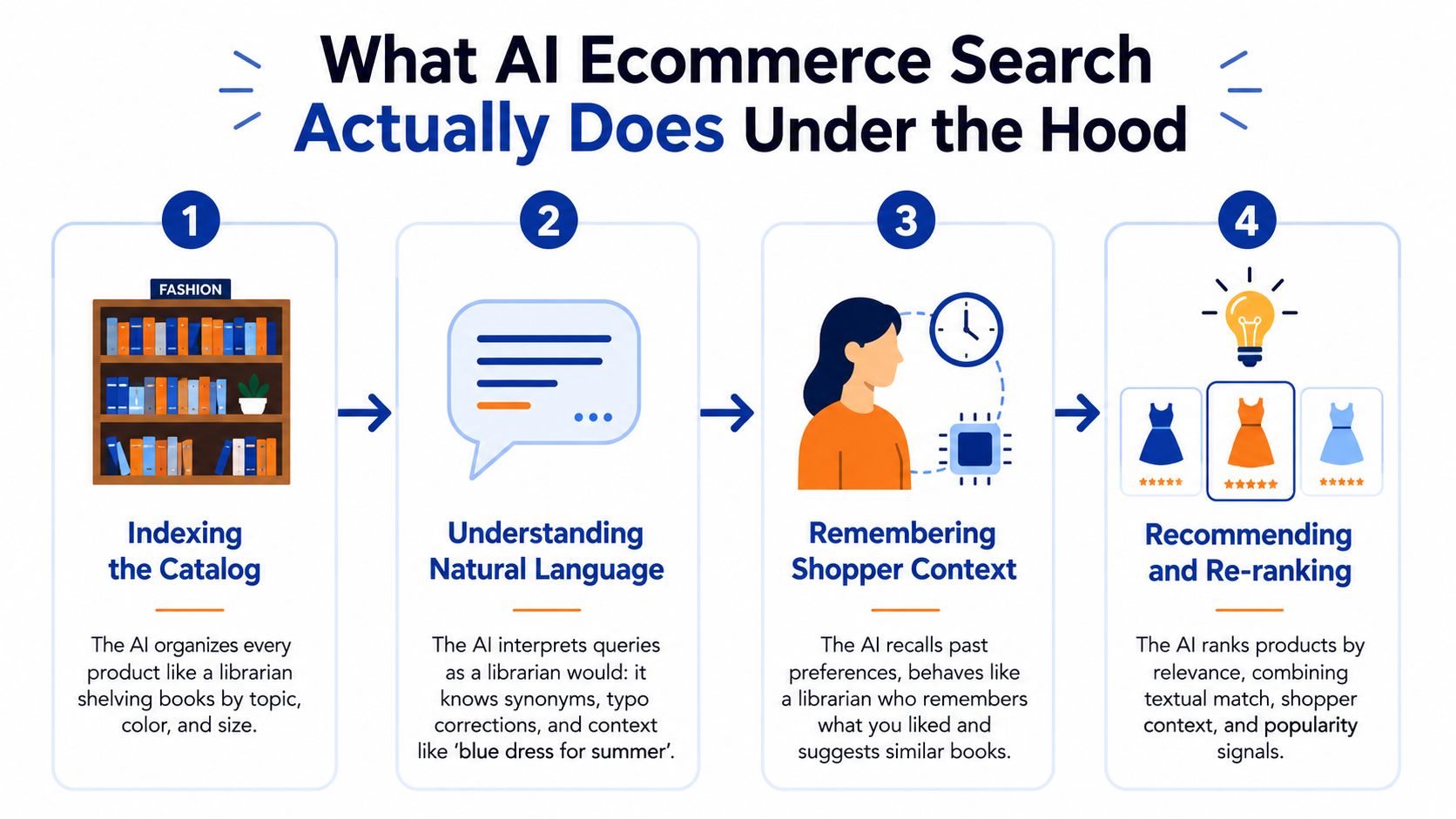
First, it organises the catalogue
The system indexes product titles, descriptions, categories, attributes, images, reviews, availability, and variant data. It can enrich incomplete records through image and metadata analysis, a capability described in the Scale AI-funded ecommerce search project.
This indexing stage creates more than a list of words. The system can represent relationships such as “linen shirt” being a fabric and a product type, or “office-ready” being a use case. Visual systems can also help shoppers find lookalike products from an image.
Next, it interprets the query
A query understanding layer handles common problems such as typos, plurals, alternate spellings, synonyms, and implied intent. “Black trainers for rainy weather” can be separated into colour, product type, and use case, even when those phrases don't appear together in a product title.
Traditional lexical search is useful for precise terms, model numbers, and brand names. It struggles with long, conversational queries because the exact words may not exist in the catalogue. Semantic retrieval uses product embeddings, which represent related meanings in a form the search engine can compare. Product-specific training usually provides better context than a generic language model because the system learns from the retailer's categories and terminology.
Then, it ranks the candidates
Retrieval finds possible products. Ranking decides what appears first.
A ranking model may combine:
Semantic relevance: How closely the product matches the shopper's meaning.
Textual relevance: Whether important query terms appear in the record.
Behavioural signals: How shoppers interact with similar results.
Personalisation: Preferences associated with a returning shopper, where permitted.
Business rules: Stock, product availability, merchandising priorities, and commercial constraints.
Trade-offs become visible. A highly relevant product that is unavailable shouldn't outrank a suitable product ready to ship. A merchant may also choose to promote a private-label item, but that rule should be visible and measurable rather than overriding relevance.
Finally, the analytics loop records impressions, clicks, add-to-carts, purchases, reformulations, and exits. Those events help the team tune ranking and identify missing catalogue data. Merchants wanting a deeper operational overview can consult this guide to optimise product search in ecommerce.
Business Benefits and KPIs That Matter Most
AI search should earn its place through measurable commercial and customer outcomes. A smoother interface is useful, but a product lead needs to know whether shoppers find relevant items, continue browsing, and complete purchases.
The right measurement model connects each benefit to a clear KPI. Avoid promising a universal lift. Results depend on catalogue quality, traffic, baseline search performance, product availability, and how well the system handles the store's actual query mix.
Match outcomes to metrics
| Business Benefit | Primary KPI | Typical Impact Range |
|---|---|---|
| More relevant product discovery | Search conversion rate | Depends on baseline search quality and catalogue coverage |
| Better add-on suggestions | Average order value | Depends on category relationships and merchandising |
| Fewer dead ends | Zero-result rate | Depends on synonyms, attributes, and query coverage |
| Stronger result pages | Search-result abandonment rate | Depends on relevance, speed, and filter usability |
| More self-service answers | Search-assisted support deflection | Depends on content quality and support intent |
| Faster merchandising decisions | Query insight usage | Depends on reporting quality and review cadence |
A strong search dashboard starts with the funnel. Track result impressions, product clicks, add-to-carts, purchases, and revenue per visitor. Add zero-result queries and abandonment after typing, because a system that produces sales while failing a valuable customer segment may still need attention.
The Canadian adoption data gives merchants a reason to include external referrals in the same operating view. Adyen's retail research found that 36% of Canadian consumers used AI to assist with shopping in 2025, a 44% increase from the previous year, as reported by eCommerce News Canada. A store should distinguish AI-referred traffic from internal search traffic rather than combining both into one acquisition bucket.
Look beyond conversion
Query analytics can reveal demand that the catalogue doesn't serve. Frequent searches for an attribute absent from filters may indicate a merchandising gap. Repeated misspellings may justify a synonym rule. Searches for products the store doesn't sell can inform assortment planning or content strategy.
Conversion remains important, but it isn't sufficient. Review product availability, gross margin, refunds, page speed, and customer service contacts alongside search performance. A ranking change that improves clicks but surfaces unsuitable products may create downstream costs.
For a broader view of how search fits into a conversion strategy, see AI ecommerce platforms for boosting conversion. The useful question isn't “Did AI win?” It's “Which shopper problem improved, for which query type, and at what commercial cost?”
SaaS Versus Custom Build and How to Choose
Build versus buy is a stage decision, not a test of technical ambition. A small merchant may need relevance improvements quickly, while a large retailer may need control over data, ranking logic, and regional infrastructure.
SaaS platforms such as Algolia, Coveo, Constructor, and Searchspring provide managed indexing, retrieval, ranking tools, dashboards, and integrations. They're often a practical default for teams with limited machine learning capacity. The trade-offs include recurring usage costs, less control over model behaviour, dependence on a vendor's roadmap, and potential difficulty moving clickstream data later.
Custom systems built around Pinecone, Weaviate, or pgvector offer more control. They can support unusual product structures, proprietary signals, strict data residency requirements, and specialised ranking rules. They also require engineering ownership for ingestion, monitoring, evaluation, security, model updates, and incident response.
Use four decision filters
Time to value: If search performance needs attention quickly, a managed service reduces infrastructure work.
Catalogue complexity: A standard retail catalogue may fit SaaS well. Highly technical, configurable, or compliance-sensitive products may need deeper control.
Data ownership: Review how query, click, customer, and ranking data are stored, exported, and governed.
Internal capacity: Custom search needs continuing product and engineering support, not just an initial build.
| Dimension | SaaS, Algolia, Coveo, Constructor | Custom, Pinecone, Weaviate, pgvector |
|---|---|---|
| Deployment | Faster integration through managed services | Longer implementation with more internal ownership |
| Control | Configuration within vendor capabilities | Full control over retrieval and ranking |
| Data model | Adapts to supported catalogue structures | Can support specialised schemas |
| Tuning | Vendor tools and available controls | Merchant-defined models and signals |
| Operations | Vendor manages core infrastructure | Team manages reliability, monitoring, and updates |
| Portability | Review export and migration terms | More control, but implementation remains bespoke |
| Best fit | Fast-moving teams seeking managed capability | Teams with a defensible relevance problem and engineering capacity |
Decision shortcut: Choose SaaS when speed and managed operations matter most. Choose a hybrid approach when search relevance is strategically important, and your team can own the data and evaluation layer.
Avoid making cost the only filter. A lower initial implementation burden can become expensive if the vendor's ranking model cannot represent your inventory rules. A custom build can also become a liability if no one owns quality review after launch. Document the migration risk before signing, including data export, event schemas, URL behaviour, and fallback search.
Shopify and AI-Powered Product Discovery in Practice
A Shopify merchant doesn't need to jump straight to a headless architecture. The right path depends on catalogue complexity, budget, theme constraints, and how much control the team needs.
Start with native tools
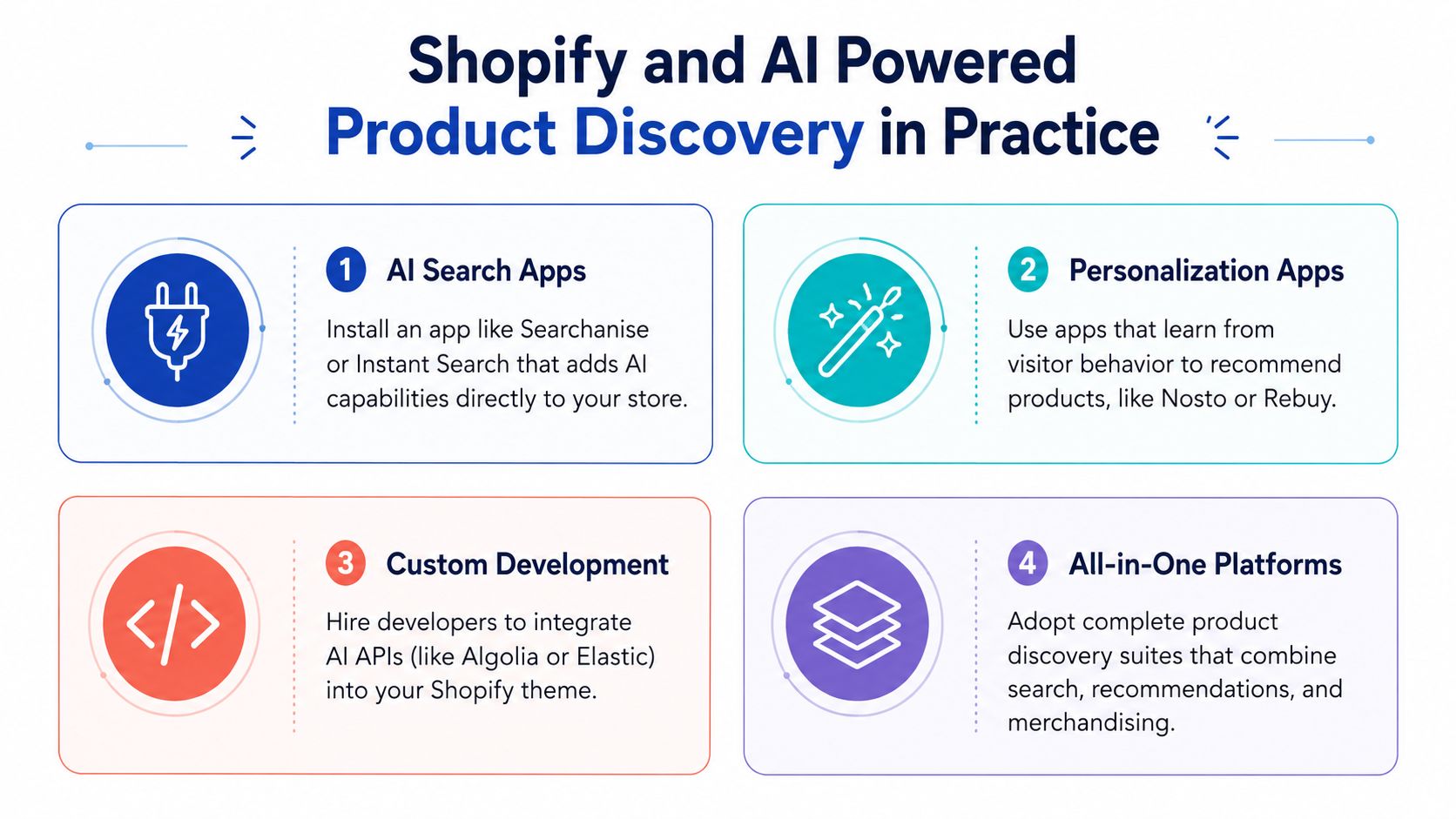
Shopify's Search and Discovery app provides synonym management, merchandising controls, filters, and basic product recommendations within Shopify's ecosystem. It's a sensible first step when the main problems are inconsistent naming, missing filters, or poor collection structure.
Its limitation is depth. Native rules may not fully interpret long, conversational requests or learn relationships between products. Before replacing it, clean titles, descriptions, variants, and attributes. A weak catalogue can make any search engine look unreliable.
Add a managed search app
Tools such as Searchanise and Boost AI Search can add typo tolerance, filters, merchandising controls, and a richer search interface without a large platform project. These apps suit teams that need a practical improvement while keeping the existing storefront and checkout.
Algolia is a step up for brands that need more control over speed, relevance, personalisation, and search analytics. The implementation requires careful event tracking and catalogue synchronisation, so it should be evaluated against the current experience rather than installed in isolation.
Consider vector search for headless stores
Stores using Shopify Hydrogen or another headless setup can add a vector retrieval layer while retaining Shopify as the commerce backend. Embeddings can help the system connect intent and meaning, but the merchant still needs robust product data, availability synchronisation, ranking rules, and monitoring.
App fees, implementation effort, integration work, and ongoing tuning all affect the budget. A small pilot is usually safer than committing to a full rebuild. For hands-on integration planning, review Cleffex's ecommerce development service, and compare practical ideas for Shopify AI solutions for ecommerce growth.
Apparel merchants should also separate search from recommendations. Search answers an expressed need, while recommendations help shoppers discover adjacent products. A useful resource on recommendations that boost apparel sales can help teams think through that second experience without confusing it with query relevance.
A Practical Implementation Roadmap for Small Teams
Small teams need a rollout that protects the live store and produces evidence quickly. You don't need a dedicated data science group to start, but you do need an owner, a clean event definition, and a narrow first test.
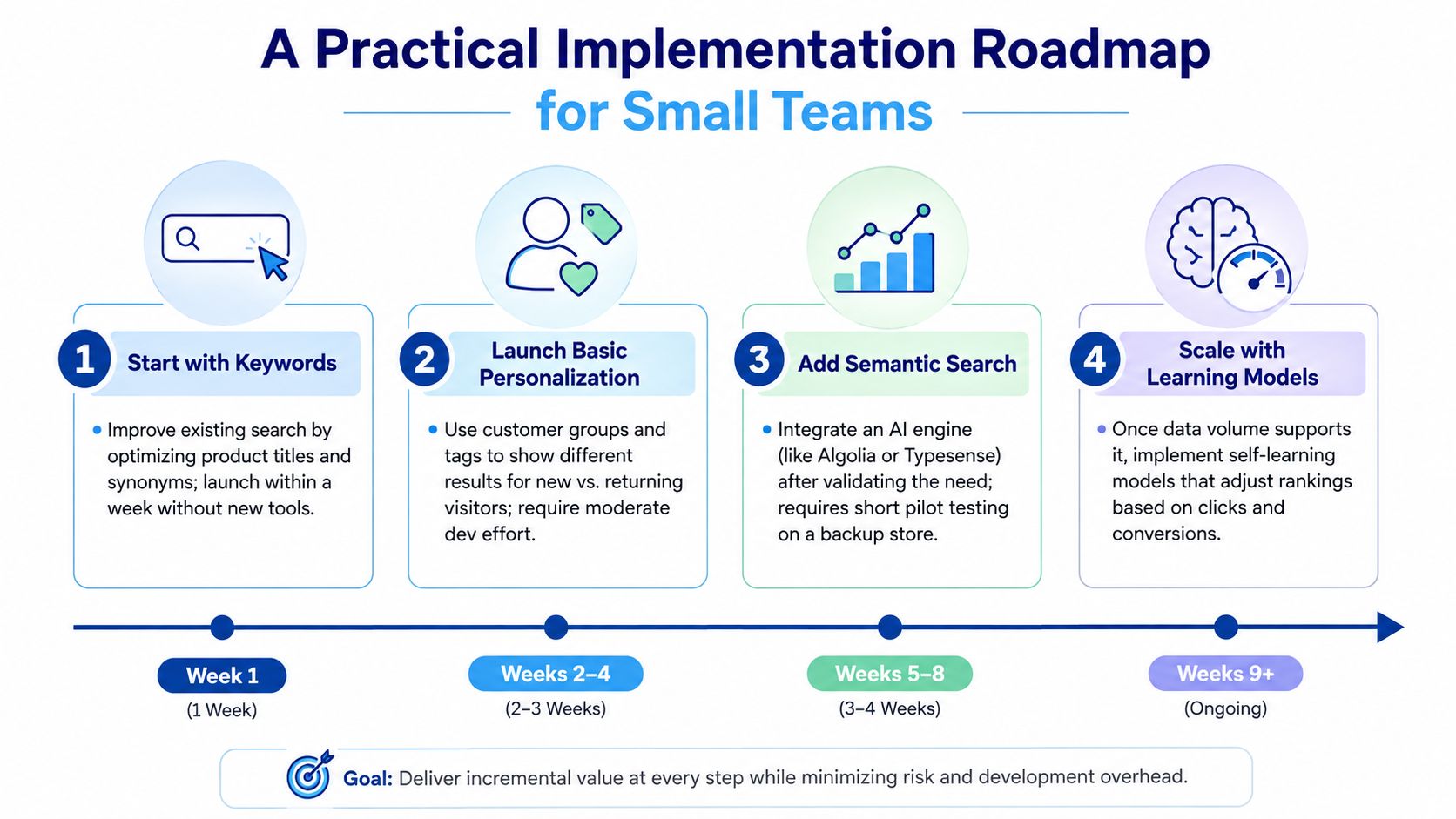
Phase one: Audit the current experience
Spend the initial audit period mapping search behaviour in analytics. Identify the highest-volume queries, the queries returning no results, common reformulations, and searches that receive clicks but no meaningful engagement.
Deliverables should include:
A query classification: Product, attribute, use case, misspelling, or unsupported intent.
A catalogue issue list: Missing attributes, duplicate variants, inconsistent naming, and stale availability.
A measurement baseline: Search clicks, add-to-carts, purchases, abandonment, and revenue per visitor.
A priority backlog: The failure cases with the clearest commercial or customer impact.
Phase two: Pilot one area
Choose one collection or category with enough activity to produce useful learning. Put the new experience behind a feature flag or controlled traffic split, and keep the existing search available as a fallback.
The pilot should test a limited set of changes, such as synonym handling, semantic retrieval, ranking rules, or improved filters. Don't combine a new engine with a redesigned results page, altered pricing, and a new merchandising strategy if you won't be able to identify what caused the outcome.
Phase three: Expand carefully
Once the pilot produces reliable evidence, extend coverage across the catalogue. Add permitted context signals for returning shoppers, but keep deterministic rules for sensitive or high-risk categories.
Phase four: Govern the system
Assign responsibility for relevance reviews, query-log monitoring, catalogue corrections, and incident escalation. Search quality changes as products, inventory, seasons, and customer language change. A monthly review cadence may work for one store, while a faster rhythm may suit a frequently changing catalogue.
Ship learning, not just software. Each phase should leave the team with a clearer decision, a better dataset, or a safer next experiment.
Measuring Success With the Right Metrics and Tests
Search is a discovery product, not a single conversion-rate button. Measure the complete path from query to result view, product click, add-to-cart, purchase, and revenue per visitor. Record zero-result rate, reformulation, and abandonment after typing so the team can see where the experience breaks.
Experience metrics add diagnostic detail. Track time to the first relevant product, average result position, query refinement, and support contacts. A fast result page with poor relevance is still a failed search experience.
Segment the evidence
A blended dashboard can hide important failures. Report results by:
Query type: Product, attribute, use case, brand, misspelling, or unsupported request.
Device: Mobile and desktop behaviour may differ.
Language and region: English and French queries need separate review for Québec.
Customer status: New and returning shoppers may respond differently to personalisation.
Category: Apparel, healthcare, insurance, and automotive products have different relevance and compliance needs.
For Québec, test accents, bilingual synonyms, translated attributes, local terminology, and legal language separately. A product can be semantically relevant in English while its French metadata remains incomplete. In healthcare and insurance, restrict sensitive attributes, document data flows, obtain appropriate consent, and review applicable provincial requirements before using customer information in ranking.
Evaluate relevance independently from commerce
For a fixed set of judged queries, precision and recall show whether relevant products are retrieved. Mean reciprocal rank and discounted cumulative gain help assess ordering. Coverage identifies valid searches that the system cannot serve, while diversity matters when several products should appear rather than near-duplicates.
Commercial constraints require their own checks. Inventory, availability, margin, and merchandising rules can change the business result without changing semantic relevance. A ranking can look better to a relevance reviewer and still create poor outcomes if it promotes unavailable or unsuitable products.
Use controlled A/B tests with stable query assignment, pre-registered primary metrics, and guardrails for refunds, margin, latency, and zero results. Test one meaningful change at a time. Offline simulations speed iteration, but only controlled customer experiments confirm impact. Watch for seasonality, bots, novelty effects, repeated test contamination, and uneven traffic across segments.
What to Do This Week and Common Questions Answered
Start with an audit, not a platform replacement. Export your highest-volume search queries, classify each by intent, and record zero-result rate, click-through, conversion, and revenue. Then inspect the catalogue for missing attributes, duplicate variants, inconsistent naming, and products that are no longer available.
Choose one high-volume category or a small long-tail query set for a pilot. Define the desired experience before comparing vendors:
Query handling: Typos, synonyms, plurals, accents, and natural-language intent.
Result controls: Filters, facets, boosts, exclusions, and stock rules.
Personalisation boundaries: What context may be used, and what must remain deterministic.
Measurement: Events, dashboards, test groups, and commercial guardrails.
Portability: Theme compatibility, accessibility, app overhead, and data export.
For Shopify, test the candidate against the current experience using the same catalogue and comparable traffic allocation. For healthcare or insurance, document data flows, limit sensitive attributes, and review consent and provincial requirements before introducing customer-level signals.
Canadian retailers should test English and French discovery independently for Québec. Check translation quality, accents, synonyms, local inventory, and region-specific brand preferences. External AI referrals also need attention. Use clear product titles, structured attributes, accurate availability and pricing, readable policies, trustworthy reviews, and comparison content that assistants can retrieve without guessing.
Frequently Asked Questions
Does AI search replace keyword search?
Usually not. Keyword retrieval remains valuable for exact brands, product codes, technical specifications, and deliberate merchandising rules. AI product search adds semantic and behavioural ranking where exact matching is too narrow.
Do I need personalisation immediately?
No. Start with deterministic improvements such as cleaner product data, typo tolerance, synonyms, filters, and better ranking rules. Add personalisation only when the value is clear, and the data use is properly governed.
How much data do I need?
You can begin with less data than many teams expect. Clean catalogue records and a well-defined evaluation set provide a useful foundation. Behavioural history helps tune rankings, but poor event tracking won't become reliable just because an AI engine is added.
How long does implementation take?
A narrow pilot can be completed in weeks rather than requiring a full commerce rebuild. The exact schedule depends on catalogue quality, integration complexity, analytics readiness, and the number of teams involved.
What should I do first?
Audit search failures, fix the highest-impact catalogue issues, and select one category for a controlled test. That sequence gives you evidence before you commit to a vendor or custom architecture.
For a wider view of retail and digital commerce capabilities, explore Cleffex's retail and ecommerce services. The right first move is usually small, measurable, and reversible.
Cleffex Digital Ltd helps merchants plan, integrate, and measure AI ecommerce search across Shopify and custom commerce environments, including catalogue enrichment, search APIs, analytics, and phased rollouts. Visit Cleffex Digital Ltd to discuss an audit or production pilot for your store.