

You're in a planning meeting, and the choice is already uncomfortable. Buy a genomic risk platform and inherit another vendor contract, another integration queue, and another dashboard nobody trusts. Build a lean in-house pipeline, and you own the data model, the consent logic, and the clinical workflow, but you also own the mistakes.
That's the core decision behind precision health technology in 2026. It's no longer a research side project. It's a procurement line item for providers, insurers, employers, and startups that want care to move from generic to targeted without breaking compliance, interoperability, or budget discipline.
Canada is a useful lens here. Genome Canada was established in 2000, and the country's precision-health ecosystem now centres on linking genomic, clinical, and digital-health data to support more individualised prevention and treatment, a direction described in peer-reviewed literature as “Precision Medicine 2.0” (peer-reviewed overview of Canada's precision-health ecosystem). The market side is moving just as fast, with North America holding 69.97% of global precision medicine revenue in 2024, about USD 21.2 billion (North America market share estimate).
If you're a CIO, founder, payer leader, or clinic operator, you need five answers fast. What precision health technology is. What belongs in the stack and what doesn't. How providers, insurers, and employers are using it. How to roll it out without stalling in integration. And whether the ROI holds up once equity, compliance, and model drift are included.
Why Precision Health Technology Is on Every 2026 Roadmap
A mid-sized Canadian clinic group is where the decision gets real. The medical director wants genomic risk stratification for preventive cardiology. The insurer partner wants API access to the same risk scores. The CIO wants to know who owns the consent records, which system is the source of truth, and how many interfaces this creates.
That is why precision health technology has moved from a research capability to an enterprise planning priority. Leaders are no longer asking whether personalised care is clinically interesting. They are asking whether the platform can be integrated, governed, and measured without turning every patient cohort into a custom project.
The market direction is clear. Canada's precision-health model links genomic data with clinical and digital-health data to support more individualised prevention and treatment, which is the practical basis of Precision Medicine 2.0. On the product side, vendors across North America are pushing the same stack decisions into buyer workflows, including AI-enabled decision support, genomics, wearables, and interoperable digital-health systems.
What this guide helps you decide
Practical rule: if a vendor cannot show where data enters, where it gets governed, where the model runs, and where the action lands, you are buying a demo, not a system.
You need five decisions, and they are business decisions first:
What precision health technology is, in plain language, so you do not overbuy analytics you cannot operationalise.
What to build versus buy, so you do not turn scarce engineering time into bespoke plumbing.
Who uses it, because provider, insurer, and employer workflows are not the same.
How to implement it, because integration fails more often than strategy.
Whether the numbers work, once you account for cost avoidance, operational change, and equity risk.
That lens matters for small enterprises too. A startup does not need a full enterprise stack on day one, but it does need a clean use case, a defensible data model, and a route to clinical validation. A CIO does not need another innovation lab. They need a system that can survive procurement, audit, and downstream workflow pressure.
Defining Precision Health Technology Without the Jargon
Precision health technology is the stack that helps health systems decide what to do for a specific person, based on their genomic, clinical, and behavioural data. Precision medicine is the clinical practice that uses those inputs. The distinction matters because buyers often fund the clinical idea but underinvest in the data and integration layers that make it work.
Precision health technology works like a personalised navigation system for care. A standard map provides the same route for every traveller, but a precision system integrates genomic data, electronic health records, and behavioural signals from sources like wearables or activity trackers. It then recalculates the optimal path for a specific individual rather than relying on an average. When conditions change, the route adapts accordingly, demonstrating its core operational value.
What it is and what it is not
It is not the same as digital health. Digital health may digitise forms, appointments, or remote monitoring without individualised inference. It is not the same as population health, which looks at groups and utilisation patterns. And it is not the same as generic personalised medicine language used in marketing when there is no integrated data pipeline behind it.
For an executive, the simplest definition is this. Precision health technology collects the right patient data, links it across systems, analyses it in context, and pushes an action back into care. That action might be a clinician alert, a patient recommendation, a triage rule, or a payer workflow.
The reason this matters in Canada is structural. The country's precision-health ecosystem is explicitly moving toward linked genomic and digital-health data, which is why interoperability and governance are not optional add-ons (Canada precision-health ecosystem). UNICEF's precision health work also frames next-generation diagnostics plus real-time biomarker monitoring as core capabilities, because they enable early diagnosis and continuous assessment of therapeutic efficacy (UNICEF precision health report).
If you need to explain the concept to a board member, use this sentence. Precision health technology is the infrastructure that lets care move from broad rules to patient-specific decisions using linked genomic, clinical, and behavioural data.
The Four Layers of the Precision Health Stack
Most vendors sell one slice of the stack and imply they cover the rest. They don't. If you want a system that holds up in production, you need to know which layer solves which problem, and where shortcuts break the chain.
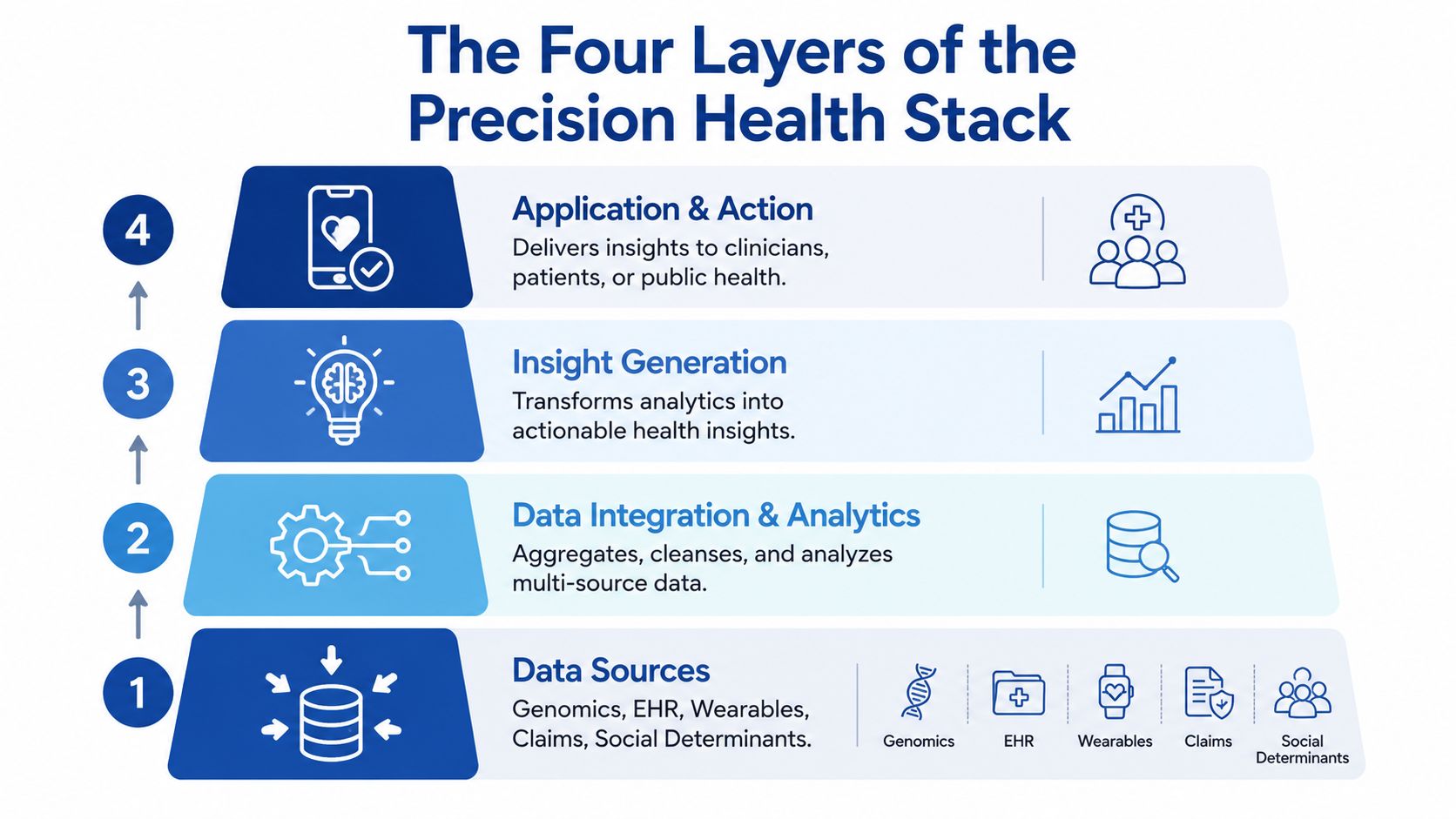
The stack has four layers. Data sources collect the raw inputs. Data integration and analytics make those inputs usable. Insight generation turns analysis into a decision. Application and action deliver that decision into the workflow that someone uses.
Layer 1 through Layer 2
At the bottom, data sources include genomics, EHR data, wearables, claims, and social determinants. You need more than one source because no single record captures a patient's full risk profile. A genomic report without care history is incomplete. An EHR without behavioural context is blunt. A wearable without identity resolution is just noisy telemetry.
The next layer is data integration and analytics. Interoperable pipelines, identity resolution, governance, and normalisation do the unglamorous work here. Skip this layer and your model ends up scoring the wrong person, duplicating records, or missing consent context. That's not a model problem; it's a data architecture problem.
Layer 3 through Layer 4
The third layer is insight generation. Risk models, biomarker interpretation, and AI-assisted summarisation transform raw signals into something clinically or operationally usable. The point is not prediction for its own sake. The point is a decision that can be acted on before the next appointment, not after the next avoidable event.
The final layer is application and action. This includes clinician dashboards, patient apps, and insurer APIs. If the insight never lands in a workflow, it dies in a pilot. That is why many programmes fail at the handoff from analytics to care delivery, even when the model itself is decent.
Rule to keep: if a vendor pitch only talks about AI and ignores identity, governance, and workflow delivery, it's missing three-quarters of the system.
How Providers, Insurers, and Employers Actually Use It
A clinic group, an insurer, and an employer can all ask for “better outcomes.” They are buying different outcomes, and they will fund different workflows.
A provider usually wants earlier intervention.
A payer wants tighter risk selection, better navigation, and lower avoidable costs.
An employer wants fewer missed workdays and stronger management of high-risk cohorts. The same data family supports all three, but the economic case changes by buyer.
Three concrete operating models
A multi-site clinic group can use genomic risk scores to prioritise preventive cardiology outreach. The workflow change looks simple on paper and is hard in practice. Care teams flag higher-risk patients for outreach, then route them into earlier screening or specialist review before the next primary-care visit. The business case comes from reduced avoidable utilisation, but only if clinicians trust the alert and the pathway is staffed.
A Canadian insurer can place the same type of risk score into underwriting support or care-navigation tools, with explicit consent flows and patient-facing explanations. That only works when the insurer can connect the score to claims and service workflows without creating a black box that members reject. Teams that are building that layer should read the AI clinical decision support guide, because it focuses on how decisions reach users, not just how models are trained.
A self-insured employer can package precision-health benefits for a high-risk segment of the workforce and track biometric response over time. The value is not in the pitch deck. It comes from whether employees use the programme, whether risk factors change, and whether the intervention stays inside privacy and consent boundaries. If the employer cannot explain how the data is separated from HR decision-making, trust drops quickly.
The commercial pattern is visible in the wider market too. Companies like Verily have moved precision health into products for research, care, and public-health workflows, including platforms that connect patient data to recommendations and operational tools. That shift shows the category moving from research infrastructure to usable business systems, as seen in Verily's precision-health platform direction.
Commercial design also depends on the operating model behind the scenes. For teams mapping scale-up paths, Head of Agents for enterprise AI is a useful reference for how enterprise AI use cases get organised around workflow, ownership, and rollout. Precision health needs the same discipline. Without it, pilots stay stuck in analysis and never reach day-to-day operations.
For insurers, the practical question is less about the model and more about the route into existing operations. If you are evaluating insurance AI solutions, insist on seeing how consent, claims, and navigation work together. Otherwise, the platform becomes another disconnected scoring layer.
A Five-Phase Implementation Roadmap That Actually Ships
Most precision health pilots die in the same place. They start with technology selection, not with a measurable clinical or commercial problem. That reverses the order and guarantees scope creep.
Phase 1 and Phase 2
Start with one use case and one KPI. Not five. Not a platform vision. One measurable outcome that a clinician, payer, or operations lead already cares about. The failure mode here is scope creep, so the prevention is brutally simple: write the KPI into the project charter and make every request justify itself against that metric.
Then audit data readiness and consent. That means identifying source systems, record linkage issues, governance approvals, and who can see what. The failure mode is consent gaps, especially in hybrid datasets that mix clinical and consumer inputs. Don't sign a model contract until the data map is explicit.
Phase 3 and Phase 4
The third phase is model development or vendor evaluation with a clinical reviewer in the loop. If you build, keep the model narrow and auditable. If you buy, demand explainability and local validation. The failure mode is model decay, because a model that looked strong in a controlled environment may not survive your actual patient mix.
The fourth phase is integration into EHR, claims, or CRM systems through HL7 FHIR and standard APIs. That is where many teams get trapped, because the model is technically working but operationally invisible. This is the phase where predictive analytics in healthcare operations becomes a concrete systems conversation, not a theory exercise.
Phase 5 and the cutover test
The final phase is ongoing monitoring for drift, equity, and compliance. If alerts are getting ignored, if subgroup performance is degrading, or if privacy terms are changing, the programme is already slipping. The failure mode is alert fatigue, which usually means you deployed too much output too early.
Non-negotiable: a thin pilot should be able to stand on its own inside 30 days for a small team, but it still needs a monitoring plan before it scales.
For buyers, the useful way to think about this is sequence, not ambition. Discovery first. Data readiness second. Clinical validation third. System integration fourth. Monitoring fifth. If a vendor wants to skip one, they're asking you to absorb the risk.
ROI Risks and the Equity Question Most Pitches Skip
The ROI case for precision health technology usually lands in three buckets. Avoided cost of care comes from earlier intervention and better triage. Operational efficiency comes from fewer manual reviews, better prioritisation, and less time spent hunting for context. New revenue or margin opportunities can come from personalised products, care-management programmes, or higher-value service lines.
The catch is that these buckets are not automatic. If the data is thin, the model is biased, or the workflow is clumsy, you don't get value. You get more alerts.
| Dimension | Typical Lever | What to Watch |
|---|---|---|
| Avoided cost of care | Earlier risk identification and intervention | Are you reducing downstream utilisation or just moving work earlier? |
| Operational efficiency | Triage automation and better prioritisation | Are clinicians actually trusting the output? |
| New revenue | Personalised offerings and premium service design | Are patients or members willing to adopt the new flow? |
| Equity | Representative datasets and subgroup review | Are under-represented groups performing worse? |
| Compliance | Consent, governance, and audit trails | Can you prove who saw what and why? |
Five risks kill these programmes more often than bad science does. Data bias can worsen outcomes for under-represented groups, so insist on representative datasets before signing. Model drift can make a deployed model stale, so set monitoring thresholds before go-live. Regulatory non-compliance across PHIPA, HIPAA, or GDPR can stop the programme, so bring legal into design, not review. Vendor lock-in can trap your data and scores in one platform, so require exportable standards. Privacy incidents can destroy trust, so keep access controls and auditability tight.
The equity question is the one most pitches skip. Minority and low-income groups can face lower access because of socioeconomic, data, and regulatory disparities, and low-resource settings often struggle with cost, training, interoperability, and insurance coverage (equity-focused precision health report, lower-resource precision medicine challenges). In Canada, that means you should treat equity as a build requirement, not a slide about inclusion.
If you want governance discipline, pair the programme with an enterprise AI governance roadmap. The governance question is not optional once clinical or claims decisions are influenced by automated scoring.
A 90-Day Starter Plan for Enterprises and Startups
A precision health rollout fails fast when teams start with the platform instead of the decision. Start with one clinical, claims, or care-management choice you want to improve. If that choice is vague, every dataset looks useful, and every vendor pitch sounds credible.
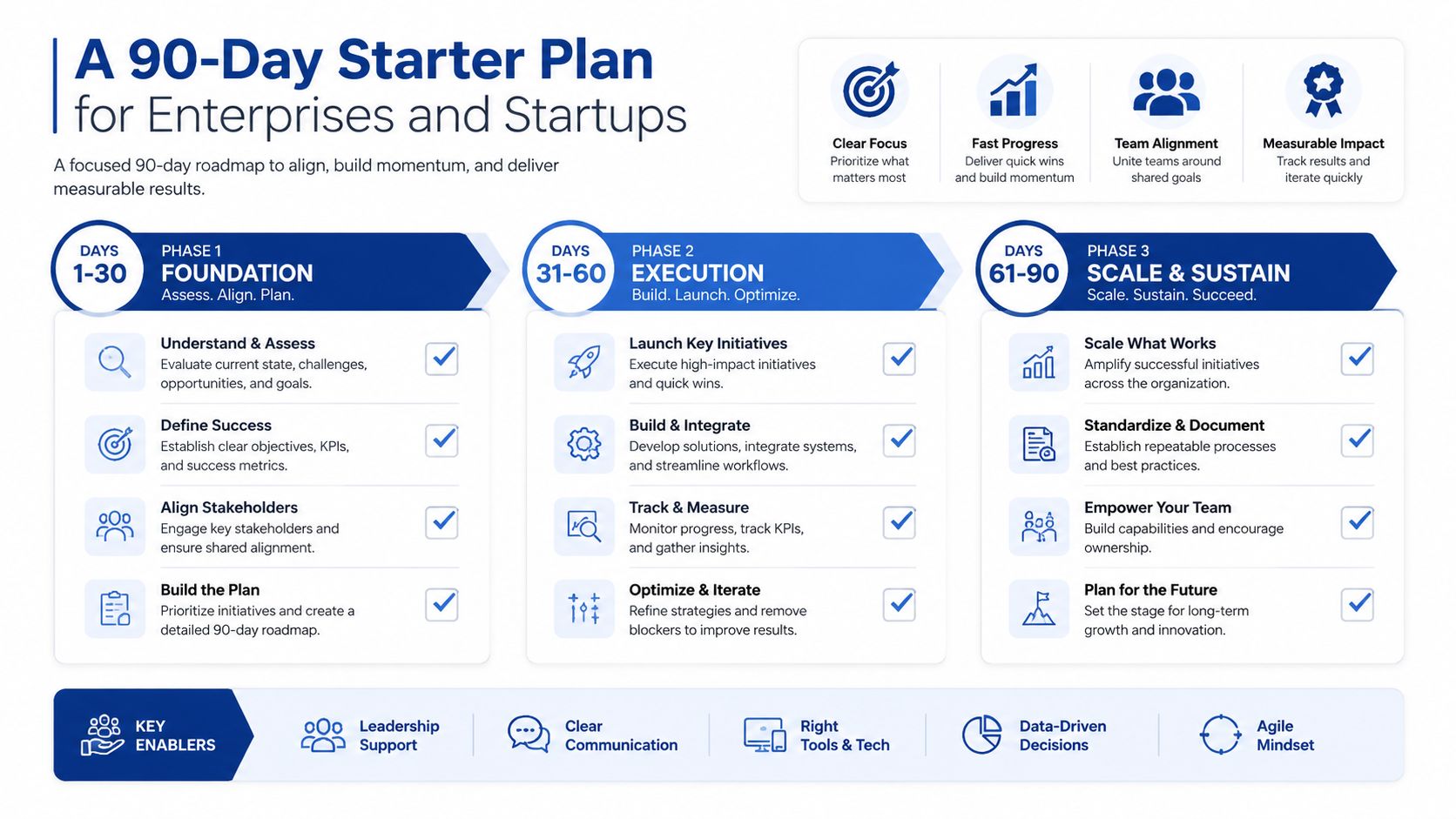
Weeks 1 to 2, lock one use case and one KPI. Weeks 3 to 6, audit data, consent, and workflow fit. Weeks 7 to 10, run a thin-slice pilot on one cohort. Weeks 11 to 12, review equity and drift before you scale. That cadence works for a 10-person startup and for a larger enterprise, because it forces evidence before expansion.
Use the buy-versus-build rule without overcomplicating it. Buy when the use case is standard, regulated, and integration-heavy. License when the core logic is proven but still needs local configuration. Build only when the differentiator is your workflow, your dataset, or your clinical logic. Anything else burns time and distracts the team from the actual bottleneck.
This week, do three things. Pick one patient or member cohort. List the systems that must connect. Name the person who will sign off on consent and clinical review. If you need support with healthcare digital transformation consulting, vendor evaluation, and integration work, Cleffex Digital Ltd is one option to review. The test is whether the partner can handle secure integration and compliant workflow design without pushing a platform-first approach.
If you are planning a precision health initiative, do not start by buying a dashboard. Define the decision, the data path, and the workflow owner first, then choose build or buy around that. Visit Cleffex Digital Ltd to discuss healthcare integration, vendor selection, and a rollout plan that fits your team's timeline and compliance needs.