


The compliance lead at a regional hospital gets the email at 4:40 p.m. A research team wants to reuse patient records for a quality project, a clinician has already agreed in principle, and IT says the data can be pulled by morning. Then someone asks the simple question nobody prepared for: who can approve this, and the request stops. That's how weak healthcare data governance shows up in real life, not as an abstract policy gap, but as a stalled workflow, a frustrated care team, and a nervous privacy office trying to untangle roles after the fact.
In Canada, this problem became more visible in the 2010s as national policy thinking shifted toward formal health data governance frameworks. The OECD's 2016 Recommendation on Health Data Governance called for national frameworks and trans-border co-operation to improve interoperability and harmonisation across countries, which matters in a decentralised system where provinces and territories control most health data operations. If you work in a clinic, hospital, insurer, or digital health vendor, governance is not just about avoiding fines. It decides whether data can move safely across care settings, whether AI projects can start on time, and whether staff trust the rules enough to follow them.
A practical governance programme prevents the kind of delay that can sink a research request. It gives the organisation a clear approval path, named decision-makers, documented reuse rules, and auditability when someone asks why a record moved or stayed put. For teams scaling platforms and integrations, a useful external reference is scaling healthcare technology, because the technical work only holds when governance keeps pace.
Why Healthcare Data Governance Matters Now
A referral request lands on a Monday morning. The clinician thinks privacy can approve secondary use, the privacy office expects research ethics to review it, and IT waits for a decision that never arrives. By afternoon, the work is stalled, and the team is left sorting out who had authority before anyone could say yes or no.
Governance sits inside care delivery, not beside it
Healthcare data governance belongs in day-to-day operations, not only in legal or security meetings. The World Bank and PAHO framing points to lifecycle controls, purpose limitation, informed consent, secure storage, and the need to balance individual privacy with the societal value of health data use. In practical terms, governance sets who can access data, why it was collected, and how it can be reused for care, research, and planning.
A clinic compliance lead sees the difference when a cross-department request arrives. The question is usually not whether the data exists. It is whether the organisation can show that the request is allowed, tightly scoped, and traceable from start to finish. Governance now sits at the centre of interoperability work, AI programmes, and any cross-border exchange that touches Canadian records.
Practical rule: if a data request needs three people to interpret the same policy, the governance model is too vague to support daily work.
The cost of delay is more than inconvenience
A delayed request often shows a deeper gap, because nobody has been given clear authority to decide on reuse. In Canada's decentralised system, that gap gets wider when different sites, regions, and departments believe they follow the same rule but apply it differently. For a compliance team, the programme can be fragile before an auditor ever asks a question.
The same pressure appears in AI projects. New initiatives ask for reusable data, derived features, and access across teams that may never have worked together before. If governance cannot keep pace, organisations fall back on ad hoc approvals, and trust erodes one exception at a time. For teams scaling platforms and integrations, scaling healthcare technology only works when governance keeps pace with the work.
What Healthcare Data Governance Means
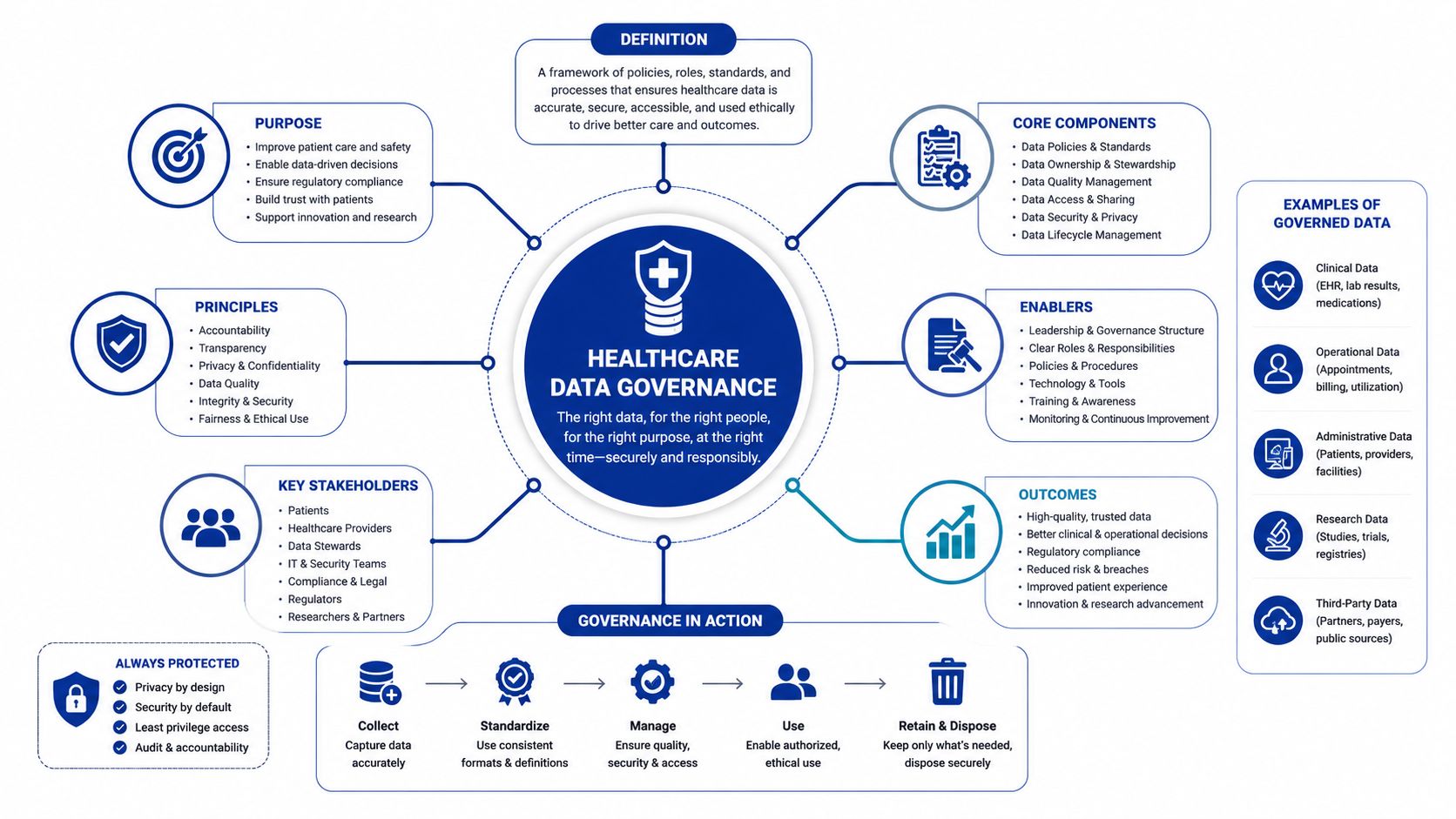
Healthcare data governance is a control system for the full data lifecycle. It covers more than privacy, and it covers more than security. It is the structure that tells an organisation how health data is collected, classified, stored, accessed, shared, reused, and eventually retired, while still keeping the data trustworthy enough for care and operational decisions.
A clinic feels the difference when a request comes in for a patient list, a research extract, or a model training set. The question is not merely whether the data exists. The key questions are who may use it, for what purpose, under which controls, and whether the answer can be defended later if someone asks why the request was approved.
The four guarantees that make the model work
AHIMA describes healthcare data governance around availability, integrity, security, and usability in practice guidance.
Availability means the right person can get the right data when it is needed. A clinician waiting for lab results that never sync into the chart is dealing with an availability failure.
Integrity means the record is reliable and has not been corrupted, duplicated, or imperceptibly altered in a way that changes meaning. If the patient's medication list contains two versions of the same drug, the workflow is already compromised.
Security means access is limited, logged, and protected against misuse. A registration clerk should not be able to browse clinical notes out of curiosity, even if the system technically allows it.
Usability means the data can be understood and used in context. If codes, labels, or metadata are inconsistent, the system may look complete and still be hard to use at the point of care.
These four ideas sound abstract until they show up in daily work. In a Canadian clinic, a clinician may need a clean view of medications across sites, while a privacy lead needs confidence that the same record is not being reused beyond the stated purpose. In a US setting, the same conversation may also involve HIPAA rules for PHI de-identification and whether a dataset can be used without exposing identifiable information. The trade-off is simple but uncomfortable: tighter controls can slow some workflows, while looser controls can erode trust and invite misuse.
A working definition you can repeat to leadership
A useful leadership definition is this. Healthcare data governance is the operating model that assigns decision rights, sets rules for access and reuse, and protects the quality, security, and usefulness of data across its lifecycle. That definition matters because it keeps the focus on accountability, not paperwork. It also helps leaders see why governance cannot live only in a policy binder or a quarterly committee deck.
A compliance lead can test the model with a simple question. Can staff find the rule, understand the rule, and follow the rule without phoning three departments? If the answer is no, the governance design is still too far from the workflow. A stronger model also gives people a way to judge exceptions, because every health system has them and pretending otherwise only pushes risk into informal approvals.
For teams needing a primer on how controls map to healthcare information systems, this overview of data security in healthcare information systems is a useful reference.
Key Regulations Shaping Healthcare Data Governance
A single patient record can fall under more than one rule set, depending on where it is used and who can see it. In the United States, HIPAA focuses on protected health information and permitted use. In the European context, GDPR places strong weight on consent, transparency, and limits on processing. In Canada, PHIPA and related provincial rules shape how personal health information is collected, used, disclosed, and protected, while the national conversation still has to work across a decentralised provincial and territorial structure.
Overlapping duties, different pressure points
Several duties show up across regimes. Purpose limitation, breach handling, minimum necessary access, and documentation of use all appear in different forms. A primary difference lies in how each regime frames permission, consent, and downstream reuse. A governance board cannot stop at saying “we comply with privacy law” and leave the matter there.
For teams that need a practical primer on how controls map to healthcare information systems, data security in healthcare information systems is a useful reference point for the technical side of the problem. The security layer matters, but it does not replace the governance layer. People still need rules about who can approve, who can override, and who documents the exception.
Cross-border analytics adds layered obligations
A cross-border analytics project can trigger multiple reviews at once. The data owner may need to confirm the purpose. Privacy counsel may need to check consent and disclosure terms. The security team may need to validate storage and transfer safeguards. If the dataset is being prepared for de-identification, a detailed reference like HIPAA rules for PHI de-identification can help teams think about the technical and legal constraints together.
The governance board's job is to decide whether the project stays inside approved use, whether it needs tighter access, or whether it should be denied. That decision should be documented in the same place every time, because consistency is what lets organisations defend the choice later. A single project can be lawful, risky, and politically sensitive at once, and governance has to hold all three realities in view.
Roles and Decision Rights Inside the Governance Model
The quickest way to break a governance programme is to define roles loosely and decisions vaguely. A title like “data steward” looks reassuring on paper, but if that person has no protected time, no escalation path, and no authority to stop a bad data change, the role is decorative. In practice, decision rights matter more than job titles.
Who owns what
A data owner is the accountable business leader for a data domain. That person approves the classification of the data, sets the acceptable use boundaries, and owns the exceptions when policy doesn't fit the actual workflow.
A data steward manages the day-to-day quality and meaning of the data, triages issues, and works with operational teams when records are messy or inconsistent.
A data custodian is usually the technical function, often IT or a managed service team, that implements access controls, logging, backup, retention tooling, and the mechanics of secure handling.
The governance council settles conflicts, approves policy changes, and handles requests that cut across departments or carry higher risk.
The recurring meeting cadence matters
Roles only work when the organisation gives them a rhythm. Stewards need a regular operating forum to review defects and changes. Owners need a decision point for access approvals and exceptions. The council needs a standing agenda for policy disputes, AI reuse requests, and issues that can't be resolved one layer down.
| Role | Main decision | Typical output | Common failure |
|---|---|---|---|
| Data owner | Classification and exceptions | Approved use boundaries | Signs papers but avoids hard calls |
| Data steward | Quality escalation and interpretation | Issue log and remediation priority | No time to act between meetings |
| Data custodian | Technical controls | Access, logging, retention, backups | Builds tools without business rules |
| Governance council | Cross-functional policy decisions | Approved standard or denial | Meets rarely and only reacts to crises |
The most common failure is leaving stewardship nominal. If the steward cannot pause a release, request a correction, or escalate a pattern of bad data, the organisation has a title without authority. That looks tidy in a charter and messy in a live clinic.
Building a Practical Implementation Roadmap
A governance programme does not start with a giant policy rollout. It starts with the data domains that hurt the organisation most when they fail. That may be patient identity, medication lists, lab results, referral data, or claims data. The point is to create visible improvement where staff already feel the pain.
The first 30 days
Begin with a focused inventory. Identify where the highest-value data lives, who touches it, and where quality problems already show up in care or reporting. Then add metadata management so the team can automatically identify and classify data across systems instead of relying on manual inventories, which are slower and easier to lose track of (Secoda healthcare data governance challenges).
A practical 30-day target is to define the first domain, the first owner, and the first steward. That creates a home for decisions. If you need a build-oriented reference for the technical side of this work, healthcare data management software development is one useful example of how the software layer connects to governance requirements.
The 60 and 90 day layers
By day 60, connect governance to master data management, access controls, and audit logging. The important point is not to automate everything. It is to stop treating each system as its own little kingdom. A shared policy only becomes real when the systems can enforce it.
By day 90, publish the first quality checks around the highest-value domain and set a routine for remediation. Recent practitioner guidance points to starting with the decisions being made on bad data, then building source-level quality checks around priority use cases rather than launching an enterprise-wide programme all at once (Hutchins Data Strategy on healthcare governance operating model). That approach fits healthcare, where visible wins build credibility faster than grand design slides.
Start narrow, prove control, then widen the scope. Teams trust what they can see working in a live workflow.
Governing AI and Secondary Data Use Without Losing Trust
Many guides get thin here. They say AI needs governance, but they rarely explain how a council should judge a reuse request. In Canada, that matters because governance is increasingly framed around protecting individuals, groups, and communities, not just satisfying a policy checklist. The hard question is who benefits, who carries the risk, and whether the consent model still makes sense once data leaves its original clinical purpose (World Bank framing on health data governance and equity).
What a defensible reuse decision looks like
A good council asks four things: is the intended use documented clearly, is the consent model, including any tiered or limited consent, consistent with the proposed use, are vulnerable populations protected from being exposed to disproportionate risk, and is there an appeal path if the request is denied?
That last question matters because denial without explanation breeds workarounds. If a team knows how to resubmit with tighter scope, stronger de-identification, or narrower access, the organisation can stay consistent without becoming obstructive. For a practical Canadian discussion of privacy and AI trade-offs, AI in healthcare data privacy in Canada is a relevant internal reference.
A worked governance decision
A mid-sized hospital receives a vendor pitch for a predictive readmission model. The council should not ask only whether the model is clever. It should ask whether the data transfer is limited to the minimum set needed, whether the vendor can document intended use, whether the hospital can audit access, and whether the project changes the risk profile for patients who are already vulnerable.
If the answers are incomplete, the council can attach conditions instead of giving a blanket approval. It may require documented uses, tighter role-based access, an explicit review of downstream reuse, and a defined exit path if the vendor's handling no longer matches the approved scope. That kind of decision preserves trust because it makes reuse conditional, visible, and reversible.
KPIs, Maturity Models, and the Operating Layer
Governance starts to matter when it becomes measurable. If you can't tell whether the programme is alive, you don't have governance; you have documents. The useful split is between leading indicators, which tell you whether the programme is being used, and lagging indicators, which tell you whether it is holding up under pressure.
What to measure first
Leading indicators should include classification coverage, access-request cycle time, and whether stewards have protected time to do the work. Lagging indicators should include incident rate, audit findings, and data-quality defects that escape into operations. If the metrics only show after-the-fact damage, they are too late to help the compliance lead steer behaviour.
| Level | Operating signal | Structural cue | Common risk |
|---|---|---|---|
| Ad hoc | Decisions vary by person | No named owners or steward time | Local workarounds |
| Repeatable | Same issue handled similarly | Basic policies and meeting cadence | Manual effort dominates |
| Defined | Domains and rules are documented | RACI exists and exceptions are logged | Teams still rely on a few experts |
| Managed | KPIs are reviewed routinely | Quality checks and escalation paths exist | Metrics are tracked but not acted on |
| Optimised | Governance shapes day-to-day workflow | Controls are embedded in systems | Overconfidence if exception review fades |
A checklist for the quality committee
Review the highest-risk domain first: Start where bad data creates the most operational pain.
Check for real steward time: A title without hours is a warning sign.
Ask how exceptions are recorded: If no one can trace the decision, the policy is weak.
Look for source-level quality checks: Governance should be visible in the workflow, not only in the report.
Scan for recurring access delays: Delays often point to unclear ownership.
Compare incidents with policy changes: If issues repeat, the fix isn't sticking.
Test the appeal path: A denied request should have a documented next step.
A mature programme isn't the one with the most documentation. It's the one where people know what to do next, and the records show that they did it.
Putting It All Together and Your First 30 Days
Three failure modes show up over and over. The first is policy written but unenforced, where staff can't tell whether the rule is real. The second is stewards without authority, where people own problems they can't fix. The third is audit treated as yearly theatre, where controls only get attention right before a review.
A simple first-month checklist
Name one priority domain: Pick the data set that causes the most friction in care or reporting.
Assign one owner and one steward: Make the accountability visible.
Write the first access rule: Keep it narrow and workable.
Map the current workflow: Find where data moves, not where the policy assumes it moves.
Add one quality check: Start at the source, not at the dashboard.
Define one exception path: Know who can say yes, no, or not yet.
Schedule the next review: Governance dies when meetings are optional.
Small teams can do this without new headcount if they stay focused. The trick is to make governance show up in a live workflow before trying to polish an enterprise charter. That is how the programme stays alive instead of becoming a folder of nice intentions.
Cleffex Digital Ltd works with healthcare and life sciences organisations that need secure software, workflow automation, and compliant data handling built into the product, not added later. If your team is trying to turn governance into something that works in daily operations, visit Cleffex Digital Ltd to explore how its development and integration services can support that effort.