

A hospital IT director can feel the pressure from every side at once. The old EHR stack is creaking, clinical teams want fewer outages, finance wants a cleaner run-rate, and procurement keeps asking whether the cloud design will still satisfy provincial privacy rules if support staff or backup systems sit outside Canada. That's the core healthcare cloud migration problem in 2026: not just moving servers, but deciding how much of your clinical estate can modernise without breaking care delivery or compliance.
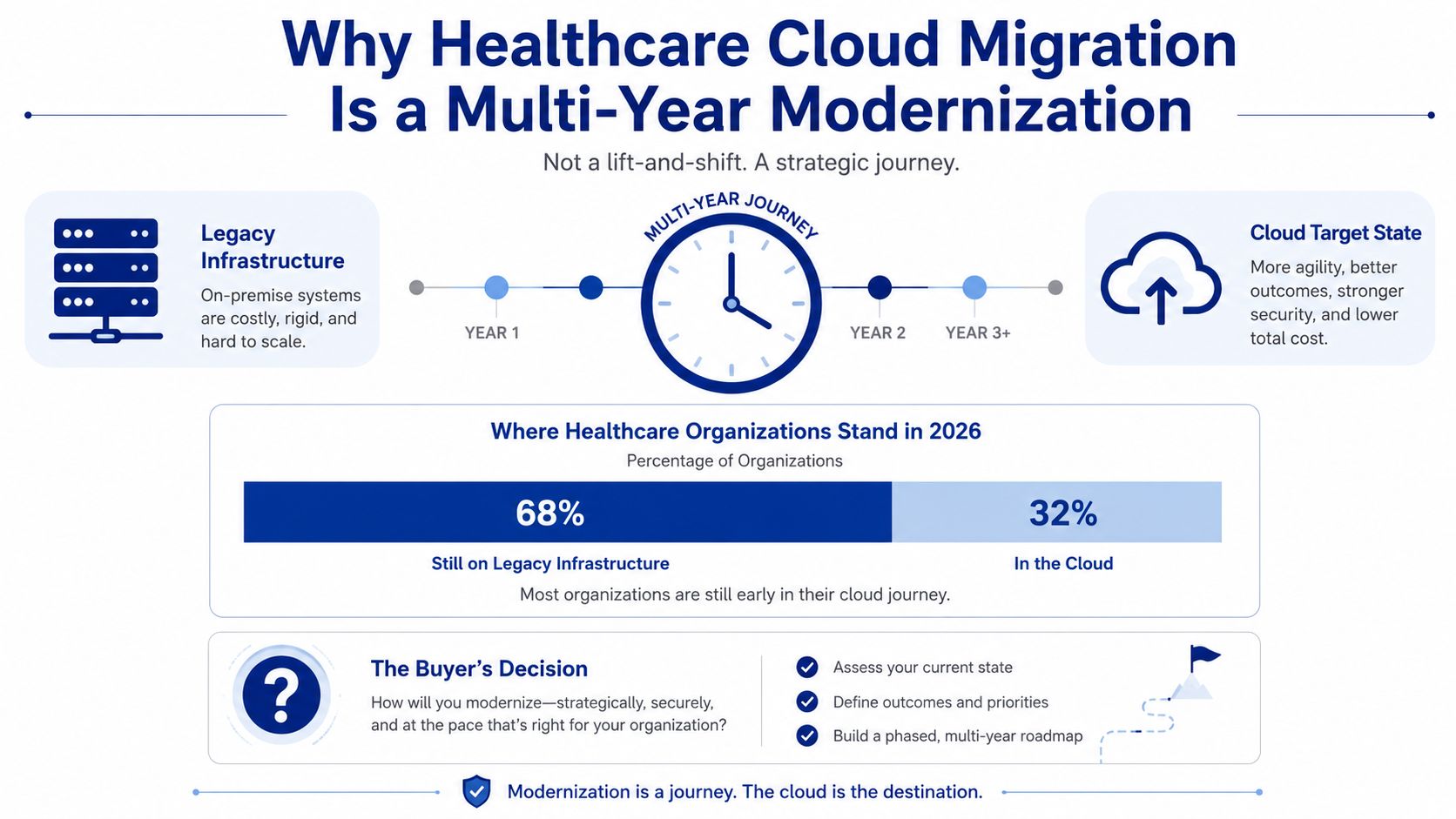
The organisations that move well usually stop treating migration as a one-time cutover. They treat it as a multi-year modernisation of applications, identity, contracts, and operating models, with the cloud used selectively where it reduces risk and improves resilience. In Canada, that matters because the hardest questions are often architectural and legal, not technical. Where does PHI live, who can access it, how do backups behave, and what happens when a vendor's subcontractor is offshore?
Why Healthcare Cloud Migration Is a Multi-Year Modernisation
A clinical IT lead doesn't usually start the week thinking about “transformation”. They start by nursing a brittle EHR, an overworked storage array, and a go-live date that can't slip because radiology, admissions, and billing all depend on the same environment. That's why healthcare cloud migration is rarely a single project. It's a chain of decisions about infrastructure, application refactoring, compliance, and clinical continuity.
What the Canadian market already tells you
The current Canadian pattern is not “all in” cloud adoption. A 2025 KLAS public cloud study reported that more than 80% of healthcare organisations were already using a public cloud provider, while nearly 40% said at least 90% of their environment still remained on-premises. The same report found that 39% planned to accelerate cloud migration in the next 12 to 24 months, with EHR migration the most common use case, followed by disaster recovery, archival storage, and analytics. KLAS public cloud study summary
That mix says a lot. Most buyers have crossed the first threshold, but they're still carrying a large legacy footprint, which means the practical answer is usually hybrid for a while, not a dramatic rip-and-replace. In the field, that looks like one team lifting archive workloads first, another moving dev and test, and a third delaying the core clinical systems until dependencies are mapped and the rollback story is clean.
Practical rule: if your EHR, imaging, and integration layers all share the same old hardware assumptions, you're not doing a cloud project. You're doing a staged operating-model change.
The business momentum is there too. A global healthcare cloud migration services market report valued the segment at US$2,624.3 million in 2024 and projected growth to US$12,650.5 million by 2030, a 30% CAGR over the period. That doesn't mean every migration should be fast. It means the market is funding tooling, skills, and service delivery that make phased modernisation more practical than it was a few years ago.
For a broader modernisation lens, the enterprise application approach at Cleffex's enterprise application modernisation strategy fits well with this reality, because healthcare buyers are usually sequencing application change, not chasing a single technical event. Ollo's write-up on Ollo's approach to secure migrations is also useful because it reinforces the same discipline: secure preparation before movement, not after.
The organisations that succeed usually start by asking one question: which workload is safe to modernise now, and which one still needs the old world to stay alive a bit longer? That answer drives everything else.
Choosing the Right Migration Strategy for Clinical Workloads
The fastest way to waste money is to call every workload a candidate for the same migration pattern. A PACS image archive and a custom lab integration engine don't behave the same way, and a patient outreach app doesn't carry the same clinical risk as a scheduling tool used at check-in. The old cloud shorthand, the five migration paths, still helps, but only when it's matched to workload behaviour.
How the 5 Rs map to actual hospital systems
Rehost works when the application is stable, under-differentiated, and expensive to keep on old hardware. A legacy PACS archive is a common fit, because the value is in storage reliability and access, not code change.
Replatform makes sense when the app is usable but needs a better runtime, such as a Windows-based scheduling system that benefits from managed hosting without a full rewrite.
Refactor belongs where the software's logic matters, especially in custom clinical integration layers. If the lab engine talks to multiple downstream systems and carries brittle interface logic, the value comes from redesigning the integration pattern, not just moving the same sprawl somewhere else.
Replace is the right call for outdated CRM-style patient outreach tools when the cloud SaaS market already covers the use case more cleanly.
Retire fits shadow systems that duplicate EHR data and create reconciliation pain.
Don't rehost everything by default. If the workload depends on tight local latency, or if a move would simply carry old technical debt into a new bill, pause and reconsider the pattern.
| Migration Strategy Fit by Healthcare Workload | Workload Example | Risk Level | Best Fit |
|---|---|---|---|
| Rehost | PACS image archive | Lower | Stable systems that need speed and minimal code change |
| Replatform | Windows scheduling app | Moderate | Legacy apps that need better hosting without full redesign |
| Refactor | Custom lab integration engine | Higher | Logic-heavy systems with many interfaces |
| Replace | Patient outreach tool | Moderate | Commodity functions already covered by SaaS |
| Retire | Shadow EHR duplicate | Lower | Redundant systems that no longer add value |
The value usually hides in the systems nobody is proud of, the duplicate reports, old task lists, and niche admin tools that survived three platform cycles. Those are often the least defended, and the easiest to simplify. In practice, the best migration portfolio is rarely elegant. It's selective.
Compliance and Data Residency Across Canadian and Global Rules
Canadian healthcare buyers don't just need a cloud that “supports compliance”. They need a design that answers where PHI sits, who can see it, and what happens when a vendor's support model crosses a border. Generic playbooks often stop at encryption and access controls. That's not enough when provincial privacy obligations, contract terms, and subcontractor access all matter at the same time.
Think in layers, not slogans
Start with the Canadian privacy layer. PHIPA and provincial health privacy rules set the expectations around health information handling, while PIPEDA can still matter in broader organisational contexts. The architectural question is simple to say and hard to execute: where does the data live, where are the backups, and where are admins allowed to operate from? A design can be technically sound and still be unacceptable if replication, logging, or support access leaves Canada in a way your legal team can't defend.
Then look at the cross-border layer. If your organisation touches US systems or works with US vendors, HIPAA's Security Rule and Privacy Rule become part of the operational baseline, especially where PHI is handled by cloud providers or business associates. If European patient data is in scope, GDPR introduces its own residency and transfer expectations. The point isn't to stack every regime on top of every workload. The point is to separate which datasets, workflows, and vendor relationships each rule governs.
The most useful procurement question is often the least glamorous one: who has subcontractor access, and under what conditions? That includes support engineers, managed service staff, logging platforms, disaster-recovery operators, and any party that might touch PHI indirectly. A good contract doesn't just name the cloud provider. It also defines disclosure, retention, backup handling, and exit rights in language legal and IT can both use.
For Canadian buyers looking at cloud-enabled healthcare platforms, Cleffex's cloud-based healthcare software in Canada is a useful local reference point because it reflects the same reality: cloud adoption only works when governance is explicit, not implied. That's the gap many generic guides miss.
Procurement test: if a vendor can't explain where support, logs, replicas, and subcontractors sit in plain language, don't assume the architecture is compliant just because the contract uses the right acronyms.
The best residency conversations happen before the shortlist is final. If they happen after signature, you've already given away negotiating power.
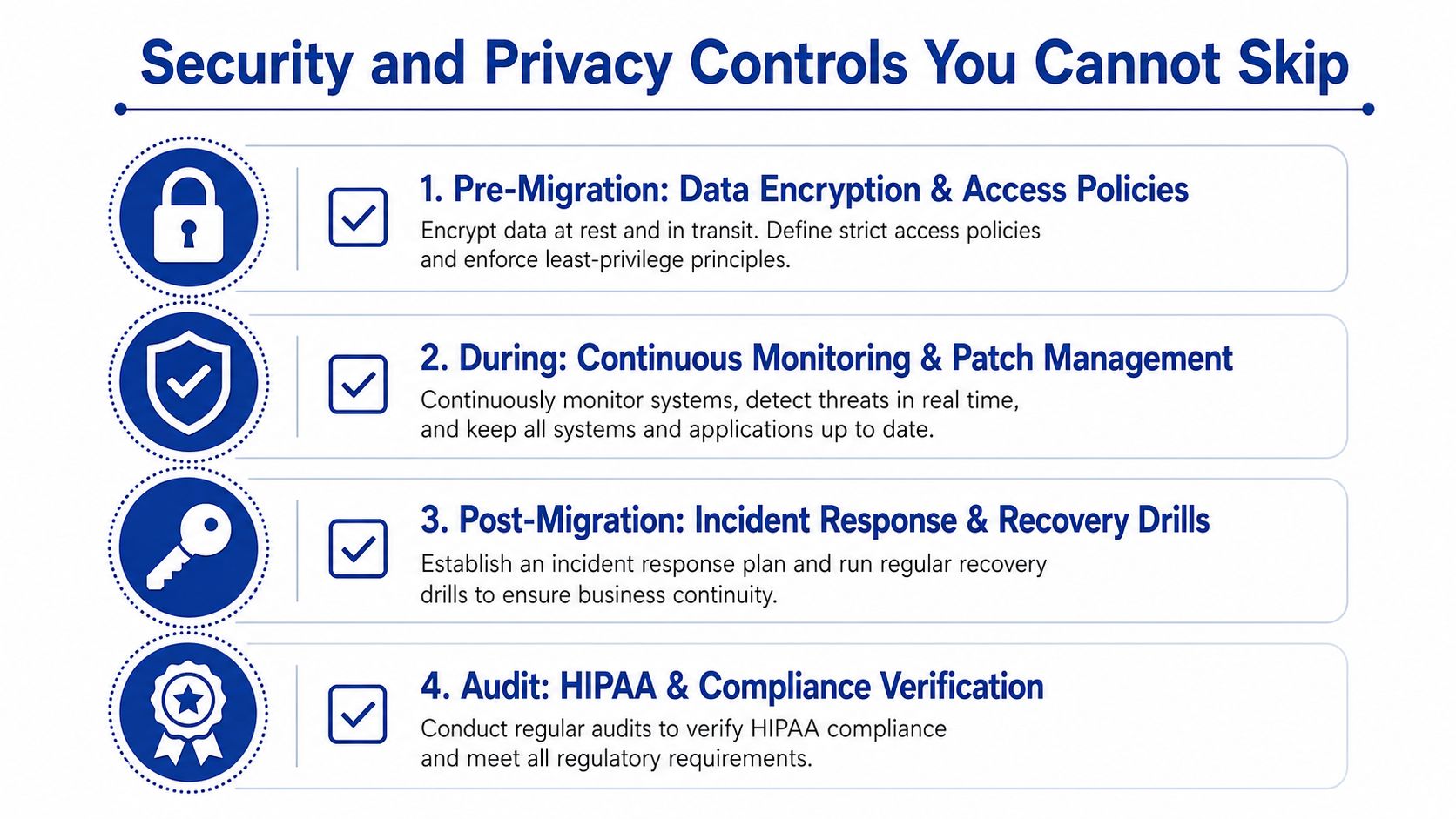
Security and Privacy Controls You Cannot Skip
A cloud migration that reaches production without hard controls becomes a delayed incident. In Canadian healthcare, the harder part is not just encrypting data or tightening permissions. It is proving that patient records stay inside the right residency boundaries, that provincial privacy obligations are met, and that any cross-border subcontractor access is visible, controlled, and contractually covered before the first workload moves.
The control stack that actually holds up
Start with encryption at rest and in transit. The cited baseline calls for AES-256 or stronger for stored data and TLS 1.2+ for transfers, including SFTP, HTTPS, and VPN tunnels. If that is not in the design, nothing else matters.
Then enforce strict access controls with privileged access management. Roles should be narrow, time-bound where possible, and auditable. Canadian buyers need to ask a harder question than “who can log in”. They need to ask who can reach PHI from another country, who can approve that access, and whether the managed-services partner has the same limits. A managed cloud service can help only when the operating model already assumes those controls, not after the fact. Many migrations stumble here because old admin habits get copied into the cloud without being rethought.
Then add audit logging that is immutable enough for investigation, and tested incident response that tells you who does what when an alert hits. Pair that with disaster recovery and business continuity controls that are exercised, not just documented. A migration is only as resilient as its last recovery drill, and in healthcare the drill has to reflect the realities of provincial reporting, retention, and access review.
The implementation sequence that keeps teams honest
Encrypt first: Set encryption standards before data moves, not after the first workload lands.
Constrain access next: Grant only the permissions each role needs, and review vendor access explicitly.
Log every PHI touchpoint: Capture identity, source, and timestamp details so access can be traced.
Test response paths: Run incident and recovery drills before cutover, then repeat them after go-live.
Validate vendor commitments: Every vendor that touches PHI needs a Business Associate Agreement (BAA), and the operational responsibilities inside it should line up with the architecture.
That is also the point where a managed-services partner can add value, but only if they understand regulated operations. Cleffex Digital Ltd sits in that category as a Canada-based software partner that works across custom development and cloud delivery, which matters more than a generic lift-and-shift promise.
For a broader operational baseline on control frameworks and compliance, DCPulse's modern data centre security compliance perspective is useful because it reinforces a hard truth: infrastructure security is a continuous discipline, not a one-time setting. It is also why penetration testing cannot wait until after cutover. By then, your users are already depending on the new environment.
Phased Migration Execution from Discovery to Cutover
The safest migrations I've seen in hospitals all start the same way. Someone finally admits they don't know every dependency, every interface, or every downstream report that will break if the source system moves too early. That honesty saves months of rework.
Start with discovery that is blunt enough to be useful
A full discovery and readiness assessment comes first. Map the applications, interfaces, batch jobs, identity dependencies, and storage relationships before anyone approves a wave plan. That's where you find the hidden blockers, the old HL7 feeds, the shared service accounts, the exports that finance still uses every month, and the archive job nobody documented.
Practical rule: if a system's owner can't describe its inbound and outbound dependencies without opening three spreadsheets, it isn't ready for migration.
Once the map is in place, select loosely coupled and non-production workloads for the first moves. Dry runs and pilots should happen before anything critical changes state. That's not caution for its own sake; it's how you find throughput issues, access problems, and logging gaps while the blast radius is still small.
Run old and new in parallel before you cut over
Parallel operation is the safety net. The sources support a 30 to 90 day validation window after cutover before legacy systems are decommissioned. In practice, that period is where clinical and operational teams prove the new environment can handle real work, not just scripted testing.
The rollback path has to stay live through each wave. If a pilot exposes a problem, you need a tested way back without restarting the project from scratch. Clinical change windows should be negotiated around patient care, not calendar convenience, and communications need to reach clinicians, administrators, and the people handling exception cases.
Don't decommission old systems on optimism. Keep them long enough to validate records, workflows, and reporting, then retire them only after the new environment has carried real load.
A phased cutover works because it respects healthcare's actual rhythm. It doesn't pretend every workload can move at once, and it doesn't force the organisation to choose between speed and safety. It gives you a sequence that survives contact with reality.
Architecture Patterns and the Vendor Selection Question
Once the migration pattern is settled, the harder procurement question appears: which platform model gives you enough control without creating a new burden? The answer isn't always the same across hospitals, and it shouldn't be. SaaS, PaaS, IaaS, hybrid, and multi-cloud each solve a different version of the same problem.
Match the pattern to the workload, not the pitch deck
SaaS fits email, collaboration, and other commodity functions that don't need deep customisation.
PaaS is stronger for clinical analytics platforms where teams want managed services but still control application logic.
IaaS remains relevant for imaging archives and custom workloads that need low-level control over runtime and storage behaviour.
Hybrid is often the practical answer where residency or latency requirements are strict, because it lets organisations keep some workloads close to home while still using cloud services where they add value.
Multi-cloud can support resilience and vendor negotiation power, but it also increases governance overhead. That trade-off is real, and too many teams underestimate the identity, logging, and procurement work that follows.
Ask the vendor four questions before you sign
Where does my data physically reside?
Ask about primary storage, backups, logs, and replicas.
Who has subcontractor access?
Don't stop at the prime provider.
What is the contractual exit path?
You need a clean way out if the relationship changes.
How is pricing structured at month 13 versus month 1?
The answer often reveals the true cost curve.
Those questions matter because total cost isn't just compute. It also includes identity and access management licensing, managed database charges, egress fees, and the difference between reserved and on-demand capacity. Buyers usually feel the first estimate and miss the second- and third-order costs until after adoption.
A strong vendor won't dodge those questions. They'll answer them in writing and tie the answers back to the architecture they're proposing. If they can't, the fit probably isn't right for healthcare.
Healthcare Cloud Migration FAQs
Which migration strategy should we choose if clinical downtime tolerance is near zero?
Start with the least disruptive option that still improves the workload, often rehost or replatform for stable systems, while keeping the rollback path and parallel run in place. Critical clinical systems should only move after pilots and dry runs prove the cutover can hold.
How do we protect PHI during the transfer window?
Use AES-256 or stronger for data at rest, TLS 1.2+ for data in transit, tight access controls, immutable logging, and a signed BAA with every vendor touching PHI. Security validation has to happen before cutover, not after.
How do we validate a pilot before approving enterprise rollout?
Run the pilot on a non-production workload, test data integrity, access, logging, and workflow behaviour, then compare the results against the legacy environment. If the pilot can't survive real operational checks, it isn't ready for scale.
How long should legacy systems stay in parallel?
The sourced guidance points to a 30 to 90-day validation period after cutover before decommissioning. That window gives teams time to confirm reporting, workflows, and rollback confidence.
If you're planning a healthcare cloud migration and need help shaping the residency model, tightening vendor controls, or sequencing a phased cutover, speak with Cleffex Digital Ltd about a migration plan that fits Canadian privacy obligations and clinical operations rather than forcing your organisation into a generic cloud template.