


Canada's healthcare AI market is no longer speculative. IMARC estimated it at USD 163.8 million in 2024 and projected USD 3,321.44 million by 2033, a 36.81% CAGR from 2025 to 2033, which is a clear signal that medical AI solutions are moving from pilots into procurement conversations across the country. For hospital leaders, that changes the question from “should we explore AI?” to “how do we buy and deploy it without creating compliance, integration, or governance debt?”
The most useful way to evaluate these systems is as infrastructure, not novelty. A tool that looks strong in a demo can still fail in a Canadian health environment if it can't fit privacy rules, clinical workflows, bilingual service expectations, or model oversight obligations. This guide is written for buyers who need practical answers, not vendor slogans, and it starts with the realities that determine whether AI becomes a durable asset or another stranded technology investment. For a broader Canadian market view, see this overview of AI healthcare solutions in Canada.
The Reality of Medical AI in Canadian Healthcare
The Canadian market signal matters because it reflects more than curiosity. Medical AI solutions are scaling into a health system that already feels pressure from documentation load, access gaps, and rising expectations for faster decision-making. The growth trajectory in Canada suggests that providers, payers, and vendors are investing because the operational need is real, not because AI is a fashionable market projection summary.
What the market growth actually means
For a CIO or VP of digital, this growth changes the buying environment in three ways. First, more vendors are entering the market, which widens choice but also increases variation in quality. Second, more Canadian organisations are asking for proof of compliance and implementation support, not just feature lists. Third, the evaluation bar is rising, because health systems now expect an AI product to work inside existing governance and care pathways, not outside them.
That is why the real decision is not whether AI can help, but where it can help safely first. In practice, Canadian systems are already moving toward low-risk, high-friction use cases such as documentation support and administrative automation before they take on more sensitive diagnostic or treatment workflows. That sequence aligns with the operational pattern described in Canadian public evidence, where AI has already been launched in areas like notetaking and scheduling to free clinician time for direct patient care Canadian AI and health evidence.
A useful framing for buyers is simple. If the solution cannot show how it fits your intake, privacy, escalation, and oversight process, it is not ready, even if the underlying model is impressive.
Practical rule: Buy for workflow fit first, model novelty second. In healthcare, a great algorithm that nobody can govern is a liability.
The strongest Canadian opportunities are therefore not abstract innovation plays. They're systems that reduce friction in the clinical day, support staff capacity, and create traceable decision support without introducing unmanaged risk. That's the lens that should shape every procurement discussion from the outset.
Understanding the Core Categories of Medical AI
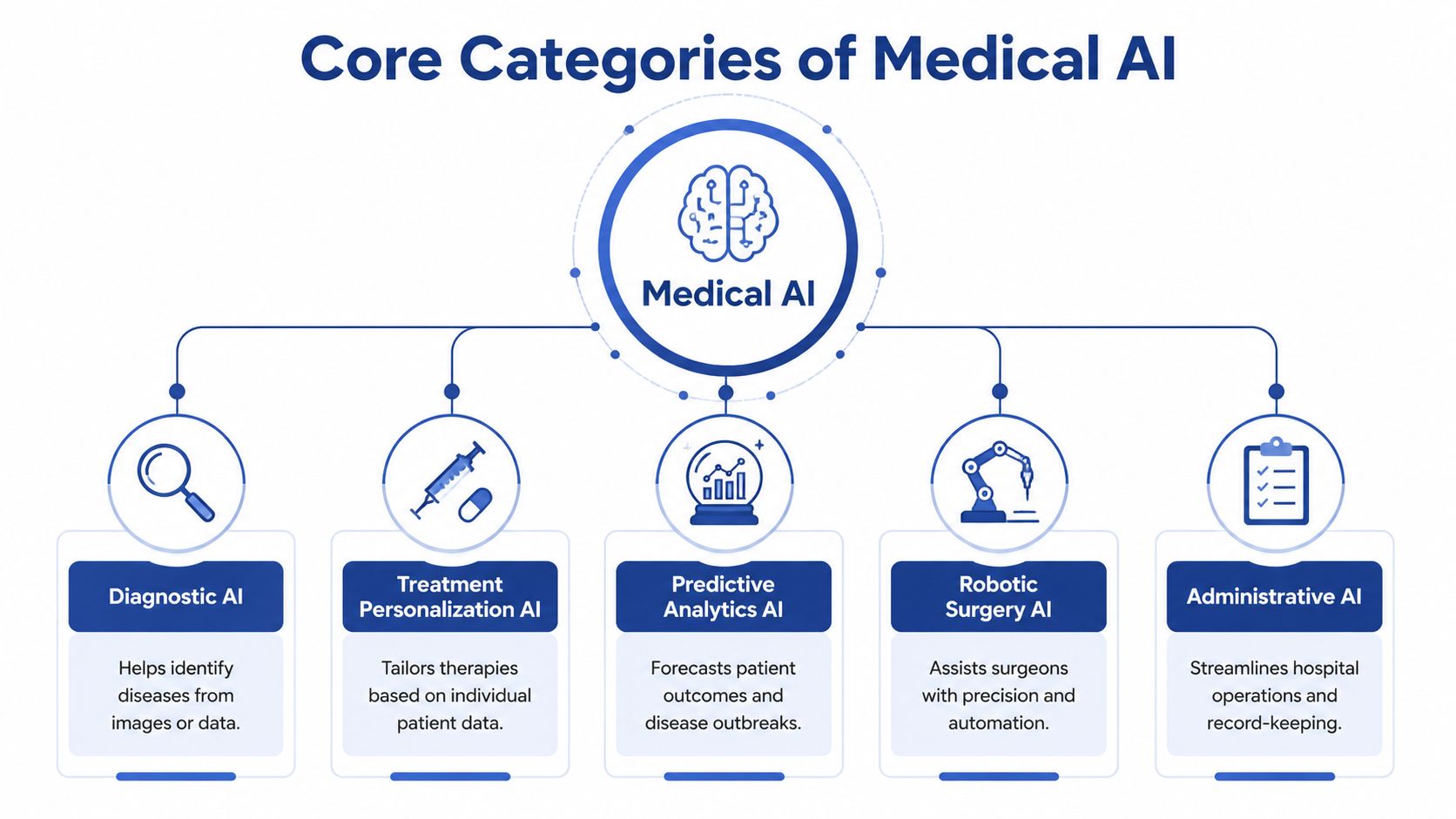
Think of medical AI solutions as a set of specialised tools, not one single product. Each category solves a different bottleneck in the patient journey, and the value comes from matching the tool to the work, not from using AI everywhere at once.
Diagnostic and decision support tools
Diagnostic AI acts like a radiologist's co-pilot. It helps surface patterns in images or data that deserve attention, but it does not replace clinical judgement. Clinical decision support is closer to a real-time evidence library, pulling relevant information into the moment when a clinician is choosing between options.
That distinction matters for procurement. Diagnostic tools fit best where volume is high and review time is limited. Decision support fits best where clinicians need consistent access to evidence, guidelines, or patient-specific context. For a hospital, both categories are only useful if they reduce cognitive load without adding another disconnected screen. A practical example of the workflow side of this category is explored in this guide to AI clinical decision support.
Predictive, language, and monitoring systems
Predictive analytics works like a health risk forecast. It looks across histories, utilisation patterns, or operational signals to help teams anticipate deterioration, demand, or resource pressure before the issue becomes visible in the bed board.
Natural language processing for EHRs is best understood as an intelligent medical scribe. It helps organise notes, summarise encounters, or extract structured meaning from unstructured text, which is why it often becomes one of the first categories to gain traction in busy clinics.
Remote patient monitoring is the virtual care watchtower. It keeps watch between visits, especially for chronic conditions, and gives care teams a way to intervene earlier when patterns change. In Canadian settings, this category becomes especially relevant when health systems need to stretch scarce clinical time across a wider geography.
Automation and specialised intervention systems
Administrative AI is the quiet workhorse. It streamlines scheduling, record handling, and repetitive back-office tasks, which often makes it easier to deploy than higher-stakes clinical systems. Canadian public evidence shows administrative use cases are already live, and that practicality is exactly why they appear early in adoption.
Robotic surgery AI sits at the more specialised end of the spectrum. It supports precision and consistency in controlled environments, but it also raises the bar for validation, training, and governance. That makes it a narrower purchase category, suitable for organisations with the volume, expertise, and capital to support it.
The buying lesson is straightforward. If a vendor can't clearly state which category it serves, which workflow it improves, and where human oversight sits, the product probably isn't mature enough for a Canadian health environment.
Key Benefits and Realistic Limitations
The strongest business case for AI in Canadian healthcare is operational, not abstract innovation. McKinsey estimates that full-scale deployment of known AI applications could reduce national healthcare spending by 4.5% to 8.0% per year, equal to about CA$14 billion to CA$26 billion annually McKinsey Canada healthcare AI analysis. That same analysis points to major savings potential in documentation, care delivery, and capacity management, which tells buyers where the value is most likely to show up first.
Where the value tends to appear
In practical terms, AI delivers when it removes repeatable work from highly trained staff. That can mean faster documentation, fewer manual handoffs, more consistent triage support, or better resource allocation across departments. It can also improve the quality of attention clinicians give to complex cases, because the system handles parts of the routine burden.
The catch is that savings don't arrive automatically. They depend on how well the tool is embedded, whether teams trust it, and whether the organisation is prepared to redesign work around it. If the AI creates an additional layer of review, the economic case weakens fast.
The limits that matter most
Bias remains one of the most important risks, especially in a country with diverse rural, Indigenous, newcomer, bilingual, and disability populations. A model that performs well in one setting can still underperform in another if the data and validation process are narrow. That's why Canadian buyers need to ask for evidence of cross-population testing, not just overall accuracy.
Integration is the other major constraint. A technically strong product can still fail if it doesn't fit the EHR, the referral pathway, or the escalation process. The result is often work duplication, not productivity gain.
Bottom line: In healthcare, the issue is rarely whether AI can produce an output. The issue is whether that output can be trusted, reviewed, and acted on inside a live clinical workflow.
There's also a people problem. AI changes responsibility lines, and staff need clarity on who reviews outputs, who escalates uncertainty, and who owns exceptions. If the organisation can't answer those questions before go-live, it's not ready for scale.
Navigating Canadian Regulatory and Privacy Frameworks
In Canada, compliance is not a final procurement checkpoint. It's part of product design. For Class II-IV machine learning-enabled medical devices, Health Canada expects applications to describe software inputs and outputs, degree of autonomy, workflow integration, and any Predetermined Change Control Plan for future model changes, per Health Canada MLMD guidance. That requirement changes how buyers should evaluate vendors, because the question becomes whether the solution was built for regulated healthcare from the start.
What Canadian buyers need to verify
A vendor should be able to explain how data is handled, where it lives, who can access it, and how changes to the model are governed over time. If the system learns or updates, the vendor should also show how updates are controlled, documented, and reviewed, given that a healthcare AI system isn't just software, but software with clinical consequences.
Privacy expectations can't be treated as a legal appendix either. They affect architecture, procurement, onboarding, and ongoing operations. For a clear Canadian discussion of data handling risks and governance concerns, see AI in healthcare data privacy in Canada.
One practical way to pressure test a vendor is to ask how they handle edge cases, not average cases. A useful outside reference is Qaly's ChatGPT ECG reader test results, which is a good reminder that model performance can look promising in one setting and miss clinically meaningful details in another. That kind of review is valuable because it highlights the difference between consumer-grade output and regulated medical use.
Canadian buyers should also think beyond federal obligations. Provincial privacy and health information rules affect deployment design, especially for hospitals that span multiple jurisdictions or share data across partner networks. The safest path is to insist that compliance artefacts, technical documentation, and clinical governance be part of the vendor package before any pilot begins.
Data Requirements and Model Governance
Good AI starts with usable data, but healthcare data is rarely tidy. Records are fragmented, definitions vary, and the same clinical event may be captured in different ways across settings. That's why the most important question isn't whether a model can train; it's whether the data pipeline supports representative, secure, and clinically meaningful inputs.
What governance has to cover
The Vector Institute's implementation toolkit frames deployment as a staged process that includes data pipelines, algorithm selection balancing performance with interpretability, bias testing across patient populations, and post-deployment monitoring for model drift Vector Institute implementation guidance. That's the right model for Canadian healthcare because it treats AI as a living system, not a one-time purchase.
Many projects falter because teams buy a model, test it in a narrow environment, and assume the work is done. In reality, performance can shift once the tool meets new patient groups, new documentation patterns, or new workflow conditions. Governance exists to catch those changes before they become safety issues.
What to demand from vendors and internal teams
A serious implementation should include clear ownership for validation, monitoring, and escalation. It should also define what “good performance” means in your setting, because a model that is acceptable in one hospital may be too noisy or too opaque in another. The right balance depends on the use case, the risk level, and the clinical consequences of error.
A concise checklist helps:
Data provenance: Know where the training and validation data came from, and whether it reflects your patient mix.
Interpretability: Confirm that clinicians can understand why the system is recommending something.
Bias review: Ask how the vendor tests across populations, not just across aggregate datasets.
Monitoring cadence: Clarify who checks for drift, how often, and what happens when performance changes.
Change control: Ensure updates are documented and approved before they touch production.
One more point matters in Canadian healthcare. Governance can't be a paper exercise owned only by IT. Clinical leadership, privacy, procurement, and operations all need to own part of the oversight model, or the system will drift away from safe use.
A Practical Roadmap for Integration and Deployment
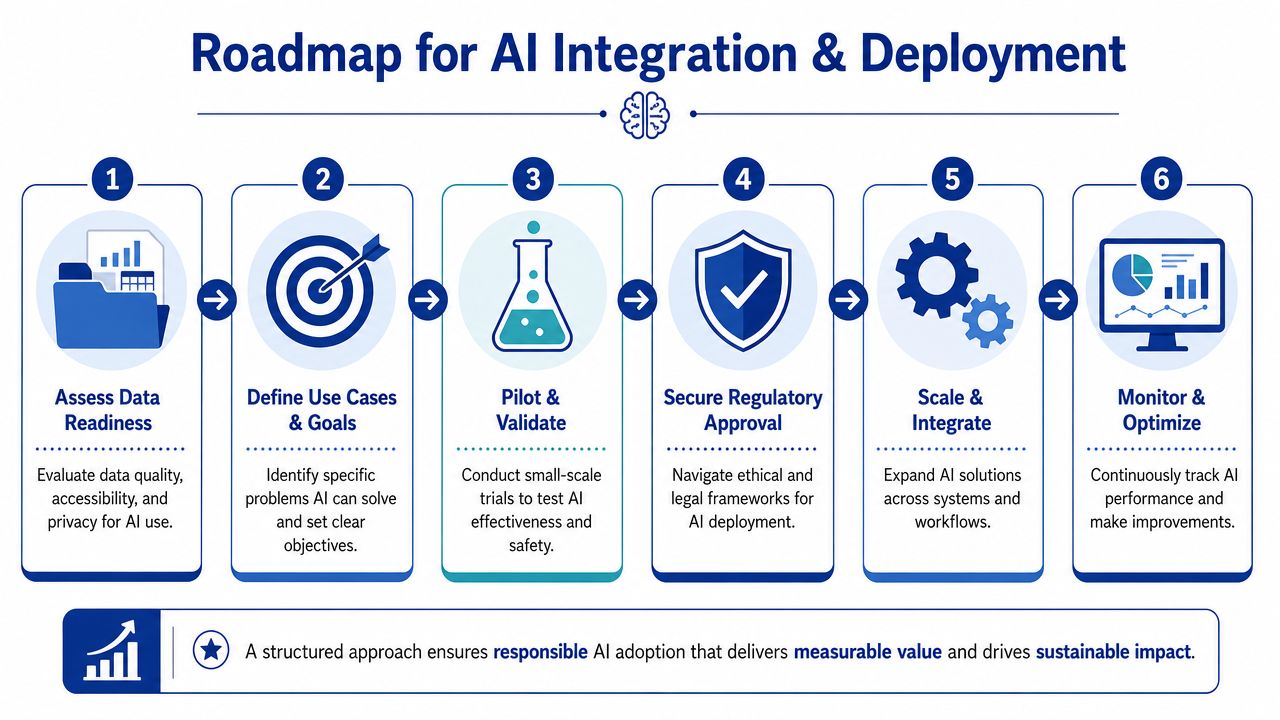
The Canadian primary-care evidence is blunt about the main blockers. It points to system and data readiness, bias and inequity, regulation of AI and big data, and the role of people as technology enablers, which tells you the barrier is often institutional readiness rather than model quality.
Start with operational fit, not a broad rollout
The safest deployment pattern is narrow, testable, and tied to one workflow. Choose a use case where the problem is clear, the data is available, and the clinical risk is manageable. That gives the organisation a chance to learn how the system behaves before it affects a wider population.
Stakeholder buy-in comes next, and it has to include the people who will live with the tool. Clinicians, privacy leads, operations managers, and frontline staff should all be part of the review. If they only see the product after procurement, resistance usually shows up later as low adoption or workarounds.
Build the pilot around measurement
A pilot should define what success looks like before it starts. That may include time saved, reduced manual review, fewer handoffs, or better consistency in a specific workflow. What matters is that the pilot produces evidence the organisation can trust, not just a proof-of-concept slide deck.
Once the pilot is stable, scale should be phased. That allows the team to re-check training, support, governance, and integration at each stage. It also gives leaders a chance to correct issues before they spread across departments.
Implementation advice: Never scale a healthcare AI tool faster than your support model can absorb it. Deployment speed without governance usually creates rework, not value.
This roadmap is also where an implementation partner matters. A vendor or services firm like Cleffex Digital Ltd can be relevant when the work requires integration, application development, or workflow redesign alongside the AI layer. That role only works if the partner treats compliance and operational fit as core deliverables, not optional extras.
Choosing the Right Vendor and Measuring ROI
A good vendor evaluation starts with one question. Can this company support a compliant, clinically validated, and operationally integrated system in Canada? If the answer is vague, the product is still too immature for a serious health environment.
Vendor checklist
| Evaluation Criterion | What to Look For |
|---|---|
| Clinical validation | Evidence the system was tested for the intended use in healthcare settings |
| Health Canada readiness | Documentation aligned to MLMD expectations, including autonomy and change control |
| Integration capability | Clear fit with existing EHRs, scheduling, or documentation workflows |
| Data security and privacy | Strong controls, access management, and auditable handling of patient data |
| Governance support | Help with monitoring, drift review, and update approval |
| Clinical usability | Outputs that clinicians can interpret quickly and trust in practice |
| Implementation support | Services for deployment, training, and workflow change management |
Measuring ROI the right way
ROI should include more than financial savings. In healthcare, the better question is whether the tool improves operational efficiency, staff experience, and decision quality without creating new risk. If a solution saves time but adds uncertainty, the net value may be lower than the vendor claims.
A strong business case usually combines hard and soft outcomes. Hard outcomes include reduced manual work and lower process friction. Soft outcomes include better clinician satisfaction and a smoother patient experience. The strongest vendors will help you measure both without forcing everything into a single financial metric.
The final test is support. A vendor that disappears after go-live shifts the burden back to your team. A vendor that stays engaged through monitoring, training, and iteration is much more likely to produce durable value in Canadian healthcare.
If you're evaluating medical AI solutions for a hospital, clinic network, or health startup in Canada, start with governance, integration, and regulatory fit, not features. Talk to Cleffex Digital Ltd about building a deployment plan that fits your workflow, privacy obligations, and implementation timeline.