

CA$648 million, that's the scale of fraud losses tied to Canadian reports in 2023, according to the Adobe summary citing the Canadian Anti-Fraud Centre. For an ecommerce business owner, that number changes the conversation. Security isn't a backend IT task. It's revenue protection, checkout integrity, and customer trust in one package.
A lot of merchants still treat ecommerce security solutions like a padlock on the browser bar. If HTTPS is on, they assume the store is secure enough. That's no longer how attacks work. Modern fraud hits logins, checkout flows, refund processes, admin panels, third-party apps, and support workflows. Attackers don't always need to “hack” a store in the dramatic sense. Sometimes they just automate abuse faster than a small team can detect it.
The practical question for Canadian businesses isn't whether security matters. It's what controls reduce risk without slowing sales. Good ecommerce security solutions don't force every customer through a maze. They put stronger checks where the risk is highest, keep payment data out of reach, and give your team early warning before fraud turns into chargebacks, downtime, or a trust problem.
Why Your Store Needs More Than a Padlock in 2026
According to Verizon's 2024 Data Breach Investigations Report, the use of stolen credentials and the exploitation of vulnerabilities remain two of the most common ways attackers get in. For an ecommerce store, that matters because both paths often bypass the “padlock means safe” assumption. HTTPS protects data in transit. It does not stop account takeover, admin abuse, fraudulent refunds, or a compromised plugin with excessive permissions.
That gap is where many Canadian merchants lose margin.
Security protects revenue, checkout continuity, and trust
A store can pass a basic visual trust check and still be exposed in ways that hurt the business every week. The problem is not only a breach in the dramatic sense. It is the slow leak of money and staff time through preventable abuse.
The business case is straightforward:
Revenue protection means blocking bad orders, promo abuse, and account takeover before they turn into chargebacks or lost inventory.
Customer trust means giving legitimate buyers enough confidence to create accounts, save payment methods, and come back.
Operational stability means your team spends less time sorting through suspicious orders, refund disputes, and admin cleanup.
Brand protection means one avoidable incident does not become the reason customers hesitate at checkout.
I advise Canadian businesses to judge security controls by one standard. Do they reduce loss without creating enough friction to hurt conversion? If the answer is no, that control belongs lower on the list.
Canadian businesses need a layered defence, not a checklist
Many merchants still buy security in pieces. A plugin for malware scans. A gateway for card handling. MFA for admins. Those are useful controls, but they do not add up to a strategy on their own.
A better approach is defence in depth across the parts of the store that attackers commonly target. Login and password reset flows. Checkout and payment handoff. Admin accounts. Third-party apps. Customer service actions such as address changes, refunds, and order edits. Each layer covers a different failure point, which is why one missed control does not automatically turn into a costly incident.
There is a trade-off here. More checks can reduce fraud, but they can also block legitimate customers and create abandoned carts. Canadian merchants need to be selective. Stronger controls should sit around high-risk actions, not every action. That usually means stricter checks for admin access, unusual login behaviour, high-value orders, and refund activity, while keeping normal browsing and checkout as easy as possible.
If you have not reviewed those risks in a structured way, an Accelerate IT Services risk assessment can help identify where a layered security model will produce the highest return first.
Mapping the Modern Ecommerce Threat Landscape
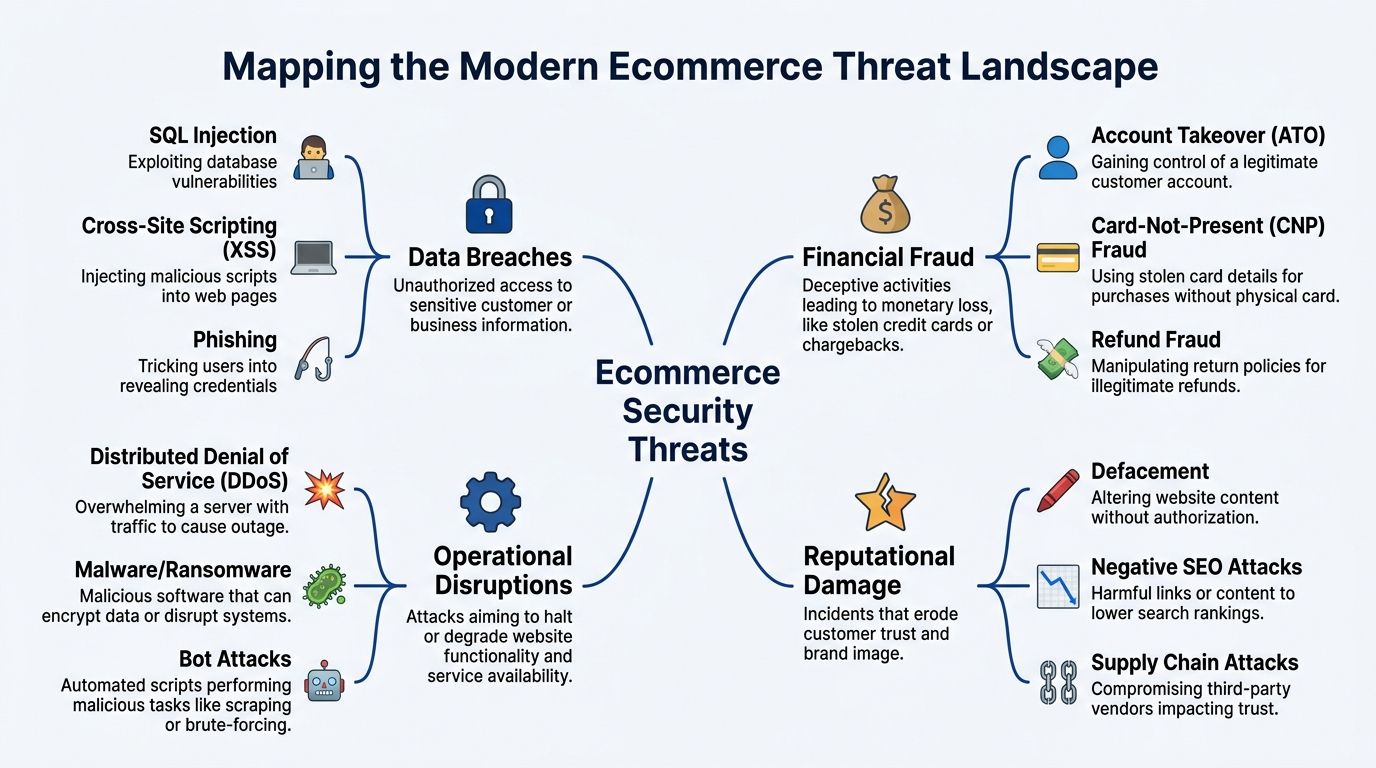
Most online stores face two categories of threats. The first is familiar: technical exploits against websites and infrastructure. The second is where many merchants are falling behind: automated abuse that looks enough like real customer behaviour to slip past basic controls.
Canada-specific threat pressure makes that distinction important. The Cyphere summary notes that Canada's Anti-Fraud Centre reported $638 million in total fraud losses in 2024, while the Canadian Centre for Cyber Security identifies phishing and ransomware as persistent threats. That's why perimeter tools alone aren't enough. Stores need defences that can handle automation, identity abuse, and operational fraud.
Classic attacks still matter
Many store compromises still start with known weaknesses. The usual examples are SQL injection, cross-site scripting, phishing, and denial-of-service activity. These aren't old problems in the sense of being gone. They're old problems in the sense that merchants should already have controls for them.
Here's the business impact behind those terms:
SQL injection can expose customer or order data if the application handles inputs poorly.
Cross-site scripting can let attackers inject malicious scripts into pages and abuse customer sessions.
Phishing often targets staff, not just customers. A stolen admin login can be more damaging than a noisy brute-force attempt.
DDoS activity can shut down promotions, launches, or seasonal traffic windows when availability matters most.
Automated abuse is the bigger operational problem
Many ecommerce security solutions need to do more than checklist compliance.
Bots can test stolen passwords, scrape pricing, abuse gift-card flows, create fake accounts, hammer login forms, and cycle through checkout attempts at a speed humans can't match. Fraudsters also combine automation with social engineering. They'll compromise a customer account, change delivery details, place orders, then pressure support for fast fulfilment before anyone notices.
A lot of merchants discover this too late because dashboards still show “traffic” and “orders,” but not the intent behind them.
The store isn't only defending against intrusions. It's defending against the misuse of normal business functions.
Risk assessment should cover abuse, not just vulnerabilities
A practical assessment has to look at how your store can be misused, not only how it can be broken. That means reviewing admin access, checkout logic, third-party apps, customer account recovery, refund workflows, and API exposure. For businesses that need a structured starting point, an Accelerate IT Services risk assessment is the kind of exercise that helps identify where technical weaknesses and business-process abuse overlap.
A merchant that only patches software is solving half the problem. The other half is understanding which actions in the store create the highest fraud advantage for an attacker.
Building Your Layered Security Defence
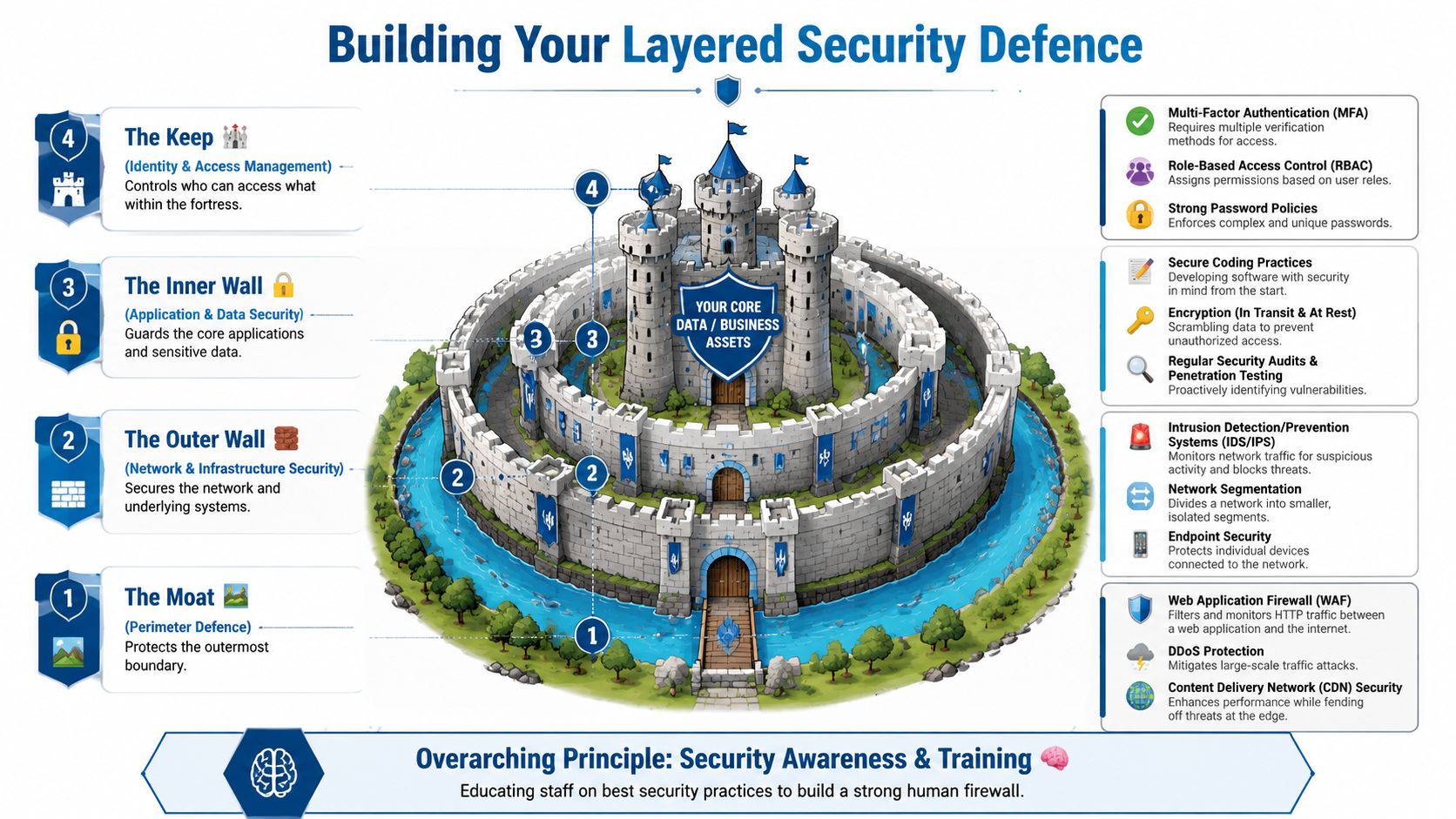
The easiest way to explain defence in depth is a fortress. Not because ecommerce security needs medieval language, but because the model is accurate. You need more than one wall, and each wall has a different job.
In practice, ecommerce security solutions work best when they stop different attack paths at different stages. Instandart reports that almost 90% of ecommerce sites use SSL certificates and 80% have adopted MFA in 2024. That tells you something important. Encryption and identity checks aren't advanced options anymore. They're the baseline.
The moat and the outer walls
Start at the edge of the store.
WAF filters malicious web requests before they reach the application. Doing so reduces exposure to common exploit attempts and suspicious patterns.
DDoS protection helps preserve availability when attackers try to overwhelm the storefront.
CDN edge security improves performance and can absorb or filter bad traffic before it reaches origin systems.
This layer is about reducing noise and absorbing impact. It won't stop every fraud event, but it does reduce the number of easy opportunities.
For teams reviewing application-level controls, these web application security best practices give a useful checklist for how code, infrastructure, and configuration should work together.
The inner walls and the keep
Once traffic reaches the app, stronger controls need to take over.
| Layer | Main control | What it protects |
|---|---|---|
| Transport | TLS/SSL | Data moving between browser and server |
| Identity | MFA and RBAC | Admin panels, dashboards, support tools |
| Data handling | Tokenisation | Card and payment data exposure |
| Validation | Secure coding and testing | Inputs, sessions, business logic |
A common misunderstanding is that SSL solves data protection on its own. It doesn't. TLS protects data in transit. Tokenisation reduces the value of payment data if attackers reach storage or downstream systems. Role-based access control limits who can reach sensitive functions in the first place.
What works: give every layer a narrow, specific job.
What fails: expecting one tool to cover transport security, fraud prevention, access control, and application abuse all at once.
Test the perimeter before an attacker does
A layered design only helps if you verify that the layers hold up effectively. External testing is especially useful for stores with custom features, API integrations, or multiple admin surfaces. For agencies, MSPs, or merchants working through channel partners, white-labeled external pentesting services can be a practical way to validate internet-facing exposure without building an in-house testing function first.
One more operational point matters here. Staff access should get the same attention as storefront traffic. If support, finance, and operations users can all reach sensitive functions with broad permissions, a single compromised account can bypass the expensive controls you put in front of customers.
Mastering PCI DSS Compliance for Secure Payments
PCI DSS gets treated like paperwork far too often. For merchants, that's the wrong frame. PCI DSS is a payment security baseline. It tells you what must be true if your store handles card data or touches the payment path.
According to NordLayer's PCI DSS overview for ecommerce security practices, PCI DSS requires a firewall, encryption of cardholder data in transit, unique user IDs, and continuous logging and testing. Those controls directly reduce breach likelihood by hardening the payment path against attacks such as XSS and SQL injection.
What the standard means in plain language
The practical reading of PCI DSS is straightforward:
Use a firewall so the payment environment isn't exposed carelessly.
Encrypt data in transit so attackers can't easily intercept cardholder information moving through the transaction flow.
Assign unique user IDs so access is traceable and shared credentials don't hide responsibility.
Log and test continuously so you can detect suspicious activity and verify controls before criminals do.
That isn't bureaucracy. That's a blueprint for reducing the chance that a checkout issue becomes a payment-data incident.
How compliance connects to real controls
A merchant usually gets into trouble when PCI DSS is isolated from the rest of the security design. It should be tied directly to storefront architecture.
For example:
A WAF helps reduce exploit attempts against the checkout and account areas.
TLS protects transaction traffic in transit.
Role-based access controls keep admin users from seeing or changing more than their job requires.
Vulnerability scanning and testing catch weaknesses before they're exploited.
If you need a practical breakdown of what merchants should implement and document, this PCI DSS compliance guide for businesses is a useful reference.
PCI DSS is the floor, not the ceiling. A compliant checkout can still suffer from account takeover, refund abuse, or poor admin hygiene.
Where merchants make avoidable mistakes
The most common error is assuming the payment processor handles everything. A processor may reduce your scope, but it doesn't secure your admin accounts, your plugins, your custom scripts, or your support workflows.
The second mistake is treating PCI DSS as a one-time project. Real payment security depends on ongoing logging, testing, and access review. If your store changes frequently, which most stores do, your payment risk changes with it.
Stopping Fraud Without Frustrating Customers
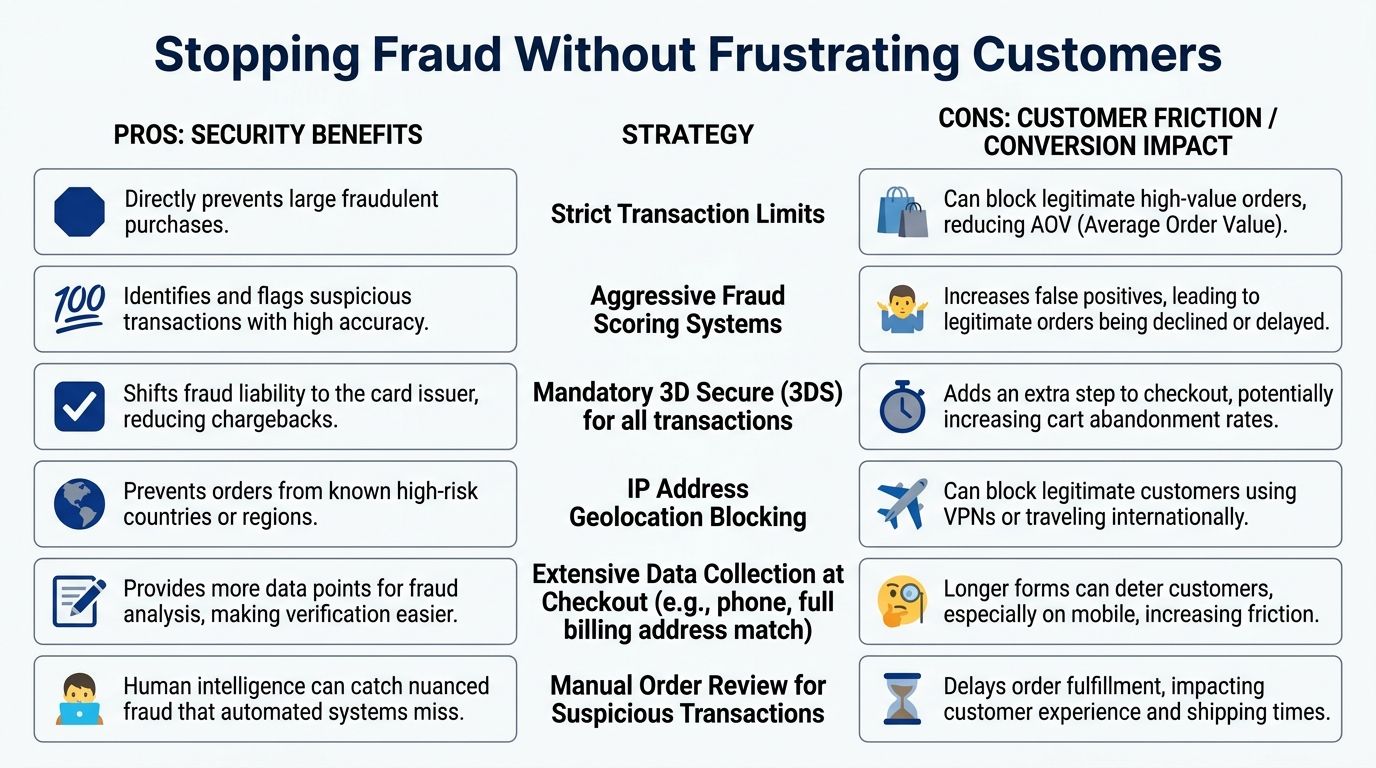
Fraud prevention often fails for one of two reasons. Either the store is too loose, and fraud gets through, or it's too aggressive and good customers get blocked. Both outcomes cost money.
That trade-off matters in Canada because SentinelOne's ecommerce security guidance notes that Canadian card-not-present fraud losses reached C$647.5 million in 2023. Their practical takeaway is the right one. Merchants need more than basic compliance, and the strongest approach uses tokenisation and risk scoring for step-up authentication only on high-risk transactions.
Invisible security is usually better security
Good customers shouldn't feel like suspects at every step. If every checkout triggers extra verification, friction rises fast. That hurts mobile conversion first, then repeat purchase behaviour.
The better model is a risk-based intervention. Let low-risk customers move smoothly. Add friction only when signals justify it.
Examples of useful signals include:
Device changes that don't match prior customer behaviour
Velocity spikes, such as repeated login or checkout attempts
Address mismatches combined with unusual order patterns
Gift-card or refund anomalies that suggest scripted abuse
Session behaviour that looks automated rather than human
High-friction controls can backfire
Some anti-fraud controls look strong on paper and perform poorly in a real store.
| Control | Where it helps | Where it hurts |
|---|---|---|
| Mandatory challenge for every order | Uniform enforcement | Slower checkout, more abandonment |
| Hard geographic blocking | Clear high-risk restrictions | False blocks for travellers and VPN users |
| Manual review of broad order sets | Human judgment on edge cases | Fulfilment delays and team overhead |
| Extra checkout fields for everyone | More verification data | Lower mobile completion |
This is why blanket rules rarely scale well. They create operational burden and customer friction at the same time.
What tends to work better
Use layered decisioning instead of all-or-nothing gates.
Tokenisation reduces exposure to payment data.
Risk scoring evaluates transaction context in the background.
Step-up authentication appears only when the risk score crosses a threshold.
Device and session analysis help separate normal repeat buyers from scripted attacks.
Manual review stays reserved for ambiguous cases.
If your team is exploring background scoring and adaptive controls, this guide to AI fraud detection for ecommerce is a solid, practical reference.
One operational lesson stands out. Fraud teams often focus heavily on checkout, but many losses start earlier. Login abuse, loyalty misuse, gift-card testing, and fake account creation can all set up downstream payment fraud. If your detection starts only when the card is entered, you're reacting late.
Your Actionable Ecommerce Security Roadmap
Security planning gets messy when merchants try to do everything at once. A phased roadmap works better. It helps you prioritise what's essential, what becomes necessary as order volume grows, and what belongs in a more mature security programme.
That direction also matches market behaviour. Market.us reports that the global ecommerce security market was valued at USD 194.40 billion in 2024 and is projected to reach USD 720.68 billion by 2034, reflecting a 14% CAGR. The same source notes that network security held a 26% share and encryption a 20% share in 2024. That investment pattern points to a clear conclusion. Layered protection is now standard practice, not an enterprise luxury.
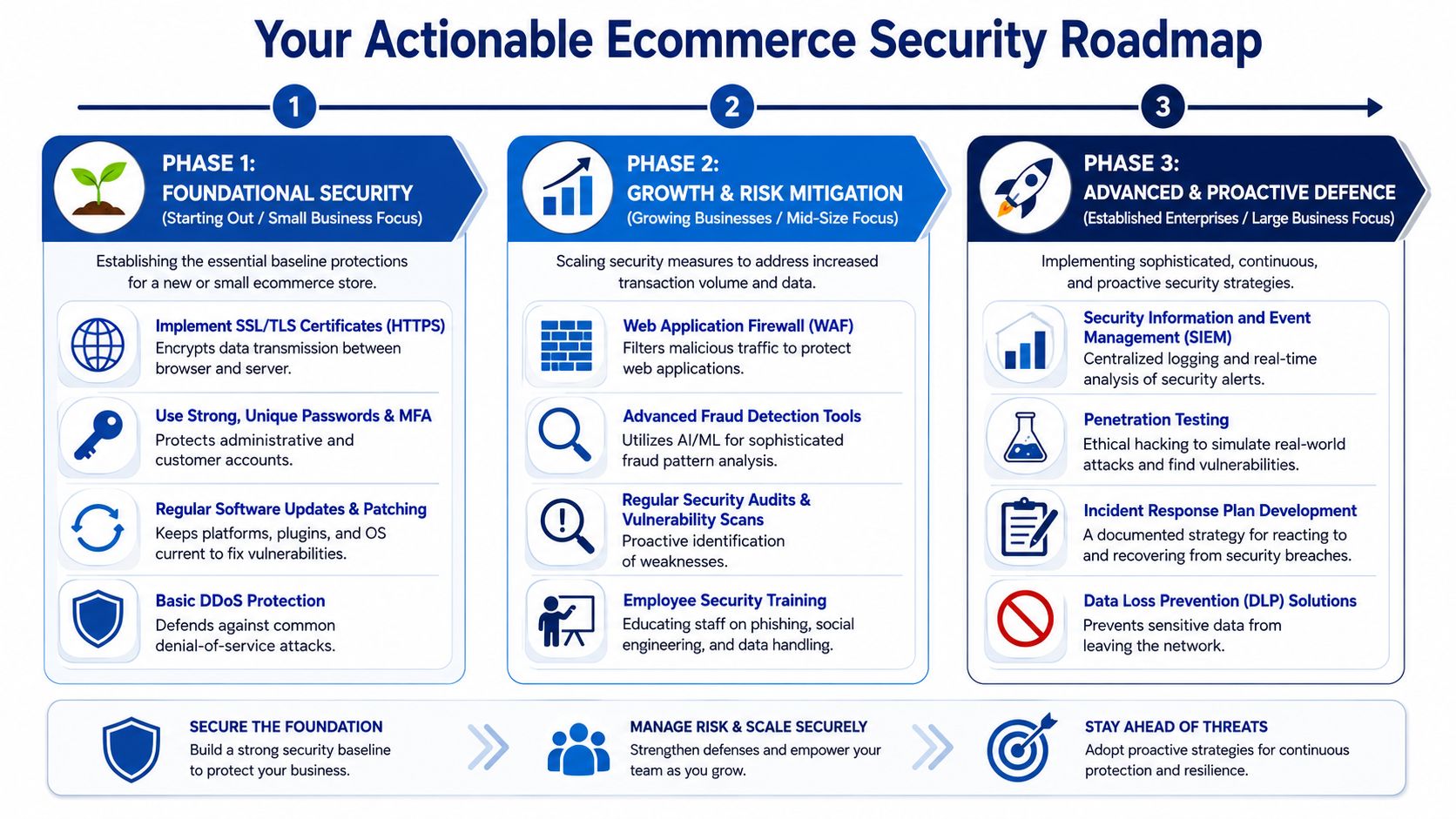
Phase 1 for foundational protection
If you're launching or running a smaller store, start with the controls that close the biggest, most obvious gaps.
Encrypt all storefront traffic with TLS.
Secure admin access with MFA and unique accounts.
Keep the platform updated, including themes, plugins, and integrations.
Use a payment setup that reduces exposure to raw card data.
Document a basic incident process so your team knows who does what if something goes wrong.
This phase is about eliminating preventable weaknesses. Most small stores get strong value here before buying more advanced tooling.
Phase 2 for growing transaction volume
As the store scales, abuse tends to become more frequent and less random.
Introduce:
A WAF to filter hostile requests before they hit the app
Fraud monitoring that evaluates device, session, and order behaviour
Regular vulnerability scans and audits
Staff training for phishing, admin hygiene, and suspicious order handling
At this stage, a custom implementation partner can matter if your stack is becoming more customised. Cleffex Digital Ltd offers custom ecommerce development services where security is built into delivery, which is relevant when merchants need platform-specific controls rather than generic plugins.
Phase 3 for mature defence
Larger or more exposed operations need continuous visibility and a rehearsed response.
Consider adding:
Centralised logging and alerting so suspicious events aren't buried across multiple tools.
Penetration testing for storefronts, APIs, and admin surfaces.
An incident response plan with clear owners, decision paths, and communication steps.
Data loss prevention and segmentation where sensitive business data needs tighter boundaries.
Mature security isn't about buying the most tools. It's about reducing blind spots between them.
A roadmap only works if someone owns it. If security tasks are split informally across marketing, operations, and a developer who “also handles hosting,” gaps appear fast.
Frequently Asked Questions About Ecommerce Security
Is Shopify or BigCommerce secure enough on its own?
Hosted platforms usually provide a stronger baseline than a poorly maintained custom store. They help with infrastructure security, updates, and some payment controls. But they don't secure your business decisions for you.
Your store can still be exposed through weak admin access, risky apps, poor permission design, unsafe custom scripts, and operational gaps in support or fulfilment. Platform security is the foundation. Your configuration, workflows, and integrations determine a large part of the remaining risk.
What should a small or mid-sized business buy first?
Start with the controls that reduce common, high-impact problems with the least operational complexity. That usually means HTTPS, MFA for all staff accounts, secure payment handling, access control, and routine updates. After that, the next logical move is usually better monitoring and a WAF.
Don't begin with the most complex fraud engine if your admin accounts still share credentials or your plugins are stale. Fancy tooling on top of weak basics is a common waste.
How much should an SMB budget for security solutions?
There isn't a single useful number because the right spend depends on your platform, customisation level, payment flows, transaction volume, and fraud exposure. A merchant with a simple hosted setup has very different needs from a business with subscriptions, custom APIs, multiple warehouses, and delegated support roles.
The better question is where a security investment removes recurring business pain. If a control reduces order review time, lowers chargeback pressure, limits admin exposure, or improves incident response, it's usually easier to justify than a generic “security package.”
What's the first thing to do if you suspect a breach?
Act fast, but don't act randomly.
Contain access by locking down affected admin accounts and limiting privileged actions.
Preserve evidence, including logs, recent changes, and suspicious transactions.
Identify scope across storefront, admin tools, payment flow, third-party apps, and customer accounts.
Notify the right parties internally and through your payment or hosting providers as needed.
Fix the entry point before restoring normal operations.
Don't prematurely delete suspicious files or turn systems back on and hope for the best. That can erase evidence and leave the actual access path open.
Do customers need MFA too?
Not always for every session. For customer accounts, MFA is most useful when tied to higher-risk actions such as password changes, unusual logins, stored payment access, or account recovery. For staff and admin users, MFA should be standard.
Are penetration tests necessary for every store?
Not every store needs the same testing depth, but any business with custom features, APIs, complex integrations, or meaningful transaction volume should validate its exposure regularly. Automated scanners find some issues. They don't replace human testing of business logic, access boundaries, and abuse paths.
Cleffex Digital Ltd helps businesses build and improve secure digital products, including ecommerce platforms, custom software, and web applications. If you're planning a new storefront or hardening an existing one, Cleffex Digital Ltd is one option for combining development delivery with practical security thinking.