

71% of consumers expect personalised communications and products or services from brands, and 80% of consumers aged 18 to 64 are more likely to purchase from a company that offers personalised shopping experiences, according to Instapage's roundup of personalisation statistics. That changes the framing.
Personalisation isn't a nice add-on for digital teams anymore. It's part of the operating model. If you run an online store, a patient-facing healthcare platform, an automotive service funnel, or a mid-market commerce stack, the real question isn't whether personalised shopping experiences matter. It's whether your systems can support them without creating data chaos, weak governance, or a brittle customer journey.
From a delivery standpoint, organisations typically fail in one of two ways. They either start with campaign ideas and no data foundation, or they buy an AI tool and expect it to fix fragmented systems. Neither path works well. The durable path is simpler: get the data right, connect the stack, activate a few high-value use cases, then measure what changed.
What Are Personalised Shopping Experiences?
A generic online experience is easy to spot. Every visitor sees the same homepage banner, the same featured products, the same email sequence, and the same cart reminder. A first-time browser, a loyal repeat buyer, and someone comparing options on mobile all get treated as if they're the same person.
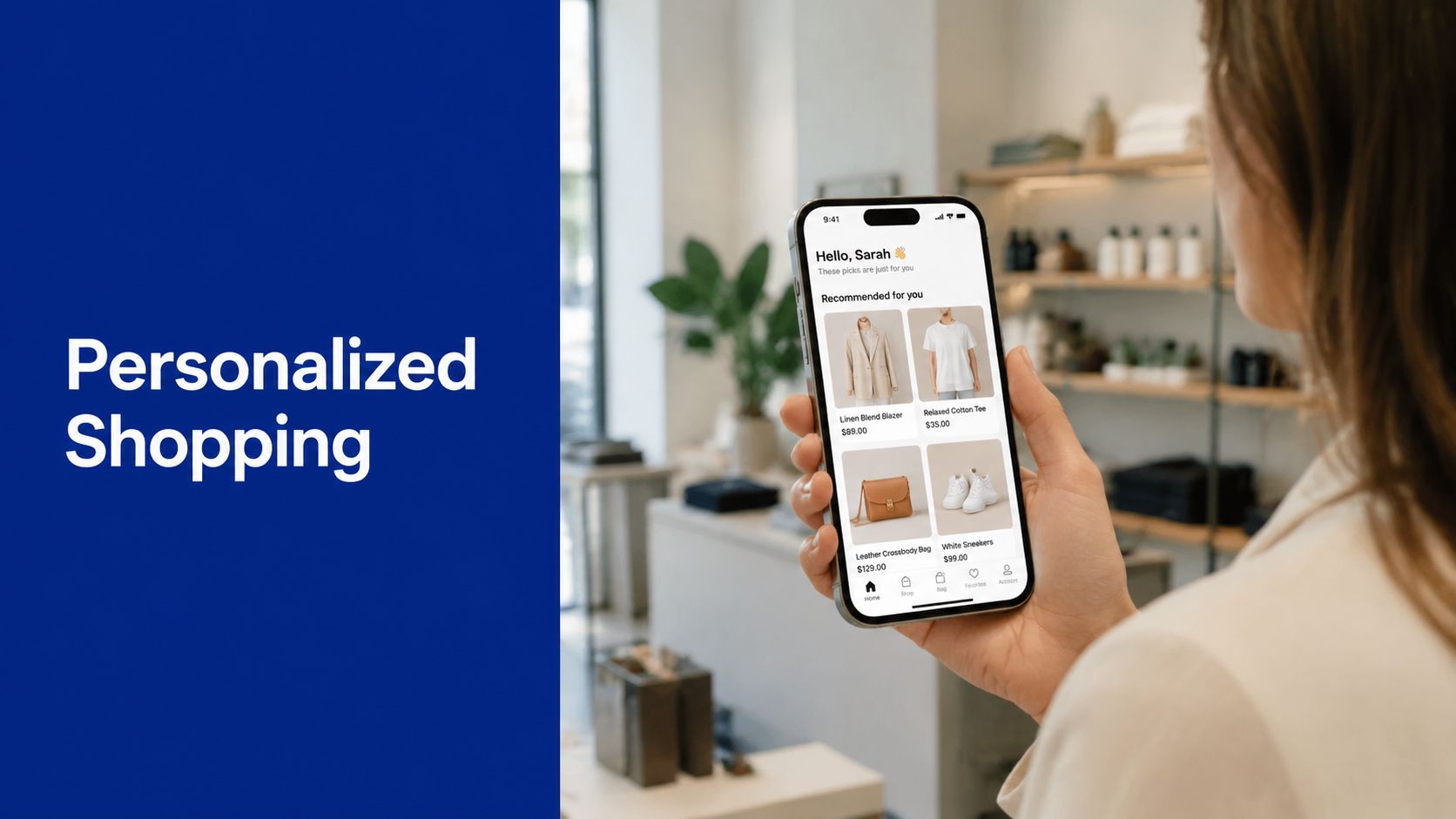
A personalised experience changes that. The site adjusts what it shows based on context, behaviour, stated preferences, and prior interactions. The message isn't just “hello, Sarah.” It's “these options fit what you've looked at, what you've bought, what you asked for, and where you are in the journey.”
That's the difference between basic personalisation and hyper-personalisation.
Basic personalisation versus hyper-personalisation
Basic personalisation is usually rule-based. If someone purchased winter tyres, show accessories related to winter driving. If someone downloaded a clinic intake form, send the next operational message rather than a broad marketing newsletter. This level is useful, especially for SMBs, because it's easier to launch and govern.
Hyper-personalisation works in real time. The system reacts to fresh signals during the session itself. It may change homepage modules, reorder product listings, trigger a service prompt, or suppress an irrelevant promotion because the user's current behaviour says something new.
A practical way to consider this:
| Approach | What it uses | Typical example |
|---|---|---|
| Basic personalisation | Past purchases, CRM fields, simple segments | Returning customer sees repeat-order suggestions |
| Hyper-personalisation | Real-time behaviour, unified profile, predictive logic | Product page content changes based on live browsing intent |
What customers actually feel
People don't experience your architecture. They experience relevance.
If the recommendations fit, the message timing makes sense, and the checkout path feels easier, customers feel understood. If the brand asks for too much data, surfaces the wrong product, or follows them with clumsy retargeting, the experience becomes intrusive fast.
For teams refining channel tactics, this overview of digital marketing personalisation strategies is useful because it maps the marketing layer to the shopping journey. On the UX side, this breakdown of AI-driven ecommerce UX for online shopping is a good companion when the challenge is turning customer data into interface decisions.
Personalisation works when it reduces effort for the customer. It fails when it only increases targeting for the brand.
The Business Case for Personalisation
Personalisation gets approved when it moves from a branding conversation to a revenue conversation. That shift matters for SMBs and mid-market firms because every integration, model, and workflow change has a cost. Leaders need evidence that the effort can affect conversion, retention, and basket value in a measurable way.
Conversion improves when relevance improves
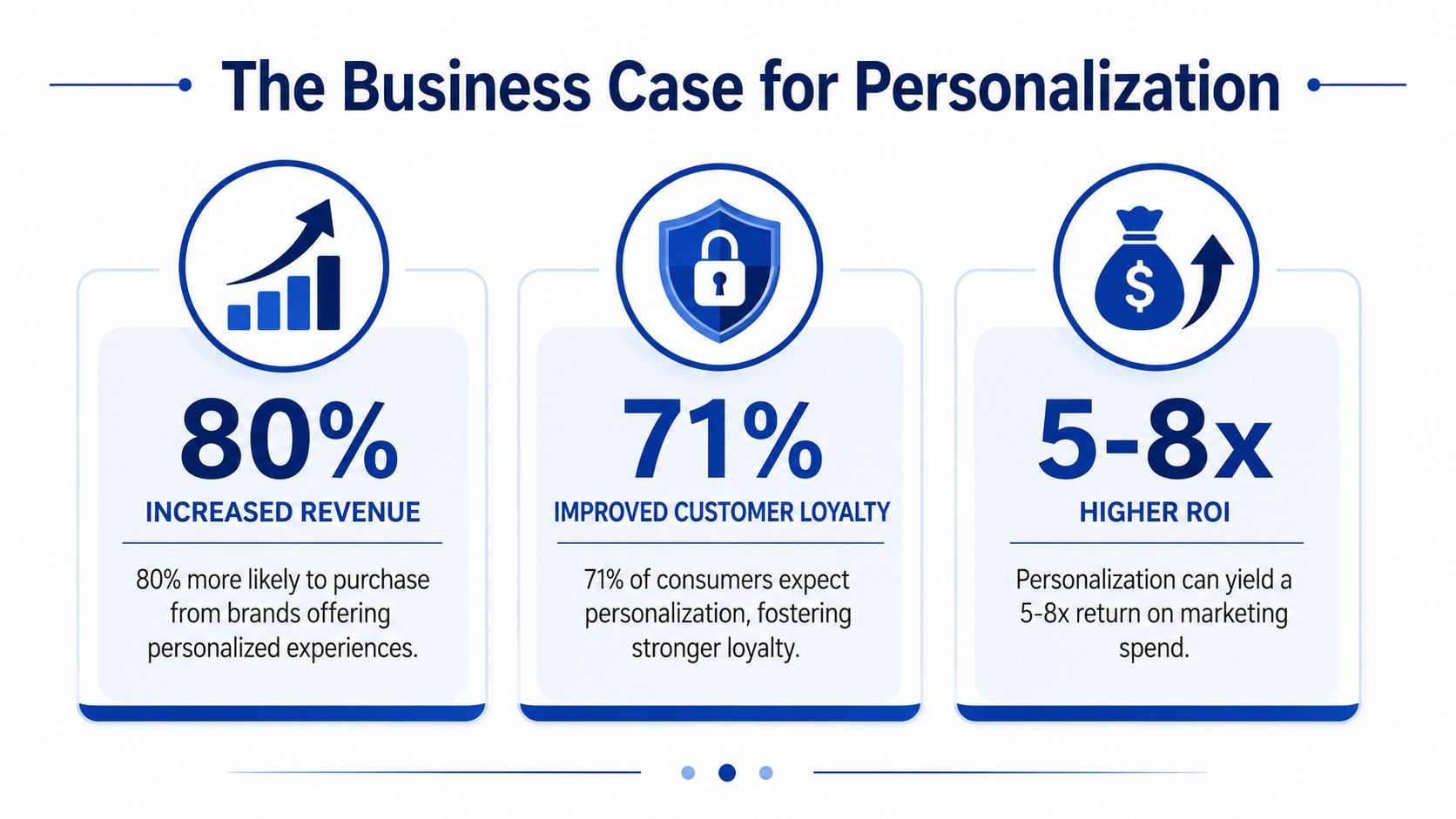
The strongest case starts with customer expectation and purchase intent. In Canada, 71% of consumers expect personalised communications and products or services from brands, and 80% of consumers aged 18 to 64 are more likely to purchase from a company that offers personalised shopping experiences, according to Instapage's data summary.
That expectation translates into action. The same source notes that personalised calls to action can produce 202% better conversion rates than default CTAs, and personalised product recommendations can raise conversion rates by as much as 320%. Those aren't small optimisation gains. They suggest that relevance changes buyer behaviour at critical moments in the funnel.
For commerce teams, this has a direct implication: don't start personalisation with broad homepage experiments if your CTA logic, recommendation widgets, and recovery flows still treat all traffic the same.
Recovery and return behaviour matter too
Not every win comes from the first session. A lot of value sits in interrupted journeys. Instapage also notes that 60% of shoppers say they're likely to return and complete a purchase after a personalised abandoned-cart reminder. That's why cart recovery is often one of the first practical use cases I'd prioritise for a resource-conscious team.
Three reasons it tends to work early:
The intent signal is already strong: The shopper placed products in the cart, so the system doesn't need to infer interest from weak browsing data.
The operational setup is manageable: You need event tracking, product data, identity resolution, and message orchestration. That's simpler than full-site real-time personalisation.
The outcome is easy to measure: Teams can compare recovery performance against a generic sequence and see whether the personalised version changes behaviour.
Revenue impact is bigger than campaign performance
There's also a broader operating lesson. Personalisation shouldn't sit only inside marketing. It belongs across merchandising, product discovery, CRM, and customer service workflows because those functions all shape the same buying journey.
Commercial reality: If your personalisation strategy lives only in email, you're leaving value on the product page, in the cart, and at checkout.
For healthcare, that may mean tailoring appointment reminders, service suggestions, or portal content around patient needs and consented preferences. For automotive, it may mean showing service packages, maintenance prompts, or finance-related content that matches vehicle history and current ownership stage. For startups, it often starts with product recommendations, segmented lifecycle flows, and personalised cart rescue.
The business case is straightforward. Personalised shopping experiences increase the odds that a customer sees something relevant, acts on it, and returns for the next interaction. When relevance improves at several points in the journey, the revenue effect compounds.
Core Technologies and Data Strategies
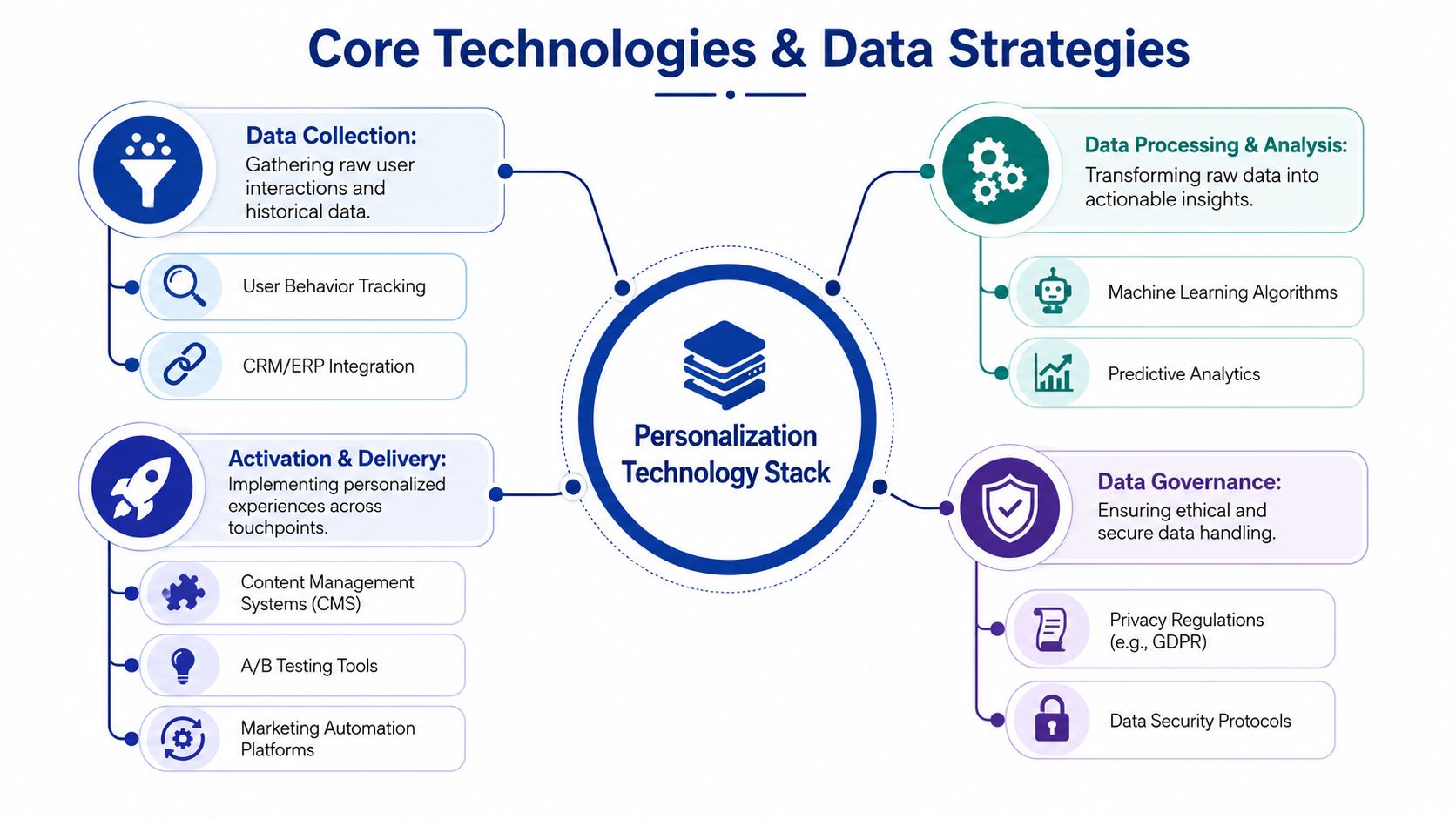
Personalisation is often discussed as if it were a feature. It's not. It's a system made of data collection, identity resolution, decisioning, content delivery, and governance. If one layer is weak, the whole experience becomes inconsistent.
In the Canadian market, 72% of medium-sized enterprises with revenue from $10M to $1B reported that AI analytics reshaped their shopping experiences by 2024, and effective systems use at least 10 distinct data points, including customer preferences, purchase history, browsing behaviour, and social media sentiment. The same benchmark states that retailers using AI to dynamically adjust homepage content and checkout experiences saw a 28% uplift in average order value.
The stack that actually powers personalisation
A working personalisation engine usually includes these layers:
Data capture layer: Website events, mobile app events, POS data, CRM records, email engagement, service interactions, and form submissions.
Profile layer: A unified customer profile that resolves identity across sessions and channels.
Decision layer: Rules, scores, or models that decide what to show, send, or suppress.
Activation layer: CMS, ecommerce platform, email platform, ad audiences, service tools, and on-site widgets.
Measurement layer: Analytics tied to experiments, segment performance, and business outcomes.
A lot of SMBs can start with Shopify, a CRM, an email platform, and a CDP-lite setup. Mid-market firms usually need stronger middleware, cleaner event schemas, and better governance between operational systems.
Data types that matter most
Not all data has equal value. The useful distinction is where the data comes from and how dependable it is.
| Data type | What it means | Why it matters |
|---|---|---|
| First-party data | Data you collect through your own channels | Strong foundation for segmentation and analytics |
| Zero-party data | Preferences the customer intentionally shares | High signal for consent-based personalisation |
| Operational data | Orders, bookings, claims, appointments, service records | Connects intent to actual business context |
Third-party signals can still exist in the ecosystem, but they shouldn't be the backbone of a modern personalisation strategy. Teams get better results when they know what the customer did, asked for, or consented to.
The best personalisation stacks don't collect the most data. They activate the most useful data.
What the engine decides in real time
Once the profile is usable, the engine needs decision logic. That may be simple at first. “If the customer has purchased category X, prioritise accessories in category Y.” Over time, it becomes more adaptive. “If the customer is price-sensitive, returning on mobile, and hovering around checkout, simplify the offer rather than adding more options.”
For product discovery teams, this explainer on a product recommendation engine is helpful because it breaks down how recommendation logic supports buying decisions rather than just filling page space. If you're evaluating applied AI patterns for commerce, this overview of AI-powered product recommendations shows how recommendation layers fit into ecommerce architecture.
Sector-specific stack choices
Healthcare needs stricter controls. The profile should expose only the fields required for the use case. A patient portal can personalise educational content, reminders, or next-step actions, but the data model must respect consent, role-based access, and clear boundaries between care information and promotional messaging.
Automotive often benefits from blending CRM, inventory, vehicle ownership data, and service history. Good personalisation in that environment isn't just “people also viewed.” It's maintenance timing, trade-in relevance, and model-specific offers based on what the business already knows.
Retail startups should stay lean. Don't begin with six tools that all claim to do AI. Start with one source of truth for customer data, one messaging platform, one experimentation process, and a recommendation layer that's connected to product catalogue quality.
A Practical Implementation Roadmap
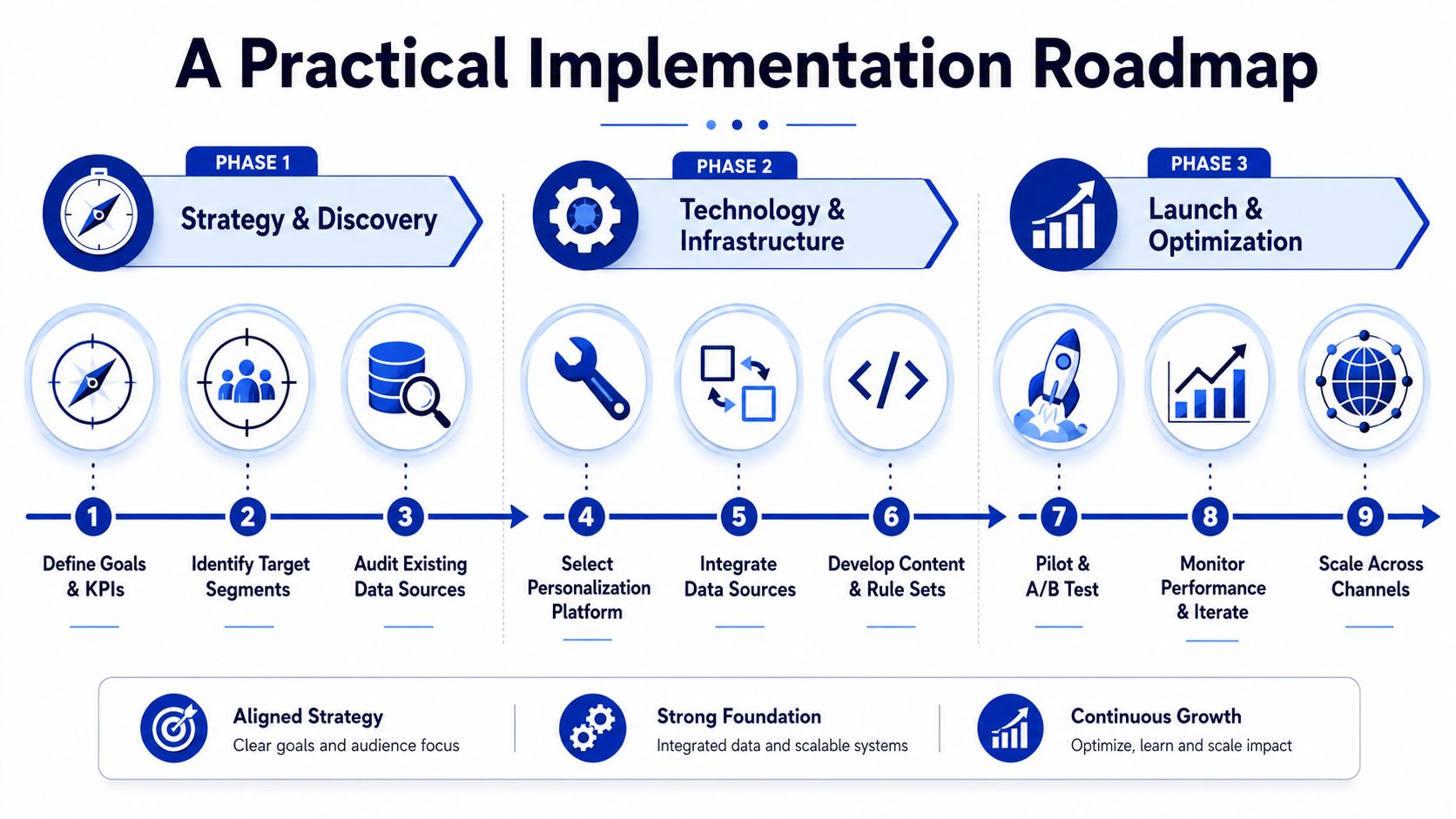
The biggest mistake in personalisation programmes is trying to launch maturity on day one. Teams jump to predictive models before they've standardised product data, fixed event naming, or agreed on who owns the customer profile. That's how projects become expensive and unreliable.
A more durable approach is phased. Deloitte reports a major perception gap: 92% of retailers believe they effectively offer personalised experiences, yet only 48% of consumers agree. The same analysis notes that companies that provide personalised experiences generate 40% more revenue than competitors, which is why execution discipline matters so much in the first place, as outlined in Deloitte's personalisation strategy analysis.
Phase 1 builds the data foundation
Start with the customer record, not the campaign.
This means auditing where customer data currently lives, how identities are matched, which events are trustworthy, and where product or service metadata is incomplete. If your healthcare portal, CRM, ecommerce store, and email platform all describe the same customer differently, personalisation will break.
Focus first on:
Identity resolution
Match customers across channels in a way that your systems can maintain.Event hygiene
Standardise key events such as product view, add to cart, appointment booked, quote requested, and service scheduled.Catalogue quality
Clean attributes, categories, tags, and content fields so recommendation and content logic have something solid to work with.
Phase 2 activates rule-based use cases
Teams start seeing practical momentum. You don't need advanced AI to create useful personalised shopping experiences.
A sensible second phase often includes:
Segmented lifecycle messaging: New visitors, repeat customers, lapsed buyers, and high-intent abandoners should not receive the same sequence.
On-site product or service modules: Show related items, relevant service bundles, or category shortcuts based on prior behaviour.
Basic suppression rules: Stop promoting what the customer already bought or completed.
These use cases are manageable, measurable, and easier to govern than fully dynamic journeys.
Implementation rule: If a team can't explain why a recommendation appeared, the logic is too opaque for an early-stage rollout.
Phase 3 adds predictive decisioning
Once the data foundation and basic activation work, then AI becomes useful. At this stage, predictive scoring, dynamic content selection, and next-best-action logic can add value without causing operational drift.
For a retail startup, that may mean ranking products differently for each session. For automotive, it may mean surfacing maintenance or trade-in journeys based on the ownership stage. For healthcare, it may mean prioritising the next helpful portal action based on prior engagement and consented preferences.
At this stage, some teams work with platform vendors, internal engineers, agency support, or a development partner such as Cleffex Digital Ltd when custom integration work is needed between commerce systems, CRM, and activation tools.
Phase 4 operationalises testing
A mature roadmap doesn't end at launch. It creates a repeatable testing cycle.
Use a simple operating rhythm:
| Area | What to review |
|---|---|
| Data | Missing events, duplicate profiles, stale attributes |
| Experience | Which modules or messages were triggered |
| Outcome | Conversion, order value, completion, retention signals |
| Governance | Consent handling, access control, opt-out logic |
That's how personalisation stays useful instead of becoming a collection of disconnected automations.
Personalisation in Action Across Industries
The most helpful way to understand personalisation is to look at where it changes day-to-day decisions. The use cases differ by sector, but the pattern stays the same. Data enters the system, the platform decides what matters now, and the experience changes in response.

A useful benchmark comes from retail. A Canadian Retail Council study found that retailers implementing hyper-personalisation saw a 22% increase in customer lifetime value and a 15% reduction in cart abandonment rates. The same data notes that when a shopper spends more than 30 seconds on a product page, triggering an immediate personalised notification can increase conversion probability by 18% compared to static campaigns.
Healthcare needs relevance with boundaries
In healthcare, the interface has to be useful without becoming invasive. A patient portal can tailor reminders, educational content, follow-up prompts, or appointment preparation guidance based on profile data and patient actions. But the content must stay within consent boundaries and clinical appropriateness.
A good implementation might do this:
Recognise context: A returning patient logging in after a recent appointment sees relevant next steps instead of generic portal announcements.
Reduce friction: Forms, reminders, and service options reflect prior interactions so patients don't keep repeating the same information.
Protect trust: Sensitive attributes are not exposed to unnecessary systems or promotional workflows.
The point isn't to “sell” healthcare services in a retail tone. It's to make the digital experience more useful and less fragmented.
Automotive works best when ownership data is connected
Automotive businesses often have stronger first-party data than they realise. Dealerships and service centres already collect vehicle information, service records, enquiry history, and customer communication preferences. The issue is usually fragmentation, not absence.
When those systems connect, the business can personalise around lifecycle events:
| Automotive signal | Personalised response |
|---|---|
| Service due date approaching | Maintenance reminder with relevant service package |
| Prior interest in a specific model | Follow-up content tied to comparable inventory |
| Existing vehicle age and history | Trade-in or upgrade prompt |
| Repeat service customer | Loyalty-focused booking experience |
That's more effective than sending the same seasonal campaign to the full database.
Retail startups should start with intent-rich moments
Startups often overcomplicate personalisation because tool vendors promise instant sophistication. In practice, the best place to start is where intent is already visible.
For a Shopify store, those moments usually include product page engagement, cart activity, checkout behaviour, and post-purchase flows. If someone lingers on a product detail page, browses a category repeatedly, or abandons a cart after comparing options, the business already has enough signal to tailor the next message or module.
Relevance beats complexity. A small store with clean product data and disciplined lifecycle flows can outperform a bigger stack with messy activation.
The same principle applies across healthcare and automotive. Start with the points where user intent is strongest and where the operational response is easiest to control.
Measuring ROI and Navigating Compliance
Personalisation programmes lose support when teams can't prove what changed or can't explain how customer data is being used. ROI and compliance belong in the same conversation because weak governance usually leads to weak measurement as well. If your data is inconsistent or over-collected, your reporting won't be trustworthy.
Canadian shoppers also care about the line between helpful and intrusive. Red Pepper Digital notes that customers expect transparency about what data is used and how to opt out, and that retailers are increasingly advised to rely on first-party and zero-party data rather than broader guessing through external signals, as outlined in this article on personalised shopper experiences and trust.
Measure the behaviour, not just the campaign
Many teams stop at opens, clicks, or module engagement. Those are useful diagnostics, but they don't prove business value on their own. Better measurement ties personalisation to customer movement through the journey.
Track metrics such as:
Segment-level conversion behaviour: Did specific audiences complete more purchases, bookings, or enquiries after the personalised experience launched?
Recommendation performance: Which recommendations generated clicks, assisted conversions, or repeat visits?
Journey completion: Did more users finish checkout, complete onboarding, or return after interruption?
Retention signals: Are repeat interactions becoming more consistent among customers exposed to personalised experiences?
A strong analytics setup is vital. Teams working on attribution and commercial visibility can use frameworks like those discussed in AI-driven ecommerce analytics in Canada to grow sales and connect experience changes to measurable business outcomes.
Compliance starts with restraint
A privacy-first strategy isn't a limitation. It's what keeps personalisation sustainable.
Three practices matter most:
Ask for data you can use
If a field won't improve the experience or support operations, don't collect it.Make consent and opt-out paths clear
Customers should understand what's being used and how to stop specific types of targeting.Keep context attached to the data
More data doesn't automatically produce better personalisation. Context and preference are what make the experience feel relevant.
The trade-off most teams miss
There's a common assumption that more data and more AI automatically create better outcomes. In practice, teams often get better results by narrowing the use case, simplifying the logic, and tightening governance.
Good personalisation feels like service. Bad personalisation feels like surveillance.
For healthcare, that means strong permissioning and limited exposure of sensitive information. For automotive, it means using ownership and service context intelligently rather than flooding customers with broad offers. For startups, it means resisting the urge to install every app that promises automation.
The durable model is simple. Collect responsibly. Unify what matters. Activate only what you can explain. Measure against business outcomes, not vanity activity.
If your team is planning personalised shopping experiences and needs help connecting data, platform logic, UX, and governance into one workable system, Cleffex Digital Ltd builds custom software, AI-enabled ecommerce solutions, and sector-specific digital products for Canadian businesses in healthcare, automotive, retail, and beyond.