

What if all your healthcare data could communicate in a unified language? Imagine your clinic’s system talking seamlessly to the pharmacy’s, which in turn could communicate effortlessly with your insurance provider. This is exactly what FHIR integration services do. They build the digital bridges that allow different healthcare systems to share information securely and efficiently, turning siloed data into a powerful asset for better care and smarter operations.
Why Connected Healthcare Is the Future

For years, vital health information has been locked away in digital filing cabinets. Every hospital, lab, and clinic used its own software, creating a fragmented landscape where critical data simply couldn’t move. This fundamental lack of interoperability has long been a source of inefficiency, delays in patient care, and a major roadblock to innovation.
This is the exact problem that FHIR, or Fast Healthcare Interoperability Resources, was designed to solve.
Think of it as a universal adapter for health data. It doesn't replace existing systems; it just teaches them to talk to each other. By using modern, web-based standards (the same kind that power the apps on your phone), FHIR creates a common language for exchanging health information.
To make this clearer, let's break down the core ideas with some simple analogies.
Understanding FHIR Integration at a Glance
| Concept | Simple Analogy | Business Value for Canadian Companies |
|---|---|---|
| FHIR Standard | A universal translator for health data. It defines the vocabulary and grammar so everyone understands each other. | Establishes a common ground for building innovative, compliant health tech solutions across Canada. |
| FHIR Resources | Like LEGO® bricks. Each brick represents a specific piece of health data (e.g., Patient, Observation, Medication). | Allows you to build specific, targeted applications by pulling only the data "bricks" you need, ensuring efficiency. |
| FHIR APIs | The messengers that carry the translated data. They are the secure pathways for apps to request and receive information. | Enables the creation of patient apps, provider portals, and analytics tools that plug directly into health records. |
| Integration Services | The expert architects and construction crew. They design and build the bridges using FHIR's rules and tools. | Provides the technical expertise to connect your systems, ensuring data flows correctly and securely, saving you time and resources. |
Ultimately, these services are what turn the promise of FHIR into a practical reality for your organisation.
The Business Value of Unlocking Data
When health data can finally move freely and securely between systems, it creates tangible value for everyone in the healthcare ecosystem. This is where professional FHIR integration services become so critical. They are the specialists who engineer the connections between these once-isolated data islands.
For Canadian businesses, from tech startups to established clinics and insurers, the benefits are immediate and clear:
Better Patient Outcomes: Clinicians get a complete, real-time view of a patient's history, leading to more accurate diagnoses and better-coordinated care plans.
More Efficient Operations: Automating data exchange slashes administrative overhead, reduces manual errors, and speeds up everything from patient referrals to insurance claims.
Fuel for Innovation: With access to standardised data, companies can build powerful new tools, from patient-facing wellness apps to advanced analytics platforms, that connect directly to official health records.
This shift isn't a far-off theory; it's happening right now. A 2021 survey found that only 24% of healthcare organisations were using FHIR APIs at scale. Yet, by the end of 2023, that number was projected to jump to 67% of providers and 61% of payers.
That’s a nearly threefold increase in just two years, a clear signal of the rapidly growing demand for expert FHIR integration services. You can learn more by exploring the impact of these trends on Canadian healthcare technology.
By adopting FHIR, you aren't just getting a technology update; you're investing in a future where data works for you. It’s the foundation for creating more intelligent, efficient, and patient-centred healthcare services across Canada.
Real-World Applications of FHIR Integration
Theory is one thing, but the real test of any technology is how it solves actual problems. When we talk about FHIR integration services, we’re not talking about abstract concepts. We’re talking about fixing the frustrating, everyday friction that slows down healthcare.
This is where FHIR stops being a technical standard and starts becoming a practical tool. It’s the connective tissue that finally lets different systems talk to each other, creating a more responsive and intelligent healthcare ecosystem.
So, what does this look like on the ground? Let's break it down by who benefits and how.
For Healthcare Providers: A Smoother, Safer Path To Care
If you work in a clinic or hospital, you know the daily grind of operational bottlenecks. A simple patient handoff, like from a family doctor to a specialist, can get bogged down in a mess of faxes, phone tag, and manual data entry. It’s slow, full of opportunities for error, and can put urgent care on hold.
This is exactly the kind of problem FHIR integration services are built to solve.
Imagine a patient needs to see a cardiologist. Instead of staff spending an hour faxing files, the primary care physician’s Electronic Health Record (EHR) uses a FHIR API. With a few clicks, the patient’s complete, up-to-date record is sent securely and instantly to the cardiologist’s system.
The domino effect of this one change is huge:
Less Administrative Burnout: Your staff are freed from chasing records and typing in data. They can focus on what they do best: caring for patients.
Better Clinical Safety: The specialist gets the full picture, allergies, current medications, and past history, immediately. This drastically cuts the risk of dangerous medical errors.
Quicker Access to Care: Referrals and appointments happen faster. For the patient, this means getting the help they need days or even weeks sooner.
And it’s not just clinical workflows. FHIR integration helps on the financial side, too. For instance, smooth data sharing with an outsourced revenue cycle management partner can supercharge efficiency, leading to better cash flow and fewer denied claims.
For Insurance Payers: From Weeks to Minutes
Insurers grapple with their own set of challenges, especially around claims processing and prior authorisations. Getting the clinical data needed to approve a service or pay a claim is often a clunky, manual back-and-forth with providers. Everyone, patient, provider, and payer, is left waiting.
FHIR completely rewrites this script. By using FHIR integration services, payers can create secure, automated links directly with provider EHRs.
When an insurer can programmatically ask for and receive the specific clinical data needed to adjudicate a claim, the entire process can shrink from weeks to mere minutes. This isn't just a small efficiency boost; it’s a fundamental upgrade to the member experience.
Value-based care is another perfect example. To measure quality outcomes for programs like HEDIS, payers need very specific data. FHIR lets them pull exactly what’s needed without forcing provider staff to fill out more forms, making these modern payment models much more practical to implement.
For Tech Startups: Building the Future of Health
The startup world is all about finding new ways to solve old problems. For health tech innovators, the biggest roadblock has always been getting access to clean, standardised health data. FHIR blows that door wide open.
A startup can now build a wellness app that connects directly and securely to a user’s official health record from their doctor or hospital. This opens up a world of powerful, personalised tools that were once impossible.
Think about the kinds of apps this makes possible:
Chronic Disease Management: A diabetes management app could pull blood glucose readings straight from a patient’s EHR, offering real-time coaching based on their actual clinical data.
Medication Adherence: An app could sync with a patient’s official prescription list, send smart reminders, and even help kickstart the renewal process through a FHIR connection.
Telehealth and Remote Monitoring: A remote monitoring platform can take data from a wearable device and push it directly into the patient's chart as a structured FHIR "Observation" for their doctor to review.
For these startups, FHIR integration services aren't a minor detail; they’re the foundation of their entire business. By building on a universal standard, they can create products that scale across countless hospitals and clinics without having to build dozens of fragile, one-off integrations. This slashes their time to market and massively expands their potential impact.
The Technical Backbone of FHIR Integration
Alright, let's get technical for a moment. To really appreciate what FHIR integration services can do, it helps to peek under the bonnet and see how the engine actually works. If you're an IT manager or a startup CTO, understanding these core concepts is crucial for making smart decisions that actually drive your business forward.
I’ve found the best way to explain FHIR is to think of it like building with digital LEGO® blocks. Every single piece of health information, a patient's name, a lab result, a prescription, is a standardised block. In the FHIR world, we call these FHIR Resources.
These resources are the very foundation of getting different systems to talk to each other. For example, a "Patient" resource holds demographic data, while an "Observation" resource is designed for a specific measurement like blood pressure. It's this simple, modular approach that makes the whole system so powerful.
Core Architectural Components
The real magic happens when you bring these pieces together. A solid FHIR integration architecture isn't one single product; it's a whole ecosystem of technologies working in harmony. It typically boils down to three key players.
FHIR Resources: As we just covered, these are the individual, standardised "LEGO blocks" of data. Think of Patient, Practitioner, Encounter, and MedicationRequest. Each one has a pre-defined structure, which is how we guarantee consistency.
FHIR Server: This is the organised storage box and retrieval system for all your resources. It acts as a secure home for your health data, one that knows exactly how to store, manage, and share information according to FHIR rules.
FHIR APIs: These are the messengers that apps use to talk to the FHIR Server. Using common web protocols (RESTful APIs), an application can securely ask the server to "GET" a patient's record or "POST" a new lab result.
This model creates a clean separation between the data itself, its storage, and how it’s accessed, the bedrock of any modern, scalable health data strategy. For a closer look at how this stacks up against older methods, our guide on modernising with EHR integration services provides some great context.
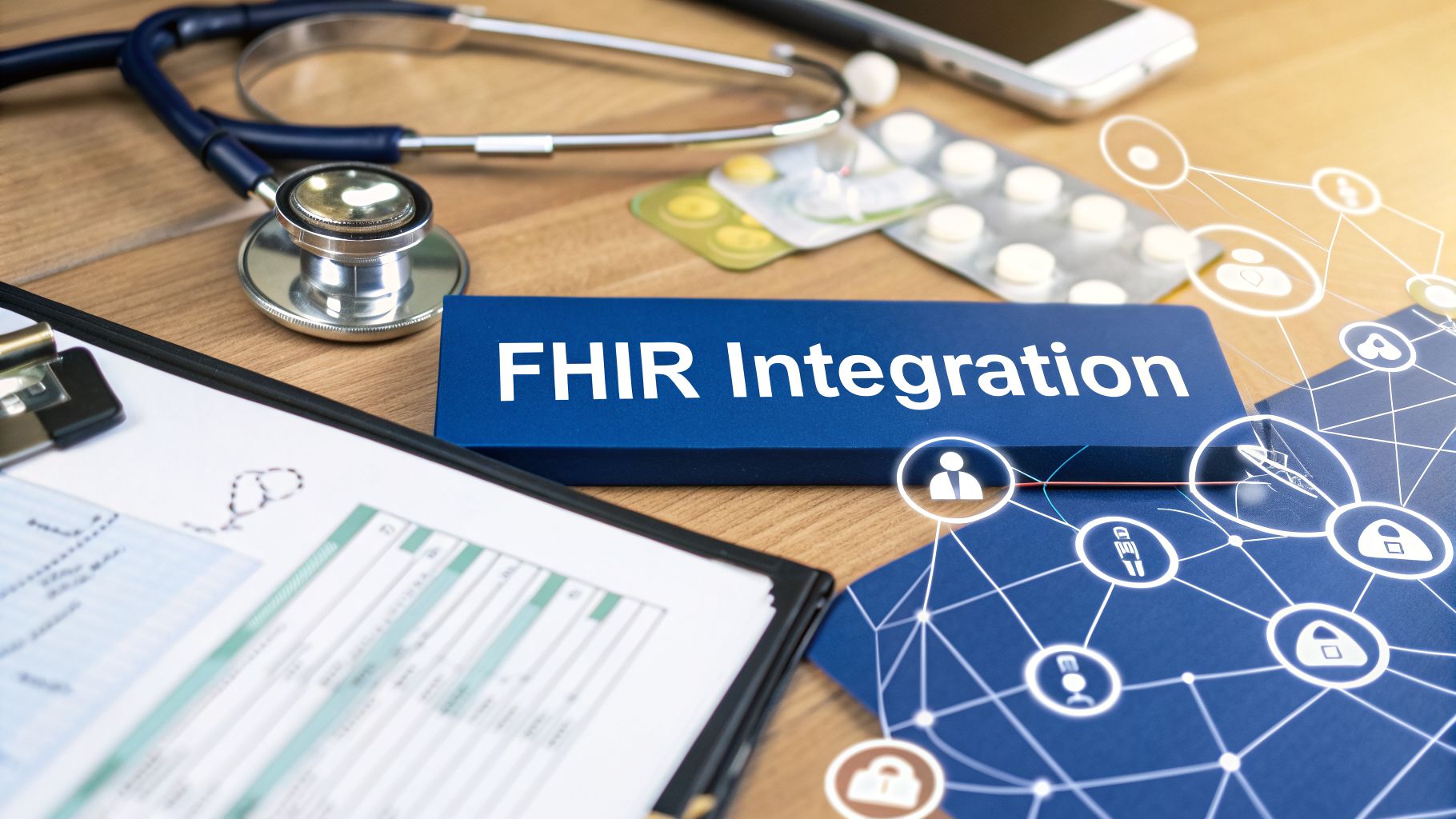
This image shows perfectly how FHIR becomes the central hub, letting data move smoothly between providers, insurers, and innovative new apps.

You can see right away that by using a common language (the API), everyone can plug into the same ecosystem without building dozens of messy, one-off connections.
Data Flow Patterns and Security
So, how does the data actually move? It’s all managed through those APIs. In a simple setup, a patient portal might directly ask a hospital's FHIR server for upcoming appointment data. In a more advanced scenario, you could have an API gateway where a single request from a wellness app triggers data pulls from a lab, a clinic, and a pharmacy all at once, with the gateway neatly packaging the response.
Security isn't an afterthought; it’s baked right into the architecture with a protocol called SMART on FHIR.
Think of SMART on FHIR as the digital security guard for your data. It uses modern authentication standards (OAuth 2.0) to make sure only authorised users and apps can access specific data, and only for the reasons they've been given permission.
This means a scheduling app might only get to see appointment times, while a doctor’s diagnostic tool gets access to a patient's complete clinical history. This fine-grained control is essential for protecting patient privacy and meeting strict Canadian compliance laws.
The scalability here is huge. A fantastic case study from Greenway Health showed them migrating 638 clients to a FHIR-based cloud platform in Canada in under 24 hours. The system processed 9.5 billion FHIR resources without a single error, proving just how tough the standard is. You can read the full story of this incredible FHIR implementation on AWS HealthLake Canada. This is real-world proof that FHIR integration services provide a remarkably reliable and efficient technical backbone for modern healthcare.
Navigating Canadian Healthcare Compliance
If you're handling health information in Canada, compliance isn't just a good idea; it's the law. The rules are a complex mix of federal and provincial legislation, each with its own strict demands. This is precisely why professional FHIR integration services are more than just a technical provider; they're an essential part of your risk management strategy.
It’s easy to think that bringing in a new standard like FHIR would add another layer of compliance headaches. But actually, the opposite is true. The FHIR standard was designed from the ground up with modern security in mind, making it a powerful ally for meeting and maintaining Canadian privacy regulations.
The Canadian Compliance Puzzle
In Canada, personal health information is shielded by multiple layers of law. At the top, the federal Personal Information Protection and Electronic Documents Act (PIPEDA) sets the ground rules for how private-sector organisations can collect, use, and share personal data.
But it doesn't stop there. Many provinces have their own health-specific privacy laws that are considered "substantially similar" to PIPEDA. For any data handling that happens within one of these provinces, their local law takes precedence.
Ontario: The Personal Health Information Protection Act (PHIPA) is the key piece of legislation for health data.
Alberta: The Health Information Act (HIA) dictates the rules for custodians of health information.
British Columbia: A combination of the Freedom of Information and Protection of Privacy Act (FIPPA) and the Personal Information Protection Act (PIPA) applies.
The good news is that FHIR's design directly supports the core principles of these laws, like consent, accountability, and secure safeguards, by giving you a structured, auditable framework for managing data access.
FHIR isn't just about moving data; it's about moving data correctly and securely. Its built-in security features provide a strong foundation for a compliant data strategy, turning a complex legal obligation into a manageable technical implementation.
How FHIR Is Built for Security
One of FHIR's biggest strengths is that security isn't just an afterthought or an add-on; it's baked right into its core design. This is mainly accomplished through a protocol called SMART on FHIR.
Think of SMART on FHIR as the bouncer and the VIP guest list for your health data. It uses proven, modern authentication standards (like OAuth 2.0) to make sure only authorised users and applications can get to specific pieces of information. This means a patient's scheduling app might only get permission to see appointment times, while a physician's EMR can access the full clinical history. That kind of granular control is essential for privacy.
Other key security features include:
Robust Audit Logging: FHIR servers are built to keep a detailed log of every single time data is accessed, who asked for what, when they asked for it, and why. This audit trail is critical for proving you're compliant.
End-to-End Encryption: Your data is kept scrambled and unreadable both while it's moving between systems (in transit) and while it's being stored (at rest), protecting it from prying eyes.
While our focus here is on Canada, it's always smart to understand the broader regulatory world. Many of the technical safeguards needed to build secure apps are universal.
The Canadian FHIR Landscape
Canada has been pushing for wider FHIR adoption for several years now, with an active community working on national standards since 2016. Progress hasn't been as fast as some had hoped, partly because of lingering questions about regulatory frameworks and some knowledge gaps in the market.
Ultimately, finding a partner with deep expertise in FHIR integration services who truly understands the unique Canadian context is the key to a successful and compliant project. It’s a vital step in any modern digital transformation in healthcare.
Your Step-by-Step FHIR Implementation Roadmap

Starting a FHIR integration project might seem daunting, but it’s a lot more manageable when you have a clear plan. By breaking the process down into logical phases, you can move from a great idea to a fully functional solution with confidence. While a good provider of FHIR integration services will guide you, understanding the roadmap yourself is crucial for a successful partnership.
It's a bit like building a custom home. You wouldn’t just start pouring a foundation without a blueprint. A proper FHIR project is the same; it follows four distinct stages to ensure what you build is secure, stable, and actually solves your business problems.
Phase 1: Strategy and Discovery
This first step is all about defining your "why." It's arguably the most important phase because the decisions made here set the direction for everything that follows. The goal is to get crystal clear on the business problem you're trying to solve and what specific data you'll need.
What does a win look like for your organisation? Are you trying to automate insurance claims, simplify patient referrals between clinics, or build a new patient-facing app? Your business goals have to be the starting point.
During this phase, you and your integration partner will:
Define Clear Business Goals: Pinpoint the exact outcome, like reducing administrative overhead by 20% or cutting down patient onboarding times.
Identify Key Data Sources: Figure out where the information you need currently resides. Is it locked in an old EHR, a custom database, or a third-party lab system?
Assess Data Quality: Get an honest look at the state of your data. Is it clean and structured, or will it need a lot of clean-up work before it’s usable?
Getting this discovery work right prevents expensive detours down the road and ensures your technical solution is aimed squarely at a real business need.
Phase 2: Planning and Vendor Selection
With a solid strategy in place, it's time to draft the blueprint. This is where you map out the project specifics and, most importantly, choose the right team to bring your vision to life. You need to select a partner who not only provides expert FHIR integration services but also truly understands the Canadian healthcare environment.
When you're evaluating vendors, look for more than just technical chops. You need a team that gets your business context and can help you navigate the tricky compliance landscape.
A strong technology partner doesn't just write code; they act as a strategic guide. They should challenge your assumptions, help you navigate regulatory requirements like PHIPA, and design a solution that is both effective today and scalable for tomorrow.
Once you’ve found the right partner, you'll work together to build a detailed project plan. This means defining the scope, setting achievable timelines, and agreeing on a budget. This plan becomes the playbook for every step that follows.
Phase 3: Development and Testing
Now the real work begins. This is where your plan turns into a tangible product as the development team starts building the connections and writing the code that lets your systems speak FHIR.
A huge part of this phase is data mapping. Think of it as being a translator. You're teaching the system how to convert data from your old format into standardised FHIR Resources. For example, your legacy system's "Client_ID" field needs to be correctly mapped to the standard FHIR "Patient.identifier" so other systems can understand it.
Rigorous testing is essential. The new integration must be put through its paces to check for functionality, security vulnerabilities, and performance bottlenecks. You have to be sure it can handle real-world use without faltering, that data is flowing correctly, and that all security controls are rock-solid.
Phase 4: Deployment and Maintenance
After passing all tests, your solution is ready for "go-live." It's deployed into your live environment where it can start delivering value. We often recommend a careful, phased rollout to keep any disruptions to a minimum.
But the job isn’t done once the switch is flipped. Healthcare is constantly evolving, regulations change, software is updated, and your business needs will shift. Ongoing maintenance and support are critical to making sure your integration stays secure, compliant, and effective for years to come.
A good partner will provide a support plan to monitor the system, apply patches, and help you adapt the solution as your organisation grows. This long-term commitment is fundamental to getting the best return on your investment in modern healthcare data management software development.
Your FHIR Integration Questions, Answered
When people start exploring FHIR, a lot of the same practical questions tend to pop up. As integration specialists, we've heard them all. Here are straightforward answers to some of the most common ones we get from leaders and IT managers.
What's the Difference Between HL7 v2, CDA, and FHIR?
Think of it like this: HL7 v2 was the original workhorse of health data exchange. It's like a fax machine; it got the job done for decades, but it's rigid, point-to-point, and not built for the modern, interactive web.
Then came CDA (Clinical Document Architecture). This was a step up, like turning a patient's record into a PDF. It’s a standardised, readable snapshot of clinical information, which is great for sharing a complete document. The problem? It's static. You can't easily query just the allergies or update just the latest lab result.
FHIR is the modern solution. It uses the same technology (RESTful APIs) that powers the apps on your phone. Instead of sending a whole document, you can ask for specific, bite-sized pieces of data in real-time. This is what lets a patient portal instantly pull up your medication list or an appointment booking app write directly to a clinic’s schedule. It’s flexible, developer-friendly, and the standard that modern FHIR integration services are built on.
Can Our Small Clinic or Startup Afford FHIR Integration?
Absolutely. One of the best things about FHIR is that you don't have to boil the ocean. You can start small and see an immediate impact without a massive, enterprise-sized budget.
Many successful projects start with one specific, high-value goal. For a small clinic, that could be as simple as integrating an online appointment booking tool that syncs directly with the EHR. This single project frees up administrative staff and makes life easier for patients right away.
By focusing on a Minimum Viable Product (MVP), you can get a powerful solution up and running with a manageable investment. A good technology partner will help you identify that first win and scope a project that fits your budget while delivering a clear, fast return.
Do We Need To Replace Our Existing EHR To Use FHIR?
Most of the time, the answer is no. This is a common fear, but it's usually unfounded.
Many modern EHRs already have FHIR capabilities built right in, ready to be activated. But even if you're working with an older, legacy system that doesn't speak FHIR, you're not stuck. Expert FHIR integration services can build what's called a "FHIR facade."
This is essentially a translation layer that sits on top of your existing software. It acts as an interpreter, receiving modern FHIR requests and translating them into a language your old system understands, and vice-versa. This gives you all the benefits of modern data exchange without the cost and disruption of a "rip-and-replace" project.
How Much Does a FHIR Integration Project Cost in Canada?
There’s no single price tag, as the cost really depends on the complexity of the project. However, we can break it down into some general ranges.
Simple Projects: Connecting a single app to one EHR system with a well-documented API might fall in the $20,000 to $50,000 range.
Complex Projects: A large-scale initiative, like integrating multiple legacy hospital systems to feed into an advanced analytics platform, could easily go beyond $250,000.
What drives the cost? The final number is influenced by the number of systems you're connecting, the quality of the source data, how much data mapping is needed, and the specific security and compliance requirements (like PHIPA) that have to be met. A proper discovery phase is the only way to get a truly accurate estimate.
Ready to unlock the power of your healthcare data? The team at Cleffex Digital Ltd specialises in building secure, compliant, and scalable FHIR solutions for Canadian businesses. Contact us today to start your integration journey.