

So, what exactly is AI-powered Shopify development? It’s essentially the practice of weaving artificial intelligence directly into the fabric of a Shopify store. The goal is to automate tasks, make customer experiences feel truly one-of-a-kind, and ultimately, drive more sales.
Think of it like giving your online shop a brilliant assistant who learns from every customer interaction. This assistant can then make smarter decisions on everything from suggesting the perfect product to providing instant, helpful support.
The New Standard for Ecommerce Success

Today’s ecommerce world is incredibly crowded. Just having a great-looking store isn’t enough to cut through the noise anymore. To capture and hold a customer's attention, businesses need platforms that are smarter and more responsive. This is where AI-powered Shopify development isn't just a nice-to-have; it’s becoming the new benchmark for brands serious about growth.
This approach completely rethinks the customer journey. It transforms your store from a simple place for transactions into a hub for memorable interactions that build real loyalty and boost your revenue.
Why AI Is a Game-Changer
Artificial intelligence gives your Shopify store a predictive brain that learns and adjusts on the fly. This is a massive shift, especially for small businesses and growing brands, as it unlocks powerful tools that were once only available to retail giants. The advantages are tangible and directly feed your bottom line.
Deeper Personalisation: AI algorithms dive into customer data to craft unique shopping experiences. This could mean anything from perfectly timed product recommendations to marketing messages that feel like they were written just for them.
Operational Efficiency: AI takes over the repetitive but crucial tasks. Think automated inventory management, handling common customer service questions, or even dynamic pricing adjustments, which frees up your team to focus on bigger-picture growth strategies.
Enhanced Customer Insights: AI is fantastic at spotting patterns hidden deep within your sales data. It can tell you what your customers really want and reveal the subtle behaviours that drive their purchasing decisions.
To stand out in such a competitive market, it’s vital to constantly find ways to improve ecommerce conversion rates and keep customers engaged.
By integrating AI, you're not just tacking on new features; you're building a responsive ecommerce ecosystem. Your store evolves from a static product catalogue into a dynamic sales partner that actively works to improve conversions and keep customers happy.
Making this technological leap can feel daunting, but it doesn't have to be. A forward-thinking software development company can make advanced technology both approachable and profitable for your business. Partnering with specialists in AI-driven Shopify development services helps you create superior AI-powered ecommerce experiences that will truly set your brand apart.
What Is AI-Powered Shopify Development, Really?
Let's cut through the buzzwords. When we talk about AI-powered Shopify development, we're not talking about some far-off, sci-fi concept. It’s about making your online store smarter and more intuitive right now.
Think of it this way: instead of a static digital catalogue, your ecommerce site becomes a dynamic, intelligent sales assistant. It's one that understands and anticipates what each customer wants, often before they even realise it themselves. At its core, this means integrating artificial intelligence technologies directly into your Shopify store to supercharge its capabilities. It's not about replacing the human touch; it's about making your store operate with a level of precision and personalisation that would be impossible to manage manually.
The Core Technologies Making It Happen
To really see the potential here, it helps to know what’s working behind the scenes. Think of these as the specialised tools in a developer's kit, each playing a crucial role in creating a more intelligent shopping experience. For a deeper dive, you can explore our detailed guide on AI-powered ecommerce development.
These are the main pillars of AI in ecommerce today:
Machine Learning (ML): This is the predictive engine for your store. ML algorithms sift through huge amounts of data, like past purchases, browsing history, and seasonal trends, to forecast what customers will do next. It's the crystal ball that fuels personalised product recommendations and predicts which items will be hot next season.
Natural Language Processing (NLP): NLP gives your store the power to understand and respond to human language, just like a person would. It's the technology that drives smart chatbots that can handle customer questions naturally. It also makes your search bar much smarter, so when a customer types "show me warm blue jumpers for winter," they get exactly what they're looking for because the AI understands the intent, not just the keywords.
Computer Vision: This technology lets your store "see" and interpret images. Its most exciting use is in visual search. A customer can snap a photo of a product they love, upload it, and your store can instantly find similar items in your inventory.
This isn't just a trend; it's a major shift. The adoption of AI in Canada's Shopify ecosystem is accelerating, with 78% of organisations now integrating AI – a huge jump from just 55% in 2023. This momentum is undeniable, particularly as Shopify's growth in North America is being led by Canadian merchants. For businesses in sectors like insurance and automotive, AI-driven predictive analytics can boost ecommerce sales by as much as 59% simply through better recommendations.
By weaving these technologies into the fabric of a Shopify store, we move beyond simple automation. We build a system that learns from every single interaction, getting progressively better at serving customers and hitting your business goals.
Ultimately, these tools work in concert to create a seamless, intelligent customer journey. A shopper might chat with an NLP-powered bot, receive ML-driven recommendations based on that conversation, and even use computer vision to find a product they saw on the street. This interconnected experience is what defines modern ecommerce and builds lasting customer loyalty.
Real-World AI Applications That Will Transform Your Store

So, what does AI actually do inside a Shopify store? It’s time to move past the buzzwords and look at the practical, on-the-ground applications that are already delivering serious results. These aren't just futuristic concepts; they are real-world tools you can implement right now to solve common ecommerce headaches.
At its heart, AI helps create a shopping experience that feels more intuitive, helpful, and efficient for everyone. Each use case we'll cover tackles a specific pain point, whether it's a customer struggling to find the right product or your team getting bogged down by manual tasks.
Hyper-Personalised Customer Journeys
Imagine a first-time visitor lands on your site. Instead of a one-size-fits-all homepage, they're greeted with products that reflect their location, the local weather, and what’s currently trending in their city. That’s the magic of AI-driven personalisation.
Using machine learning, your store can instantly analyse browsing habits, purchase history, and even abandoned carts to build a unique storefront for every single user. Your shop stops feeling like a static catalogue and starts acting like a personal shopper, guiding customers directly to the products they’re most likely to love.
By making every touchpoint feel relevant, you dramatically increase the odds of making a sale. In fact, businesses that nail personalisation see revenue lifts of 5% to 15% and get 10% to 30% more out of their marketing spend.
This is exactly where the right development partner comes in. They can turn all that raw customer data into a seamless, personalised journey that not only drives sales but also builds real brand loyalty.
Intelligent Product Recommendations
The old "You might also like" widget just doesn't cut it anymore. AI-powered recommendation engines dig much, much deeper. They work to understand a shopper's intent and the intricate relationships between different products in your inventory.
This technology can spot items that are frequently purchased together, suggest the perfect accessory for something just added to the cart, or even offer a great alternative if an item is out of stock. It’s like having a top-tier sales assistant working for you 24/7. This isn't just about upselling; it's about making the customer's shopping experience genuinely better, which naturally boosts the average order value.
Smarter Search and Discovery
Nothing kills a sale faster than a frustrating search bar. AI completely flips the script, making your store's search function both intelligent and forgiving.
Natural Language Understanding: Shoppers can type like they talk. A query like "show me black running shoes under £100" is understood perfectly, intent and all.
Typo Tolerance: A simple misspelling no longer leads to a "no results found" dead end. The system recognises the mistake and serves up the right products anyway.
Visual Search: This is a game-changer. A customer can upload a photo of a product they saw somewhere else, and the AI will find similar items in your store. It’s an entirely new, visual way for people to discover what you sell.
These small upgrades make a massive difference. They remove friction, help customers find what they need in seconds, and can seriously slash your bounce rate.
Automated and Intelligent Operations
AI doesn't just work on the front end. It can be a massive force multiplier for your back-end operations, saving your team countless hours and cutting down on operational costs. For instance, putting AI content optimisation for ecommerce to work ensures your product descriptions and marketing messages are always hitting the mark.
Here’s a quick look at where automation can have the biggest impact:
AI-Powered Chatbots: Modern chatbots can handle the lion's share of routine support questions, things like "Where is my order?" or "What's your return policy?", freeing up your human agents to tackle the truly complex customer issues.
Dynamic Pricing: Algorithms can adjust prices on the fly based on competitor pricing, demand, and inventory levels, helping you stay competitive and maximise your profit margins.
Inventory Forecasting: By analysing historical sales data, seasonality, and market trends, AI can predict future demand with startling accuracy. This helps you avoid costly stockouts or the cash-flow crunch of overstocking.
The following table breaks down how these AI applications translate directly into business value.
Key AI Applications in Shopify and Their Business Impact
This table outlines specific AI-driven functionalities available for Shopify stores and quantifies the tangible business benefits they deliver.
| AI Application | Functionality Description | Key Business Impact |
|---|---|---|
| Personalisation Engine | Dynamically tailors website content, product sorting, and promotions based on individual user behaviour and data. | Increased conversion rates (up to 15%), higher customer lifetime value (CLV), and improved user engagement. |
| Recommendation Engine | Suggests relevant products ("frequently bought together," "inspired by your browsing") using collaborative filtering and content-based models. | Boost in Average Order Value (AOV) by 10-30%, enhanced product discovery, and longer session durations. |
| AI-Powered Search | Utilises Natural Language Processing (NLP) and visual search to understand complex queries, correct typos, and process image-based searches. | Reduced site abandonment, faster product discovery, and a significant drop in "zero results" search queries. |
| AI Chatbots | Provides 24/7 automated customer support for common queries, order tracking, and lead qualification. | Lower support costs (up to 30%), improved customer satisfaction (CSAT) scores, and increased lead conversion. |
| Automated Merchandising | Automatically optimises product placement and collection sorting based on real-time sales data, trends, and inventory levels. | Increased sales for high-margin products, reduced manual effort for merchandising teams, and faster reaction to market trends. |
| Predictive Analytics | Forecasts future sales, customer demand, and potential churn by analysing historical data and identifying patterns. | Optimised inventory management (reducing overstock/stockouts), more effective marketing spend, and proactive customer retention. |
Each of these applications represents a powerful tool for growth. By integrating them, you're not just adding features; you're building a smarter, more resilient ecommerce business that can adapt and thrive.
Building the Business Case for AI Investment
Let’s be honest: adopting any new technology needs a strong justification, and AI is no exception. It's easy to get caught up in the buzz, but the real reason to invest in AI-powered Shopify development comes down to its direct, measurable impact on your bottom line. Think of it less as a cost and more as deploying a powerful profit-driver that works for you 24/7.
At its core, the business case for AI targets the three metrics that every ecommerce manager lives and breathes: boosting conversion rates, increasing average order value (AOV), and building real, long-term customer loyalty. AI tackles each of these head-on, turning raw data into real financial returns. By making your store smarter, you make it more profitable.
From Data Points to Pounds and Pence
The return on investment (ROI) from AI isn't some vague, far-off promise; it's a calculable outcome. When AI algorithms dig into customer behaviour, they find clear opportunities to sell more effectively. For instance, personalised marketing campaigns driven by machine learning consistently outperform generic, one-size-fits-all promotions.
Why? Because they put the right offer in front of the right person at the exact moment they’re most likely to buy. It's the same story with predictive inventory management. This does more than just keep popular items in stock; it dramatically cuts down on waste from overstocking and frees up cash that would otherwise be tied up in unsold goods. These aren't just minor tweaks; they represent significant financial gains.
Quantifying the Impact on Key Metrics
So, how does this all translate to real-world growth? Let's break down how AI moves the needles on the metrics that actually matter. Each improvement is another brick in the foundation of sustainable profitability.
Boosting Conversion Rates: AI-driven personalisation means every visitor gets a version of your store that speaks directly to them. When you show people relevant products on the homepage and offer smart recommendations, you remove the friction from shopping. A purchase becomes the natural next step.
Increasing Average Order Value (AOV): This is where intelligent recommendation engines really shine. They're masters of the upsell and cross-sell, suggesting the perfect accessory for an item already in the cart or bundling products that people often buy together. Just like that, the value of each transaction goes up.
Driving Customer Loyalty and LTV: Customers stick with brands that "get" them. AI-powered support can resolve issues instantly, while personalised follow-up marketing keeps your brand top of mind long after the first purchase. This focus on the entire customer journey is how you build a loyal base with a high lifetime value (LTV).
The proof is already there for merchants who've made the leap. Canadian businesses using AI-powered Shopify development are seeing major cost reductions and efficiency gains, especially in inventory management and customer engagement. Take Shopify merchant Balance ONE, for example. They used a machine learning model for predictive inventory and slashed their cost-per-order by an incredible 32% year-over-year. This isn't an isolated case. Major reports show that six out of ten retail buyers confirm AI significantly improves their forecasting abilities. You can read more about these AI benefits on Shopify's blog.
Investing in AI is fundamentally about building a more resilient and competitive business. It allows you to automate routine tasks, make smarter strategic decisions, and, most importantly, create the kind of exceptional AI-powered ecommerce experiences that turn casual shoppers into lifelong advocates for your brand.
Ultimately, the business case for AI is just plain compelling. It’s about using intelligent technology to build a self-optimising ecommerce engine. This kind of strategic move, supported by a skilled software development company, is what separates the market leaders from everyone else. The goal is to create a system that not only meets today's demands but also anticipates what's next, securing your growth for the long haul. As a leader in this space, our team is dedicated to helping you do just that. You can explore our AI-driven Shopify development services to see exactly how we make it happen.
Your Roadmap to Implementing AI on Shopify
Making the leap from understanding why you need AI to figuring out how to implement it is where things get exciting. Bringing artificial intelligence into your Shopify store isn't some kind of dark art; it's a methodical process. This roadmap will walk you through it, breaking a big project down into clear, manageable steps to get you set up for success.
The journey starts not with a line of code, but with a clear business goal. From there, we'll move into getting your data ready, picking the right tools, and executing the plan carefully. A solid plan ensures your investment in AI-powered Shopify development starts paying for itself right away.
Phase 1: Define Your Goals and Prepare Your Data
Before you start thinking about algorithms or apps, you need to answer one simple question: What problem are you actually trying to solve? Fuzzy goals like "we want to use AI" are a fast track to wasted time and money. You need to get specific.
Goal Setting: Are you trying to boost your average order value by 15% with smarter product recommendations? Or maybe you want to cut down on customer support tickets by 40% with an intelligent chatbot? Nailing down these concrete targets will shape every decision you make from here on out.
Data Readiness: AI runs on data. Simple as that. Your first real technical task is to take a hard look at your customer, product, and sales data. Is it clean? Is it accessible? Tidy, well-organised data is the foundation of any good AI project. Without it, even the most sophisticated models will fall flat.
Getting this initial planning phase right is absolutely critical. It ties your tech strategy directly to your business goals, making sure the final product delivers a real, measurable return. The process below shows how these focused efforts turn into real financial gains.
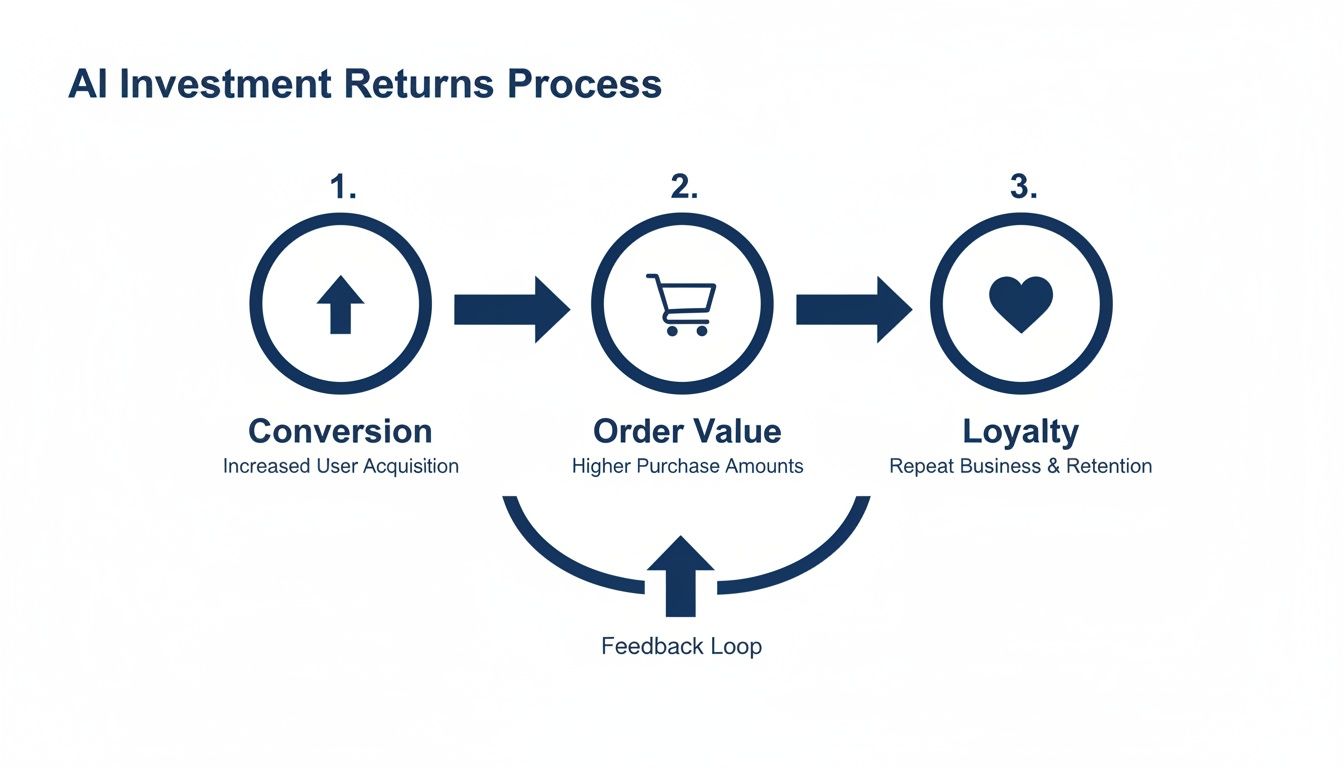
As you can see, it's a self-reinforcing cycle. Better conversions and higher order values build stronger customer loyalty, which in turn fuels more growth.
Phase 2: Choose Your Tools and Development Path
Okay, so your goals are set, and your data is clean. Now it's time to pick the right tools for the job. You’ve basically got two main paths you can take: use existing Shopify apps or go for a full custom build.
Off-the-Shelf Apps: The Shopify App Store has a ton of AI-driven tools for everything from SEO and product recommendations to chatbots. They're usually quick to install and pretty budget-friendly, making them a great starting point if you're just dipping your toes into AI.
Custom Solutions: When you have a unique problem to solve, or you want to build a serious competitive edge, a custom-built solution is the way to go, as we explored in our software development solutions guide. This approach gives you total flexibility to build something that fits your business logic perfectly, which we've also explored in our guide on headless commerce with AI.
The right choice really boils down to your budget, timeline, and how unique your needs are. A lot of businesses start with apps to test the waters and then move on to custom solutions as they grow and their needs get more specific.
Working with an experienced development partner can help you figure out which path makes the most sense. They can look at what you need and recommend the best approach, whether that’s integrating a few third-party tools or building a custom AI model from scratch.
Phase 3: Develop, Test, and Optimise
This is where the plan becomes a reality. The development phase is all about connecting your chosen AI tools to your Shopify store's data and making sure everything looks and works great on the front-end. Technical precision here is non-negotiable.
Once it's built, you have to test it. And then test it again. This means making sure the AI is doing what it's supposed to do, that it isn't slowing your site down, and most importantly, that it’s actually making the customer experience better.
But launching is just the beginning. The real magic of AI is its ability to learn and adapt over time. You need to keep a close eye on performance, listen to customer feedback, and continuously tweak the models to squeeze every last drop of value out of them. This ongoing cycle of optimisation is what separates a decent AI implementation from a truly great one.
Choosing the Right Partner for Your AI Future
Jumping into AI-powered ecommerce is a big move, and honestly, the partner you choose is the single most important factor in whether you succeed or fail. We're not just talking about a technical upgrade here; bringing AI into your Shopify store is a fundamental shift in your business strategy. You aren’t just hiring coders, you’re bringing on a partner who needs to get your vision and turn it into a smart, profitable reality.
Pulling off an AI strategy demands a very specific mix of skills. You need a team with serious technical chops in machine learning and data science, but they also need to have real, hands-on experience in the ecommerce world. That's the only way you can be sure they won't just build fancy features, but build features that actually lead to higher conversion rates and bigger average order values.
What to Look for in a Development Partner
Picking a partner for your AI-powered Shopify development project isn't a decision to take lightly. The right team will feel like an extension of your own, walking you through the complex parts and making sure the final product hits your business goals. Since AI projects are rarely a "set it and forget it" deal, you need a partner who embraces an agile, collaborative approach – one ready for ongoing tweaks and optimisation.
Here are the key things to look for:
Proven AI Expertise: Ask to see their work. They should have a portfolio full of successful AI projects, ideally for other ecommerce businesses.
Industry-Specific Knowledge: A partner who already understands the nuances of your market can offer strategic advice that goes far beyond just the tech.
A Collaborative Mindset: The best results always come from a true partnership where ideas flow freely, and the strategy is built together.
Focus on Business Goals: Every conversation should eventually come back to one question: "How will this help us reach our commercial targets?"
This is critical for small businesses, where every pound invested has to deliver a return. In Canada, Shopify’s own AI tools are already helping businesses with under £10M in revenue compete. In fact, Shopify's merchant base grew by a massive 20% in the third quarter of 2025 alone, largely because AI features that automate everything from creating discounts to tracking sales are attracting new entrepreneurs at a pace not seen since the pandemic. You can read more about how AI is fuelling ecommerce growth on Dig.watch.
Taking the Next Step on Your AI Journey
The power of AI to create smarter, more personal, and more efficient online stores is undeniable. From deeply personalised shopping journeys to streamlined back-end operations, the opportunities for growth are right there for the taking. The path forward starts with a simple conversation.
Finding the right partner means you’re not just buying a service; you’re investing in a strategic relationship that will shape your store's future. It’s about building a competitive advantage that lasts.
As a leading software development company, we specialise in creating AI-driven Shopify development services that deliver results you can see and measure. Our whole focus is on building sophisticated AI-powered ecommerce experiences that drive real growth and create customers who stick around.
We invite you to take the next step. To get a better feel for our approach and see how we’ve helped businesses just like yours, explore our story and meet our team by visiting our about us page.
Frequently Asked Questions
Thinking about bringing AI into your Shopify store often sparks a few questions. We get it. To help, we’ve gathered some of the most common ones we hear from business owners and laid out some straight-up answers.
This isn't about getting bogged down in technical jargon. It's about giving you the practical info you need on things like cost, data, and day-to-day management so you can feel confident about your next move.
How Much Does It Cost to Implement AI on Shopify?
The price tag for adding AI to your Shopify store can swing pretty widely. It really boils down to how ambitious your plans are.
For many businesses, starting is as simple as adding an app from the Shopify App Store, which often comes with a straightforward monthly subscription. But if you're looking for something truly unique to your business, a custom-built solution with a development partner will naturally be a larger investment. The trick is to start with a clear goal. That way, whether you're spending a little or a lot, every pound is aimed at creating powerful AI-powered ecommerce experiences that deliver a real, measurable return.
Do I Need a Huge Amount of Data to Start?
This is a big one, and thankfully, it's a myth. While it's true that complex AI models love lots of data, you absolutely do not need a massive archive of customer information to get going.
You can start small with AI tools that deliver immediate value using the data you already have. A smart chatbot, for instance, doesn't need years of customer service chats to be effective from day one.
Here’s a little secret: the quality and cleanliness of your data are often way more important than the sheer amount, especially at the beginning. A small, well-organised dataset will almost always give you better results than a giant, messy one.
As your business grows, so will your data. You can then scale up to more advanced AI features. It’s all about starting smart and building momentum.
Is Managing AI Too Complex for a Small Business?
Not anymore. The best part about the current wave of AI tools is that many are built specifically for business owners, not data scientists. They come with simple, intuitive dashboards that let you tweak settings and see results without writing a single line of code.
And for those more advanced, custom projects? That's where a good development partner comes in. A specialised software development company handles all the technical heavy lifting: the model training, the integration, the fine-tuning. This leaves you free to focus on what you do best: using the insights to grow your brand. Partnering with experts in AI-driven Shopify development services makes this powerful technology a manageable and highly effective tool for any business.
Ready to build a smarter, more profitable Shopify store? The team at Cleffex Digital Ltd specialises in creating AI-powered ecommerce solutions that drive real results. Contact us today to start the conversation.