

Think of hospital materials management software as the central command centre for a hospital's entire supply chain. It’s the system that tracks, manages, and orders every single item a hospital needs to function, from simple bandages to sophisticated surgical implants.
This software replaces chaotic, manual processes with a smart, automated system. Its goal is to make sure vital supplies are always on hand when needed, but without tying up precious capital in overstocked storerooms or letting items expire on the shelf.
The Unseen Engine of Hospital Operations
A hospital's supply chain is its circulatory system, pumping essential resources to every corner of the facility, the emergency department, the ICU, and the operating theatre. In this system, hospital materials management software is the heart, managing the flow with precision and intelligence. Without it, the whole operation slows down, becoming inefficient and riddled with errors.
This technology is the leap from cluttered supply closets and outdated spreadsheets to real-time, system-wide visibility. Clinicians no longer have to waste critical minutes searching for a specific piece of equipment or, worse, discover a necessary medication is out of stock during a procedure.
The software gives immediate answers to crucial questions: How many sutures do we have left? Where’s the closest portable X-ray machine? Which batch of medication is about to expire?
Balancing the Scales Between Cost and Care
Every hospital walks a tightrope, trying to balance tight budgets with the absolute need for top-tier patient care. Carrying too much inventory is a huge financial drain; it ties up money and leads to waste from expired products, a problem that costs the healthcare system billions each year.
But the flip side is even more dangerous. Not having enough inventory, a stockout, can lead to postponed surgeries and create genuine risks to patient safety.
This is where materials management software truly proves its worth. It’s not just about counting boxes; it’s about mastering that delicate dance between supply and demand. By automating and refining how supplies are managed, hospitals see major improvements across the board.
Financial Stability: It slashes costs by reducing waste from expired or lost items and uses data to prevent over-ordering.
Operational Agility: The system automates routine jobs like placing new orders and tracking shipments, freeing up staff to focus on patients, not paperwork.
Improved Patient Safety: It guarantees that clinicians have the right, non-expired supplies and properly maintained equipment at the exact moment they need it. This is a fundamental building block of safe medical care.
A strong materials management system isn't just a "nice-to-have"; it's foundational to a hospital's core mission. It builds a logistical backbone sturdy enough to support both clinical excellence and financial sustainability.
Ultimately, this software provides the framework needed to run a modern, complex healthcare facility. It transforms the high-stakes, often frantic process of managing thousands of medical products into a controlled, predictable, and intelligent operation, ensuring patient care can always be the number one priority.
How Core Software Modules Actually Work
To really get a feel for how this kind of software changes the game in a hospital, we need to pop the hood and look at its core modules. The best way to think about it is like a highly coordinated team of specialists. Each module has a distinct job, but they all work together to create a smart, seamless system that keeps track of every single supply and piece of equipment across the entire hospital.
This is all about turning chaos into order. Hospitals are incredibly complex environments, and without the right tools, managing the supply chain can feel like untangling a massive knot.

As you can see, the software acts as the central brain, taking all that complexity and transforming it into a structured, predictable process. Let's break down the four key modules that make this happen.
The Inventory Management Module
At the very centre of the system is the inventory management module. This is the single source of truth, a real-time, digital ledger of every item in the hospital, from sterile gloves to highly specialised cardiac stents. It completely automates the tedious and error-prone job of manual counting.
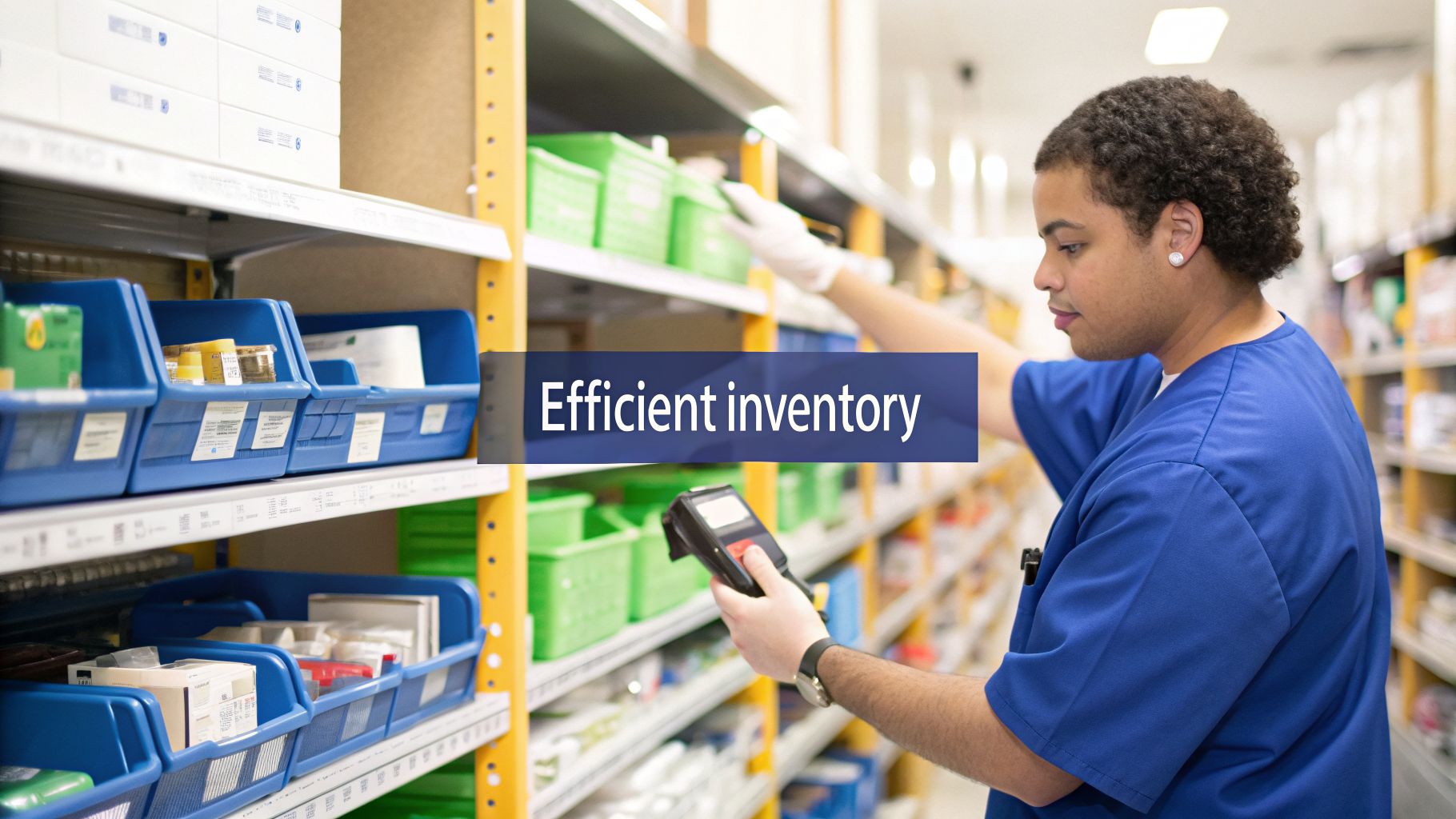
Think about it this way: when a nurse scans the barcode on a saline bag before hanging it, the system instantly subtracts that bag from the central inventory. That one simple scan updates stock levels for everyone, providing crystal-clear visibility and helping prevent dangerous shortages of critical supplies.
The Procurement Module
This module is basically the hospital’s automated purchasing agent. It taps into the real-time data from the inventory module to know exactly when to reorder supplies. This stops both last-minute panic buys and the wasteful practice of overstocking shelves with items that might expire. It turns procurement from a reactive fire drill into a proactive, data-driven strategy.
Most systems are set up with PAR (Periodic Automatic Replacement) levels. When the stock of surgical masks, for instance, dips below a pre-set number, the module automatically creates a purchase order and sends it off to an approved supplier. This creates a steady, reliable flow of materials right when you need them, all without someone having to manually check a supply closet.
By linking real-time usage data directly to the purchasing process, the procurement module ensures that the hospital buys only what it needs, precisely when it's needed. This closes the loop between consumption and replenishment, drastically reducing carrying costs.
The Asset Tracking Module
Hospitals aren't just managing disposable supplies; they have thousands of high-value, mobile assets to worry about, things like infusion pumps, portable ultrasound machines, and wheelchairs. The asset tracking module works like an internal GPS, giving staff the ability to find any tagged piece of equipment in seconds.
This is typically done with technology like RFID (Radio-Frequency Identification). A small RFID tag on an IV pump sends out a signal that gets picked up by receivers placed around the hospital. So, when a nurse needs a pump, they don't have to run from floor to floor. They just check a central dashboard to see the exact location of the nearest available one.
Reduces Search Time: Clinical staff get to spend less time hunting for equipment and more time focused on patients.
Improves Utilisation: Hospitals can make much better use of the equipment they already own, often avoiding the need to buy or rent more.
Prevents Loss and Theft: Having a clear trail of where expensive devices are provides accountability and helps stop them from being misplaced or walking out the door.
The Charge Capture Module
Finally, the charge capture module is the system's financial watchdog. Its job is to make sure the hospital gets properly paid for every single supply used in patient care. This module closes a notorious gap between what happens in a clinical setting and what ends up on a patient's bill, a gap that leads to massive revenue leakage. Studies show that hospitals often fail to capture charges for 5-15% of billable supplies, adding up to millions in lost revenue.
Here’s how it works: when a surgeon uses a high-value implant during a procedure, its barcode is scanned. The charge capture module instantly logs this and ties it to that specific patient's record. That information then flows automatically to the hospital’s billing system, ensuring the item appears accurately on the final invoice. That simple scan closes a critical financial loop that is so often missed in manual workflows.
The Real-World Benefits for Your Facility
Bringing in modern hospital materials management software isn't just about organising supply closets; it’s about driving real, measurable improvements that touch every corner of your facility. You'll see the impact on your bottom line, in the accuracy of your stockrooms, and most importantly, in the quality of care your patients receive. Think of it as creating a ripple effect where smarter data leads to serious cost savings and a stronger culture of safety.

When you switch from reactive to proactive management, you get a clear view of where every dollar is going and where it's being wasted. This kind of insight is gold when it comes to negotiating better deals with suppliers or making purchasing decisions based on what your hospital actually uses, not just guesswork.
Drastically Reduce Operational Costs
One of the first things you'll notice is a major drop in supply chain costs. Let's be honest, manual inventory is a recipe for inefficiency. It often leads to overstocking "just in case," which just results in a mountain of expired or obsolete items. The U.S. healthcare system loses an estimated $765 billion to waste every year, and expired medical supplies are a huge part of that problem.
This is where the software really shines. It automates a First-In, First-Out (FIFO) system, making sure supplies with the closest expiry dates are used first. It’s a simple concept, but it systematically stops items from expiring on the shelf and turns a massive financial drain into a predictable, managed expense.
Here in Canada, this technology has become essential for provincial health systems looking to tighten their belts. Canadian hospitals that have automated their inventory systems have cut their on-hand stock by up to 30%. That directly tackles the chronic problems of surpluses and sudden stockouts that are so common with pen-and-paper methods.
Achieve Pinpoint Inventory Accuracy
What if you could know, right now, the exact location and quantity of every single item in your hospital? From a box of gloves to a high-value surgical implant, that's the level of visibility a proper materials management system provides. It puts an end to the frantic searches and unexpected shortages that can delay procedures and put patient care at risk.
How? It’s all about integrating tools like barcode and RFID scanning right at the point of care. When a clinician uses a supply, a quick scan logs it, and the central inventory is updated instantly. This simple action keeps your records perfectly current, creating a reliable foundation for your entire supply chain. If you want to dig deeper into the mechanics, our guide on how automation benefits your inventory counting systems may be helpful.
By creating a single source of truth for all hospital supplies, this software eliminates both the slow bleed of expired goods and the sudden panic of a stockout. It builds a stable, predictable supply chain you can actually depend on.
Fundamentally Enhance Patient Safety
At the end of the day, every system in a hospital has one primary job: keep patients safe. Materials management is absolutely fundamental to that mission. Having the right supplies, equipment, and medications ready to go, and knowing they are sterile and within their expiry date, is non-negotiable for delivering safe, effective care.
A good system means that if a device is recalled, you can locate and pull every single one from circulation in minutes, not hours or days. It ensures a surgeon has the correct implant for a procedure and that nurses aren't scrambling for supplies during a code blue. Tools like healthcare safety software are a key part of this ecosystem, protecting both patients and staff. By removing these logistical hurdles, the software lets your clinical teams focus entirely on what they do best: caring for people.
Choosing The Right Features And Integrations
When you’re looking at hospital materials management software, it's easy to get lost in feature lists. But the real value isn't just in what the software does on its own; it's in how well it connects with the other critical systems running your hospital. A standalone tool is a dead end; an integrated one becomes the central nervous system for your entire supply chain.

Think of it like this: you wouldn't hire a specialist physician who refuses to speak with the rest of the care team. In the same way, your software has to "talk" to your existing technology to be truly effective. This constant communication ensures that crucial data flows freely to where it's needed most, from the stockroom to the operating theatre and the finance department.
Core Features Every Modern Hospital Needs
Before you even think about connecting systems, the software itself needs a solid foundation. These aren't just nice-to-haves; they are the absolute essentials for any hospital that's serious about managing its supplies effectively.
Mobile Barcode and RFID Scanning: This is non-negotiable. Your staff must be able to track supplies from the moment they arrive at the point of care using handheld devices. This simple capability all but eliminates manual data entry errors and keeps your inventory counts accurate in real time.
Predictive Analytics and Forecasting: A good system tells you what you have on the shelves. A great system tells you what you're going to need next week. By analysing historical usage data, it can forecast future demand, helping you avoid both surprise stockouts of critical items and the high costs of carrying too much inventory.
Intuitive Dashboards and Reporting: All the data in the world is useless if you can't make sense of it. Clear, customisable dashboards provide a simple, at-a-glance view of key metrics like inventory turnover, department spending, and supplier lead times. This empowers administrators to make smarter, faster decisions based on hard numbers, not guesswork. For more on how technology can enhance operational visibility, see what we've written about IoT in warehouse management.
The Power of Smart System Integrations
This is where everything comes together. When your materials management software is integrated with other core hospital platforms, you break down the data silos that cause so many headaches. Instead of isolated pools of information, you get a single, unified view of your operations.
Of course, any software handling patient-adjacent data must meet stringent security and privacy rules. A detailed HIPAA compliance for healthcare providers guide is a great resource for understanding these complex requirements.
Integration isn't a luxury feature; it's the bridge that connects your supply chain directly to patient care and financial stability. It makes sure every supply used is tracked, billed, and reordered with precision.
Two integrations stand out as essential: the connection to your Electronic Health Record (EHR) and your Enterprise Resource Planning (ERP) system. Let's look at why these links are so powerful.
The table below breaks down how these crucial integrations work and the direct impact they have on a hospital's day-to-day operations.
Critical Software Integrations And Their Impact
| Integration Type | Primary Function | Key Benefit for Hospitals |
|---|---|---|
| Electronic Health Record (EHR) | Links a specific supply's usage directly to a patient's medical file. | Guarantees accurate charge capture for every single item, preventing revenue loss and improving billing accuracy. |
| Enterprise Resource Planning (ERP) | Connects procurement and inventory data with the hospital's main financial systems. | Creates a seamless financial workflow, from raising a purchase order to paying an invoice, offering a clear line of sight into departmental spending. |
With these systems connected, you create a seamless, automated loop. Imagine a nurse in the OR scans a high-value implant before a procedure. Instantly, the integration does two things: it adds the charge to the patient's file in the EHR and alerts the ERP that the item needs to be reordered and paid for.
This single, automated action gets rid of manual paperwork, drastically reduces the chance of human error, and accelerates the entire billing cycle. It delivers a level of financial oversight and operational efficiency that is simply impossible to achieve when your systems don't communicate.
A Practical Guide to Implementation and Vendor Selection
Picking the right hospital materials management software is just the first step. The real test comes down to how well you bring it into your daily operations. A thoughtful rollout is what separates a tool that gathers digital dust from a system that becomes the new backbone of your facility. This isn't about flipping a switch; it's about carefully guiding your people through a major operational shift.
Success hinges on a solid roadmap that accounts for the technology, your internal processes, and, most importantly, your team. A phased deployment, where you introduce the software one department at a time, is almost always more manageable than a "big bang" launch. It lets your team learn, adapt, and build confidence in smaller, more controlled stages.
Charting Your Implementation Journey
The work begins long before the software ever goes live. It starts with anticipating the common hurdles, like the headache of migrating data from clunky old systems and managing the natural human resistance to change. You absolutely need a clear plan for training and support to get over these bumps.
Effective training isn't one-size-fits-all. A materials manager needs to get comfortable with analytics and reporting, while a clinical nurse just needs to master point-of-use scanning quickly and easily. Hands-on sessions and readily available support are key to building the skills and confidence for everyone to get on board.
Proactive change management is the secret sauce for a successful implementation. It’s all about communicating the why, why the change is happening, how it makes life better for staff, and what support they’ll have along the way. When your team understands the mission, they become partners in the process instead of roadblocks.
To navigate this journey successfully, you need a partner, not just a provider. The vendor you choose is a critical piece of the puzzle, which brings us to the all-important task of selection. Remember, you’re not just buying a product; you're starting a long-term relationship.
Selecting the Right Software Vendor
Choosing a vendor for your hospital materials management software requires a deep-dive evaluation that goes way beyond a feature checklist. You need a partner who genuinely understands the unique pressures and strict regulatory demands of the Canadian healthcare environment.
The market for these systems is growing fast. The Canadian Healthcare Supply Chain Management Market, which this software is part of, was valued at USD 83.8 million in 2023. It's expected to hit USD 224.80 million by 2032 as more hospitals adopt advanced tech. You can dig into the numbers in this market growth analysis. All this growth means more options, making a structured selection process non-negotiable.
Here’s a checklist to guide your evaluation and help you make a smart decision:
Healthcare-Specific Experience: Does the vendor have a proven track record with hospitals like yours? Insist on seeing case studies and talking to references from other Canadian healthcare facilities.
Regulatory Compliance: The vendor has to show rock-solid compliance with PIPEDA and other provincial privacy laws. Their system must be built from the ground up to secure sensitive health information.
Scalability and Future-Proofing: Can the software grow with you? Make sure the platform can handle future expansions, new departments, or integrations with technologies that are just on the horizon.
Quality of Customer Support: What does their support actually look like? Ask about response times, availability, and the expertise of their team. A critical issue at 3 a.m. needs a fast, knowledgeable response.
Integration Capabilities: The vendor should have a clear, documented history of successfully connecting their software with the major EHR and ERP systems used across Canada.
User-Friendliness: A system with all the bells and whistles is useless if it’s a pain to use. Get your end-users, the nurses and supply techs, involved in the demo process to see how intuitive it really is.
By focusing on a strategic implementation plan and a meticulous vendor selection process, you set your facility up for a win. To get a broader perspective on building these kinds of systems, you might find our guide on hospital management software development helpful. This dual focus ensures your investment pays off with real improvements in cost control, efficiency, and patient safety for years to come.
How To Measure Success and Prove Your ROI
Bringing in new hospital materials management software is a serious investment. But its value isn't just a gut feeling, it's something you can prove with cold, hard numbers. The trick is to track the right performance indicators (KPIs) and turn those operational improvements into a clear return on investment (ROI). This is how you build a rock-solid business case showing exactly how the software shores up your hospital's financial health.
The goal is to stop relying on stories and start presenting concrete data that leadership can sink their teeth into. When you can pinpoint how the technology cuts waste, makes processes faster, and slashes costs, its value is impossible to ignore.
Key Metrics To Track
Before you can show how much you've improved, you need to know where you started. What do your numbers look like right now, before the new system goes live? Establishing this baseline is critical. Once the software is up and running, you can measure the changes in these key areas to see its direct impact.
Here are the core metrics to focus on:
Reduction in Carrying Costs: This is all about the money you spend just to have supplies sitting on a shelf, think storage space, insurance, and the capital locked up in that stock. A lower number here proves you’re running a leaner, more efficient operation.
Inventory Turnover Rate: This KPI tells you how quickly your hospital uses and replaces its inventory over a set period. A higher turnover rate is a sign of great management; it means you aren't tying up cash in slow-moving or obsolete supplies.
Decrease in Expired Stock Waste: This one is as straightforward as it is powerful. Calculate the total dollar value of supplies that hit their expiry date and have to be tossed. A big drop here is a direct, tangible cost saving that immediately boosts your ROI.
Improved Order Accuracy: Track the percentage of purchase orders that come in perfectly, no errors, no backorders, no wrong items. Better accuracy means less time wasted on returns and fewer frustrating interruptions for clinical staff.
Measuring success is about telling a story with data. It’s showing how an investment in smarter supply chain technology directly translates into a healthier bottom line and a more resilient hospital.
Calculating Your Return on Investment
After you've collected a few months of data from the new system, you can put together a clear ROI calculation. The formula itself is simple, but the real work is in gathering the right numbers to plug into it.
Here’s a basic framework to get you started:
Calculate Total Financial Gain: Add up all the savings you've tracked. This includes the money saved from less expired stock, lower carrying costs, and even efficiency gains (like the value of staff time no longer spent on manual counts). For instance, if you saved $50,000 in expired supplies and cut carrying costs by $25,000, your total gain is $75,000.
Determine the Total Cost of Investment: Tally up everything you spent to get the system running. This includes software licensing fees, implementation services, any new hardware (like scanners), and staff training time. Let’s say this all adds up to $60,000.
Apply the ROI Formula: The calculation is: (Financial Gain – Cost of Investment) / Cost of Investment.
Using our example: ($75,000 – $60,000) / $60,000 = 0.25.
To make it a percentage, just multiply by 100. Your ROI is 25%. This gives you a clear, compelling figure that proves the software's positive financial impact.
Frequently Asked Questions
When you start digging into hospital materials management software, a lot of practical questions come to the surface. It's one thing to talk about features, but it's another to understand how it all works on the ground. Let's tackle some of the most common questions we hear from healthcare leaders.
How Does This Software Actually Reduce Medical Supply Waste?
This is a big one, because waste is a massive drain on any hospital's budget. The software attacks this problem from a couple of key angles.
First, it automates a First-In, First-Out (FIFO) system. This means it tracks expiry dates and makes sure the supplies closest to expiring get used first. It sounds simple, but it's incredibly effective at stopping you from having to throw out perfectly good, but expired, items.
It also gives you crystal-clear, real-time data on what's being used and where. This kills the guesswork that leads to over-ordering and dusty shelves full of obsolete stock. You start making purchasing decisions based on what you know you need, not what you think you need.
Is This Kind of Software Only for Big Hospitals?
Not at all. While massive medical centres get a lot of value from it, we often see smaller and rural hospitals reap even bigger proportional rewards. For them, every dollar and every minute of a nurse's time is absolutely critical.
We saw a case with a 25-bed critical access hospital that was struggling with cash flow. By implementing tighter inventory controls with this type of system, they freed up $51,000 in cash and slashed their on-hand inventory by 20% in the very first month. It proves the ROI is there, no matter the size of your facility.
The core principles are universal: cut waste, improve accuracy, and give clinical staff more time for patients. The software simply scales to deliver that value, whether you have 25 beds or 500.
What’s the Single Biggest Hurdle When Implementing It?
Honestly, it's rarely the technology itself. The biggest challenge is almost always change management. You're asking people, nurses, supply techs, administrators, to change habits they've had for years, sometimes decades. Moving from a familiar manual process to a new digital one can be met with resistance if not handled carefully.
The key is a thoughtful rollout. Instead of a "big bang" launch, we recommend a phased approach, maybe starting with one department like the OR or ICU. This lets the team learn in a more controlled setting, builds their confidence, and lets them see the benefits firsthand. Once they realise how much easier it makes their jobs, they become your biggest advocates, and adoption starts to spread naturally.
At Cleffex Digital Ltd, we build custom software that solves the real-world operational puzzles unique to the healthcare industry. Our systems are designed from the ground up to boost efficiency, ensure compliance, and ultimately improve patient safety. Discover how our expertise can benefit your facility.