

AI chatbots aren't some far-off, futuristic concept for ecommerce and retail anymore. Think of them as your new, always-on digital personal shoppers. They're there to greet customers, answer questions in a flash, and create personalised experiences that genuinely boost sales and keep people coming back.
This guide will walk you through exactly how to bring this essential technology into your business.
Your New Digital Personal Shopper
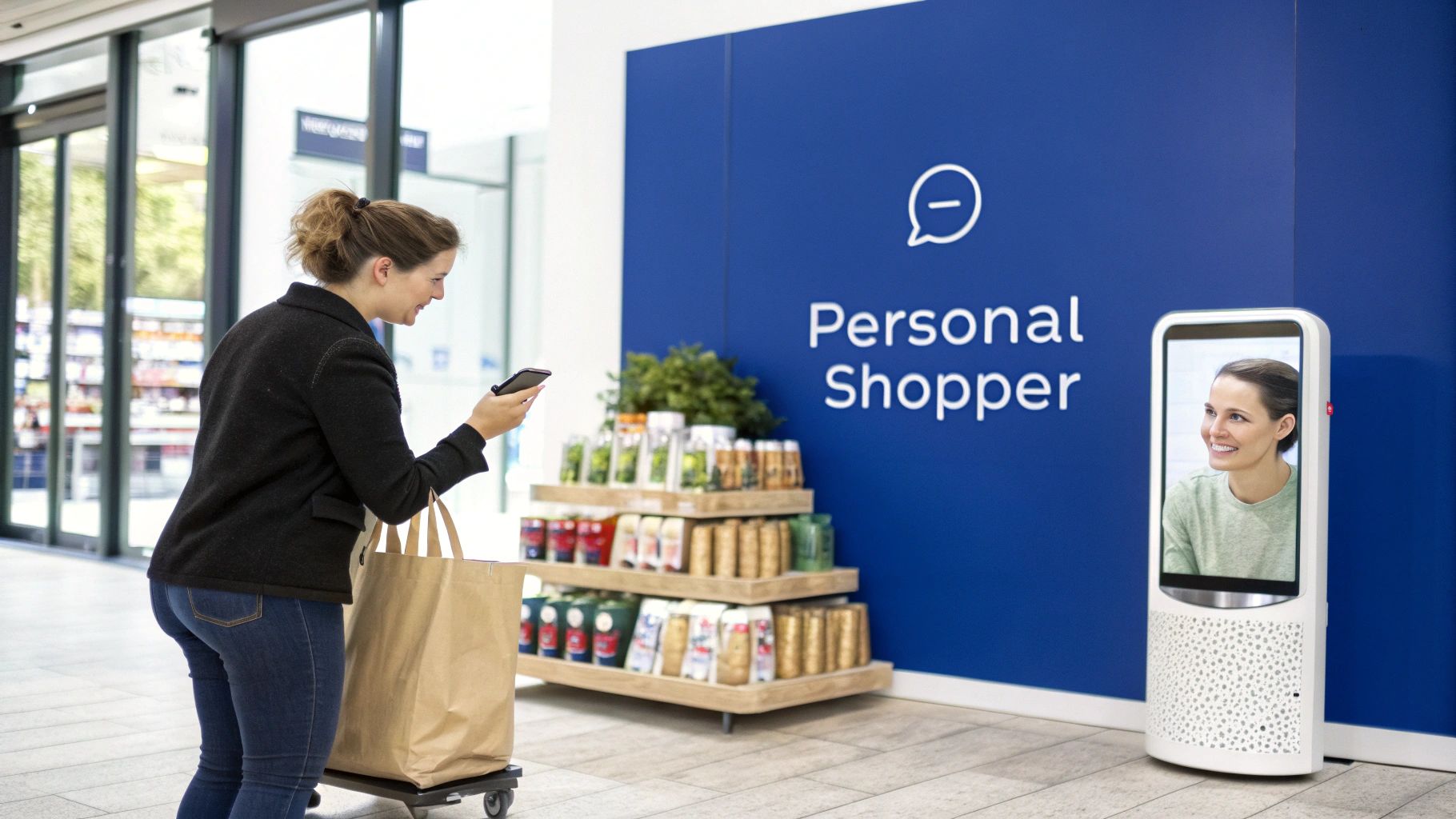
Imagine having a sales associate who works around the clock, remembers every single customer's style and preferences, and is always ready to help. That’s pretty much what a modern AI chatbot for ecommerce and retail can do for you. It's a powerful tool for any online storefront, guiding customers with the expertise of a seasoned personal shopper.
These smart assistants help create tailored shopping journeys that drive sales and build real customer relationships. It doesn't matter if you're running a brand-new Shopify store or a large, established enterprise – getting to grips with AI chatbots is no longer optional; it's a must-do to stay competitive.
The Shift in Consumer Behaviour
This move toward AI-driven shopping isn't just a fleeting trend. It’s a real change in how people shop and buy things online. Customers are getting more and more used to chatting with AI to find what they're looking for, and retailers need to keep up. This makes AI chatbots a vital part of today's customer journey.
A recent survey really drives this point home. Back in July 2025, Omnisend and Cint discovered that a staggering 56% of Canadian consumers are already using generative AI tools to help with their online shopping. The top uses? Product research (33%) and finding personalised recommendations (26%).
The message here is loud and clear: your customers are already using AI to help them decide what to buy. They now expect the brands they love to offer that same smart, instant assistance.
"A chatbot is your best salesperson. It can talk to thousands of customers at once, 24/7, and give each one a uniquely personal experience."
Why It Matters for Your Business
Adding an AI chatbot to your store isn't just about looking modern. It brings real, tangible benefits that you'll see in your bottom line.
Instant Customer Support: Chatbots can immediately answer all the common questions about shipping, returns, and product specifics. This frees up your human support team to handle the trickier, more complex problems.
Increased Conversions: They can proactively chat with visitors, help recover abandoned carts, and guide shoppers smoothly toward the checkout. It's like having someone there to nudge them over the finish line.
Hyper-Personalisation: A good chatbot can offer product suggestions based on what a user is looking at right now, as well as their past purchases. For a deeper dive, check out our article on AI-powered product recommendations.
Deeper Customer Insights: Every single conversation is a goldmine of data. You learn what your customers are looking for, what their pain points are, and what they love, which helps you fine-tune everything from your product lineup to your marketing.
How AI Chatbots Drive Business Growth

It’s easy to get caught up in the technology, but the real story behind an AI chatbot for ecommerce and retail is its direct impact on your bottom line. These aren't just flashy gadgets; they're powerful engines for growth, designed to deliver results you can actually measure.
At their core, AI chatbots help your business in three fundamental ways: they help you sell more, spend less, and keep your customers coming back. Each of these pillars works in concert, creating a business that's more efficient, profitable, and focused on the people who matter most – your customers.
Let's dig into how this all translates into a real return on your investment.
Boosting Your Revenue Stream
Think of an AI chatbot as a proactive sales associate who's always on the clock. The moment a visitor lands on your site, the chatbot can greet them, ask what they're looking for, and guide them toward products they’ll genuinely love. It's the digital equivalent of a skilled expert in a brick-and-mortar store, turning casual browsers into confident buyers.
For instance, a chatbot can instantly show a customer a curated list of in-stock items that match their needs. It can also handle crucial sales tasks, like sending a timely nudge and maybe a small discount to someone who left items in their cart. Understanding how an AI chatbot for ecommerce can transform your sales funnel is key to unlocking this potential.
Slashing Operational Costs
One of the quickest wins you'll see is the automation of those repetitive, time-consuming support questions. A well-designed chatbot can handle up to 80% of common customer queries on its own, answering questions about order status, return policies, and shipping details without needing any human help.
By taking these high-volume, low-complexity tasks off your team's plate, you free up your skilled agents to tackle the tricky, high-value issues that truly require a human touch. The result is a more efficient support team and a serious reduction in costs.
This drive for efficiency is a huge reason for the technology's rapid adoption. In Canada, for example, the connection between AI integration and soaring ecommerce sales is clear. Monthly sales are on track to hit around $4.3 billion by 2025, a massive jump from less than $2 billion back in 2019. This trend highlights just how directly AI tools can fuel commercial success.
Cultivating Lasting Customer Loyalty
In the competitive world of ecommerce, loyalty is your most valuable currency. AI chatbots are brilliant at building stronger customer relationships because they provide personalised, convenient experiences every single time. By remembering a customer's past purchases and browsing history, they can offer recommendations that feel genuinely helpful, not just automated.
This kind of personal touch makes shoppers feel seen and understood, turning a simple transaction into a real connection. When a customer knows they can get instant answers and smart suggestions 24/7, they have every reason to come back.
Here’s how chatbots build that loyalty:
Instant Gratification: Customers get what they need immediately, day or night, building trust in your brand.
Personalised Journeys: By using customer data, chatbots create shopping experiences that feel unique, boosting satisfaction.
Effortless Problem Solving: Fixing a problem quickly and smoothly can turn a potential complaint into a moment of delight.
By delivering in these three areas, AI chatbots become a core part of any smart growth strategy. If you're curious about the wider applications of this tech, our guide on AI in retail and ecommerce offers even more detail.
ROI of AI Chatbots in Ecommerce
To truly grasp the value, it helps to see the numbers side-by-side. The following table breaks down the key benefits of AI chatbots and shows how they translate into a quantifiable return on investment for your ecommerce business.
| Business Area | Key Benefit | Potential ROI Metric | Example Application |
|---|---|---|---|
| Sales & Marketing | Increased Conversion Rates | 5-15% uplift in sales conversions | Guiding users to products, recovering abandoned carts with discounts. |
| Customer Support | Reduced Operational Costs | 25-40% reduction in support agent workload | Automating responses to "Where is my order?" and return policy questions. |
| Customer Experience | Higher Customer Satisfaction | 15-25% increase in CSAT/NPS scores | Providing 24/7 instant support and personalised product recommendations. |
| Lead Generation | Improved Lead Quality | 20% increase in qualified leads | Proactively engaging website visitors and qualifying their needs. |
As you can see, the impact isn't just theoretical. By automating key interactions and personalising the customer journey, AI chatbots deliver measurable improvements across the entire business, making them a powerful investment for growth.
Putting Your Chatbot to Work
Theory is one thing, but seeing an AI chatbot in action is where the lightbulb really goes on. These aren't just glorified FAQ pages; they're active partners in the entire customer journey, from that first curious click all the way through to post-purchase care.
So, let's get practical. We’ll walk through the most powerful ways AI chatbots for ecommerce and retail can make a real difference, looking at concrete use cases and even sample conversations. You'll see exactly how these interactions play out to build a smoother, more profitable shopping experience.
Guiding Product Discovery
Think of your chatbot as a digital personal shopper. Instead of making customers wrestle with complicated menus and confusing filters, it can understand what they're looking for in their own words. This transforms a potentially frustrating search into a genuinely helpful conversation.
It's an incredibly effective approach because it taps directly into how people want to shop now. We all want fast, personal service, and a chatbot can mirror that experience of walking into a store and asking a knowledgeable associate for a hand.
Example Conversation Flow: Product Discovery
Customer: "Hi, I'm looking for a waterproof jacket for hiking in British Columbia. I need something lightweight but warm, and my budget is under $300."
Chatbot: "I can definitely help with that! We have a few great options that fit your needs. To narrow it down, do you have a colour preference?"
Customer: "Black or dark grey."
Chatbot: "Perfect. Here are three top-rated waterproof jackets under $300 that come in black or dark grey. They're all designed for the kind of weather you get in B.C. Would you like to compare their features?"
Answering Common Support Questions
Let's be honest, your customer service team probably spends a huge chunk of its day answering the same questions over and over. "Where is my order?" "What's your return policy?" An AI chatbot can handle these queries instantly, 24/7, freeing up your team to tackle the trickier issues that need a human touch.
This isn't just about cutting costs; it's about making customers happier. Zendesk found that 72% of consumers expect immediate service, and a chatbot is the single best way to deliver it.
By automating routine inquiries, a chatbot acts as a first line of defence, filtering and resolving the majority of support tickets. This allows your human team to focus on building relationships and solving problems that require a human touch.
Recovering Abandoned Carts
Every abandoned cart is a sale that slipped through your fingers. AI chatbots can jump in and proactively re-engage customers who are about to leave your site with items still in their basket. A timely, helpful message can be the gentle nudge they need to complete their purchase.
This is one of the most direct and measurable ways to boost revenue. The chatbot can ask if they have questions, offer help with sizing, or even present a small, time-sensitive discount to seal the deal.
Example Conversation Flow: Cart Recovery
Chatbot (proactively messages after 60 seconds of cart inactivity): "Hi there! I noticed you have some great items in your cart. Can I help you with any questions about sizing or shipping before you check out?"
Customer: "I was just wondering how long shipping takes to Toronto."
Chatbot: "Standard shipping to Toronto typically takes 3-5 business days. We also have an express option that arrives in 1-2 days. If you complete your order in the next 10 minutes, I can add a code for free standard shipping!"
Providing Personalised Recommendations
Real personalisation is much more than just plugging a customer's first name into an email. By connecting to your ecommerce platform like Shopify, a chatbot can see a user's browsing history and past purchases to suggest things they'll actually love. It makes the whole shopping experience feel curated and personal.
For example, if someone is looking at a specific pair of running shoes, the chatbot can intelligently suggest complementary products.
Socks designed for running
Moisture-wicking athletic tops
GPS watches compatible with their fitness goals
This kind of smart cross-selling doesn't just increase your average order value. It shows your customers that you get them, building the kind of loyalty that brings them back again and again.
Building Your AI Chatbot Implementation Roadmap
Getting an AI chatbot up and running for your retail or ecommerce business is far more achievable than most people think. You don’t need to be a tech wizard, but you absolutely need a solid plan. Think of it like building a house: you start with a clear blueprint before you even touch a shovel.
This roadmap breaks the whole process down into four straightforward phases. Follow these steps, and you’ll go from a rough idea to a fully functional chatbot that actually helps your business grow.
Phase 1: Define Your Core Objectives
Before you even glance at a chatbot platform, you need to answer one crucial question: What problem, specifically, are you trying to solve? A vague goal like "improve customer service" just won't cut it. You need to get granular and identify the exact pain points you're targeting.
Are you trying to cut down the flood of "Where is my order?" support tickets? Do you want to boost your conversion rate by engaging shoppers who seem to be hesitating on a product page? Or is your main focus on winning back more abandoned carts? Nailing these specific, measurable goals right at the start will shape every single decision you make later on.
A well-defined objective acts as your North Star. It ensures every feature you build and every script you write is laser-focused on delivering a real, tangible return on your investment.
Phase 2: Choose the Right Platform
Once your goals are crystal clear, it’s time to pick your tools. The market is packed with options, from simple, free tools like Shopify Inbox to more powerful platforms like Tidio, and they all offer different strengths. Your choice should line up perfectly with your objectives and the technical resources you have on hand.
Here’s what to look for when you're comparing platforms:
Ease of Use: Can your team actually manage and update the chatbot without calling in a developer? Look for tools with intuitive, visual builders.
Integration Capabilities: How well does it play with your existing tech stack? It needs to connect smoothly with your ecommerce platform (like Shopify), your CRM, and your inventory system to give customers accurate, real-time info.
Scalability: Will this platform keep up as your business grows? A solution that handles 100 chats a day might buckle under the pressure of 1,000.
Customisation: Can you make the chatbot sound like your brand? The ability to tailor its voice and conversation style is essential for a good customer experience.
This flowchart shows some of the common jobs a well-integrated chatbot can take on, from helping customers find products to recovering abandoned carts.
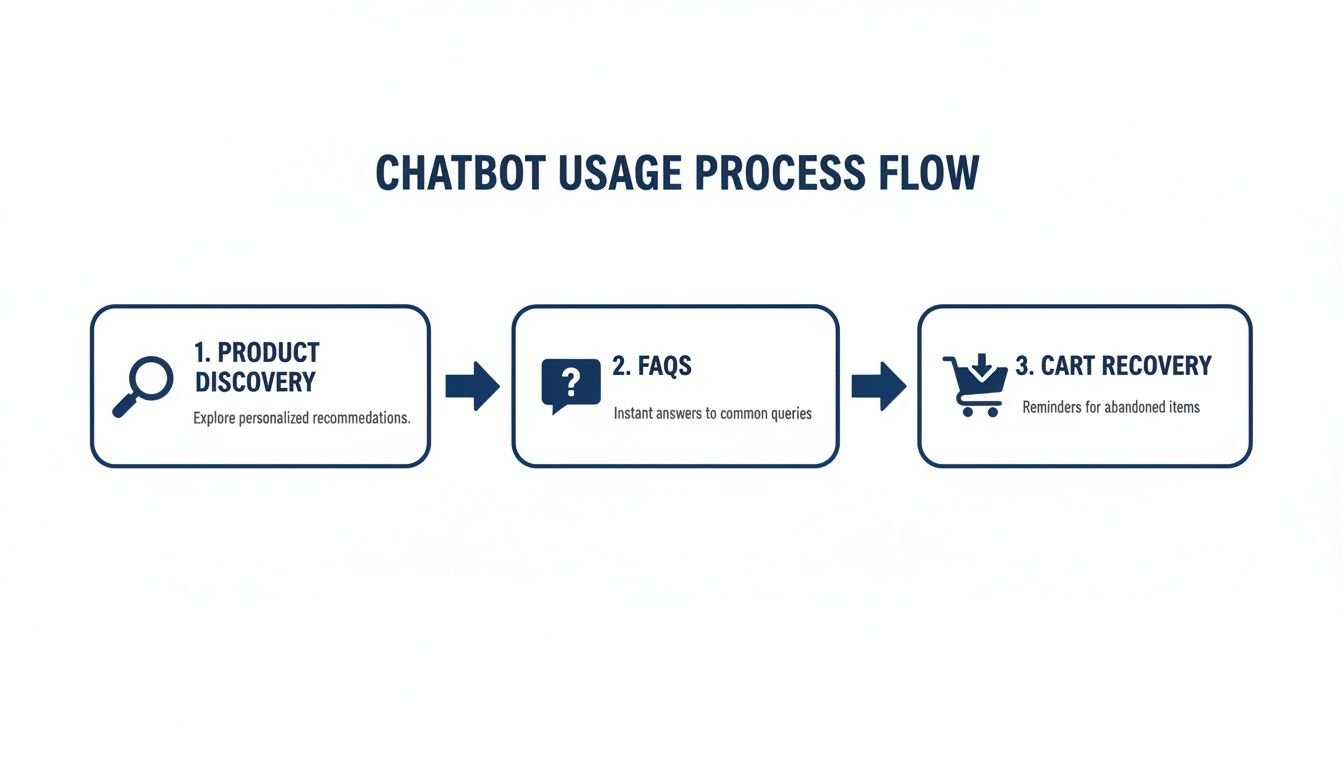
As you can see, a single tool can guide customers through the most important parts of their journey, which directly helps both your support team's efficiency and your sales numbers.
Phase 3: Train Your Chatbot with Quality Data
An AI chatbot is only as smart as the information you feed it. This training phase is where you give your bot the knowledge it needs to be genuinely helpful. You'll pull data from different parts of your business to build its brain.
Start by gathering your most important information:
Frequently Asked Questions (FAQs): Collect every common question you get about shipping, returns, product sizing, and store policies. This is your foundation.
Product Catalogue: Feed it all the details for every single product: descriptions, specs, materials, and pricing.
Knowledge Base Articles: If you already have help centre articles or guides, use them. This is how you teach the chatbot to handle more complex support issues.
The quality of this initial data is everything. The more complete and accurate the information you provide now, the better your chatbot will perform right out of the gate.
Phase 4: Test, Launch, and Refine
Finally, it’s time to go live. But launching to everyone all at once is usually a bad idea. Instead, start with a controlled testing phase to iron out the kinks before your chatbot meets all your customers.
First, do an internal test. Have your own team throw everything they can at the chatbot – weird questions, tricky requests, you name it. Try to break it. Once you're confident it can hold its own, move to a limited beta launch. You could switch it on for a single product page or only show it to a small percentage of your website visitors.
During this phase, keep a close eye on how it's doing. Read through the conversation logs to spot where customers are getting stuck or where the bot is giving wrong answers. Use what you learn to constantly tweak its responses and conversational flows. This is how you turn a good chatbot into a truly great one.
Integrating Your Chatbot with Your Tech Stack
An AI chatbot is only as smart as the information it can access. If it’s working in a silo, it’s not much more than a fancy FAQ page. The real power is unleashed when you connect it directly to the heart of your business operations.
Think of it this way: a disconnected bot can’t check an order status, see if a product is in stock, or know who your most loyal customers are. To provide the kind of instant, accurate, and personalised help that today’s shoppers demand, your chatbot needs to be fully integrated with the tools you already use every day.
Connecting to Your Core Systems
The magic truly begins when your chatbot can tap into your existing platforms. This is what allows it to pull live data, making every conversation dynamic, relevant, and genuinely helpful.
Here are the most critical connections to make:
Ecommerce Platforms (e.g., Shopify): This one is non-negotiable. Linking to your store lets the bot look up products, check prices, recommend alternatives, and even help customers build their cart directly in the chat.
Customer Relationship Management (CRM): By syncing with your CRM, the chatbot instantly knows a customer's history. It can greet repeat buyers by name, reference past purchases, and tailor offers that make them feel valued.
Inventory Management Systems: This connection is crucial for preventing customer frustration. The chatbot can provide real-time stock levels, letting a customer know if an item is available online, in a local store, or when it might be back in stock.
When your systems are integrated, you create a single source of truth. The information your chatbot gives a customer about their order is the exact same information your support team sees, which builds trust and eliminates confusion.
How Integrations Work in Practice
So, how do all these different software systems actually talk to each other? The technical backbone is built on Application Programming Interfaces (APIs), which act as bridges allowing data to flow between them. Another key tool is using webhooks for seamless integration, which lets one system send real-time updates to another the moment something happens.
For instance, when your shipping partner marks an order as "out for delivery," a webhook can instantly ping your chatbot. The bot can then proactively message the customer with the exciting news. This kind of automated communication creates a beautifully smooth and transparent post-purchase journey.
Getting these connections right is fundamental. If you're building out your digital foundation, our guide on selecting the right tech stack can provide some really practical advice.
Choosing an Integration-Friendly Vendor
Not all chatbot platforms are built the same, especially when it comes to connectivity. As you shop around, make sure to prioritise vendors that already have pre-built, "out-of-the-box" integrations for the tools you rely on. This will save you a massive amount of time, money, and headaches compared to building everything from scratch.
A good starting point is to create a checklist to compare your options.
Chatbot Vendor Selection Checklist
This checklist will help you systematically evaluate potential chatbot platforms, ensuring you choose a solution that fits your existing technology and future goals.
| Evaluation Criteria | Key Considerations | Importance (High/Medium/Low) |
|---|---|---|
| Native Ecommerce Integration | Does it connect seamlessly with my platform (e.g., Shopify, Magento)? | High |
| CRM Connectivity | Are there pre-built integrations for my CRM (e.g., Salesforce, HubSpot)? | High |
| API Accessibility | Is there a well-documented and flexible API for custom needs? | High |
| Ease of Integration | How much developer time is needed? Are the tools user-friendly? | Medium |
| Support for Other Tools | Can it connect to my inventory, shipping, or marketing software? | Medium |
| Data Security | What protocols are in place to protect customer data during transfer? | High |
| Scalability | Can the integrations handle growing transaction and data volumes? | Medium |
| Vendor Support | How helpful is their team when it comes to setting up integrations? | Low |
By carefully considering these points, you can find a partner that makes integration a simple process rather than a complex project. Choosing a platform with robust integration capabilities means your AI chatbot will be a deeply embedded, high-performing asset from day one.
Measuring Performance and Building Customer Trust
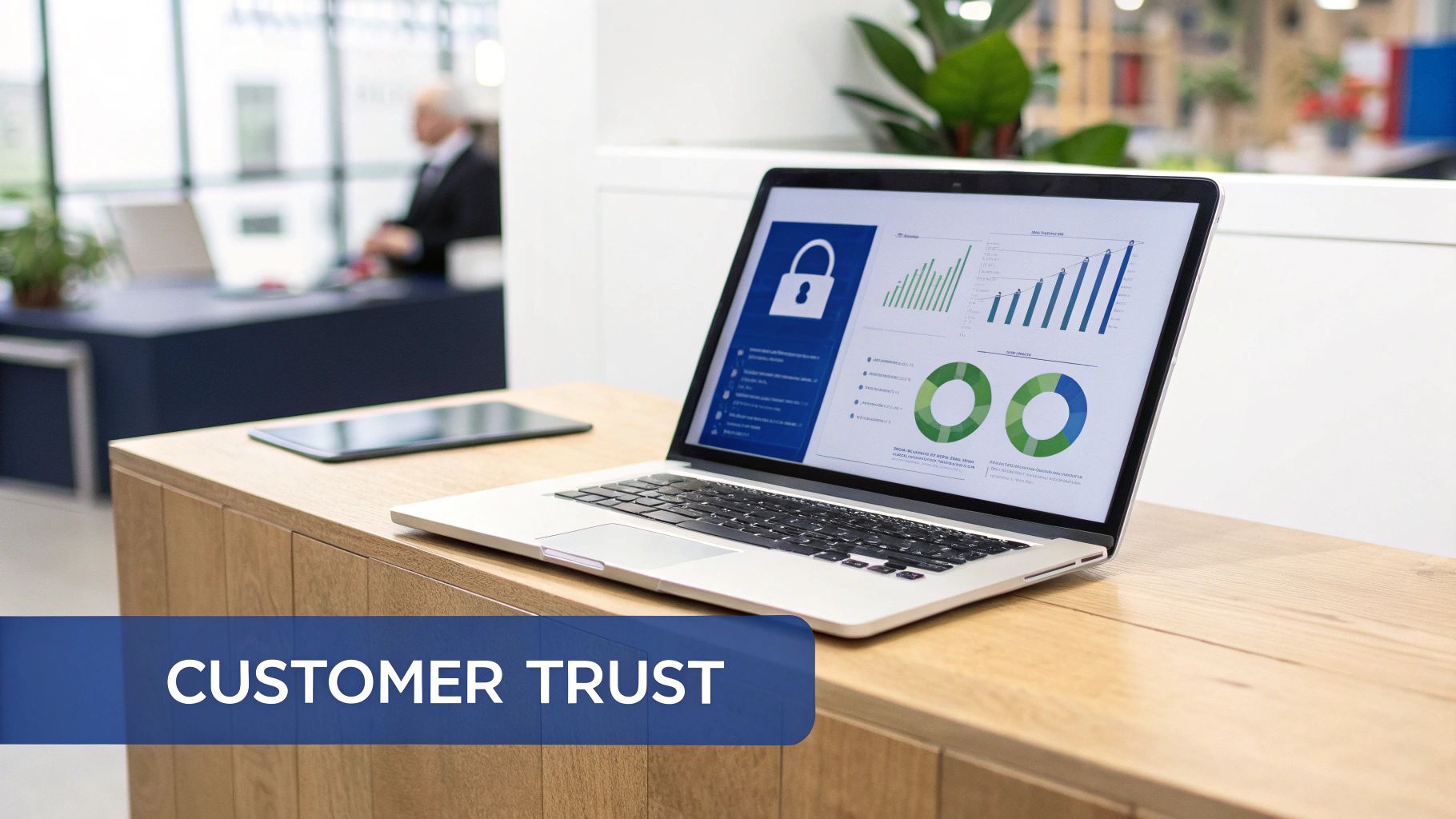
Putting an AI chatbot to work in your retail business isn’t a one-and-done job. Think of it less like a piece of software and more like a new team member. To get the most out of it, you need to constantly check in, measure how it’s doing, and make sure it’s earning your customers’ confidence.
This really comes down to two things: setting clear goals to track its impact and being completely transparent with your customers. Trust is the currency of retail, and that applies just as much to your bot as it does to your staff.
Key Performance Indicators for Your Chatbot
To figure out if your chatbot is actually adding value, you need to look past basic metrics like how many chats it handles. The right Key Performance Indicators (KPIs) give you a real story about what’s working and what needs a tune-up.
Here are the essential numbers to keep an eye on:
Resolution Rate: What percentage of issues does the bot solve on its own, without needing to pass the customer to a human? A high number here is a fantastic sign of efficiency.
Customer Satisfaction (CSAT) Score: This is your direct line to customer sentiment. A simple post-chat survey asking, "How did we do?" is the clearest way to know if your bot is helping or hurting the customer experience.
Conversion Lift: Are chatbot conversations turning into sales? This is where the rubber meets the road – tracking how many abandoned carts are saved or product recommendations are purchased tells you its direct impact on revenue.
Interaction Volume: Are more people using the bot over time? Growing numbers usually mean customers find it helpful and easy to use, which is a big win.
Watching these KPIs closely lets you make smart, data-backed tweaks to your chatbot’s responses and knowledge, squeezing more value out of your investment.
Building Trust Through Transparency and Security
Great metrics don't mean much if your customers are wary of the bot. Building that trust starts with being honest and showing you take their privacy seriously. People are more savvy than ever about their data, and they expect you to be a good steward of it.
The first step is simple: be upfront. Always make it clear that your customer is talking to an AI. It sets the right expectations from the get-go and avoids that frustrating feeling of being tricked.
Trust is built in moments of transparency. Always give customers a clear and simple way to connect with a human agent if they need one. A forced loop with a bot is a fast track to frustration and lost sales.
Beyond that, you have to lock down your data security. Make sure your chatbot complies with privacy laws like Canada’s PIPEDA. This means telling customers what information you're collecting and why, usually to make their experience better. Assuring them that their personal details and shopping history are safe is absolutely critical for keeping your brand’s reputation intact.
Common Questions About Ecommerce AI Chatbots
It’s only natural to have a few questions when you’re looking at bringing new tech into your business. When it comes to AI chatbots for ecommerce and retail, I find that owners and managers tend to circle back to the same core concerns: cost, complexity, and the impact on their team.
Let's clear the air and tackle those big questions head-on. Getting straight answers is the only way to make a smart decision for your company.
Will an AI Chatbot Replace My Team?
This is easily the most common worry I hear, and the answer is a firm "no." A chatbot isn't here to replace your people; it's here to make their jobs better.
Think of it as the ultimate assistant. It’s designed to handle the avalanche of repetitive, simple questions that eat up your team's day. Things like "Where's my order?" or "What's your return policy?" can be answered instantly, 24/7, without a human lifting a finger. This frees your expert staff to focus on the complex, sensitive issues where a human touch really matters – the conversations that build relationships and solve real problems. The result is a more efficient team that’s less burned out.
How Much Does a Chatbot Cost?
The good news is that the price tag can be surprisingly flexible. You don't need a massive enterprise budget to get started.
For small businesses, especially those on platforms like Shopify, you can find excellent plug-and-play solutions starting around $50 to $100 per month. These are fantastic for managing FAQs and basic support. For larger operations needing a custom-built bot that weaves into complex systems like your CRM, inventory, and ERP, the investment can run from a few thousand to tens of thousands of dollars.
The real goal isn't just to buy a tool; it's to invest in a solution that solves a specific business problem. Whether you're trying to slash support tickets or boost conversion rates, the cost should always be weighed against the value it brings back.
Is It Difficult to Train and Maintain?
It’s much more straightforward than you might think, thanks to huge leaps in AI technology. The initial training is mostly about giving the chatbot your existing knowledge. You can simply upload documents you already have:
Your website's FAQ page
Detailed product descriptions
Help centre articles and policy documents
The chatbot digests all of this to build its brain. From there, maintenance is an ongoing, but totally manageable process. You’ll review conversation logs to spot where customers are getting stuck or where the bot might have misunderstood something. It’s a simple feedback loop that lets you continuously fine-tune its answers, making it smarter and more helpful over time.
Can a Chatbot Create a Personal Experience?
Absolutely. In fact, this is where modern AI chatbots truly come alive. When you connect a chatbot to your ecommerce platform and CRM, it can tap into a goldmine of customer data, like their past purchases and what they've been browsing.
This is what allows the bot to deliver a genuinely personal touch. It can greet a returning customer by name, suggest products it knows they'll love based on previous orders, and offer support that’s actually relevant to them. It stops being a robotic Q&A and becomes a helpful, one-on-one conversation, much like you’d get from a seasoned associate in a physical store. That’s how you build real loyalty and drive more sales.
Ready to see how an AI-powered chatbot can transform your customer experience and drive growth? Cleffex Digital Ltd builds intelligent, integrated solutions that solve real business challenges. Discover how our innovative technology can work for you at Cleffex.com.