

Before you even start looking for an ecommerce app development company in Canada, it’s crucial to wrap your head around just how big the opportunity is. The Canadian digital market isn’t just growing; it’s booming. For any business serious about a mobile-first strategy, this is fertile ground. A custom app has quickly shifted from a “nice-to-have” to a core tool for connecting with today’s digitally native customer.
Understanding Canada’s Ecommerce Opportunity
What used to be a steady, predictable climb in Canadian ecommerce has turned into a rocket launch. This shift is fundamentally changing how people shop and interact with brands, making a dedicated mobile app more important than ever. If your business isn’t adapting, you risk getting left behind in a market that’s increasingly dominated by mobile sales.

This isn’t just a temporary spike; it’s a long-term change in consumer habits. The numbers tell the story. Canada’s ecommerce market hit a valuation of USD 1041.5 billion in 2024, and it’s not slowing down. Projections show it soaring toward USD 6850.3 billion by 2035, all thanks to a seriously impressive annual growth rate. You can dive deeper into these trends in the full research on Canada’s ecommerce market.
The Big Shift to Mobile-First Consumers
The smartphone is at the centre of this entire movement. Canadians aren’t just window shopping on their phones anymore. They’re going through the whole buying journey, from discovering a product to checking out, all within an app. A responsive website is a good start, but it often can’t deliver the smooth, intuitive experience that a dedicated app can.
Just look at a few trends that are driving this mobile-first world:
Mobile Wallet Popularity: With over 64.9% of Canadian smartphone users now using mobile wallets, the demand for quick, secure, one-tap payments inside an app is crystal clear.
Mobile’s Share of Sales: Mobile devices are already responsible for about 40% of all ecommerce transactions in Canada, and that number is ticking up every year.
The Power of Personalisation: People now expect a shopping experience that feels like it was made just for them. Apps are brilliant at this, using data to serve up relevant product suggestions and exclusive offers.
A custom ecommerce app gives you a direct, personal line to your customers. It’s your own branded space on their most personal device: their phone, creating incredible opportunities to build loyalty and keep them engaged.
Where the Growth is Happening
This move to mobile is happening across every industry you can think of. A boutique fashion store in Toronto could use an app to send push notifications to local shoppers about a flash sale. A national auto parts supplier could simplify B2B orders with a custom app featuring real-time inventory and one-click re-ordering. It’s all about making life easier for your customers.
The opportunity is massive, especially for small and medium-sized businesses. With ecommerce set to make up 13.0% of all retail sales by 2025, a polished app can give you a real competitive advantage. It lets smaller brands offer a sophisticated, user-friendly experience that can go toe-to-toe with the big guys. This is especially powerful when you integrate modern tools, which you can learn more about in our guide to AI-powered ecommerce solutions in Canada.
Ultimately, building an app is about meeting Canadian consumers exactly where they are: on their phones.
Defining Your App Vision and Project Scope
Jumping into development without a clear plan is like setting sail without a map. You’ll probably hit land eventually, but it won’t be where you intended, and the trip will cost you a fortune. Before you even think about talking to an ecommerce app development company in Canada, the single most important thing you can do is create a strategic blueprint.
This is all about turning big-picture business goals into a solid, actionable vision for your app. Are you trying to bump online sales by 20%? Is the real goal to build customer loyalty and get more repeat business? Maybe you’re looking to streamline a clunky B2B ordering system. You have to get specific.
Start With Your Customer, Not Your Features
It’s tempting to get caught up in cool, flashy features, but the apps that truly succeed always start with a deep understanding of the user. Who are you actually building this for? A crystal-clear picture of your target audience will steer every single decision you make, from the interface design right down to your marketing plan.
Let’s say you run a boutique in Toronto that sells sustainable fashion. Your customer isn’t just anyone. They’re likely eco-conscious, prefer quality over quantity, and probably discover new brands on their phone. That insight alone gives your app a clear direction.
For that kind of audience, you’d want to build an app with features like:
Detailed product stories that show where the materials came from and how the clothes were made ethically.
A slick visual search feature, so someone can snap a photo of an item they like and find similar sustainable options in your store.
A built-in loyalty program that gives repeat shoppers first dibs on new collections.
This customer-first mindset ensures you’re building a tool that people actually want and need, not just another app that gets deleted after one use.
Map The Entire Customer Journey
Once you know who your user is, mentally walk through every single step they’ll take inside your app. This “journey mapping” is crucial for creating a smooth, intuitive experience. Your mission is to squash any tiny frustration that might make someone give up and abandon their cart.
Sticking with our Toronto boutique example, the customer’s journey could look something like this:
Discovery: They see an Instagram ad and download the app. The sign-up is fast and immediately showcases the brand’s sustainable mission.
Browsing: They can easily sort through categories, filter by values like “vegan” or “locally made,” and see beautiful, high-resolution product photos.
Consideration: They add items to a wishlist and read the detailed product stories, which builds trust and a connection to the brand.
Purchase: The checkout is a breeze, offering Apple Pay or Google Pay for a one-tap purchase.
Post-Purchase: They get push notifications about their order status and a personalised thank-you message.
Mapping out this flow helps you spot potential roadblocks and ensures every interaction with your app strengthens your brand.
A well-defined project scope, born from a clear vision and customer journey map, is the foundation of an accurate quote. It eliminates guesswork, prevents scope creep, and sets a clear direction for the development team.
As you nail down your app’s core features and target audience, you also need to think about the money. How will this app actually generate revenue? Take some time to explore different mobile app monetisation strategies to make sure your business model is solid from day one.
When you hand a development partner a detailed brief like this, you’re doing more than just asking for a price; you’re showing them you have a clear vision and are serious about building something great. That clarity is what turns a vendor into a true strategic partner.
How to Evaluate Canadian App Development Partners
Choosing the right partner is, without a doubt, the most critical decision you’ll make for your entire project. This is where your idea meets reality, and the team you bring on board will have a direct hand in whether your app succeeds or fails. You’re not just looking for a vendor; you need a strategic ally, an ecommerce app development company in Canada that’s genuinely invested in your growth.
That means you have to look past the slick sales pitches and glossy websites. A truly great partner has the track record to prove their worth, transparent processes you can trust, and the technical chops to bring your vision to life securely and on budget.
Before you even start talking to companies, it helps to map out how your business goals connect to your target audience and, ultimately, the features your app needs.
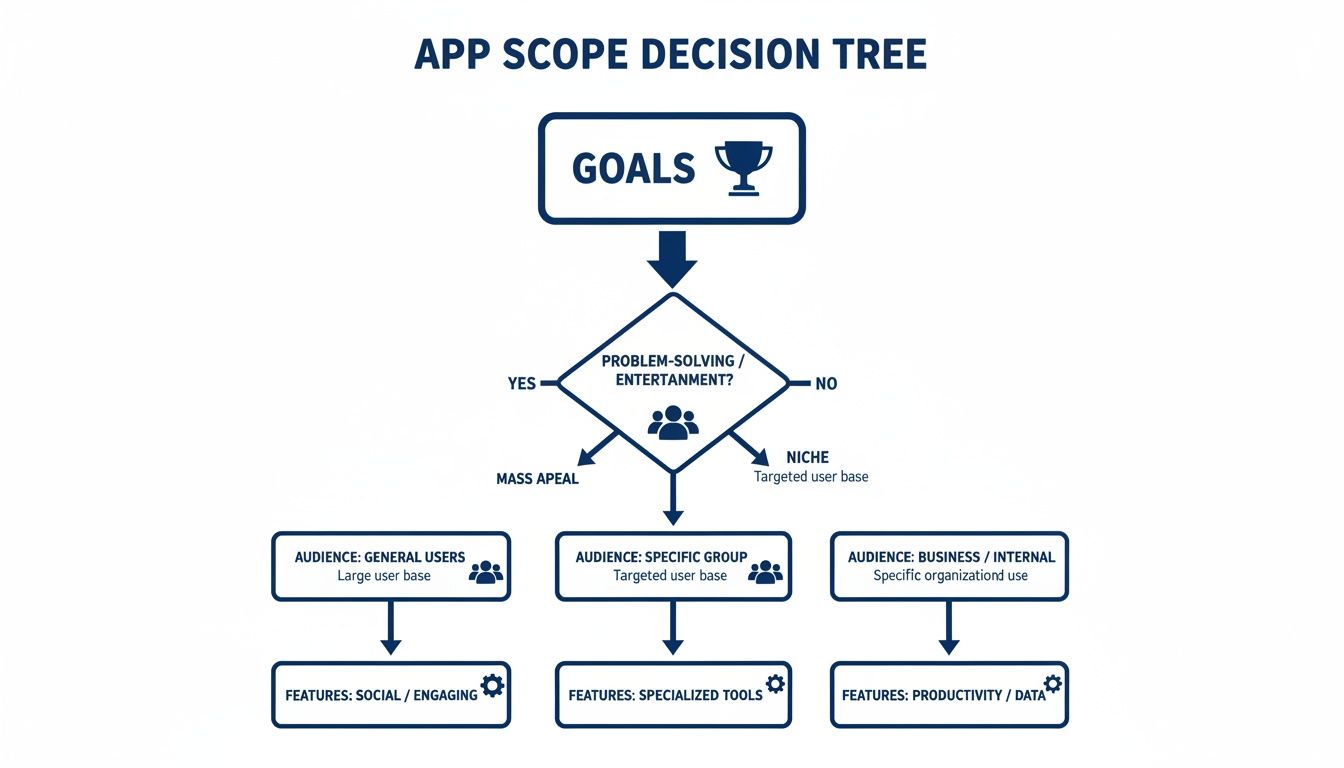
Starting with clear goals helps you zero in on your audience, which then makes it much easier to decide on the must-have features.
Dig Into Their Portfolio and Case Studies
A portfolio is much more than a gallery of pretty screenshots; it’s hard evidence of a company’s real-world experience. Don’t just skim it; really dig in. Look for apps that feel similar to what you want to build, whether that’s in your industry or in terms of complex functionality. If you’re a retailer, for example, have they built apps with sophisticated inventory management or integrated loyalty programs?
When you’re looking at a case study, ask the tough questions:
What was the actual business problem they were hired to solve?
What part did they play: was it just design, or full-stack development and quality assurance?
Can they share any concrete numbers on how the app performed after it launched?
A top-tier firm will have no problem walking you through the challenges they hit and how they creatively solved them. They won’t just show you the shiny finished product.
Verify Their Technical Expertise
This one’s non-negotiable. Your potential partner must be fluent in the modern technologies needed to build a high-performing ecommerce app. That means having deep expertise in both front-end (everything your customer sees and interacts with) and back-end (the server, database, and all the business logic that makes it work).
This is especially critical in Canada, where mobile commerce is exploding. With a third of all purchases now happening on mobile devices, developers need to be masters of creating thumb-friendly navigation and checkout flows that are lightning-fast. To grab a piece of the CA$52 billion Canadian ecommerce market, where 11.5% of all retail spending now happens online, your app has to be flawless.
An exceptional development partner doesn’t just write code; they architect solutions. They should be able to clearly explain why they chose a particular technology and how that choice will help you scale and stay secure down the road.
Assess Their Communication and Project Management Style
How an agency communicates is just as important as how well they code. A mismatch in style can quickly lead to frustrating delays, crossed wires, and a blown budget. Today, the gold standard for app development is the Agile methodology.
Agile breaks a huge project down into small, manageable cycles called “sprints.” This allows the team to be flexible, gather feedback constantly, and make adjustments on the fly. You’ll want to ask any potential partner to walk you through their Agile process.
How often can you expect meetings or check-ins?
What project management tools do they use (like Jira or Trello)?
Who will be your main point of contact?
Clear, consistent communication is the foundation of a successful project. You should feel like a core part of the team, not an outsider anxiously waiting for an email. For more on this, our guide on 10 simple tips to choose the right software development company is a great resource.
To help you spot the good from the bad, we’ve put together a quick comparison table. This isn’t an exhaustive list, but it covers the core things I look for when vetting a new partner.
Key Evaluation Criteria for a Canadian App Development Partner
| Evaluation Area | What to Look For | Red Flags to Avoid |
|---|---|---|
| Portfolio & Case Studies | Detailed case studies showing specific problems, their solutions, and measurable results (e.g., increased revenue). | A gallery of screenshots with no context, or vague claims like "improved user engagement." |
| Technical Skills | Deep expertise in modern tech stacks (e.g., React Native, Swift, Kotlin) and a clear rationale for their tech choices. | "We can build anything!" with no specialisation. Hesitation to discuss technical architecture or security. |
| Project Management | A defined Agile or similar iterative process. Clear communication channels and regular, scheduled check-ins. | Vague timelines, no mention of project management tools, or a single point of contact who seems overwhelmed. |
| Security & Compliance | Proactive discussion of data security and experience with Canadian regulations like PIPEDA. | Dismissive attitude towards compliance, or treating security as an afterthought. |
| Client References | Eager to provide multiple relevant client contacts who can speak to their process and problem-solving skills. | Reluctance to provide references, or only offering contacts from projects completed years ago. |
Think of this table as your gut-check guide during those initial conversations. A great partner will check all the right boxes without you even having to push.
Always, Always Check References
Finally, never skip the reference check. A confident, capable company will be more than happy to connect you with past clients. When you get them on the phone, go beyond the generic "Were you happy with them?"
Ask pointed questions that get to the heart of the matter:
How did the team handle it when something unexpected came up, or the project scope changed?
Was the final product delivered on time and, just as importantly, within the budget you agreed on?
What has the support been like since the app launched?
The answers you get here will give you an unfiltered look at what it’s really like to work with them. It’s the single best way to confirm that their sales pitch lines up with their actual performance.
Choosing The Right Tech Stack For The Canadian Market
Think of the technology behind your ecommerce app as its engine. Choosing the right one isn't about getting bogged down in technical jargon; it's about matching the technology to your actual business goals. You don’t need to be a developer to make a smart call, but you do need to grasp the real-world trade-offs. The decision you make here will echo through your app's performance, how easily it can grow, and what it costs to maintain down the road.
This is a foundational choice, and it's critical when you're looking for the right ecommerce app development company in Canada. Their expertise with a particular tech stack will essentially set the course for your entire project.
Native vs Hybrid vs Web Apps
One of the first, and most important, conversations you'll have with any potential development partner is whether to build a native, hybrid, or progressive web app (PWA). Each path has its own pros and cons, and the best fit really depends on your specific needs, budget, and how fast you want to get to market.
Native Apps: These are the specialists. They're built from the ground up for a single operating system – either iOS (using Swift or Objective-C) or Android (using Kotlin or Java). The payoff is peak performance, top-tier security, and seamless access to a phone’s hardware, like the camera and GPS. The catch? It's expensive, as you're effectively paying to build and maintain two separate applications.
Hybrid Apps: This is the flexible all-rounder. Using frameworks like React Native or Flutter, developers write a single codebase that works beautifully on both iOS and Android devices. This route dramatically cuts down on development time and cost. For most ecommerce apps, the performance is so good that it's virtually impossible to tell them apart from a native app.
Progressive Web Apps (PWAs): Think of a PWA as a website that’s been trained to act just like a native app. Users can add it to their home screen and even get push notifications, all without ever visiting an app store. PWAs are a brilliant and cost-effective way for businesses to establish a solid mobile presence quickly.
For a lot of Canadian businesses, the hybrid approach really hits the sweet spot. It offers a fantastic balance of high performance and cost-efficiency, letting you launch faster without sacrificing the smooth user experience your customers expect. We dive much deeper into this in our step-by-step guide on selecting the right tech stack.
Popular Platforms And Technologies
Once you've settled on the type of app, you need to think about the backend: the system that will manage your products, orders, and customer data. For many businesses, especially those starting out or looking to scale intelligently, this conversation often leads to Shopify. As a Canadian-born global giant, Shopify offers an incredibly robust, scalable, and secure foundation for ecommerce.
To really see if it’s a fit, it helps to understand what Shopify is and how it helps brands grow. A skilled development partner can create a custom mobile app that integrates perfectly with a Shopify backend. This gives you the best of both worlds: a world-class ecommerce engine powering a unique, branded app that you control completely. Of course, for fully custom backends, technologies like Node.js, Python (Django), and Ruby on Rails are also excellent choices, each with its own advantages in scalability and performance.
The right tech stack is not about chasing the "newest" or "trendiest" thing. It's about choosing proven, well-supported, and scalable tools that solve your specific business challenges and prepare you for future growth.
Navigating Canadian Security And Compliance
This is precisely where partnering with a Canadian development team becomes a game-changer. When you're building an app for the Canadian market, you absolutely have to play by the rules, and that means complying with federal and provincial privacy laws. The big one is the Personal Information Protection and Electronic Documents Act (PIPEDA).
PIPEDA dictates how businesses collect, use, and disclose personal information. Any app that handles customer names, addresses, or payment details falls directly under its watch. This isn't something you can afford to get wrong.
A partner with deep roots in the Canadian market will instinctively know how to handle this. They’ll understand things like:
Data Sovereignty: They know the importance of keeping Canadian user data on servers located within Canada and have the expertise to implement it correctly.
Consent Protocols: Your app must get clear, explicit consent for data collection. It can’t be buried in a mountain of legal text.
Security Safeguards: They will build your app from day one with the right encryption and security measures to protect the sensitive information you're collecting.
Ignoring PIPEDA can lead to hefty fines, but the real damage is to your reputation. Losing customer trust can be fatal. When you’re interviewing potential partners, ask them point-blank about their experience building PIPEDA-compliant apps. Their answer will tell you everything.
Getting on the Same Page: Pricing and Partnership Models
Let's talk money. When you're vetting an ecommerce app development company in Canada, how they structure their pricing is just as important as the quality of their code. A good partner will be upfront about their models, laying everything out so you can find a fit for your budget and how you like to work.
There’s no single "best" way to structure a project; it all depends on your goals. You'll generally come across three main options, and knowing the ins and outs of each will save you headaches down the road. It’s all about aligning expectations from day one.
The Fixed Price Model: Predictable and Defined
This is the simplest model to understand: you agree on a specific scope of work for one set price. It’s a clean, straightforward contract. This approach works best for smaller, well-defined projects where you can map out every single feature before development kicks off.
Think of an MVP (Minimum Viable Product) for a new online boutique. The needs are clear: product pages, a shopping cart, and a standard checkout. There are no major unknowns. The scope is tight, making it easy to put a firm number on it.
The upside is budget certainty. You know exactly what you’ll spend. The downside? It's rigid. If a brilliant new feature idea pops up halfway through, you can't just slide it in. You'll need a formal change request, a new quote, and that can slow things down and increase the final cost.
The Time and Materials Model: Flexible and Agile
This model is the polar opposite of a fixed price. With Time and Materials (T&M), you pay for the actual hours the team works on your project, plus any direct costs for things like third-party software. It’s essentially a pay-as-you-go system.
T&M is perfect for larger, more complex projects where the requirements are likely to evolve. Maybe you're building a sophisticated platform with AI-powered recommendations and several custom integrations. You know you’ll need to adapt based on user feedback after launch. This model gives you the freedom to pivot and make changes on the fly without being locked into a plan you made six months ago.
The Time & Materials model naturally creates a more collaborative relationship. It supports an agile development process, letting us adjust priorities sprint by sprint to make sure the end product is exactly what your business needs.
The Dedicated Team Model: Your Own Integrated Crew
For businesses with serious, long-term development needs, the Dedicated Team model is often the smartest play. Your development partner assembles a full team: developers, designers, a project manager, and QA specialists, who work only on your projects. It’s the closest you can get to having a full-time, in-house tech team, but without the headaches of recruitment and HR.
This is a powerful option for established businesses looking to innovate continuously. Take the Canadian B2B ecommerce market, for example. It's growing at a 12.5% compound annual growth rate, a sign that companies are investing heavily in digital. They need ongoing work on complex systems like automated catalogues and secure B2B portals. You can dive deeper into the dynamic Canadian ecommerce market on trade.gov.
A dedicated team provides that consistent, focused expertise. They get to know your business inside and out, becoming a true strategic partner for your long-term growth.
Ready to Start Building Your App?
Picking the right ecommerce app development company in Canada is a big deal. It’s the decision that will shape your mobile success for years to come. Hopefully, this guide has given you a solid roadmap to move from a rough idea to a concrete plan of action. The path from a great concept to a successful app isn't just about technology; it’s about finding a partner who genuinely gets the Canadian market.
This is what we do every day at Cleffex Digital Ltd. We team up with Canadian businesses from nimble startups to established brands to create ecommerce apps that are secure, built to grow, and truly focused on the user. The result? Real, measurable growth. Our skill isn't just in the code; it’s in understanding your business goals and turning them into a digital experience your customers will love.
Let's Build This Together
We believe in working together, openly and honestly. We bring our experience to the table to make sure your project is a winner from day one.
Here’s a glimpse of how we make it happen:
Smarter UX with AI: We build intelligent user experiences that learn from customer behaviour, which helps push engagement and sales.
Agile Approach: We work in flexible, iterative cycles. This means we can pivot when needed and get your app to market faster without cutting corners.
Platform Experts: We have deep expertise in platforms like Shopify, allowing us to build powerful solutions that you can easily manage and scale up.
Think of your ecommerce app as more than just another sales channel. It’s your best tool for creating lasting customer relationships and a serious investment in your brand’s future.
If you're ready to turn your app idea into a cornerstone of your business, let's talk. You can schedule a no-obligation consultation with our team. We’ll have a real conversation about your vision, explore what’s possible, and map out the best way to get there.
Frequently Asked Questions
When you're looking to hire a development partner, it's natural to have a lot of questions. It's a big decision. To help you get some clarity and feel more confident, we’ve put together answers to the questions we hear most often from businesses just like yours.
Think of this as a straightforward chat to help you finalise your choice and get your project moving.
How Much Does an Ecommerce App Cost In Canada?
This is always the first question, and the honest answer is: it depends. There’s no single price tag. A straightforward ecommerce app, what we'd call a Minimum Viable Product (MVP), could start around $30,000. On the other hand, a highly complex, feature-packed application with custom integrations and AI features can easily climb north of $250,000.
What drives that number up or down? It really comes down to three things:
Complexity: A simple storefront is one thing. An app with custom animations, multiple third-party API connections (think shipping, payments, and inventory systems), and a sophisticated backend is a whole different ball game.
Platform Choice: Do you need an app for both iPhones and Android devices? Building two separate "native" apps is the most robust but also the most expensive route. A hybrid app, which uses a shared codebase for both platforms, is often a more budget-friendly starting point.
The Team: The size and location of the development team, the designers, developers, and testers, will naturally influence the final cost.
The best way to get a real number is to start with a clear scope. When you can hand a development partner a detailed brief, they can give you a much more precise estimate. It’s the single best way to prevent surprise costs down the road.
How Long Does It Take To Build An App?
Just like cost, the timeline is tied directly to complexity. A streamlined MVP can be brought to life and launched in as little as 3 to 4 months. For more ambitious apps with intricate features, you should realistically plan for a timeline of 6 to 9 months, and sometimes even longer.
The journey from idea to app store has several key stages, each with its own timeline:
Discovery & Planning: Nailing down the strategy, features, and tech requirements.
UI/UX Design: This is where we create the blueprints – wireframes, mockups, and prototypes.
Development: The actual coding of the app's front-end and back-end.
Testing & QA: We put the app through its paces to squash bugs and ensure it runs smoothly.
Deployment: Getting it approved and listed on the Apple App Store and Google Play Store.
At Cleffex, we favour an agile development process. This approach lets us break the project into smaller "sprints," which means we can iterate faster and get a working version of your app in your hands much sooner.
Should I Choose A Local Canadian Company?
You can find talent anywhere in the world, that’s true. But partnering with a local ecommerce app development company in Canada gives you some serious home-field advantages. A Canadian team just gets the local market, how Canadian consumers shop, and crucially, our unique legal and compliance requirements.
Having a deep understanding of Canadian privacy laws like PIPEDA (Personal Information Protection and Electronic Documents Act) isn't just a "nice-to-have," it's essential. A Canadian partner will build compliance into your app's DNA from day one, protecting your business and your customers' data. That local knowledge helps you sidestep expensive legal headaches and builds immediate trust with your users.
Ready to turn your vision into a high-performing ecommerce app? At Cleffex Digital Ltd, we combine local market knowledge with world-class technical expertise to build solutions that drive growth for Canadian businesses. Let's discuss your project today.