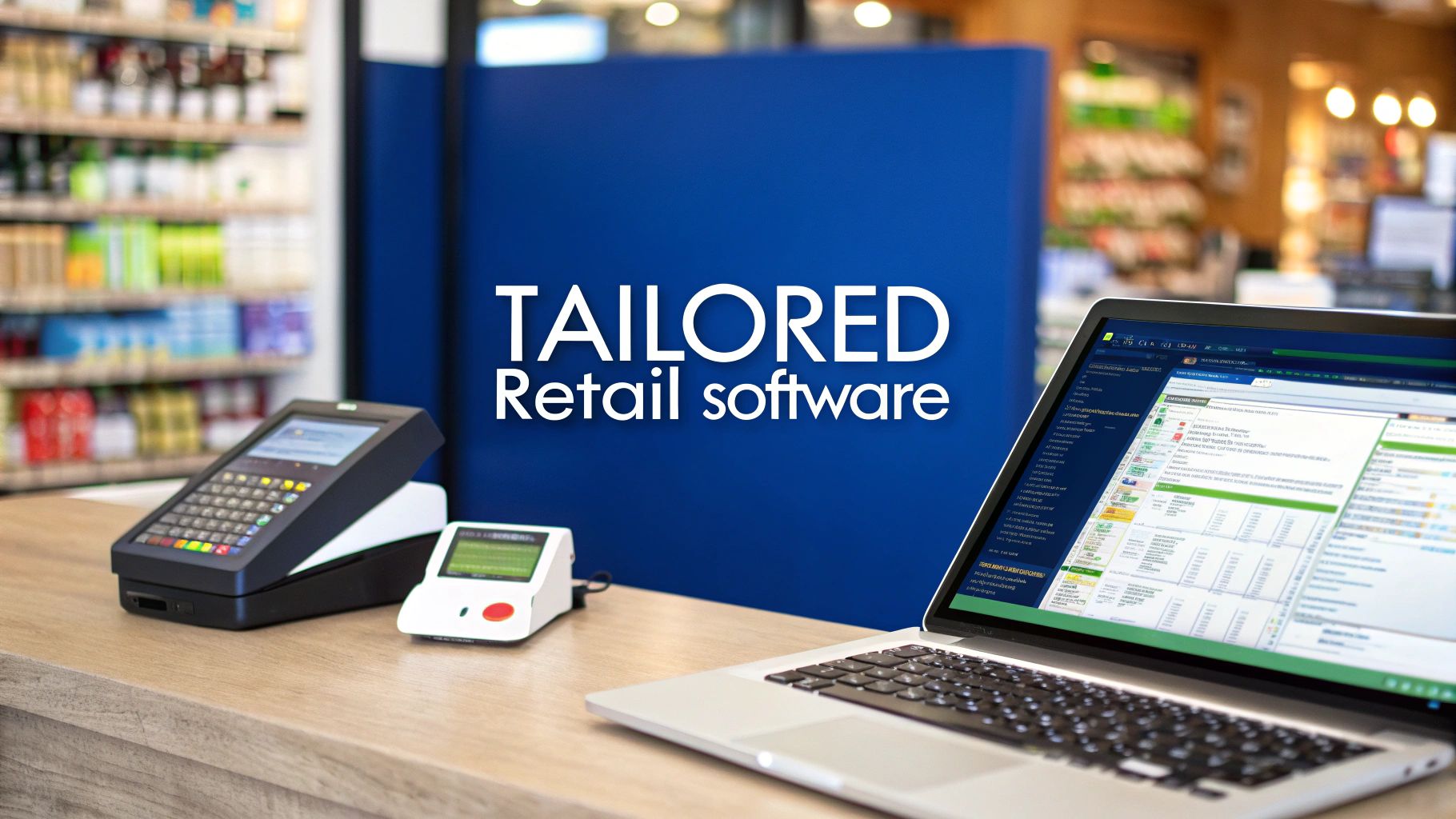


When you hear the term custom retail software, think of it less as a product and more as a tailored business partner. Unlike a generic, off-the-shelf system that forces you to adapt, a custom solution is built from the ground up to fit your unique operations, workflows, and customer base.
It’s like the difference between buying a suit off the rack versus having one made by a master tailor—one might do the job, but the other is crafted for a perfect fit that enhances everything.
Moving Beyond One-Size-Fits-All Retail Software
So many retailers get stuck trying to wedge their unique business processes into the rigid box of generic software. This one-size-fits-all approach often creates more headaches than it solves. You end up with clunky workflows, data silos, and a customer experience that feels disconnected. It’s a classic case of the technology dictating how you run your business, instead of the other way around.
Custom retail software completely flips that script. It’s a digital ecosystem designed to align perfectly with your specific goals. It’s built around how your team actually works, the way your customers prefer to shop, and your vision for future growth.
Pinpointing Key Operational Challenges
Generic software often stumbles in a few critical areas, creating major hurdles for a modern retail business. These are the exact pain points that a custom solution is designed to eliminate.
Key issues that bespoke software addresses include:
- Disconnected Sales Channels: When your physical store, e-commerce site, and mobile app aren’t talking to each other, you get unreliable inventory counts and a fractured view of your customers.
- Inaccurate Inventory Management: Off-the-shelf systems can struggle with the complexities of modern inventory, like product bundles, stock across multiple locations, or just-in-time ordering. This leads directly to overselling or frustrating stockouts.
- A Fragmented Customer View: Without a single, unified hub for all customer data, trying to create truly personalized marketing campaigns or meaningful loyalty programs is next to impossible.
A custom solution acts as the central nervous system for your entire retail operation. It ensures every component—from the point-of-sale terminal to the warehouse floor—works together in perfect harmony. This seamless integration is what unlocks real efficiency and a truly superior customer journey.
This guide will walk you through everything you need to know to commission a system that genuinely works for you. We’ll explore the essential components, the real-world business benefits, and the strategic thinking required to implement a platform that empowers your business rather than holding it back. For a deeper dive, you can explore our detailed comparison between custom and off-the-shelf software.
Making the switch from a generic tool to a purpose-built asset isn't just about smoothing out today's operations. It's about laying a scalable foundation that can adapt to new market trends, sales channels, and customer expectations without forcing you to start from scratch every few years.
The Building Blocks of a Modern Retail Platform
A powerful retail platform isn't just a jumble of different tools; it’s a living, breathing system where every part talks to the others. For a retail business to truly thrive, it needs four core pillars that work in perfect harmony, sharing data to make operations smooth and intelligent. When these components are built to communicate, they do more than just manage your business—they help it grow.
This interconnected system is the heart of modern custom retail software solutions. It makes sure every action, from a simple sale to a complex marketing campaign, is smart and efficient.
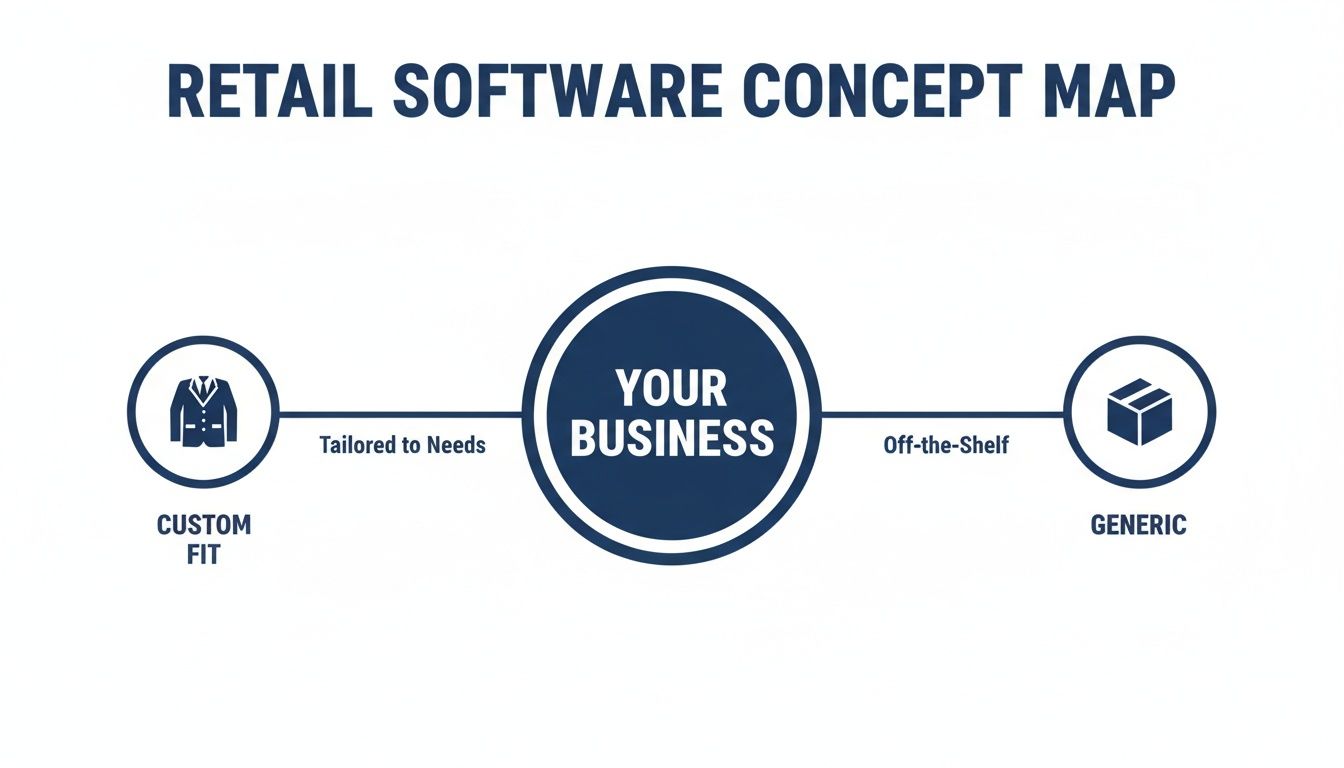
This image really gets to the heart of the matter. Businesses can either grab a generic, one-size-fits-all box off the shelf or invest in a solution that's made just for them. The big difference? A generic system gives you the basics, but a custom platform is built around your specific way of doing business, linking all the pieces that matter most.
The Point of Sale (POS): More Than Just a Till
Think of your Point of Sale (POS) system as the frontline of your entire operation. It's so much more than a digital cash register. It's where the action happens, where you gather crucial data, and where countless other processes kick off. A modern, custom-built POS is quick, intuitive, and, most importantly, deeply connected.
It's your command centre. Every time a sale goes through, it does more than just take a payment. It instantly sends vital info to every other part of your software, setting off a chain reaction of automated updates that keeps the whole business perfectly in sync.
Inventory Management: Knowing What You Have, in Real-Time
Tied directly to the POS, the inventory management module is the guardian of your stock. The moment an item sells—whether in-store or online—the system automatically subtracts it from your total count. This simple action practically wipes out the risk of accidentally selling a popular product you no longer have.
That real-time accuracy is a game-changer. It means the stock level a customer sees on your website perfectly matches what's actually on the shelf, preventing frustration and protecting your brand's reputation. The best systems can even be set up to automatically reorder products when stock drops below a certain point.
When your POS and inventory systems are truly integrated, a sale at the checkout instantly updates stock levels everywhere. That new count then syncs with your e‑commerce site, preventing overselling and creating a seamless experience for both your staff and your customers.
Imagine a boutique fashion store with both a physical shop and an online store. When a one-of-a-kind dress is sold in person, it's immediately marked as "sold out" online. No more disappointing an online shopper by letting them buy something that's already gone.
Customer Relationship Management (CRM): Building Real Connections
Every single transaction is packed with valuable customer data. A custom CRM module grabs this information from the POS and uses it to create rich, detailed customer profiles. We're talking more than just names and emails; this includes their complete purchase history, how often they shop, how much they spend, and what they like to buy.
This complete picture of your customer is a marketing goldmine. With this data at your fingertips, you can:
- Segment Your Audience: Create razor-sharp marketing campaigns for specific groups, like customers who always buy a particular brand.
- Personalise Your Offers: Send out discounts and promotions that actually mean something to individual shoppers, which naturally leads to more sales.
- Foster Loyalty: Figure out who your best customers are and reward them, giving them every reason to keep coming back. For those looking to dive deeper, this guide to customer loyalty program software is a fantastic resource.
E‑commerce Integration: Your Digital Storefront
Last but not least, the e‑commerce integration bridges the gap between your digital and physical worlds. This module makes sure your online store isn't just an afterthought but a core part of your entire retail operation.
Information flows both ways. Product details, prices, and photos are pushed from your main system to your website, while online orders are pulled back into the POS and inventory systems to be fulfilled. You can even see how this idea is being taken to the next level with concepts like headless commerce driven by AI.
When these four pillars—POS, Inventory, CRM, and E‑commerce—are custom-built to work as one, they create a single source of truth for your entire business. This powerful synergy is what separates a standard piece of software from a platform that genuinely boosts efficiency, builds lasting customer relationships, and lays the groundwork for serious growth.
Why Canadian Retailers Are Choosing Custom Solutions
The Canadian retail market isn't just a slightly colder version of the one down south; it has its own unique flavour and a distinct set of operational challenges. Trying to run a business here with generic, off-the-shelf software often feels like fitting a square peg into a round hole. You're left with clumsy workarounds and frustrating gaps in your workflow.
This is precisely why a growing number of Canadian retailers are moving to custom retail software solutions. They're not just looking for software; they're looking for a genuine strategic advantage. A bespoke platform is built from the ground up with the realities of doing business in Canada in mind—it's not a one-size-fits-all product forced to adapt, but a system designed for the specific environment it operates in.
Navigating Canada’s Unique Operational Complexities
Ever tried managing a business across multiple provinces with software that can't tell the difference between PST, GST, and HST? It's a common struggle that leads to accounting nightmares and serious compliance risks. Custom software is built to handle this kind of complexity right out of the gate.
Here are a few key Canadian challenges that custom solutions solve beautifully:
- Complex Tax Laws: A custom system can automatically apply the correct provincial and federal taxes based on where the sale happens or where the product is shipped. This ensures accuracy and makes compliance a whole lot simpler.
- Bilingual Customer Experience: Supporting both English and French is simply non-negotiable. Custom software can flawlessly manage bilingual product details, customer communications, and user interfaces across every channel, from your POS terminal to your e-commerce site.
- Supply Chain and Logistics: Canada is a massive country, and managing supply chains can be a real headache. A tailored solution can integrate directly with regional carriers and logistics partners, giving your customers accurate shipping rates and delivery estimates.
Off-the-shelf software often treats Canadian-specific requirements like bilingualism and provincial taxes as an afterthought. Custom solutions treat them as core functionalities, building them directly into the system's DNA for effortless, accurate operations.
Fuelling Growth in a Booming E-commerce Market
The shift to online shopping in Canada has been enormous, creating both incredible opportunities and intense pressure for retailers. This e-commerce explosion is a major reason why the demand for custom ERP software solutions has skyrocketed.
Consider the numbers: as of 2022, over 27 million Canadians—that's about 75% of the population—were shopping online. That figure is expected to hit 77.6% by the end of 2025. The market reflects this, with the Canada ERP Software Market valued at USD 7.06 billion in 2024 and projected to surge to USD 12.47 billion by 2030. You can check out the full report on the Canadian ERP software market growth.
This rapid growth means a scalable, powerful back-end is no longer a "nice-to-have." It’s essential for survival.
Meeting the Needs of Growing Businesses
As a Canadian business scales, its needs change—sometimes dramatically. A small retailer might just need a simple, reliable online store to get started. But as they grow, their requirements become far more complex, and a standard approach just can't keep up.
For Small Retailers:
A custom solution provides a foundation you can build on. You can start with the essentials, like an integrated POS and e-commerce platform. Later, as your business expands, you can add modules for advanced inventory or marketing automation without having to ditch your system and start over.
For Medium Enterprises:
At this stage, complexity multiplies. Custom software is crucial for automating intricate supply chains, managing inventory across multiple locations, and integrating with other core business systems like accounting or warehouse management software.
For any business serious about competing, a generic system eventually becomes a ceiling on growth. It limits your ability to adapt, innovate, and provide the seamless, personalized experience that Canadian shoppers now expect. Incorporating advanced tools is one key strategy, and you can learn more about how AI is transforming Canadian retail software development in our related article.
Ultimately, choosing a custom solution is a strategic investment in a platform that can grow and evolve right alongside your business, tailored specifically for success in the Canadian market.
What Are the Real-World Business Benefits?
When you look past the feature lists and technical jargon, the real value of a custom retail software solution is measured in what it does for your bottom line. Investing in a system built just for you isn't merely a tech upgrade; it's a strategic decision that unlocks serious operational efficiency, deepens customer relationships, and sets you up for long-term growth. These aren't separate perks—they all work together to give you a genuine edge over the competition.
Think about it this way: when your software is built around your specific workflows, the positive impact is immediate. You stop fighting against a generic system's limitations and start using a tool that actually helps your team get things done.

Driving Superior Operational Efficiency
Off-the-shelf software often forces your staff into awkward, inefficient workarounds. A custom solution does the exact opposite by automating the repetitive, time-sucking tasks that bog everyone down. Imagine a system where purchase orders are automatically created when inventory dips below a certain point, or where sales data from your store and website are pulled into a single, clean report without anyone touching a spreadsheet.
This kind of automation frees up your team to focus on what really matters—high-value work that grows the business. Instead of spending hours double-checking inventory counts, they can spend that time helping customers, planning new promotions, or training new hires.
You’ll see efficiency gains in a few key areas:
- Reduced Manual Errors: Automation drastically cuts down on human error in critical tasks like inventory management and order processing, saving you both time and money.
- Faster Workflows: By designing processes that mirror how your team actually works, you eliminate pointless steps and make everything from checkout to order fulfilment much quicker.
- Unified Data Access: Having a single source of truth means no more digging through different programs to find information. This leads to faster, smarter decision-making across the board.
Elevating the Customer Experience
In today's retail world, the customer experience is everything. Custom software gives you the power to create the kind of personalized service that turns casual shoppers into devoted fans. When your point-of-sale, CRM, and e-commerce platforms are all talking to each other, you get a complete 360-degree view of every single customer.
This unified view helps you understand their buying history, what they like, and how they interact with your brand. Armed with that knowledge, you can create marketing and service that feels incredibly relevant. For instance, you could automatically send a special offer to a customer who regularly buys a particular brand right when a new product from that line drops.
A recent study found that 81% of consumers prefer to shop with companies that offer a personalized experience. Custom software makes this possible at scale, helping you build real loyalty.
Ultimately, custom retail solutions are built to enhance what makes your business unique. This helps you improve ecommerce customer experience and drive growth by ensuring every interaction feels valuable and tailored to the individual shopper.
Building for the Future with Scalability
Perhaps the biggest long-term win is scalability. Your business isn't going to stand still, so why should your software? With a generic solution, trying to add a new sales channel, open another location, or launch a new product line can be a massive headache—if it’s even possible.
A custom system, on the other hand, is designed to grow with you. Its modular design means you can add new features or connect to new tools as your needs change, without having to start from scratch. That kind of agility is essential in the fast-moving retail industry.
This need for adaptability is driving huge growth in the Canadian software market. The sector generated USD 73,342.6 million in 2024 and is projected to nearly double to USD 139,482.2 million by 2030. Application software, which held a dominant 51.5% revenue share in 2024, is the fastest-growing segment—a trend perfectly aligned with custom retail platforms that mix AI, cloud computing, and automation. Investing in a flexible, custom platform isn't just about solving today's problems; it's about making sure your business is ready for whatever comes next.
How to Choose the Right Development Partner
Picking the right partner to build your custom retail software is one of the biggest calls you'll make. This isn't just about finding people who can code; it’s about finding a collaborator who gets your business, buys into your vision, and essentially becomes an extension of your own team.
Get it right, and your partner is a massive asset. Get it wrong, and you're looking at painful delays, a blown budget, and a final product that just doesn't hit the mark. So, you need to look past the slick sales pitch and really dig into their track record, their process, and how invested they'll be in your success.
Look Beyond Technical Skills
Sure, technical chops are table stakes, but they're far from the whole story. A team of brilliant coders who don’t understand the ins and outs of retail will have a tough time building a solution that actually solves your problems. You need a partner who speaks your language.
What does that mean? It means they have a real, provable grasp of core retail concepts like:
- Inventory management complexities: They should know the difference between managing stock in a single backroom versus across a dozen warehouses, and how to make returns and exchanges run smoothly.
- Customer journey mapping: They need to understand how your customers move between your website, your app, and your physical stores to create one seamless experience.
- Point-of-Sale workflows: They should appreciate the high-pressure environment of a checkout counter and the valuable data it produces.
This kind of industry knowledge is what separates a good partner from a great one. They won't just build what you tell them to; they’ll offer strategic advice that makes the end result even better. This is especially important in a growing field; Canada's software publishing industry, which is closely linked to custom retail software development, has grown at a compound annual rate of 4.4% over the past five years. You can find more on these trends in this report on Canadian software publishing.
Evaluate Their Project Management Approach
How a company runs the project is just as crucial as the code they write. You'll want to ask potential partners about their development methodology. Most top-tier firms today work with an Agile development framework, which is perfect for complex software builds.
Agile development isn't just a trendy term. It's a collaborative way of working that's built on flexibility and constant communication. Instead of one giant, rigid plan, the project is broken down into small, bite-sized cycles. This lets you see the progress and make changes as you go.
This back-and-forth process seriously cuts down on risk. It prevents that nightmare scenario where you wait months for the big reveal, only to find out the final product isn't what you needed at all.
Essential Questions to Ask Potential Vendors
To really get a feel for a potential partner, you have to ask the right questions—the kind that go beyond the surface and reveal their true experience and process. Don't be shy.
Here’s a quick checklist to guide those conversations:
- Can you show me case studies or live examples of similar retail projects you've completed? Nothing beats seeing their work in the wild to judge its quality.
- How do you handle scope changes once development is underway? A clear, fair process for handling changes is vital for keeping things on schedule and on budget.
- What does your long-term support and maintenance plan look like? Your software will need security patches, updates, and maybe new features down the road. A solid partner will have a plan for post-launch support.
- Who will be my main point of contact, and how often will I get updates? Consistent, clear communication is the foundation of any good partnership.
Your Partner in Custom Retail Innovation
Finding your way from a generic, off-the-shelf system to a truly custom retail software solution takes more than just coding chops. It requires a partner who genuinely gets the unique rhythm of your business. We've spent this guide exploring the common pain points of the modern retailer—disconnected channels, shaky inventory numbers, and a fractured view of your customers. Cleffex was built to solve these very problems, turning your daily operational headaches into real opportunities for growth.
We don't just write code; we architect solutions that become a central, value-driving asset for your business. Our entire process is built on a foundation of close collaboration and a deep-seated understanding of what makes retail tick.
Why Partner with Cleffex
We blend years of hands-on experience with a modern, forward-looking approach to deliver results that you can actually see and measure. Our commitment is to build a platform that not only solves today’s problems but also gives you a rock-solid foundation to scale and adapt for years to come.
When you work with us, you're getting:
- Agile Development: We follow an agile process that keeps you in the loop every step of the way. This flexibility means the final product is a true reflection of your vision and can easily pivot when needed.
- Proven Retail Expertise: We have a long history of helping retailers—from ambitious startups to established medium-sized businesses—build secure, scalable, and genuinely effective platforms.
- A Focus on Your Goals: Everything starts with listening. We take the time to understand your specific challenges and what you want to achieve, ensuring the software we create delivers a tangible return on your investment.
Choosing a development partner is a huge decision. At Cleffex, we see ourselves as an extension of your team, fully dedicated to turning your vision into a powerful tool that drives efficiency, builds customer loyalty, and sharpens your competitive edge.
Your business is unique, and your software should be too. Let's start a conversation about how a custom-built platform can help you hit even your most ambitious targets.
Ready to build a solution that finally fits? Schedule a complimentary consultation with our experts today. We’ll listen to your challenges and map out a clear path forward for your custom retail software.
Your Questions Answered: What to Expect with Custom Retail Software
It’s completely normal to have a few questions when you’re thinking about building a custom software solution. After all, it's a big decision for your retail business. Let's walk through some of the most common questions we get, so you can feel confident about the path forward.
Our aim here is to give you clear, practical answers that cut through the noise and build on what we've already covered.
How Long Does a Custom Build Take?
The honest answer? It depends on what you need. A typical project, from the first discovery call to launch day, usually falls somewhere between four and nine months.
If you're looking for a focused solution with essential features like a point-of-sale system and straightforward inventory tracking, we’re likely looking at the shorter end of that timeline. On the other hand, if your vision includes a full-scale platform with a sophisticated CRM, support for multiple warehouses, and deep integrations with other systems, it will naturally take more time. We often use an agile approach, which means we can roll out core features first, letting you get value from your investment much sooner.
Is Custom Software More Expensive Than Off-the-Shelf Options?
The initial investment for a custom build is typically higher, but it’s crucial to look at the long-term picture. Off-the-shelf software often comes with ongoing subscription fees, and you might be paying for a bundle of features you never even touch.
Think of custom software as a business asset you own, not just another monthly expense. You're investing in a tool designed specifically for how you operate, which creates efficiencies that save you money down the road. It's a scalable solution built to grow alongside your business.
Can It Integrate with My Existing Tools?
Yes, absolutely. This is one of the biggest reasons retailers choose the custom route. A key part of building effective custom retail software solutions is making sure they play nicely with the tools you already use every day.
We can build solid, reliable connections to your essential systems, including:
- Accounting software like QuickBooks or Xero
- Marketing platforms such as Mailchimp or Klaviyo
- Third-party logistics (3PL) providers to keep your fulfilment process smooth
This creates a truly connected operation where information flows freely, breaking down frustrating data silos and giving you a single source of truth.
What Support Is Available After Launch?
A good development partner doesn’t just build your software and walk away. We see the launch as the beginning of our relationship, not the end. You can expect ongoing support and maintenance plans to keep your platform running perfectly for years to come.
These support packages usually cover everything from technical help and bug fixes to critical security updates. As your business changes, we can also work with you to add new features. This partnership ensures your software remains secure, efficient, and perfectly aligned with your business goals.
Your business has its own unique rhythm, and your software should match it. At Cleffex, we create custom retail solutions that tackle real-world problems and help our clients grow.
Ready to build a platform that truly fits your business? Schedule a complimentary consultation with our experts today.