

AI in ecommerce isn't some far-off idea; it's a set of practical tools that Canadian businesses are using right now to get closer to their customers, figure out what they’ll buy next, and keep the right products on their shelves. Think of it less as a robot taking over and more as a super-smart assistant who works around the clock to help your business grow.
This shift is happening today, and for retailers, it's quickly becoming essential for staying in the game.
Why AI Is a Game-Changer for Canadian Retail

The Canadian ecommerce market is growing like never before, which is great for business but also means the competition is tougher than ever. For retailers of all sizes, from a small boutique in Halifax to a mid-sized enterprise in Vancouver, the conversation has moved on from whether they should use artificial intelligence to how fast they can get it working for them. AI is what’s powering the next wave of online shopping, taking messy piles of customer data and turning them into clear actions that boost the bottom line.
It’s not about replacing the human element of your business. It's about enhancing it. By letting AI handle the heavy lifting with data, you and your team can focus on the bigger picture: strategy, creative thinking, and building real connections with your customers.
The Real Problems AI Is Solving
The move towards AI isn't just about chasing the latest trend; it's driven by real-world needs that deliver clear results. In a packed marketplace, retailers are looking for an edge, and AI provides it.
Finding and Winning New Customers: AI can spot patterns in data to identify your ideal customers and then help tailor your marketing to speak directly to them.
Smarter Inventory Management: Instead of guessing, predictive analytics can forecast demand with surprising accuracy, preventing those costly "out of stock" notices or, just as bad, having too much cash tied up in products that aren't moving.
Crafting One-of-a-Kind Experiences: Tools like recommendation engines and intelligent chatbots make each shopper feel like the site was designed just for them, guiding them to products they'll genuinely love.
"At its heart, AI in retail is about understanding what a customer wants, sometimes even before they do. It turns a standard online store into a personal shopper for every single person who visits, which is how you build loyalty and drive sales."
This isn't just theory; the numbers tell the story. Ecommerce sales in Canada have skyrocketed, climbing from under $2 billion a month in 2019 to a projected $4.3 billion by 2025. This incredible growth, which has kept retail's contribution to Canada's GDP above 5% since 2019, highlights why AI is so critical. In fact, a study shows that 51% of Canadian ecommerce businesses are already using AI to make shopping smoother and more personal. You can read more about AI's impact on Canadian retail search to see how your own business can adapt.
To give you a quick overview, here's a look at some of the most common ways AI is being put to work.
Key AI Applications in Ecommerce and Their Business Impact
This table provides a quick summary of the most impactful AI solutions and the direct benefits they offer to retail and ecommerce businesses.
| AI Application | Primary Function | Key Business Benefit |
|---|---|---|
| Personalisation Engines | Tailors content, products, and offers to individual users. | Higher engagement, increased conversion rates, and improved customer loyalty. |
| Recommendation Systems | Suggests relevant products based on browsing history and past purchases. | Increased average order value (AOV) through effective cross-selling and upselling. |
| Dynamic Pricing | Adjusts prices in real-time based on demand, competition, and inventory. | Maximised profit margins and a stronger competitive position in the market. |
| Demand Forecasting | Predicts future sales trends using historical data and market signals. | Optimised inventory levels, reduced stockouts, and minimised overstock costs. |
| AI-Powered Search | Understands natural language queries to deliver highly relevant search results. | Better user experience, lower bounce rates, and faster product discovery. |
| Customer Service Chatbots | Provides 24/7 automated support for common questions and issues. | Reduced support costs, faster response times, and improved customer satisfaction. |
Each of these applications addresses a specific challenge that retailers face every day.
Throughout this guide, we'll dive deep into the most effective AI solutions for ecommerce & retail. We’ll start with the basics, like smarter search functions, and build up to more advanced strategies, like dynamic pricing. Our goal is to give you a clear roadmap for bringing these powerful tools into your business and, most importantly, measuring the real impact they have on your success.
Core AI Tools Driving Real Ecommerce Success
The term "AI" can feel a bit abstract, but its real value in retail comes from specific, practical tools that solve everyday business problems. These are the engines working behind the scenes, turning a standard online shop into a smart, responsive sales machine.
Getting a handle on these core applications is the first step to unlocking their potential. Each of these AI solutions for ecommerce & retail is designed to fix a different piece of the customer journey or an operational headache. Let's break down the most impactful ones and see how they actually work.
AI Personalisation and Product Recommendations
Think of AI personalisation as your store’s best employee, the one who remembers every customer's style and what they’ve been eyeing. This technology watches how a shopper behaves: what they click on, what they’ve bought before, even what they skip over, to curate a storefront just for them. The goal is simple: make every visitor feel like the store was designed with them in mind.
This is so much more than just putting a customer's name in an email. Real AI personalisation can change the products on the homepage, reorder categories, and surface the most relevant promotions. When it’s done right, it can drive a 40% increase in revenue.
Product recommendations are a huge part of this. Using clever algorithms, AI suggests other items a customer is highly likely to buy. It’s the digital version of a great salesperson asking, "Did you see these shoes that would go perfectly with that?"
Upselling: Showing a customer a slightly better, premium version of the product they're currently looking at.
Cross-selling: Offering complementary items that work with what's already in their cart, like batteries for a new gadget.
These suggestions are a fantastic way to boost your average order value (AOV) and make the shopping experience genuinely more helpful. To see how these systems tick, you can explore our guide on AI-powered product recommendations.
Intelligent Search That Understands Intent
If a customer can't find what they're looking for, they're gone. Traditional search bars often stumble because they need exact keyword matches. If someone searches for a "warm coat for winter," a basic search might not show a "puffer jacket," even if it’s the perfect option.
AI-powered search is much smarter. It uses Natural Language Processing (NLP) to figure out what customers mean, not just what they type. It understands synonyms, fixes typos, and grasps the context behind a search to deliver far more relevant results. This gets the right products in front of buyers faster and keeps them from bouncing off your site in frustration.
This shift towards intelligent discovery is happening fast. In Canada, a staggering 85% of shoppers used AI for product discovery during Black Friday. With 35-40% of business professionals now using AI daily, retailers have to adapt just to stay visible.
Dynamic Pricing and Demand Forecasting
Dynamic pricing gives your business the agility to react to the market in real time. It works a lot like how airlines adjust ticket prices based on demand. An AI system can automatically optimise your product prices by analysing things like:
What your competitors are charging
Your current stock levels
Market demand and how fast a product is selling
The behaviour of different customer segments
This makes sure your pricing is always competitive, helping you maximise profit margins without accidentally under- or over-pricing your goods.
Working hand-in-hand with this is demand forecasting. Instead of relying on last year's sales figures and a bit of guesswork, AI digs into historical data, market trends, and even outside factors like upcoming holidays or weather patterns to predict future demand with remarkable accuracy. This is easily one of the most powerful AI solutions for ecommerce & retail, as it helps you avoid the high costs of both stockouts and overstuffed warehouses.
As you explore these core tools, it’s also worth looking at the top AI lead generation tools available today. These systems are designed to fill the top of your sales funnel, bringing in the customer traffic that your other AI tools can then nurture and convert. They all work together, creating a powerful ecosystem that drives growth from the first click all the way to the final purchase.
Here’s the rewritten section, designed to sound like it was written by an experienced human expert.
Using Smart AI to Shape the Customer Journey
While AI is brilliant at sorting out the back-end stuff like pricing and inventory, its real magic often shines on the front lines – the customer experience. The best AI solutions for ecommerce & retail act like your most helpful, switched-on sales associate, ready 24/7 to guide, assist, and impress every single person who lands on your site.
When you remove the little frustrations and add a personal touch to the shopping process, you build the kind of trust that turns a first-time visitor into a loyal customer. It’s all about making the experience feel natural, helpful, and built just for them.
The New Generation of AI Chatbots
Let's be honest, we've all been frustrated by clunky, unhelpful chatbots. But the technology has come a long way. Today’s AI chatbots are sophisticated conversational assistants, acting as your first line of customer support and resolving common issues instantly, day or night.
Instead of making someone dig through a dense FAQ page, a chatbot can give them a shipping update, explain your return policy, or find the right size in seconds. But it doesn't stop there. A truly smart chatbot can also become a personal shopper, pointing customers toward product categories or suggesting items that would go perfectly with what they're already looking at. To see just how capable they've become, check out our in-depth guide to AI chatbots for ecommerce and retail.
In Canada, AI is quickly becoming a non-negotiable part of retail. The natural language processing (NLP) that powers these bots is on track to become a market worth over $112 billion by 2030. But there's a catch. While 22% of shoppers are using AI to find new products, only 14% fully trust them. This "AI trust gap" is a huge deal, and it shows why businesses need to focus on implementing AI that is secure, transparent, and genuinely helpful.
Making Products Tangible with Visual AI
One of the biggest hurdles in online shopping has always been the inability to see or touch a product. Visual AI is closing that gap by creating an interactive layer that brings your products to life right on the customer's screen.
Here are a couple of game-changing examples:
Virtual Try-On Tools: A massive win for fashion and beauty retailers. This tech lets a customer use their phone's camera to see how a new jacket, a pair of glasses, or a shade of lipstick will actually look on them. It takes the guesswork out of the purchase and has been proven to slash return rates.
Visual Search: This is pure shopping genius. A customer sees a chair they love on Instagram, snaps a picture, and uploads it to your site to find the exact one or something very similar. It creates a direct line from inspiration to purchase.
Visual AI helps customers shop with confidence. By removing uncertainty and making product discovery more intuitive, it empowers them to make better decisions, and that's how you build real, lasting brand trust.
Turning Customer Feedback into a Clear Roadmap
The customer's journey doesn't stop once they've paid. Their feedback, in reviews, surveys, and social media posts, is an absolute goldmine. The problem is, who has time to manually read through thousands of comments?
This is where AI steps in. It can scan all that customer feedback from every corner of the internet and spot the patterns, good and bad.
AI can instantly flag that customers love a product's quality but are consistently complaining about the flimsy packaging. Suddenly, you have a data-backed, crystal-clear path for improvement. It’s about listening at scale and fine-tuning your business based on what your customers are really saying.
Your Practical Roadmap to Implementing AI
Bringing AI into your business might sound complicated, but it doesn't have to be. By breaking the process down into a few manageable steps, you can start using powerful AI solutions for ecommerce & retail without the overwhelm. The key is to start smart, prove the value quickly, and then build on that success.
Think of it like building a house. You wouldn't just start hammering nails without a blueprint. First, you figure out which room you need most, check your foundation, and only then do you pick up the tools.
Pinpoint Your Biggest Opportunity
Before you even think about technology, take a hard look at your business. Where are the biggest friction points for your customers? Where are you losing sales or wasting money? The best place to start with AI is by zeroing in on a single, high-impact problem.
What's your most pressing goal?
Slash cart abandonment rates? If shoppers are bailing before they buy, an AI-powered chatbot or a well-timed exit-intent offer could be the perfect fix.
Boost your average order value (AOV)? Smart product recommendation engines are built to do exactly that – encourage customers to add just one more thing to their cart.
Get a grip on your supply chain? If stockouts or overstocked warehouses are giving you headaches, AI-driven demand forecasting can bring immediate relief.
Focusing on one clear goal stops you from getting sidetracked and makes sure your first AI project delivers a return you can actually measure. It's about finding the nail before you reach for the hammer.
Get Your Data Ready for AI
Data is the fuel for any AI system. If you feed an algorithm messy, incomplete, or just plain wrong information, you're going to get garbage results. It's a tale as old as time.
Before you flip the switch on any AI tool, you need to get your house in order. Clean, well-organised, and accessible data is the absolute bedrock of a successful AI strategy. Without it, even the most sophisticated algorithm will fall flat.
This doesn't mean you need perfectly pristine data from day one. Just start by making sure your core information, like customer purchase histories, product details, and website traffic, is being collected consistently and stored in a central spot where a new system can easily find it.
This flowchart shows how different AI tools can step in to help at each stage of the customer journey, from the moment they discover your brand to when they click "buy."
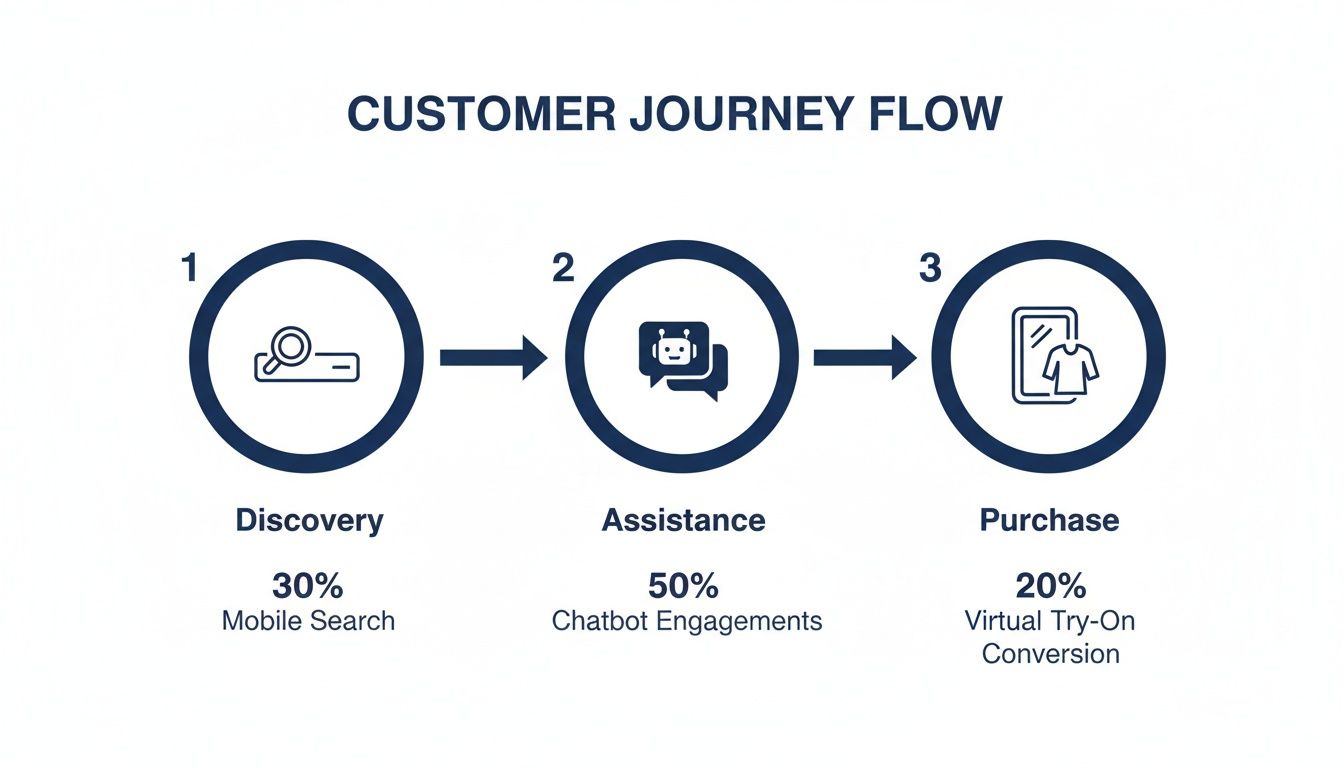
Visualising the journey this way helps you see exactly where an AI tool could smooth out a bump in the road and make the path to checkout that much easier.
Choose the Right Technology for Your Business
Once you know your goal and have a handle on your data, it's time to pick your tools. The right tech for you will depend on your team's skills, your budget, and the specific problem you're trying to solve.
Thinking about how to get started? A comparison of the common approaches can help you find the right fit for your business goals and resources.
Comparing AI Implementation Approaches
| Approach | Best For | Pros | Cons |
|---|---|---|---|
| Out-of-the-Box Platform Features | Beginners and SMEs on platforms like Shopify or BigCommerce. | Easy to activate, low technical skill required, seamless integration. | Limited customisation, may not solve highly specific problems. |
| Third-Party AI Plugins & Apps | Businesses needing a specific function (e.g., advanced search, chatbot) without a custom build. | Quick deployment, often cost-effective, wide variety of solutions available. | Potential integration issues, data may be siloed, subscription costs add up. |
| Custom AI Development | Mid-to-large enterprises with unique challenges and the resources to build a tailored solution. | Solves your exact problem, fully owned IP, highly scalable. | Significant upfront investment, requires specialised expertise, longer time to market. |
Each path has its trade-offs. Starting with built-in features is often the most straightforward way to get your feet wet, while a custom solution offers the most power if you have a truly unique challenge to tackle. To learn more about that approach, you might want to explore the details of AI-powered ecommerce development.
Start Small with a Pilot Project
Finally, resist the temptation to overhaul your entire operation at once. The smartest way to roll out AI is to start with a small, contained pilot project. Pick one specific area to test, maybe add an AI chatbot to your three highest-traffic product pages or trial a new recommendation algorithm on just one product category.
This approach gives you a few major advantages:
Lower Risk: It keeps your initial investment of time and money to a minimum.
Faster Learning: You get to see what works and what doesn't very quickly, letting you adjust your strategy on the fly.
Prove the ROI: A successful pilot gives you hard numbers. You can use that data to make the case for more investment and get your whole team excited about what's possible.
By following this step-by-step roadmap, you can demystify the process and start weaving AI into your retail business in a structured, strategic, and ultimately successful way.
You wouldn't invest in a new storefront without knowing if it brought in more customers, right? The same logic applies to AI. Pouring money into new technology without a clear way to measure its impact is just a shot in the dark. To really see what your AI solutions for ecommerce & retail are doing for your business, you need to look past the hype and focus on the numbers.
Success isn't about having the fanciest new tool. It's about seeing a real, tangible return on that investment (ROI).
The key is tracking the right things. If you're using AI to interact with customers, say with a new personalisation engine, your metrics should all point back to revenue and loyalty. On the other hand, for AI working behind the scenes on your operations, you're looking for cost savings and efficiency boosts. Different tools have different jobs, so you need to measure their performance accordingly.
Key Metrics for Customer-Facing AI
When you put AI in front of your customers, the aim is simple: make them want to buy more, and more often. Your key performance indicators (KPIs) need to show you whether that’s actually happening.
Here’s what you should be watching like a hawk:
Conversion Rate: This is the big one. Are more people who visit your site actually buying something? You can find out for sure by running an A/B test – pit your AI-driven experience against your old setup and see which one comes out on top.
Average Order Value (AOV): Are those AI product recommendations actually working? If your AOV starts to climb, it's a great sign that customers are adding those "you might also like" items to their cart. This proves your upselling and cross-selling are hitting the mark.
Customer Lifetime Value (CLV): This metric is all about the long game. Good AI should help you build lasting relationships. Tracking CLV shows you if you're successfully turning one-time shoppers into loyal fans who keep coming back for more.
Measuring Operational AI Efficiency
For the AI tools humming away in the background, success looks a little different. It’s measured in dollars saved and processes made smoother. These systems are your workhorses, designed to make your business leaner and more responsive.
Look for tangible improvements in these areas:
Inventory Holding Costs: A smart AI demand forecast should mean you have less cash tied up in stock just sitting on a shelf. If you see this number go down, that's a clear win for your bottom line.
Stockout Rate: Nothing's worse than a customer wanting a popular item that's out of stock. AI is meant to help you see demand spikes coming. A lower stockout rate means fewer missed sales and a much better customer experience.
Figuring out your ROI isn’t just a one-time thing to justify the expense. Think of it as an ongoing conversation with your data. It proves that your AI solutions for ecommerce & retail are consistently delivering value and, just as importantly, tells you where to invest next.
To get your ROI, the formula is pretty simple. Take the financial gain you got from the AI (like extra revenue or cost savings) and subtract what the solution cost you. Then, divide that result by the cost. This gives you a straightforward percentage that proves the project was a financial success and helps you build the case for doing even more with AI.
Navigating AI Risks and Building Customer Trust
Adopting artificial intelligence is about more than just boosting your bottom line; it's about doing it responsibly. While the opportunities that AI solutions for ecommerce & retail bring are exciting, they come with a few hurdles. If you ignore these challenges, you risk damaging the very customer relationships and brand reputation you've worked so hard to build.
It all starts with being upfront and incredibly careful with customer data. Here in Canada, we have regulations like the Personal Information Protection and Electronic Documents Act (PIPEDA) that lay down the law on how businesses must handle personal information. Your privacy policy can't just be boilerplate text; it needs to clearly spell out what data you collect and exactly how your AI uses it to make shopping better for your customers.
Overcoming Algorithmic Bias
One of the biggest tripwires in the world of AI is something called algorithmic bias. Think of it this way: if your AI learns from old sales data that reflects past human biases, the system won't just learn those biases; it can actually make them worse. Imagine a pricing algorithm that starts offering different discounts to people based on their postal code. That's a fast track to unfair treatment and unhappy customers.
To get ahead of this, you need to be proactive:
Audit your data sets before you even think about training a model. Look for and correct any hidden biases.
Regularly test your AI's outputs to make sure it's treating every customer group fairly and consistently.
Make fairness a core principle when designing your model, ensuring it doesn't lead to discriminatory results.
Trust is the currency of modern retail. When customers believe you are using their data ethically and fairly, they reward you with their loyalty. Misusing that trust, even unintentionally, can be incredibly difficult to recover from.
The Importance of Explainable AI
Another real challenge is the "black box" problem. Some of the more powerful AI models can make decisions in ways that are nearly impossible for a person to follow. So, when your AI denies a customer a special offer or recommends a completely bizarre product, you need to be able to figure out why. Without that insight, you can't fix the problem or give the customer a straight answer.
This is where explainable AI (XAI) comes into play. It's crucial to work with AI tools that are transparent and can actually show their work. This kind of clarity lets you squash bugs, maintain accountability, and feel confident in the technology you're using. By building these ethical practices into your strategy from day one, you can implement AI in a way that not only drives growth but also strengthens the very foundation of your customer relationships.
Common Questions About AI in Ecommerce
Dipping your toes into artificial intelligence can feel like a big step, and it naturally brings up practical questions about cost, complexity, and the all-important bottom line. Many business owners I talk to wonder if these powerful tools are genuinely within their reach. Let's tackle some of the most common concerns head-on.
The good news? Many of the best AI solutions for ecommerce & retail are more accessible than you might think.
Is AI Too Expensive for a Small Business?
This is probably the number one question I hear, and the answer is a firm "no." The old idea that AI requires a massive, six-figure investment is pretty much a myth these days. The entire market has shifted, putting incredibly sophisticated tools within the grasp of small and mid-sized businesses.
For starters, many ecommerce platforms like Shopify now include AI-driven features right out of the box as part of your subscription. Beyond that, a whole ecosystem of third-party apps offers specific AI tools, like smart search or customer service chatbots, for a simple monthly fee. This "pay-as-you-grow" approach lets you start small, see real results, and then decide where to invest more, all without needing a huge upfront budget.
Do I Need a Team of Data Scientists?
Another popular misconception is that you need a team of PhDs in a back room to get any value from AI. While a custom-built, enterprise-level system might call for that, the vast majority of AI tools available to retailers are designed for business people, not data scientists.
Modern AI platforms are all about user-friendly dashboards and intuitive controls. The goal is to make it easy to get campaigns running without writing a single line of code.
Today's best AI tools are built for accessibility. They're designed to empower your existing team: your marketers, merchandisers, and customer service staff, to make smarter, data-driven decisions without needing a technical background.
And if you do decide to tackle a more complex project? You can always bring in a technology partner to handle the heavy lifting. This gives you the expertise you need without the long-term cost of hiring a full-time data science team.
How Quickly Will I See Results from AI?
This really depends on the tool you're using. One of the great things about implementing AI is that some tools deliver value almost immediately, while others are more of a slow burn, building momentum over time to create deeper, more strategic advantages.
Here’s a rough idea of what to expect:
Immediate Impact (Days to Weeks): AI-powered chatbots can start improving customer satisfaction and freeing up your support team from day one. Dynamic pricing tools can also begin tweaking prices to optimise your margins right away.
Short-Term Gains (1-3 Months): Personalisation and product recommendation engines need a little time to watch and learn from your customer behaviour. You'll likely see a real lift in conversion rates and average order value within the first quarter.
Long-Term Value (3-6+ Months): The more strategic tools, like demand forecasting and inventory optimisation, deliver their biggest wins over the long haul. As they analyse more sales history and seasonal trends, their predictions get sharper, leading to major cost savings and fewer stockouts.
At Cleffex Digital Ltd, our speciality is making advanced technology accessible and genuinely impactful for businesses of all sizes. We can help you pinpoint the right AI solutions for your specific goals and walk you through a practical, results-focused implementation. Find out how we can help you grow.