

Picture your online shop knowing every customer like the owner of a local corner store, ready to suggest the perfect product before they even think to search for it. This isn't science fiction; it's the reality made possible by AI-powered ecommerce solutions in Canada, which are turning digital retail from a simple transaction into a deeply personal experience. For Canadian businesses, this technology is no longer a futuristic idea; it's a critical tool for growth right now.
The New Reality of Canadian Retail and Ecommerce AI

Let's face it: the Canadian ecommerce market is tougher than ever. Shoppers have endless options at their fingertips, and they expect online experiences to be smooth, intuitive, and almost clairvoyant. Just having a website isn't enough anymore to win them over and keep them coming back.
This is exactly where Artificial Intelligence (AI) comes in, acting as a brilliant digital co-pilot for your business. Don't think of it as just complicated code. Instead, imagine a team of virtual experts working 24/7 to analyse customer behaviour, spot emerging trends, and handle routine tasks automatically. This frees you up to focus on the bigger picture.
A Smarter Way to Sell Online
At its heart, AI gives your online store the power to learn and adapt on the fly. It quietly observes how people interact with your site: what they click on, the search terms they use, and what ends up in their baskets. It then uses that insight to make smart decisions that make the shopping journey better for every single visitor.
For instance, AI can:
Anticipate what customers want by recommending products they're likely to love but might not have found on their own.
Keep operations running smoothly by managing inventory levels automatically, ensuring popular items stay in stock without the risk of over-ordering.
Improve customer support with intelligent chatbots that provide instant answers to common questions, any time of day or night.
This marks a huge shift in how online retail works. We're moving away from the old one-size-fits-all model and toward a new standard where every interaction feels unique to the individual.
The real magic of AI in ecommerce is its ability to deliver the kind of personal attention you'd get in a high-end boutique, but at the scale of a national retailer. It forges a connection that can turn first-time buyers into loyal fans.
Staying Competitive in the Canadian Market
For any Canadian business, bringing AI into the fold is quickly becoming essential for both survival and growth. The companies that got in early are already reaping the rewards, from higher sales conversion rates to much more efficient operations. The best part? The technology levels the playing field, allowing small and mid-sized businesses to offer the kind of polished, personal service that was once only possible for the big retail giants. You can learn how AI in ecommerce is shaping Canadian retail in our detailed guide.
By integrating AI-powered ecommerce solutions, Canada-based businesses can build stronger, more customer-focused operations. This technology is the key to finding new opportunities, boosting sales, and creating a brand that truly stands out in a crowded digital world.
Understanding Core AI Capabilities for Ecommerce

To really get a grip on what AI can do, you have to look past the buzzwords. Think of it less as a single, all-knowing brain and more like a digital toolkit full of specialised instruments. Each tool has a specific job, and when they work together, they build a smarter, more efficient, and genuinely personal shopping experience for your customers.
These tools are already making a big difference in the Canadian ecommerce world. In 2025, over 12.2% of Canadian businesses reported using AI to produce goods or deliver services – that’s double the 6.1% from the previous year. For online retail specifically, the use of AI-driven marketing automation has jumped from 15.2% to 23.1%, which shows just how fast businesses are getting on board. You can dive deeper into this trend in the full report from Statistics Canada about AI adoption and its impact on Canadian businesses.
This isn't just hype; the adoption is happening because the benefits are real and immediate. Let's break down the core capabilities that make up the foundation of AI-powered ecommerce solutions in Canada.
Hyper-Personalisation and Smart Recommendations
At its heart, a standard ecommerce site can feel pretty anonymous. AI completely flips that script by creating a one-to-one connection with every single shopper. It digs into the data: things like browsing history, past purchases, and even what someone left in their basket, to build a unique profile for each visitor.
This lets you deliver an experience that feels like it was made just for them. For example, if a customer in Toronto has been eyeing winter coats, an AI system can suggest the perfect parka right as a cold snap hits the forecast. It’s like having a fantastic shop assistant who remembers every customer's tastes.
AI-driven personalisation is the difference between showing a customer a random catalogue of products and guiding them directly to the items they never knew they needed but now can't live without.
This is so much more than the basic "customers who bought this also bought…" suggestions. Modern AI can spot subtle patterns, recommending accessories that are a perfect match for a recent purchase or suggesting a new brand based on a shopper's unique style. This doesn't just bump up the average order value; it makes customers feel seen and understood.
Intelligent Search and Conversational Commerce
A clunky search bar is one of the quickest ways to lose a sale. AI turns your site's search from a rigid keyword-matcher into an intelligent assistant. Customers can use natural, everyday language, including colloquialisms or conversational French for a shopper in Montreal, and the AI actually understands what they mean.
So, a search for "warm boots for a Quebec winter" will pull up properly insulated footwear, not just anything with the word "boot" in the description.
This same technology is what powers the chatbots and virtual assistants that can:
Answer product questions on the spot, 24/7.
Walk users through the checkout process.
Handle returns and order tracking without needing a human to step in.
A great example of this in action is the rise of AI virtual try-on technology, which lets customers see what a product will look like on them before they buy. These tools smooth out the buying journey and provide instant help, which is a huge win for customer satisfaction.
Dynamic Pricing and Fraud Detection
Figuring out the right price for your products is a constant balancing act. AI-powered dynamic pricing models look at everything in real-time: market demand, what your competitors are doing, your inventory levels, and even regional factors, to suggest the optimal price. This could mean a product is priced slightly differently in British Columbia versus Newfoundland based on local demand, keeping you competitive without killing your margins.
At the same time, AI acts as a powerful security guard against fraud. Its algorithms are trained to analyse transaction patterns, instantly flagging suspicious activity that doesn't fit with normal Canadian banking behaviour. This protects your business from costly chargebacks and, just as importantly, secures your customers' data, building crucial trust.
Risk Scoring: AI gives every transaction a risk score based on hundreds of different variables.
Pattern Recognition: It learns what your legitimate customers look like and spots anomalies immediately.
Reduced False Positives: Unlike older, rule-based systems, AI is much better at telling genuine customers apart from fraudsters, so you stop blocking legitimate orders.
Predictive Analytics for Inventory Automation
Finally, one of the most game-changing AI-powered ecommerce solutions Canada-based businesses can adopt is predictive inventory management. Running out of a popular seller or getting stuck with a warehouse full of overstock can sink your profits. AI forecasting tools look at historical sales, seasonal trends, and market shifts to predict future demand with uncanny accuracy.
For example, an AI system can see a sales spike for patriotic gear coming in the weeks before Canada Day and automatically flag the need to reorder. This makes sure you have the right products on the shelf at the right time, freeing up your cash flow and maximising every sales opportunity. We cover this in more detail in our guide on AI inventory management for ecommerce. It’s about automating a critical, time-consuming task and preventing expensive mistakes.
How to Navigate the Canadian Ecommerce Landscape
Running an online store in Canada is about more than just setting up a website and listing your products. It’s a market with its own distinct cultural and legal personality. If you just grab a generic AI tool built for the US or Europe, you’ll quickly find it misses the mark, failing to connect with Canadian shoppers or meet our country’s legal standards.
To really get it right, you need an AI strategy designed from the ground up for this environment. It's about finding solutions that are not just smart, but also sensitive to Canada’s privacy laws, bilingualism, and the sheer logistical puzzle of serving customers from coast to coast.
Adhering to Canadian Privacy and Data Laws
First things first: your AI has to play by Canada’s rules on privacy. The Personal Information Protection and Electronic Documents Act (PIPEDA) is the law of the land, dictating how businesses can collect, use, and share personal information. Any AI tool you use that touches customer data needs to be fully compliant.
This isn’t just a box to tick. It means being transparent about how you handle data and only using it in ways your customers have agreed to. With the conversation around data sovereignty getting louder, many Canadian companies now prefer solutions that keep their customer data stored right here in Canada. It’s an added layer of security and a powerful trust signal.
An AI solution is only as valuable as the trust it builds. For Canadian shoppers, that trust starts with knowing their personal information is protected according to the country's stringent privacy laws, making PIPEDA compliance a non-negotiable foundation for your ecommerce strategy.
Getting this wrong isn’t just about facing potential fines. It can do real damage to your brand’s reputation, especially with savvy Canadian consumers who care deeply about their privacy.
Delivering an Authentic Bilingual Experience
Canada is officially bilingual, and your online store needs to be, too. Just plugging your English text into a simple translation machine won't cut it. Customers can spot a lazy translation a mile away. What you need is an authentic experience that understands the cultural and linguistic nuances.
This is where truly smart AI-powered ecommerce solutions in Canada make all the difference. They go far beyond literal translation with a few key abilities:
Real-Time, Contextual Translation: Modern AI can translate everything from product descriptions to customer service chats on the fly, capturing the right tone and local phrasing for both English and French speakers.
Culturally Relevant Marketing: The system can analyse user behaviour to deliver marketing campaigns that genuinely connect with English Canada and Québec, making sure your promotions feel right for each audience.
Bilingual Search Optimisation: AI helps customers find what they’re looking for using natural, conversational language in either English or French, even understanding regional dialects.
This kind of linguistic polish makes every customer feel seen and valued, which is absolutely essential for building a loyal, cross-country customer base.
Mastering Localisation for a Vast Country
From the Rockies to the Maritimes, Canada is a huge country with a patchwork of provincial rules. This creates some serious logistical headaches, but it’s another area where AI can step in to simplify things, especially when it comes to payments, shipping, and taxes.
Think about sales tax. It’s a notoriously tricky calculation, with different rates and rules for GST, PST, and HST depending on where the customer lives. An AI-driven system can automate this at checkout, instantly applying the correct tax and saving you from costly errors and manual work.
It doesn't stop there. AI can also untangle your supply chain. It crunches the data on shipping routes, carrier performance, and delivery addresses to pinpoint the cheapest, fastest way to get an order to a customer, whether they’re in downtown Vancouver or a remote town in the territories. That kind of intelligence is critical for keeping costs down and hitting the delivery promises your customers expect.
To put it all together, here is a quick look at how AI specifically helps address the common challenges of selling online in Canada.
Key AI Applications for Canadian Ecommerce Challenges
| Canadian Challenge | AI-Powered Solution | Business Impact |
|---|---|---|
| Complex Privacy Laws (PIPEDA) | AI models trained on compliant data; automated data masking and consent management. | Reduces legal risk, builds customer trust, and avoids reputational damage. |
| Bilingual Customer Base | Real-time, context-aware translation for site content, search, and customer support. | Creates an inclusive UX, boosts engagement, and expands market reach in Québec. |
| Variable Provincial Sales Tax | Automated tax calculation engines that update in real-time at checkout. | Ensures tax compliance, eliminates costly manual errors, and improves checkout speed. |
| Vast Geographic Distances | AI-powered logistics optimisation for route planning, carrier selection, and inventory placement. | Lowers shipping costs, shortens delivery times, and enhances customer satisfaction. |
Ultimately, using AI to tackle these uniquely Canadian problems isn't just about efficiency; it's about creating a smarter, more responsive, and more respectful experience for every customer.
Driving Real ROI for Canadian Businesses with AI
Let's move past the theory. The real test for any technology is whether it actually makes you money. For Canadian small and mid-market businesses, bringing AI into the fold isn't about jumping on a bandwagon; it’s about getting real, measurable results that fatten the bottom line. And the success stories are popping up all over the country.
These aren't just big-city corporations, either. We're seeing how AI can be a powerful, accessible tool for any Canadian business looking to scale up without spiralling costs. The financial impact is undeniable, showing a clear line from investing in smart tools to seeing solid gains in revenue and big savings on the operational side.
Case Study: A Vancouver Fashion Boutique
Picture a fashion boutique in Vancouver struggling with a classic ecommerce headache: abandoned baskets. People would browse, find things they loved, add them to their basket… and then vanish. By bringing in an AI-powered exit-intent tool, the boutique turned that moment of hesitation into a sale.
The system got smart. It learned to spot the exact signs of a customer about to click away. Just at that moment, it would pop up a personalised, time-sensitive offer, maybe a small discount or free shipping, based on what was in their basket. The impact was fast and clear: the boutique cut basket abandonment by 25% in a single quarter.
That one change didn't just save lost sales; it made the whole shopping experience better by giving customers a helpful nudge right when they needed it.
Case Study: A Calgary Electronics Retailer
Now, let's head to Calgary, where an electronics retailer had the opposite problem: too much stock. All that extra inventory was tying up cash and forcing them into costly markdowns. They decided to lean on AI-powered ecommerce solutions in Canada to build a predictive inventory system.
The AI dug into their sales history, looked at market trends, and even factored in local events to forecast demand with incredible accuracy. This lets the retailer stock just enough of the popular items without getting buried in products that weren't moving. This smart shift slashed their overstock costs by a hefty 15%, freeing up a ton of cash to reinvest in the business.
These real-world examples hammer home a critical point: AI delivers its biggest wins when you point it at a specific, high-impact business problem. It’s all about using smart automation to turn your biggest operational headaches into financial victories.
The timing couldn't be better. Canada’s ecommerce market is the perfect playground for these kinds of innovations. The sector is still riding high, with online retail sales staying way above pre-pandemic numbers. Projections for 2024 put the gross merchandise value at around US$89.4 billion, and it's expected to rocket past US$104 billion by 2029. This growth is being led by sectors like fashion and electronics, where AI can make all the difference.
Breaking Down the Financial Gains
The return you get from AI isn't just about one number. It creates a domino effect across your entire business, with benefits that build on each other. To get the most out of it, you need to understand the real drivers of AI ROI for retailers deep inside your daily operations.
Here’s a look at how the numbers usually stack up:
Increased Revenue: Smart personalisation and recommendation engines can easily lift sales by 5–15%. They do it by bumping up the average order value and getting more people to click "buy."
Higher Customer Lifetime Value (CLV): When you deliver a genuinely personal and smooth experience, people stick around. AI helps build that loyalty, driving repeat business and stopping customers from wandering off to competitors.
Operational Savings: Think about all the time spent on manual tasks. Automating things like inventory counts, answering basic customer questions, and flagging fraudulent orders cuts down on labour costs and, just as importantly, prevents expensive human errors. Our guide on AI ecommerce automation for boosting sales dives deeper into this.
For Canadian businesses, the message is simple. Investing in the right AI tools isn't a cost; it's one of the most direct routes to boosting profits and securing a real competitive edge.
Your Practical Roadmap for AI Implementation
Bringing artificial intelligence into your business doesn't have to be some massive, intimidating project. Honestly, the most successful rollouts of AI-powered ecommerce solutions in Canada I've seen all started with a clear, step-by-step plan. Think of it less like a giant leap of faith and more like a series of manageable steps, with each one building on the last to create powerful, long-term results.
We can break this down into four distinct phases: assessment, pilot, integration, and scaling. Following this path helps demystify the process, proves the value of AI quickly, and builds the confidence you need to make it a core part of your growth strategy.
Phase 1: The Assessment
Before you spend a single dollar, the very first step is to figure out where AI can actually make the biggest impact. The goal here is to identify the low-hanging fruit; those areas of your business where a small, smart change can deliver an outsized return.
Start by asking a few key questions about your daily operations:
Where are our biggest operational headaches? Is it wrestling with inventory, answering the same customer questions over and over, or watching sales slip away from abandoned baskets?
What do customers complain about most? Maybe they find your site's search function clumsy, or the product recommendations feel completely random.
Which manual tasks eat up the most time? Think about things like calculating provincial sales tax for every order or manually flagging potentially fraudulent transactions.
The answers you come up with will point you directly toward the most promising places to start. The ideal first project solves a genuine pain point and has a clear way to measure success.
Phase 2: The Pilot Project
Once you’ve zeroed in on a target area, it's time to run a small, controlled test. This pilot phase is absolutely critical because it lets you prove the technology’s value on a small scale before you commit to a full, company-wide rollout. It’s all about getting a quick win to build momentum.
A perfect example of a pilot project is setting up an AI chatbot to handle customer service inquiries after hours. It’s a self-contained project with a clear goal: reduce response times and free up your team to handle more complex issues. You can easily measure its success by tracking metrics like the number of questions resolved without any human help and the effect on customer satisfaction scores.
A successful pilot project becomes your internal business case. It gives you hard data that proves the investment works, making it much easier to get buy-in from your team and stakeholders for more ambitious projects down the line.
The key is to start small, prove the return on investment (ROI), and learn from the experience before you expand.
This visual shows a simple flow for achieving that ROI, starting with a specific AI tool like an exit-intent offer and tracing its path to measurable business outcomes.
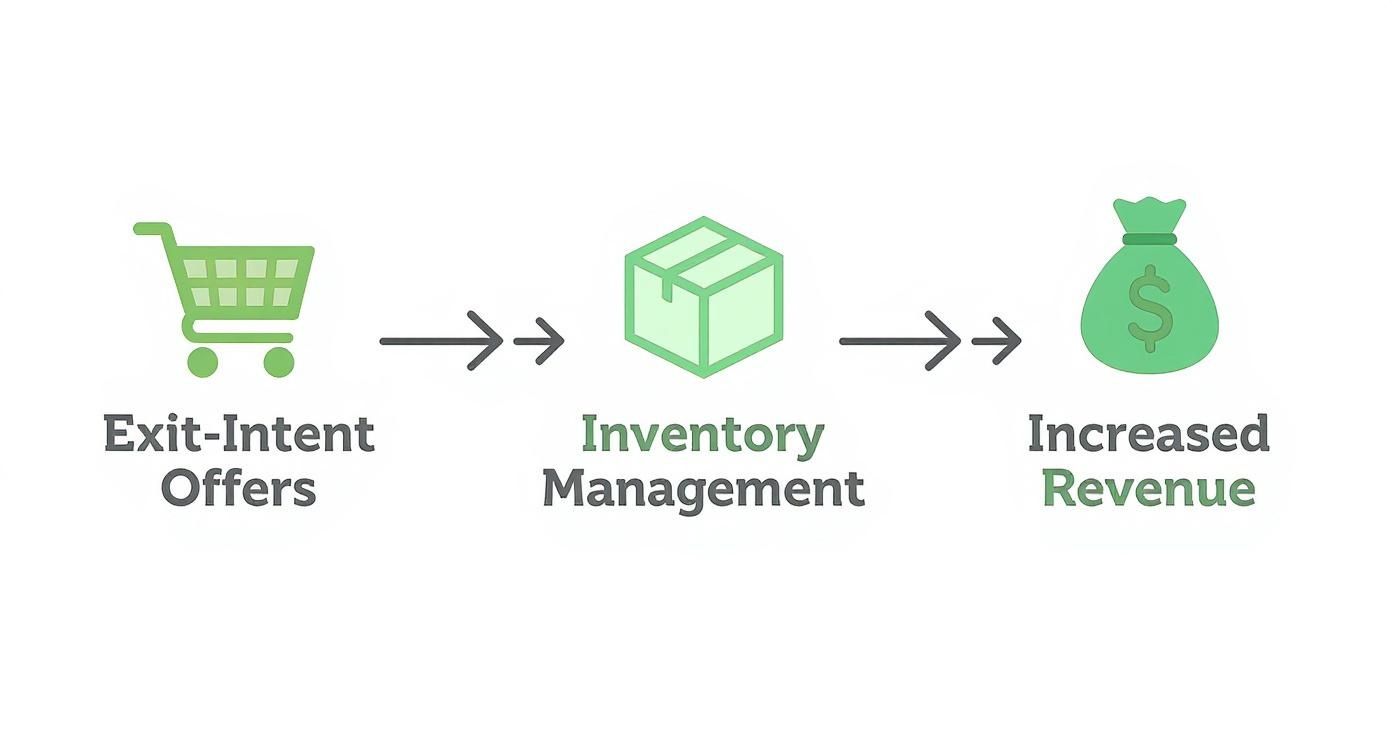
This illustrates how a single, targeted AI tool can create a positive ripple effect, improving how you operate and directly boosting your bottom line.
Phase 3: The Integration
With a successful pilot under your belt, the next move is to integrate the AI solution more deeply into your existing tech. For most Canadian ecommerce businesses, this means connecting your new tools with platforms like Shopify, Magento (now Adobe Commerce), or Salesforce Commerce Cloud.
This part requires careful planning to make sure data flows seamlessly between your systems. For instance, your AI recommendation engine needs to talk to your product catalogue and customer database to do its job. A well-planned integration ensures your AI tools aren't just working in a silo but are actively enhancing the platforms you already depend on every day.
Phase 4: The Scaling
Finally, we get to the scaling phase. This is where you take everything you learned from your successful pilot and apply it across your entire operation. If that AI chatbot was a game-changer for customer service, maybe you could expand its capabilities or deploy similar automation in your sales and marketing departments.
Scaling isn’t a one-and-done event; it’s an ongoing process of finding new opportunities for AI to add value. It's about building a culture of continuous improvement, where your team is always looking for ways to use technology to work smarter, not harder. This methodical approach is what ensures your investment in AI-powered ecommerce solutions in Canada delivers sustainable, long-term growth.
Picking the right partner to help you bring AI into your business is every bit as critical as the technology itself. A good partner doesn't just install software and walk away. They become your strategic guide, helping you navigate the unique twists and turns of the Canadian market, from respecting strict privacy laws like PIPEDA to creating a truly seamless bilingual experience for your customers.
The best technology providers know that AI-powered ecommerce solutions in Canada can't be pulled off a shelf. Their first step is always to listen, getting a real handle on your specific business challenges and what you want to achieve. From there, they build a strategy that fits your company, can grow with you, and is laser-focused on delivering a clear return on your investment.
What to Look for in a Provider
As you start looking at potential partners, put the ones with a deep, proven understanding of the Canadian ecommerce scene at the top of your list. You want a team that has a track record of helping businesses just like yours clear the specific hurdles we’ve talked about. This ensures your AI strategy is not only effective but also compliant from the get-go.
A genuine partner is there for the whole journey, not just the beginning. They should cover:
Initial Strategy and Consultation: Helping you pinpoint exactly where AI can make the biggest difference in your operations.
Custom Implementation: Building and integrating solutions that mesh perfectly with the systems you already use.
Ongoing Support and Optimisation: Keeping a close eye on performance and constantly fine-tuning your AI tools to get you the best possible results.
Choosing a partner is about finding a team that is genuinely invested in your success. They should feel like an extension of your own crew, committed to helping you hit your growth targets and build a smarter, more customer-centric business.
The right firm ensures you’re building a long-term capability, not just buying a tool. This is vital as customer habits continue to shift. For example, a recent study highlighted that 15% of Canadians aged 16-24 now turn to conversational AI first when researching products. This trend alone shows why having an agile, expert partner is so important.
At Cleffex, we specialise in creating AI-powered ecommerce solutions for Canada that deliver real, measurable business outcomes. We’re with you every step of the way, from the initial assessment to full-scale implementation, making sure your investment leads to lasting success. If you're ready to see what AI can really do for your business, let's talk.
Frequently Asked Questions
It's natural to have questions when you're looking at bringing AI into your business. We get it. To help, we've gathered the most common questions we hear from Canadian business owners just like you.
How Much Does It Cost To Implement AI in a Small Canadian Ecommerce Business?
The cost of adding AI isn't a single sticker price; it really depends on what you want to achieve. For a small Canadian business, getting started can be much more affordable than you might think. Many modern tools operate on a subscription model, so you don't need a huge upfront investment to get going.
You can begin with one specific tool that solves a clear problem, like an AI chatbot to handle after-hours customer questions or a smart recommendation engine to boost your average order value. These usually have flexible pricing tiers that can scale as you grow. This lets you prove the ROI on a smaller project before you go all-in on a full suite of AI-powered ecommerce solutions in Canada.
Think of your first AI project as a strategic experiment, not a massive cost. Pick one specific, measurable goal, like cutting down on abandoned baskets, and find a tool that helps you do just that. You'll see real value, fast.
Will AI Replace Our Customer Service Team?
This is a big one, but the reality on the ground is much more collaborative. The goal of AI isn't to replace your team, but to give them superpowers. It acts as a powerful assistant, taking on the repetitive, everyday questions that can bog your people down.
For example, an AI chatbot can instantly answer "Where's my order?" or explain your return policy, 24/7. This frees up your human agents to pour their energy into the trickier, more personal customer situations that require a real human touch. The end result is faster support for everyone and happier customers.
Is My Customer Data Safe with AI Tools?
Absolutely. Data security isn't just important; it's a deal-breaker, especially with Canada's strict privacy laws. When you're using AI-powered ecommerce solutions in Canada, your provider must be compliant with the Personal Information Protection and Electronic Documents Act (PIPEDA).
This means any reputable AI tool is built with privacy in mind from the start, using tight data controls to protect sensitive info. When you're picking a partner, always ask about their compliance and data storage policies. The best providers will even offer to host your data exclusively within Canada, giving you and your customers an added layer of confidence.
Ready to see what AI can do for your Canadian ecommerce business? Cleffex Digital Ltd specialises in building practical AI solutions that drive growth, create better customer experiences, and deliver real results. Let us help you start your AI journey the right way. Start your transformation today.