

Think of AI-driven ecommerce UX as the art of using artificial intelligence to build online shopping experiences that are incredibly personal, smart, and responsive. It’s a move away from the old one-size-fits-all website towards a living, breathing storefront that morphs to fit every single visitor’s wants and needs as they happen. The end result is a customer journey that feels effortless and genuinely engaging.
The Dawn of Intelligent Shopping Experiences
Is your online shop essentially a digital catalogue? It works, sure, but it’s impersonal. It presents the exact same products, in the exact same order, to a first-time browser and a loyal customer of five years.
Now, imagine that same shop acting like a top-tier personal shopper, someone who intuits what a customer wants before they even search for it, gets their unique style, and guides them straight to the perfect find. That’s the real magic of AI in ecommerce UX.
This is all about making the shopping journey feel less like sifting through a giant database and more like a helpful conversation. Technologies like machine learning and natural language processing are what make this possible, giving online stores the power to become incredibly intuitive. Instead of making customers do all the hard work, the experience itself is built around them.
What This Means for Your Business
Weaving this kind of intelligence into your user experience isn't just about a modern facelift; it creates real, measurable business results. The biggest wins show up directly in the ecommerce metrics you're already tracking.
Better Conversion Rates: When you put the perfect product in front of the right person at just the right moment, you eliminate the hurdles that stop them from buying.
Stronger Customer Loyalty: Shoppers who feel understood and valued are far more likely to come back. A personal touch forges a connection that a generic storefront simply can't.
Higher Average Order Value: Smart recommendation engines can suggest relevant add-ons and complementary items a customer will actually find useful, naturally increasing the size of their basket.
At its core, AI-driven UX is about swapping out guesswork for decisions backed by hard data. It’s the next logical step for any ecommerce business that wants to truly stand out.
The financial impact is already here, and it's huge. Just look at the Canadian ecommerce market, where AI-powered personalisation is fuelling massive growth. Projections show the market hitting USD 71.04 billion by 2031, and smart product recommendations alone are set to drive ecommerce sales up by an incredible 59%. If you want to dive deeper, you can explore more data on the Canadian ecommerce market to see where things are headed. This isn't some far-off trend; it’s the new baseline for success.
The Core Pillars of AI-Driven Ecommerce UX
To really get what makes an AI-driven ecommerce UX so powerful, we need to peek behind the curtain at the core technologies driving it. Think of these as the fundamental building blocks that take a standard online shop and turn it into an intelligent, responsive, and genuinely personal shopping space. Each pillar solves a specific customer problem, and together, they create a smooth and satisfying journey from the first click to the final checkout.
This shift from a static, one-size-fits-all storefront to a dynamic, personal experience is what AI in ecommerce is all about.
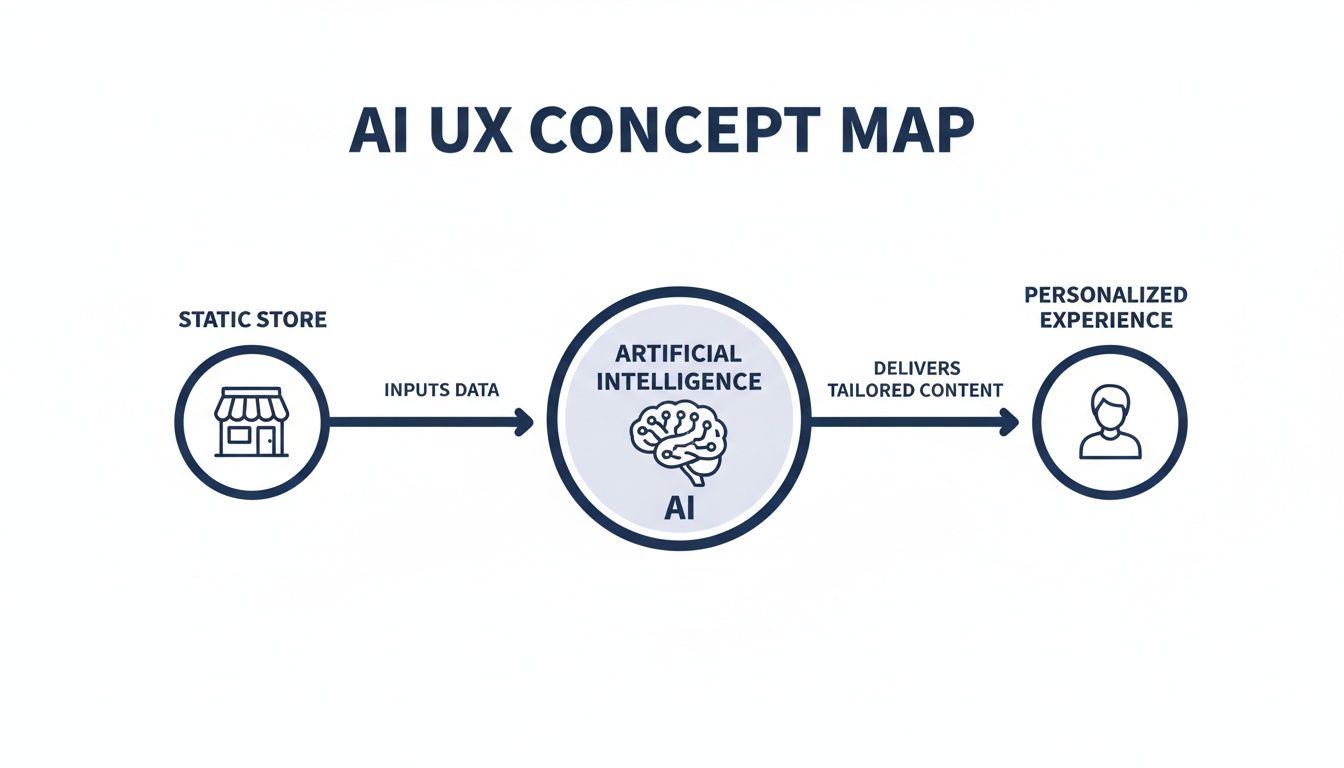
This simple flow shows how a traditional store can feed its data into an AI engine, which then creates a unique, tailor-made experience for every single user.
To put the difference into perspective, let's compare the old way with the new.
Comparing Traditional UX With AI-Driven UX
This table breaks down the key differences between a standard ecommerce site and one supercharged by artificial intelligence. You can quickly see how AI adds layers of intelligence and responsiveness that a traditional setup just can't match.
| Feature | Traditional Ecommerce UX | AI-Driven Ecommerce UX |
|---|---|---|
| Personalisation | Generic content, maybe a "Welcome, [Name]!" | Dynamic content, product sorting, and offers based on real-time behaviour. |
| Product Recommendations | Based on "most popular" or manually curated lists. | Predictive suggestions based on individual and similar users' data. |
| On-Site Search | Strict keyword matching; typos often lead to "no results." | Understands natural language, corrects typos, and supports visual search. |
| User Interface (UI) | A fixed, one-size-fits-all layout for everyone. | The layout adapts to the user's context, device, or past behaviour. |
| Customer Support | Relies on human agents during business hours or static FAQs. | 24/7 support through intelligent chatbots that can handle complex queries. |
As the table shows, AI doesn't just make small tweaks; it fundamentally changes the relationship between the customer and the storefront.
Hyper-Personalisation in Real-Time
Hyper-personalisation is about making every shopper feel like the site was built just for them. It’s a world away from simply using a customer's name in an email. AI achieves this by analysing a user’s real-time behaviour, what they click, what they scroll past, and how long they look at an item, to instantly change the content they see.
Imagine a visitor who was looking at running shoes last week. When they return, instead of the generic homepage, they’re greeted with the newest trainers, articles on running techniques, and maybe a deal on athletic socks. That’s AI making split-second decisions to be immediately relevant. You can see more practical AI personalisation examples in ecommerce to get a feel for its impact.
Intelligent Recommendation Engines
Recommendation engines are the workhorses of an AI-powered UX. They’re responsible for those familiar "You might also like…" sections, but modern AI has made them much smarter. We've moved beyond simple popularity-based suggestions to truly predictive recommendations.
These systems sift through massive datasets, spotting subtle patterns in purchase histories and browsing data from millions of users. They can then predict what a specific user is likely to want next, even if they've never looked at that product category before. For a business, this is a fantastic way to increase the average order value through effective cross-selling and up-selling. Exploring the various AI-powered product recommendations on the market can show just how sophisticated this has become.
Smarter Search and Discovery
Nothing kills a sale faster than a frustrating search bar. AI turns a rigid keyword-matching tool into an intelligent discovery engine that actually understands what people mean.
Natural Language Processing (NLP): This lets users search with everyday phrases like "show me warm jackets for winter under £100" and get spot-on results.
Visual Search: Customers can upload a photo of a product they love and instantly find similar items in your inventory. No more guessing keywords!
Error Tolerance: AI-powered search understands and corrects typos, so a simple mistake doesn’t lead to a dead end.
By making it easy for customers to find what they want (and discover things they didn’t even know they needed), you slash friction and keep people on your site.
Adaptive User Interfaces
An adaptive user interface (UI) is one that literally changes based on who is using it. AI can re-arrange on-screen elements, tweak the navigation, or change promotional banners to better suit an individual’s known habits or their device.
For instance, the interface might push the "Buy Now" button to the forefront for a decisive, returning customer. But for a new visitor, it might highlight customer reviews and detailed product specs instead. This ensures the most important information and actions are always right where they need to be.
Conversational Commerce
Finally, conversational commerce brings AI-powered chatbots and voice assistants into the mix for instant, 24/7 support. These aren't the clunky bots of a few years ago. Today's AI assistants can handle complex questions, guide users through a purchase, track orders, and even process returns.
This is like having a helpful sales expert on every page of your site, ready to jump in at a moment's notice. It’s no wonder 51% of ecommerce companies are already using AI to create these kinds of smoother shopping experiences. And the trend is only growing; by 2028, it's expected that a third of online retailers will be using advanced AI agents, a massive leap from today.
Your Roadmap for Implementing an AI-Powered UX
Knowing what an AI-driven ecommerce UX can do is one thing; actually building it is another. Shifting from theory to practice is where the real work begins, but it doesn't have to be overwhelming.
This roadmap breaks the entire process down into clear, manageable stages. Whether you're a small startup or an established enterprise, you can follow this path to integrate AI without getting lost in the complexity. And it all starts with the one thing that powers every smart feature: your data.
Building Your Data Foundation
Before you can even think about algorithms, you need to get your data house in order. Think of customer data as the fuel for your AI engine; the cleaner the fuel, the smoother and more powerful it runs. The whole point is to collect and organise the information that tells the story of your customers' behaviours and preferences.
This means pulling together data from every single place a customer interacts with your brand. You're looking for the hidden patterns in what they buy, what they browse, and how they move through your site.
Key data sources to bring together include:
Transactional Data: The basics of what's been bought, how often, and for how much. This includes purchase history and average order value.
Behavioural Data: This is all about what users do on your site, the clicks, the viewed products, the abandoned baskets, and the exact words they type into the search bar.
Customer Profile Data: Information like demographics, loyalty programme status, or any other details customers have willingly shared with you.
Just having the data isn't enough. It needs to be clean, organised, and ready for your systems to use. A messy, fragmented dataset is the fastest way to get flawed insights and an AI that just doesn't perform.
Choosing Your Tools and Platforms
Once your data is sorted, it's time to pick your tools. The market is full of options, ranging from simple plug-and-play apps to completely custom-built AI systems. The right choice for you will come down to your goals, your in-house technical skills, and, of course, your budget.
For many businesses, particularly those using platforms like Shopify, starting with third-party apps is the most practical entry point. These tools can add powerful features like intelligent search or product recommendations with very little heavy lifting on your end.
But as your ambitions grow, a custom solution might start to look more appealing. It’s a bigger investment, for sure, but it gives you total control to craft an AI-powered experience that is a perfect reflection of your unique brand.
The key is to start with a clear objective. Are you trying to increase conversion rates by 43% with search optimisation, or is your focus on boosting average order value? Your goal will point you to the right tool.
Integration and Deployment Best Practices
Rolling out new AI features without causing chaos requires a smart integration plan. A phased approach is almost always the right call, as it lets you introduce new capabilities one by one without disrupting the customer experience.
For example, you might start by launching an AI-powered search function. After you've had time to gather data and see its positive impact, your next move could be implementing personalised product suggestions. To go deeper, you can learn more about how to effectively deploy AI-powered product recommendations in our detailed guide.
This step-by-step rollout minimises risk and makes it far easier to see what’s working and what needs tweaking. Always test new features in a safe, controlled environment before you push them live to all your customers. This helps you iron out the kinks without your live site taking a hit.
Measurement and Optimisation
Flipping the switch on your AI features isn't the finish line; it’s the start of a continuous loop of learning and improvement. To really know if your AI-driven UX is making a difference, you need to track the right Key Performance Indicators (KPIs) and be ready to fine-tune your systems.
First, define what success looks like for each feature. Your measurement framework should be a blend of metrics that track both customer engagement and actual sales.
Essential KPIs to Monitor:
Conversion Rate From Search: What percentage of people who use your search bar end up buying something? This directly measures how effective your search tool is.
Click-Through Rate (CTR) on Recommendations: How often are customers actually clicking on the products your AI suggests? A high CTR is a great sign that your suggestions are hitting the mark.
Average Order Value (AOV): Are AI-driven cross-sells and up-sells encouraging customers to spend more per order?
Zero-Result Searches: A search that returns "no results found" is a dead end for a customer. Your goal should be to get this number as close to zero as possible.
Use A/B testing to put your AI features to the test against your old setup. For instance, you could pit two different recommendation algorithms against each other to see which one drives more revenue. This data-first approach is what allows you to constantly refine your strategy, making sure your AI-driven ecommerce UX is always delivering real, measurable value.
Navigating Implementation Challenges and Ethics

Jumping into an AI-driven ecommerce UX holds incredible promise, but let's be realistic, it's a path with its share of obstacles. A successful rollout means going in with a clear-eyed view of the common challenges and a rock-solid commitment to ethical practices. It's all about striking a careful balance between powerful automation and the responsibility you have to your customers.
How you navigate this path can be the difference between creating a fiercely loyal customer base and pushing them away. The biggest hurdles usually come down to data quality, being transparent about your methods, and finding that sweet spot between algorithms and the human touch.
Upholding Data Privacy and Compliance
In a world where personalisation runs on data, handling that information responsibly isn't just a good idea; it's everything. For businesses in Canada, this means knowing the Personal Information Protection and Electronic Documents Act (PIPEDA) inside and out. Customers are savvier than ever about their data, and one slip-up can do lasting damage to your reputation.
You have to be upfront about your privacy practices. Shoppers need easy-to-find, simple-to-understand information on what data you’re collecting and how you’re using it to improve their experience. This isn't just a checkbox exercise anymore; it's a foundational piece of a trustworthy AI-driven ecommerce UX.
Think of it this way: securing customer data isn't just about following the rules. It's about honouring the trust someone places in your brand. Ethical data handling is the proof behind your promise, and that's what builds long-term loyalty.
This proactive approach also happens to be great for security. If you're looking to go deeper, our guide on AI fraud detection for ecommerce is a great resource for protecting your business and your customers.
Avoiding Common Implementation Pitfalls
Even with the best game plan, it's easy to stumble when putting AI into practice. The first step to making your investment count is knowing what not to do.
One of the most common mistakes? Building on a shaky foundation of low-quality data. If your data is a mess, incomplete, inaccurate, or full of biases, your AI's output will be a mess, too. It’s the classic "garbage in, garbage out" scenario, and it leads directly to terrible recommendations and a frustrating user experience.
Another trap is falling in love with over-automation. Yes, AI is incredibly efficient, but stripping away the human element completely can leave your brand feeling cold. Customers still want to know there's a real person they can talk to for complex problems or a bit of genuine advice.
Here are three key mistakes to keep on your radar:
The 'Black Box' Problem: Never use an AI model you don’t understand. If you can't explain why the AI suggested a certain product, you can't fix it when it gets things wrong or reassure customers that the process is fair.
Ignoring User Feedback: AI learns from data, but nothing beats direct feedback from a human. If you're not actively listening to what customers are saying about the AI-powered features, you're missing out on the most valuable insights for improvement.
Setting It and Forgetting It: AI isn't a slow cooker. These systems demand constant attention, monitoring, A/B testing, and fine-tuning to keep up with shifting customer behaviours. An unmanaged AI can quickly go from a valuable asset to a liability.
How AI-Driven UX Plays Out in Different Industries
The true magic of an AI-driven ecommerce UX really comes to life when you see it tackling specific industry problems. The core ideas, personalisation, smart recommendations, and effortless search, are always there, but how they're used can look wildly different from one business to the next.
Let's look at some real-world examples of how companies are putting these AI strategies to work to solve unique customer challenges and grow their business. These stories show just how adaptable AI is, offering solid inspiration no matter what you sell.
Retail and Fashion Startups
The fast-moving world of retail, particularly for startups, is the perfect place to see AI in action. Picture a small Shopify store that sells sustainable fashion. By plugging in a dynamic content engine, its homepage can completely change for every single visitor. A first-time browser might be greeted with a video sharing the brand's ethical mission. A returning customer who last looked at knitwear? They'll see the newest collection of organic cotton jumpers right away.
This isn't just about basic product suggestions. The AI digs into browsing habits to reshuffle how products are displayed, pushing the items a specific user is most likely to buy right to the top of the page. It’s a subtle tweak that removes friction and can give a growing brand a serious boost in conversions.
An AI-driven approach gives even the smallest retailers the power to offer a personal touch that was once only possible in a physical boutique. It levels the playing field, making a sophisticated customer experience something everyone can achieve.
For a closer look at the specific tools making waves in fashion ecommerce, this guide on the 12 best AI tools for fashion brands is a fantastic resource.
Financial and Insurance Services
You might not immediately think of financial services as a hotspot for ecommerce UX, but AI is making incredibly complex products much easier to understand and buy. Take an insurance company that has always struggled with a clunky, confusing quoting process. By bringing in an AI-powered quoting engine, they can simplify the entire experience.
Instead of forcing someone to fill out page after page of forms, a chatbot can ask a few simple, conversational questions. Behind the scenes, the AI crunches thousands of data points to deliver a personalised quote in seconds. It can even break down policy details into plain language, cutting through the confusing jargon that often scares customers away. This doesn't just make for a better user experience; it dramatically increases the number of qualified leads.
Health and Wellness Platforms
In the health and wellness sector, trust and personalisation are everything. An online store selling supplements and wellness products can use AI to build genuine, data-backed relationships with its customers.
Here’s what that looks like in practice:
A new user fills out a wellness quiz, sharing their goals, diet, and lifestyle habits.
The AI takes that information and creates a personalised dashboard, suggesting the right vitamins, protein powders, or fitness programmes for them.
As the user logs their progress or buys products, the AI is always learning and fine-tuning its recommendations, adapting to their health journey as it unfolds.
This turns a simple transaction into something that feels more like a personal health consultation.
Automotive Industry Innovations
The car industry is using AI-driven ecommerce UX to bring the car buying and ownership experience into the modern era. An AI-powered vehicle configurator, for example, can walk a buyer through building their dream car. As they choose an engine and trim level, the AI can intelligently recommend compatible add-ons, like a performance wheel package or a premium sound system.
But it doesn't stop there. After the sale, the same AI can send personalised service reminders based on how the car is actually being driven, not just on a generic schedule. It might suggest seasonal tyre changes or point out new accessories that fit the owner's specific model, creating value and building brand loyalty long after the keys have been handed over. It’s a perfect example of how AI can turn a one-time purchase into a lasting customer relationship.
Ready To Build Your Intelligent Store? A Partnership Can Make All the Difference
Stepping into the world of AI-driven ecommerce UX can feel like a huge leap, but it’s the most logical move for any business serious about growth. We’ve walked through everything from hyper-personalisation to smarter search, and these aren't just abstract ideas; they're real, practical tools that create amazing shopping experiences and deliver tangible results. The trick is getting from a great idea to a successful launch with a clear plan and the right people on your side.
This is exactly where a strategic partnership becomes so important. Instead of trying to piece together the complexities of AI on your own, you can team up with experts who know how to turn your business goals into a seamless, intelligent customer experience.
Finding Your Strategic Technology Partner
At Cleffex, we don’t just build software; we build partnerships. Our mission is to solve real business problems with smart, well-executed technology. We ground our work in agile development and bring a deep-seated understanding of what makes ecommerce tick. We've worked with everyone from ambitious startups needing a solid foundation to established brands looking to sharpen their edge with sophisticated AI.
We focus our expertise where it matters most for you:
Custom Software Development: We create AI solutions built from the ground up to match your specific workflows and customer paths.
Agile Development Practices: Our iterative approach keeps us nimble, letting us refine and perfect your AI features as the project evolves.
AI-Powered Shopify UX/UI Design: We have a special knack for elevating Shopify stores with smart features that genuinely increase engagement and drive sales.
We’ve seen firsthand that the best AI solutions are born from true collaboration. Our aim is to become an extension of your team, working right alongside you to make sure every feature we build is perfectly in sync with your vision for the future.
Whether you’re just starting to think about adding a recommendation engine or you’re ready to design a fully adaptive interface, our team has the technical chops and strategic foresight to get you there. We’re here to help you unlock what AI can really do, turning your ecommerce site into a smart, customer-focused engine for growth.
Let’s build that future, together.
Frequently Asked Questions
As you start thinking about an AI-driven ecommerce UX, a few practical questions are bound to pop up. We've tackled the most common ones here to give you a clear picture of what bringing this technology into your business really looks like.
How Much Does It Cost To Implement AI?
The cost of implementing AI can swing wildly, but that’s actually a good thing; it means there’s an entry point for almost any budget. You don't need to build a massive, custom system from the ground up just to get started.
For many small businesses, especially those on platforms like Shopify, the easiest way in is through third-party apps. These can bolt on powerful features like intelligent search or personalised recommendations for a simple monthly fee, often ranging from under a hundred to several hundred pounds.
At the other end of the scale, a completely bespoke AI system built from scratch just for your business is a major investment. This route gives you total control and makes sense for larger companies with very specific operational needs.
Can AI Really Understand My Customers Better Than I Can?
This is a great question, and one we hear a lot. The point of AI isn't to replace your deep, human understanding of your customers, but to give it superpowers. You know their stories, their motivations, and what makes them tick.
What AI adds is the ability to crunch thousands, or even millions, of data points in real-time, something no person could ever do. It finds tiny patterns in how people behave, spots connections you'd never see, and makes predictions with startling accuracy.
Think of AI as your most dedicated analyst. It does the heavy lifting of sifting through mountains of data, which frees you up to focus on the creative, big-picture strategy that only a human can bring.
What Is the Best First Step for a Small Business?
For a small business, the best first step is always something low-risk, high-impact, and easy to measure. Don't try to reinvent your entire customer experience overnight. Instead, pick one specific, nagging problem and solve it.
A fantastic place to start is with an intelligent search tool or a product recommendation engine. Why? Because you can directly tie their performance to crucial metrics like conversion rates and average order value. For instance, just implementing a smarter search function can lead to a 43% increase in conversion rates by helping people find what they’re looking for faster.
This approach gives you a clear return on your investment, helps you learn how AI operates in your store, and builds your confidence for bigger projects down the road.
Ready to transform your customer experience with a strategic partner who gets your goals? The team at Cleffex specialises in building intelligent, high-performing ecommerce solutions that drive real growth. Let's start the conversation.