

Artificial intelligence in retail and ecommerce isn't some far-off idea anymore; it's the engine running under the hood of today's most successful online stores. At its heart, AI uses data to automate tasks and personalise the shopping journey, basically acting like a brilliant personal shopper for every single customer who visits your site. This technology is already changing the game for businesses of all sizes, from customer chats to behind-the-scenes operations.
The New Digital Storefront AI in Retail and Ecommerce

Picture walking into a boutique where the displays instantly rearrange to feature only things you’d love. A friendly assistant already knows your style, and the stockroom seems to magically know what you're going to buy next. That's exactly what AI in retail and ecommerce does, only in the digital world. It creates smart, responsive, and incredibly efficient places to shop online.
For Canadian businesses, whether you're a small Shopify store or a major retailer, this isn't just a nice-to-have. It’s quickly becoming a must-have to stay competitive. AI quietly works in the background, analysing customer behaviour, predicting what’s next, and making operations smoother, which ultimately means more sales and happier customers.
How AI Is Redefining the Shopping Experience
The influence of AI is woven into every single interaction a customer has with your brand. It’s the secret sauce that lets businesses deliver the smooth, intuitive experiences that shoppers now demand. It’s worth taking a moment to understand how AI is transforming ecommerce strategy on a deeper level.
In this guide, we'll give you practical insights into the key areas where AI is truly making its mark:
Hyper-Personalisation: Think unique shopping experiences built around each person's past clicks and purchases.
Intelligent Inventory Management: Forecasting demand with stunning accuracy, so you can finally stop worrying about stockouts or overstock.
Enhanced Customer Service: Using smart chatbots that can answer questions and solve problems instantly, day or night.
Dynamic Operations: Fine-tuning everything from pricing to supply chain logistics on the fly.
At Cleffex Digital, we see it every day: integrating AI turns a basic online shop into a powerful sales machine. The goal is simple – make every customer feel like you truly get them. That's what builds loyalty and drives revenue.
By getting a handle on these applications, you can start building a clear plan for your own business. It's about more than just plugging in a new tool; it requires the right expertise to make these systems work together seamlessly. A great starting point is exploring what next-gen-ecommerce-software can do.
Throughout this guide, we’ll break all this down into simple, practical steps, helping you use the power of AI to build a more profitable, customer-focused business.
Understanding the Building Blocks of AI
To get a real handle on how AI can work for your retail or ecommerce business, it helps to peel back the layers and look at the core technologies powering it. Forget the sci-fi stuff for a moment. Think of AI less as a single, all-knowing brain and more like a set of specialised tools, each designed for a specific job. Knowing what these tools are and what they do is the first step to figuring out where they can make the biggest impact in your company.
At its heart, AI is about building systems that can do things that typically require human smarts, like spotting trends, making predictions, or even having a conversation. For a business leader, that means getting your hands on tools that can process, learn from, and act on information at a speed and scale that’s simply beyond human capability.
Machine Learning: The Data Detective
Imagine bringing on a new team member who pores over every single sales report, customer review, and market trend you have. Over time, they don't just report the numbers; they start to see the hidden patterns and get incredibly good at predicting what’s coming next. That’s Machine Learning (ML) in a nutshell. It's the engine of modern AI, built to find meaningful patterns in your data and use them to make educated guesses about the future.
An ML model could sift through years of transaction history to flag customers who are about to leave or pinpoint which products are going to fly off the shelves next quarter. The more data it sees, the better it gets, constantly tweaking its own logic without anyone needing to write new code for every possible outcome.
Natural Language Processing: The Digital Communicator
Now, picture a customer service expert who can understand and answer emails, webchats, and social media comments instantly, 24/7, without ever getting flustered. That’s the job of Natural Language Processing (NLP). This is the part of AI that teaches computers how to read, understand, and even generate human language.
In retail, NLP is what makes intelligent chatbots possible, handling everything from "Where's my order?" to complex product questions. It's also used to analyse thousands of customer reviews to get a clear sense of public sentiment. It’s the technology that closes the gap between how people talk and how computers think.
Computer Vision: The Sharp-Eyed Observer
Finally, think of a warehouse manager who can scan an entire floor in a single glance, instantly spotting a misplaced pallet or counting every last box with perfect accuracy. This is Computer Vision, the branch of AI that gives machines the ability to interpret the world through images and video.
You're already seeing it in action across ecommerce:
Visual Search: Lets a shopper upload a photo of a jacket they saw on the street and find similar ones in your store.
Automated Quality Checks: Spots tiny defects on products coming off the assembly line.
In-store Analytics: Anonymously tracks how customers move through a physical store to help optimise the layout.
The shift from theory to practice is happening fast. Here in Canada, AI in retail isn't a futuristic concept anymore; it's a strategic priority. A recent report found that 86% of Canadian retail executives believe AI is fundamentally changing the industry, and they're banking on it for serious returns. You can dig into the details in the latest report on generative AI from KPMG.
The evolution is pretty straightforward: AI began by telling us what happened (data analysis), then it started predicting what will happen (predictive insights), and now it can even create what should happen next (generative actions).
By getting familiar with these core functions: learning from data, understanding language, and seeing the world, you can start to map out how AI can build a smarter, more responsive, and more profitable retail operation.
Here are the key ways AI is making a real difference in how retail businesses operate, from the storefront right down to the warehouse floor.
It’s one thing to talk about AI in theory, but seeing it in action is where you grasp its true power. Across the retail world, AI is no longer just a background process; it's actively driving operational success. It’s being used to solve some of the oldest, most stubborn challenges in the industry with incredible precision and speed.
These aren't just flashy tech add-ons. They represent a fundamental shift in how stores can understand their customers, manage their stock, and price their products to stay profitable and efficient.
Hyper-Personalisation: Creating a Unique Shopping Journey for Every Customer
One of the biggest hurdles for any online retailer is the generic, one-size-fits-all shopping experience. It's a recipe for high bounce rates and abandoned carts. Today's shoppers expect to find what they're looking for instantly, and bland, generic recommendations just don't cut it anymore.
This is where AI steps in to deliver hyper-personalisation. Think of it as a sharp, intuitive personal shopper for every single visitor. The AI analyses everything: browsing history, past purchases, even how someone moves their mouse, to figure out their unique style and needs.
For instance, an AI on a Shopify store might see a customer looking at hiking boots. A basic site would just show more boots. But a smart AI anticipates their next step, recommending durable waterproof socks or a lightweight backpack for an upcoming trip. That kind of curated experience makes a customer feel seen and understood, which does wonders for engagement and sales.
By turning a generic storefront into a personal boutique for every visitor, AI directly tackles the problem of cart abandonment. It replaces frustrating searches with delightful discoveries, turning casual browsers into loyal customers.
Predictive Demand Forecasting: Staying One Step Ahead of Trends
The inventory balancing act is a classic retailer's headache. If you order too much, you’re stuck with cash tied up in overstock. Order too little, and you’re hit with stockouts, lost sales, and unhappy customers. Old-school forecasting methods that just look at past sales are easily blindsided by sudden market shifts or viral trends.
AI-powered predictive demand forecasting completely changes the game. It crunches massive amounts of data: not just past sales, but also weather patterns, social media chatter, and even what your competitors are doing, to predict future demand with startling accuracy. It’s like having a sophisticated early warning system for your entire supply chain.
A Canadian retailer, for example, could use it to see a coming spike in demand for winter tyres in Alberta a full week before the first major snowfall is even forecasted. This allows them to get stock in place right when customers start looking. That kind of foresight is a massive advantage.
Dynamic Pricing: Responding to the Market in Real Time
Setting the right price is everything, but static pricing often leaves money on the table. A product's ideal price can fluctuate based on demand, a competitor's sale, inventory levels, or even the time of day. Trying to track all these moving parts manually is impossible if you have more than a handful of products.
This is exactly what dynamic pricing algorithms are for. These AI tools constantly scan the market and automatically adjust prices to keep you competitive while protecting your profit margins.
It's happening all around you:
An airline automatically bumps up the price for the last few seats on a popular flight.
An ecommerce site drops the price on an older phone model to clear out stock before the new one arrives.
A fashion brand might slightly increase the price of a dress that's suddenly blowing up on social media.
This instant responsiveness makes sure your pricing strategy is always grounded in current market reality, not yesterday's assumptions.
Intelligent Inventory Management: Getting Your Stock Levels Just Right
Beyond just forecasting, AI plays a massive part in the day-to-day logistics of your inventory. Intelligent inventory management uses AI to automate reordering, figure out the most efficient warehouse layouts, and keep carrying costs to a minimum. These systems can tell you exactly when to restock a specific item at a particular location to avoid a stockout without creating a surplus.
We've covered the incredible efficiencies gained through AI inventory management for ecommerce before, and it's clear this technology is a core force reshaping Canada's retail landscape.
The numbers speak for themselves. The global AI in retail market is expected to leap from US$11.6 billion in 2024 to around US$40.7 billion by 2030. Retailers in North America who have put documented AI programs in place are already seeing 30% reductions in stockouts and 15% cuts in logistics costs, proving the huge financial upside. You can dive deeper into the forces shaping the future of retail on cgi.com.
To bring it all together, here’s a quick summary of how these AI applications directly tackle common retail problems and drive tangible results.
Impact of AI Across Retail Operations
| AI Application | Business Problem Solved | Key Benefit/KPI Improvement |
|---|---|---|
| Hyper-Personalisation | Generic user experience, low conversion rates, and cart abandonment. | Increased customer engagement, higher average order value (AOV), and improved conversion rates. |
| Predictive Demand Forecasting | Inaccurate inventory planning, leading to stockouts or overstock. | Reduced stockouts by up to 30%, lower inventory holding costs, and improved supply chain efficiency. |
| Dynamic Pricing | Leaving money on the table with static prices; inability to react to market changes. | Maximised profit margins, improved competitiveness, and faster inventory turnover. |
| Intelligent Inventory Management | Manual reordering errors, inefficient warehouse operations, and high logistics costs. | Lowered logistics costs by up to 15%, automated and optimised stock replenishment, and minimised waste. |
Each of these applications provides a powerful tool for retailers to become more agile, efficient, and customer-focused in a competitive market.
Enhancing The Customer Journey with AI
While AI works wonders behind the scenes, its most noticeable impact is happening right where it matters most: the customer experience. This is where AI truly shines, transforming the often-clunky process of online shopping into the smooth, intuitive, and responsive journey that builds real brand loyalty.
Think of it this way: AI can turn your online store from a static digital catalogue into a dynamic, helpful shopping companion. It's all about meeting customers in their moment of need and anticipating what they want next, making the whole experience feel less like a transaction and more like a helpful conversation.
AI-Powered Chatbots and Virtual Assistants
Let's be honest, the old chatbots were pretty limited. They were glorified FAQ pages. Today's AI-powered chatbots and virtual assistants are a world apart; they're sophisticated conversational partners, ready to help 24/7.
These smart assistants do more than just answer "Where is my order?". They can handle complex requests, like processing a return from start to finish, without needing a human to step in. Even better, they can act as personal stylists, asking about an upcoming event or style preference to recommend the perfect outfit. This level of instant, quality support keeps customers happy and frees up your human agents to tackle the really tricky problems.
Visual Search: The Shazam for Shopping
Ever seen a product you loved out in the wild but had no way to find it online? A customer spots the perfect pair of shoes on a stranger, but with no brand name, that potential sale just walks away. Visual search completely flips this script. It’s basically "Shazam for shopping."
A customer can just snap a photo or upload a screenshot, and the AI instantly combs through your inventory to find the exact match or a handful of visually similar options. It takes the guesswork out of discovery and connects a flash of inspiration directly to your product page. This is a game-changer for visually-driven industries like fashion, home decor, and furniture.
The concept is beautifully simple: if a customer can see it, they should be able to buy it. Visual search closes the gap between the real world and your online store, creating a seamless and incredibly intuitive path to purchase.
AI-Driven UX and UI Design
What if your website could intelligently rearrange itself for every single visitor to be as effective as possible? That’s not science fiction; it’s the power of AI-driven UX/UI design. Instead of a one-size-fits-all layout, AI can dynamically change everything from promotional banners to button colours based on what a user is doing in real-time.
For instance, if the AI notices a shopper is spending time looking at organic cotton products, it could instantly push your "Sustainable Collection" banner to the top of their homepage. This constant, subtle optimisation ensures the interface is always dialled in for conversion for that specific individual. Exploring the ultimate guide to ecommerce personalisation shows just how far this technology can take you.
This smarter approach to design is becoming critical as AI rewires how Canadian shoppers find things online. A 2026 trend analysis shows that AI-powered search is fundamentally altering consumer habits, and brands that fail to adapt are quickly losing ground. As search engines bake AI into their core, retailers clinging to outdated SEO strategies are watching their traffic dry up while their AI-savvy competitors pull ahead. You can learn more about how AI is reshaping retail search in Canada on retail-insider.com.
Building Your AI Implementation Roadmap
Jumping into AI isn't like flipping a switch. It’s a strategic journey that needs a solid plan. Whether you're a growing Shopify store or a major enterprise, a clear roadmap is the only way to tap into the real power of AI in retail and ecommerce. Think of this plan as your guide; it makes sure every step you take is intentional, measurable, and directly supports your core business goals.
The whole process can be broken down into manageable phases, with each one building on the last. Starting with a strong foundation helps you sidestep common mistakes, like pouring money into the wrong tech or launching a project without knowing what success even looks like. A thoughtful approach turns what seems like a massive undertaking into a series of achievable steps.
This diagram shows how different AI tools can work together to improve the customer journey, from their first interaction right through to a personalised shopping experience.
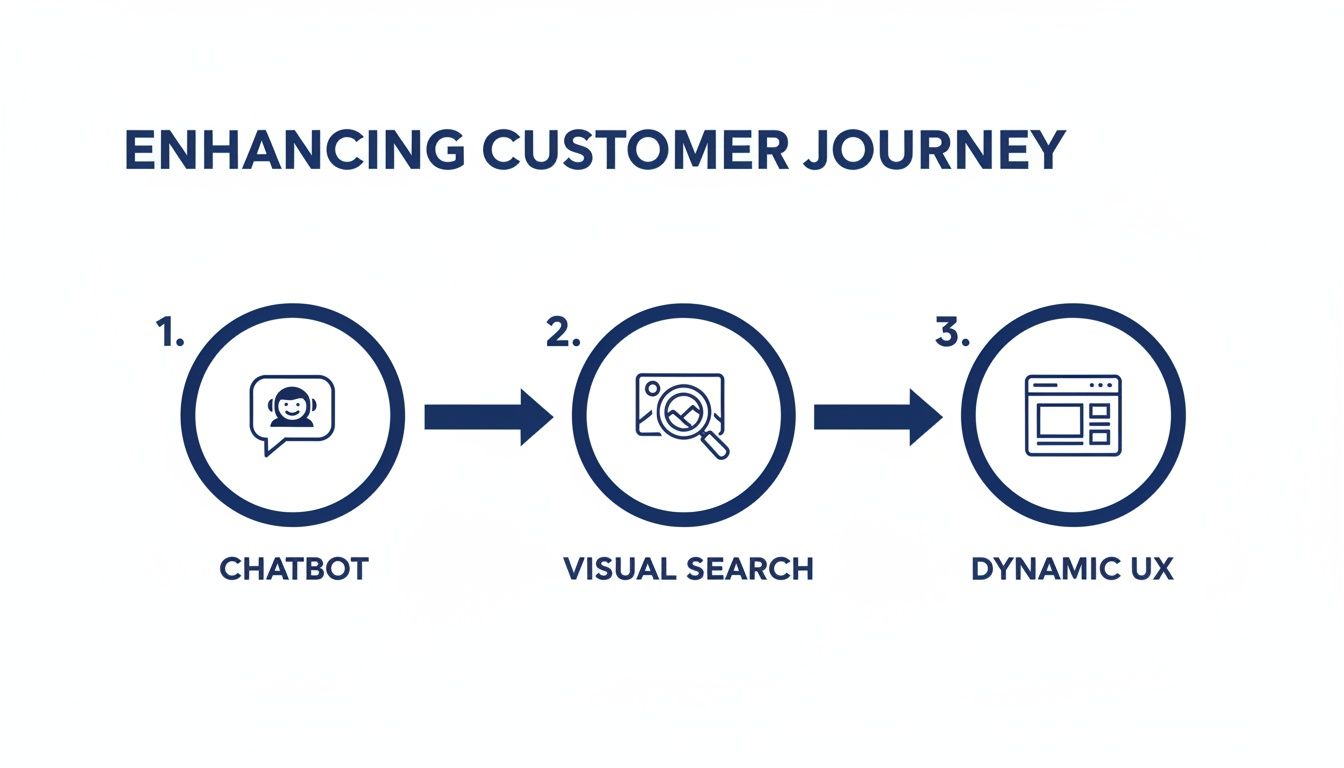
This flow illustrates a common path: a customer might first chat with an AI bot for help, then use visual search to pinpoint a product, and finally land on a webpage that dynamically adjusts just for them.
Identify Business Goals and Use Cases
Before you get dazzled by any technology, the first question should always be: "What problem are we actually trying to solve?" A successful AI strategy doesn't start with the tech; it starts with clear business goals. Are you trying to slash your cart abandonment rate, bring down customer service costs, or finally get a handle on inventory accuracy?
Once you know your main objective, you can pinpoint the AI use cases that will make the biggest impact. For instance, if your goal is to boost customer lifetime value, diving into hyper-personalisation and predictive product recommendations is a fantastic place to start.
Here's a simple way to connect your goals to real actions:
Define the Goal: Increase average order value by 15%.
Identify the Pain Point: Shoppers aren't finding relevant add-on items.
Select the AI Use Case: Deploy an AI-powered recommendation engine on product pages and in the checkout process.
This method ensures your investment in AI is directly linked to a tangible business outcome, which makes building a case for it a whole lot easier.
Prepare Your Data and Governance
AI runs on data. Simple as that. Without high-quality, accessible data, even the most sophisticated algorithms are useless. This phase is all about getting your digital house in order, which means taking a hard look at the quality, quantity, and structure of the information you already have.
You need to be honest about your data readiness. Do you have a single source of truth for customer data, or is it scattered across a dozen different platforms? Is your data clean and consistently formatted? Nailing down strong data governance practices is non-negotiable for ensuring accuracy and staying compliant with privacy laws.
Think of data as the fuel for your AI engine. Bad fuel won't just make the engine sputter; it can cause serious, expensive damage. Investing time in cleaning up and organising your data isn't just a recommendation; it's a prerequisite for any serious AI project.
Choose the Right Technology Stack
With your goals set and your data prepped, it's time to pick your tools. The tech stack you build will depend on your budget, your team's technical skills, and what you're trying to accomplish. The options usually fall into one of three buckets.
Platform Plugins: For businesses using platforms like Shopify, many AI features (think chatbots or recommendation engines) are available as simple, off-the-shelf plugins. This is often the quickest and most affordable way to get started.
SaaS Solutions: These are specialised AI platforms that integrate with your existing systems. They give you more power and customisation than plugins without forcing you to build everything from scratch.
Custom Solutions: For large enterprises facing unique challenges, a custom-built AI solution might be the only way to go. This route offers total flexibility but demands a major investment in both time and technical talent.
Pilot Small and Scale Smart
Whatever you do, don't attempt a "big bang" launch. The smartest strategy is to begin with a small, manageable pilot project. Pick one specific use case, like a chatbot that answers your top 10 most frequent customer questions, and roll it out on a limited basis.
This pilot lets you test your assumptions, collect real-world data, and measure the results without risking your entire operation. Based on what you learn, you can fine-tune your approach and make a smart decision about scaling it across the rest of the business. This cycle of piloting, measuring, and scaling is the safest and most effective path to integrating AI successfully across your company.
Choosing Your AI Partners and Tools
Picking the right technology is probably one of the most important calls you'll make when bringing AI into your business. The market for AI in retail and ecommerce is packed with choices, from simple plug-and-play apps to massive, custom-built systems. The right decision really comes down to what you’re trying to achieve, what your team can handle, and how much you have to spend.
This isn’t just a hunt for the flashiest features; it's about finding a solution that can grow alongside you. A small business running on Shopify might get everything it needs from an off-the-shelf app. On the other hand, a larger enterprise dealing with complex logistics will likely need something built just for them. The trick is to weigh every option against where you want your business to be in the long run.
Evaluating Your Core Options
You’ll generally find yourself looking at three main paths, each with its own set of pros and cons. Getting a handle on these is the first step to making a smart choice that fits how your business actually operates.
SaaS Solutions & Platform Plugins: Think of these as ready-to-use tools that slot right into platforms like Shopify or Magento. They're typically the fastest and cheapest way to get started with AI for specific jobs, like running a chatbot or personalising product recommendations. The trade-off? You often sacrifice a degree of customisation.
AI Platforms: These are a step up – more like a full toolkit than a single wrench. They offer a whole suite of AI capabilities and can connect different parts of your business. You get a lot more flexibility than with a simple plugin, but they do require more effort to set up and a bigger budget.
Custom Builds: This is the top-tier option. Working with a development partner to build a unique AI solution gives you total control to solve your most specific business challenges. It’s also the most demanding route, requiring a serious investment of time, money, and technical skill. But, if done right, it can give you a massive competitive advantage.
The best path is the one that fixes your most pressing problem today while leaving room to grow tomorrow. There’s no point in building a complex custom system if a simple SaaS tool can deliver 80% of the value for a fraction of the time and cost.
Key Questions for Potential Vendors
When you start talking to vendors, it’s time to dig deeper than the sales pitch. You need to understand how their tech will actually work inside your business. For a closer look at what's out there, a good guide like the 12 Best AI Tools for Fashion Brands can provide some concrete examples.
Here’s a checklist of questions to keep in your back pocket for those conversations:
Integration Capabilities: How well does your tool play with our current systems? We need it to connect smoothly with our CRM, ERP, and ecommerce platform.
Scalability: Can your system keep up as we grow? We need to know it can handle our projected traffic and transaction volumes for the next three to five years.
Data Security and Compliance: Tell me exactly what you do to protect our customer data and stay compliant with regulations. This is non-negotiable for us.
Ongoing Support and Training: What happens after we sign the contract? What kind of support is included, and will you help train our team to use the platform effectively?
Industry Expertise: Have you worked with businesses like ours before? Show me some case studies or examples of how you've solved similar problems in our industry, whether it's automotive, fashion, or another niche.
Remember, finding the right partner is just as critical as picking the right tool. You want someone who gets your industry, understands your goals, and is ready to guide you through the whole process.
Got Questions About AI in Retail? We've Got Answers.
Even with a solid plan, jumping into the world of AI for retail and ecommerce can feel like a big step. It’s natural to have questions. Here, we tackle some of the most common ones we hear from business leaders, giving you the straightforward, practical answers you need to move forward.
Most of these questions boil down to the same things: cost, complexity, and what AI can really do for the bottom line. Getting these answers sorted is the final, crucial step before you commit.
Is AI Just a Game for the Big Retailers?
Not anymore. While it’s true that the big players have been using sophisticated AI for years, the game has completely changed. Today, AI is far more accessible for small and medium-sized businesses. Many powerful tools are now available as affordable plugins or cloud-based services for platforms like Shopify, giving you access to things like chatbots and product recommendations without needing a huge upfront investment.
The trick is to start small and solve a specific, high-impact problem. For a smaller shop, that could be as simple as automating common customer service questions. The time you free up for your team can deliver a fantastic return on a very modest budget.
The real power of AI isn't just about doing things at a massive scale; it's about being smarter. A small boutique using AI to nail its marketing personalisation can absolutely outmanoeuvre a larger, slower competitor by creating a better, more intimate customer experience.
What Kind of ROI Should I Expect from an AI Project?
The return on investment can vary a lot depending on what you're trying to achieve, but the results are almost always impressive. Most businesses start seeing a tangible impact within 3-6 months, with a full return on their initial investment typically landing somewhere in the 12-18 month range.
Here are a few areas where you'll see the numbers move:
Conversion Rates: Smart personalisation and better search results often lead to an immediate lift in sales.
Operational Costs: Getting your inventory right with AI-powered forecasting can slash logistics costs by up to 15%.
Customer Satisfaction: AI chatbots can successfully handle up to 70% of customer chats from start to finish, which means faster answers and happier shoppers.
Is AI Going to Replace My Team?
This is probably the biggest worry we hear, but the best AI strategies don't replace people; they make them better at their jobs. AI is brilliant at chewing through repetitive, data-heavy tasks that humans find tedious. This frees up your team to focus on the stuff that actually requires a human touch: strategy, creativity, and building real customer relationships.
Think of it this way: an AI tool can scan thousands of customer reviews in seconds to spot a new trend. But it takes a human product manager to understand the why behind that trend and decide what to build next. AI gives you the data-backed insight; your people provide the wisdom and make the final call.
Ready to figure out what AI could do for your business specifically? At Cleffex Digital Ltd, we build custom software solutions designed to solve real-world problems. Let's map out your AI journey together. Get in touch with our experts today.