

So, what are AI WooCommerce solutions, really? Think of them as a collection of smart tools designed to automate tasks, tailor customer experiences, and sharpen the operations of your online store. They’re like having a super-intelligent assistant who crunches data behind the scenes to make your shop run smoother and bring in more revenue.
The New Era of AI in WooCommerce

Let's cut through the jargon. Imagine you could hire a team of experts who work around the clock, for a fraction of the cost. That's what AI WooCommerce solutions offer. One is a data wizard, forecasting next season's bestsellers. Another acts as a personal stylist, knowing exactly what each customer will love. And a third is your ever-vigilant security detail, spotting sketchy transactions before they cause a problem.
This isn't science fiction anymore; it’s a very real toolkit for growing your business. As we dive in, it helps to understand the engine driving these tasks. A great place to start is understanding how an AI agent platform works to orchestrate all these intelligent actions. By plugging these systems into your store, you can automate complex jobs that used to eat up hours of manual work.
Shifting from Manual to Automated Intelligence
The real game-changer is moving from being reactive to proactive. Instead of just shipping out orders as they come in, your store starts to predict what customers want and what the market is doing next. This change is directly fueled by a huge shift in how people shop, especially right here in Canada.
Recent studies show that AI use among Canadian shoppers more than doubled in just one year, rocketing from 11% to 30%. Younger buyers are all over it, with 45% of Gen Z now using AI assistants. Here's the kicker: 51% of Canadian consumers are now open to letting AI manage their entire shopping journey, from finding the product to checking out, all based on their known preferences.
This trend tells us that customers aren't just putting up with AI; they're starting to expect the seamless, personalised experiences it creates. For anyone running a WooCommerce store, this is no longer a "nice-to-have" feature. It's becoming essential for staying in the game.
Bringing AI into your store helps you meet these new expectations by delivering:
Smarter Search: Customers can find exactly what they’re looking for, even if they don’t know the right words to describe it.
True Personalisation: Every visitor sees the products and promotions that are most likely to catch their eye.
Efficient Operations: You can put inventory management and fraud prevention on autopilot, freeing you up to focus on the bigger picture.
Where AI Actually Makes a Difference in Your Store
It’s one thing to talk about AI in theory, but it’s another to see it actually solve the real-world problems you face every day. The best AI WooCommerce solutions aren’t just fancy tech; they’re practical tools that turn operational headaches into genuine growth opportunities.
Let’s get specific and look at five areas where AI can have a massive impact on how your store runs and how much it sells.
From Vague Searches to Smart Discoveries
We’ve all been there. A customer searches for a "warm jacket for winter" and your site shows them a random pile of results, including thin rain shells and lightweight windbreakers. That happens because old-school search bars just match keywords; they don't understand what the customer actually wants. It's a quick way to frustrate someone into leaving your site.
Now, imagine that same search powered by AI. It becomes a savvy sales assistant. It understands that "warm jacket" implies insulation and weather resistance. It can even figure out typos or messy queries, guiding shoppers directly to the products they were picturing in their heads. That’s how you turn a search into a sale.
Hyper-Personalisation for Every Visitor
For years, the standard approach was to show every single visitor the same homepage, the same promotions, and the same product layout. This one-size-fits-all model is a huge missed opportunity because it ignores the unique tastes and needs of each shopper.
AI flips this entirely by crafting a dynamic, one-to-one shopping experience. It looks at a user's browsing history, what they've bought before, and even how they're clicking around your site right now. The result? A storefront that literally reorganises itself for every person, putting the products and offers they're most likely to love front and centre.
This isn't just a nice-to-have feature; the economic impact is huge. For Canadian retailers, AI-driven product recommendations are expected to boost e-commerce sales by an incredible 59%. That's a direct lift to your bottom line. It proves that the real value comes from creating a better customer experience, which naturally leads to more revenue. You can explore more about how AI is shaping Canada’s digital economy in this research.
Smarter Inventory and Pricing Decisions
Guesswork is one of the most expensive habits in retail. If you overstock, your cash is tied up in products that aren't selling. If you understock, you're losing sales and letting down customers. Trying to adjust prices manually to keep up with the market is always a step behind.
This is where AI forecasting shines. These tools dig into your historical sales data, look at current market trends, and even account for things like upcoming holidays to predict what you're going to sell with uncanny accuracy. On top of that, dynamic pricing algorithms can tweak prices in real-time, helping you maximise your profit margins without alienating shoppers. Our guide on AI-driven demand forecasting offers a deeper look into this process.
Always-On, Intelligent Customer Support
When a customer has a question at 2 AM, they either get an answer immediately or they find a competitor who can give them one. Sticking to human-only support means you’re only available during business hours, which costs you sales and gets expensive as you grow.
Modern AI chatbots solve this by offering instant, 24/7 support. They can handle all the common questions: order status, return policies, product details, freeing up your team to deal with the more complex issues that require a human touch. These bots can even act as sales agents, suggesting products and guiding people through checkout.
Proactive Fraud Detection and Prevention
Chargebacks are the bane of every online store owner. Traditional fraud filters are often too blunt; they block legitimate customers by mistake while somehow missing sophisticated scam artists. It's a frustrating cycle of lost revenue and unhappy shoppers.
In contrast, advanced AI fraud solutions analyse thousands of data points for every single transaction in the blink of an eye. They learn the subtle, almost invisible patterns of fraudulent behaviour. This lets you block fraudulent orders with high precision while giving your real customers a completely seamless checkout. You end up protecting your revenue and your reputation.
Choosing Your Path: AI Plugins vs. Custom Solutions
Once you’ve seen what AI can do, the big question becomes: how do you actually get it working in your WooCommerce store? You’ve really got two main roads to go down, and the best one for you hinges on your budget, timeline, and what you’re trying to achieve.
Think of it like buying a suit. You can get a great-looking one right off the rack that fits well, or you can have one tailor-made to your exact measurements. Both will make you look sharp, but they're built for different needs and come with different price tags.
This decision tree gives you a great visual for how specific business needs, like better personalisation or smarter search, point toward different AI tools.
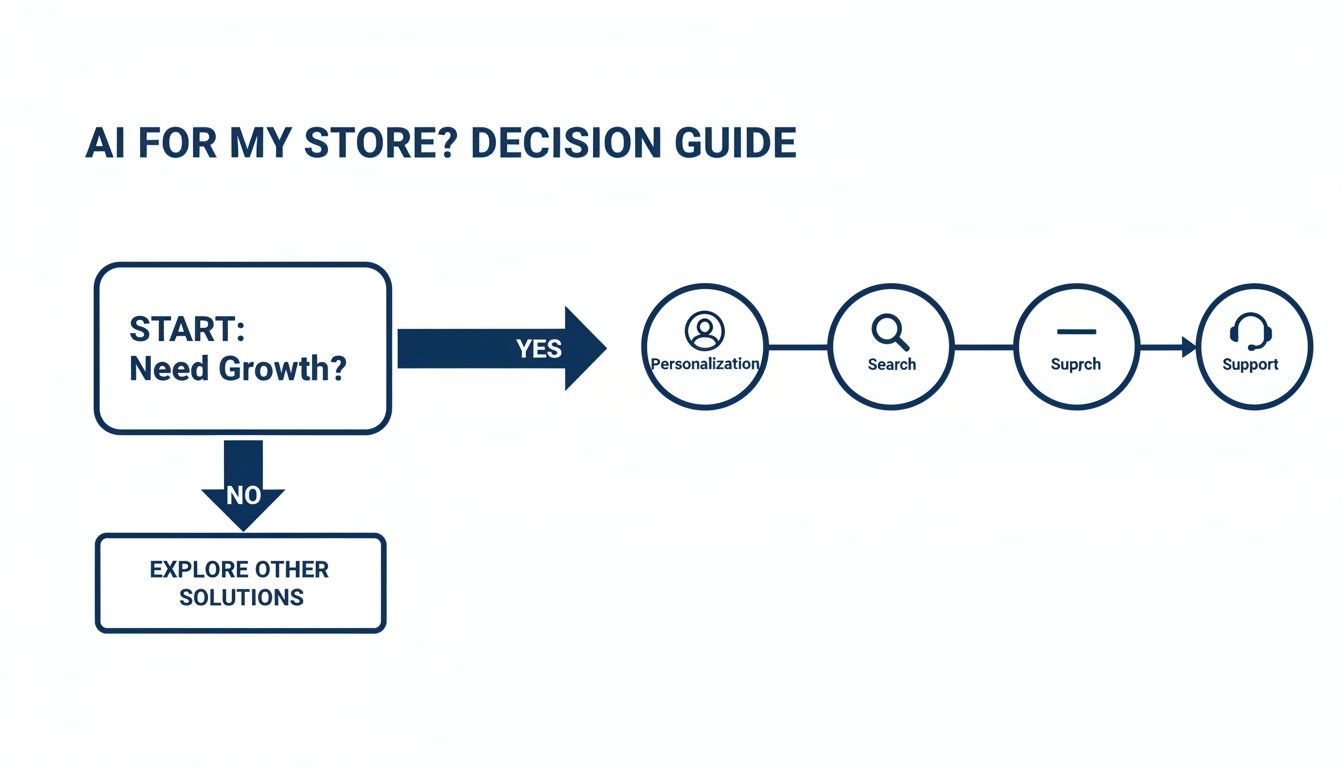
The takeaway is simple: always start with the problem you're trying to solve, not the technology.
The Quick-Start: Off-the-Shelf AI Plugins
AI plugins are the “off-the-shelf” option. They’re ready-to-go solutions you can install and get running in a few hours, not months. This is the perfect route for anyone who wants to dip their toes into AI without committing to a massive upfront investment.
These tools are designed to solve very common e-commerce problems right out of the box. You can find excellent plugins to instantly supercharge your site search, add a Netflix-style recommendation engine, or launch a 24/7 chatbot.
Speed: You can get a powerful new feature live on your site incredibly fast.
Cost: Most plugins run on a monthly or annual subscription, which is much easier on the wallet to get started.
Simplicity: They’re built for store owners, not developers, with user-friendly dashboards and simple setup wizards.
The trade-off? You get what you get. You’re using a tool that hundreds of other stores are also using, so it won’t be perfectly moulded to your brand’s unique flavour or specific operational needs.
The Perfect Fit: Custom AI Integrations
A custom AI integration is your bespoke, tailor-made suit. This path means partnering with developers to build an AI solution from the ground up, designed specifically around your business. If you have a one-of-a-kind dataset, a complex inventory problem, or a visionary idea for how to interact with customers, this is the way to go.
This approach delivers a serious competitive advantage because the solution is entirely your own. You can train AI models on your own customer data, creating a level of personalisation that no off-the-shelf tool can ever hope to match. You can get a better sense of what's possible by exploring the world of AI ecommerce development services that handle these builds.
With a custom solution, you can weave AI directly into the fabric of your business, from warehouse logistics to predictive marketing campaigns. You're not just buying a tool; you're investing in a proprietary asset that grows with you.
Of course, a custom build requires a bigger budget and more time. But what you get in return is almost limitless potential. The final product is a powerful engine built to execute your business strategy and truly set you apart.
To make the choice clearer, let’s break down the key differences side-by-side.
Comparing AI Plugins vs Custom Solutions
| Factor | Off-the-Shelf AI Plugins | Custom AI Integrations |
|---|---|---|
| Speed to Implement | Fast (Hours to days) | Slow (Months to a year or more) |
| Initial Cost | Low (Often a subscription fee) | High (Significant upfront investment) |
| Customisation | Limited (Confined to plugin settings) | Unlimited (Built to your exact specs) |
| Competitive Edge | Low (Anyone can use the same tool) | High (Proprietary and unique to you) |
| Required Expertise | Minimal (Designed for non-tech users) | High (Requires a skilled development partner) |
| Scalability | Good (Managed by the plugin provider) | Excellent (Designed for your growth plan) |
Ultimately, there's no single "best" answer. An off-the-shelf plugin is an excellent way to solve an immediate problem and prove the value of AI. A custom integration, on the other hand, is a long-term strategic investment for when you're ready to build a truly unique advantage.
Creating a Step-by-Step AI Rollout Plan

Weaving artificial intelligence into your WooCommerce store is a journey, not a sprint. Trying to do everything at once: the "big bang" approach, is a recipe for confusion and wasted cash. A much smarter way is to roll things out in measured steps, letting you test, learn, and build on each success.
This kind of phased approach takes the risk out of the investment. It lets you prove that each new AI feature is actually delivering value before you commit to the next one. It’s all about building momentum and making a solid business case every step of the way.
Stage 1: Start with a Pilot Project
Your first move should be small, focused, and aimed at a high-impact problem. Find a single, nagging pain point that an AI tool is perfectly suited to fix. For instance, if you notice a lot of customers giving up after a frustrating site search, an AI-powered search plugin makes for an ideal pilot project.
The whole point here is to score a quick, decisive win. By zeroing in on one clear problem, you can easily track performance and see a clear return on your investment (ROI). A successful pilot builds the confidence and the internal buy-in you'll need to go further with AI.
Key Takeaway: Don't try to boil the ocean by overhauling your entire store overnight. A successful pilot acts as a powerful proof of concept, showing exactly how AI WooCommerce solutions can solve real business challenges and deliver tangible results.
Stage 2: Move to a Phased Rollout
Once your pilot has proven its value, it's time to broaden your scope. Take what you learned from that first test and let it guide your next moves. Did better search directly lift your conversion rates? Great. The next logical step might be adding AI-driven product recommendations to make that customer journey even smoother.
This stage is about methodically layering on new AI capabilities. Each feature should build on the last, creating a smarter, more connected shopping experience. It’s an iterative process, where you're constantly improving based on real data coming from your own store.
Stage 3: Continuously Optimise and Scale
AI isn't something you can just set up and walk away from. This final stage is really an ongoing cycle of fine-tuning and optimisation. You need to be regularly checking your performance metrics to see what’s working, what isn't, and where you can make improvements. As your business grows, your AI strategy has to scale right along with it.
The Canadian e-commerce scene is a great example of this trend; 51% of businesses here are already using AI for personalisation. With the market projected to hit $22.6 billion by 2032, there's a clear roadmap for growth that even small and medium-sized businesses on WooCommerce can follow. You can learn more about these AI statistics and what they mean for the market. This constant optimisation is what keeps your store competitive and ensures you're always meeting your customers' ever-changing expectations.
Finding the Right AI Development Partner
Bringing a custom AI solution to life isn't just about hiring a team of coders; it's about finding a strategic partner. The best partners don't lead with technology. Instead, they start by digging deep into your business goals and then figure out how AI can help you get there.
This choice is a big deal. You're entrusting a team to build a core, revenue-generating asset for your business, so you can't afford a mismatch. You need a partner with a rock-solid, verifiable track record in both artificial intelligence and ecommerce. Since your store is built on WooCommerce, their team's hands-on experience with WooCommerce development is absolutely essential; they have to know its architecture inside and out.
Vetting Potential Partners
Before you sign any contracts, you have to do your homework. A thorough vetting process is the only way to see past a slick sales pitch and confirm they have the technical chops and business acumen to deliver real results.
Start by asking some direct questions that get to the heart of their capabilities:
Portfolio Review: Ask them to walk you through successful AI WooCommerce solutions they’ve built for businesses like yours. What problems did they solve?
Team Expertise: Who, specifically, will be working on your project? What are their qualifications and direct experience in AI, machine learning, and ecommerce?
Business Focus: How do they propose to measure success? Get them talking about your key metrics, like conversion rates, average order value, or customer lifetime value.
Long-Term Support: What happens after launch day? Ask about their plans for ongoing maintenance, performance optimisation, and support.
Your ideal partner is a collaborator, not just an order-taker. They should be confident enough to challenge your ideas and suggest better alternatives based on their experience, always with an eye on delivering a competitive advantage and a clear return on your investment.
Managing this relationship effectively is just as important as the initial selection. Whether you need niche expertise or want to scale your development efforts quickly, knowing how to outsource software development properly is a critical skill for any business owner aiming to build powerful, custom AI tools.
Common Questions About AI for WooCommerce
It's natural to have questions when you're looking at bringing AI into your WooCommerce store. Let's break down some of the most common ones we hear from business owners.
How Much Is This Going to Cost?
The price tag for AI can swing pretty widely. Off-the-shelf AI plugins are usually quite affordable, with many starting at a small monthly subscription and climbing to a few hundred dollars. They're a fantastic way to dip your toes in the water.
A completely custom AI solution, on the other hand, is a more significant undertaking. You're likely looking at a starting point in the thousands, with costs that grow depending on how complex your needs are. The real trick is finding that sweet spot where your investment is directly tied to a return you can actually measure.
Do I Need to Be a Tech Whiz to Use This?
Not at all, especially if you're starting with plugins. Most of the popular AI tools are built for regular store owners, not developers. They have intuitive dashboards and straightforward setups.
If you decide to go the custom route, you'll be relying on the technical know-how of your development partner. What's far more important on your end is having a crystal-clear understanding of your business goals and what your customer data is telling you. That’s what will truly steer the project to success.
Is This Going to Slow Down My Website?
This is a big one, and a valid concern. A poorly built tool absolutely can bog down your site, which is why choosing the right plugin or partner is so critical. Any well-made AI plugin is designed to be as lightweight and efficient as possible, minimising any hit to your page load times.
When it comes to custom work, an experienced development team will be obsessed with performance. They'll focus on clean code and smart architecture to make sure the AI features are an asset, not an anchor. Always run site speed tests before and after launching anything new.
What Kind of Data Do I Actually Need?
The more good, clean data you have, the more powerful your AI will be. At a minimum, you’ll want to have your product catalogue, customer order history, and basic website analytics ready to go.
For the really impactful stuff like deep personalisation, you'll need behavioural data, think clicks, product views, and how long people spend on certain pages. The good news is that most WooCommerce sites are already collecting this info. The first job is just getting it organised.
Ready to build an AI solution that drives real growth for your WooCommerce store? The team at Cleffex Digital Ltd specialises in creating custom AI and software solutions that solve unique business challenges. Let's build your competitive advantage together.