

AI powered product recommendations aren’t some far-off idea anymore; they’re a vital tool that essentially gives every single online visitor their own personal shopper. This technology uses artificial intelligence to sift through customer data: things like what they’ve clicked on, what they’ve bought before, and how they navigate your site, to serve up products perfectly matched to their tastes. The result? A noticeable lift in both sales and customer happiness.
Why AI Personalisation Is the New Standard in Shopping

Think about the difference between two brick-and-mortar stores. In the first, you wander around aisles while the sales staff just watches silently. That’s what most static, non-personalised websites feel like. Now, imagine a second store where a skilled assistant greets you, instantly gets your style, and points you toward items you’ll genuinely love. That’s the magic of AI-powered product recommendations brought to life online.
This kind of smart tech has gone from a “nice-to-have” luxury for massive retailers to an absolute must-have for all sorts of businesses. We’re seeing it everywhere, from car dealerships suggesting custom features to healthcare portals recommending relevant wellness products. It marks a huge shift in how businesses connect with people online.
The Core Benefits of AI-Driven Suggestions
Bringing an AI recommendation engine into your business does more than just show off fancy tech; it directly impacts your bottom line and helps you build real relationships with customers. It’s not about bombarding people with more products. It’s about showing them the right products at exactly the right moment.
The main advantages really boil down to a few key things:
- Boosting Average Order Value (AOV): By intelligently suggesting complementary items or relevant upgrades, AI gives customers a gentle nudge to add more to their basket. It’s the digital equivalent of suggesting the perfect shoes to go with that dress or the essential accessory for a new phone.
- Building Lasting Customer Loyalty: People stick with brands that “get” them. When your website shows that you understand a customer’s needs and preferences, they feel seen and valued, which turns a one-time purchase into a long-term relationship.
- Enhancing the User Experience: Let’s be honest, nobody enjoys endlessly scrolling through irrelevant items. AI cuts through the noise, helping shoppers find what they’re looking for fast and even discover new products they’ll love.
This strategic use of AI makes shopping feel more relevant and convenient, which is a massive advantage in today’s crowded market. It delivers on the modern consumer’s expectation for an experience that’s built just for them.
To get the full picture of how AI is reshaping online shopping, consider how tools like AI chatbots for ecommerce can even provide personalised recommendations, making the entire customer journey feel more connected and helpful.
For a deeper dive, you can explore our ultimate guide to ecommerce personalisation. By weaving intelligent suggestions into your digital storefront, you can unlock some serious growth.
The Real-World Business Impact of AI Recommendations
It’s one thing to talk about AI-powered product recommendations in theory, but what really matters is the bottom-line impact. This isn’t just about cool technology; it’s about connecting directly to core business goals and seeing a measurable return on your investment.

For a small business, this kind of AI is a game-changer. It gives you the power to create the kind of deeply personal shopping experience that was once only possible for retail giants. Suddenly, you can compete on a much more level playing field and start building a fiercely loyal customer base.
For medium-sized companies, the focus shifts to optimisation at scale. Here, AI helps you maximise customer lifetime value (CLV), boost your retention rates, and make sure every single interaction is as profitable and meaningful as it can be.
A Powerful Tool for Every Industry
The power of AI recommendations goes far beyond the typical retail checkout. Imagine an insurance platform that intelligently suggests useful add-ons, like travel or gadget coverage, to someone buying home insurance. Not only does this bump up the transaction value, but it also leaves the customer feeling more comprehensively protected, which builds trust and strengthens the relationship.
Or think about a healthcare portal. It could recommend relevant wellness articles, local services, or even nutritional supplements based on a person’s browsing history and stated health goals. This simple act transforms the portal from a mere service provider into a trusted adviser. These examples show how personalisation creates real value, no matter the industry.
The core idea is the same everywhere: when you anticipate a customer’s needs and show them relevant options, you create significant value for them and for your business. That’s how you foster loyalty and drive serious revenue.
This isn’t a niche trend anymore. In Canada, the adoption of AI-powered recommendation systems is picking up steam, with the share of businesses using them jumping from 12.3% to 14.0% in just a single year. This is part of a larger movement where overall AI use for delivering services has doubled, according to Statistics Canada.
From Static to Dynamic: A Clear Comparison
To really see the difference AI makes, let’s look at a simple ‘before and after.’ The change isn’t just a minor tweak; it’s a complete shift in how you engage with your customers. To get the most out of this shift, businesses need to tap into powerful AI-driven sales insights.
The table below paints a clear picture of this transformation.
Business Impact Before and After AI Recommendations
| Business Metric | Without AI Recommendations (Traditional Approach) | With AI Recommendations (Personalised Approach) |
|---|---|---|
| Customer Journey | Generic, one-size-fits-all experience for every visitor. | A unique, dynamic journey tailored to individual behaviour. |
| Product Discovery | Relies on manual search and category navigation by the user. | Proactive suggestions of relevant items, reducing effort. |
| Conversion Rate | Lower, as users may leave if they can’t easily find what they need. | Significantly higher, with up to a 915% increase in some cases. |
| Average Order Value | Stagnant, with very limited opportunities for upselling. | Increased through smart, relevant cross-selling and upselling. |
| Customer Retention | Weaker, because the experience is impersonal and forgettable. | Stronger, building real loyalty through a feeling of being understood. |
As you can see, the ‘after’ column isn’t just an improvement; it represents a fundamentally better way of doing business.
Putting this technology to work is a direct route to achieving these kinds of results. A smart approach, often starting with expert AI-driven ecommerce website development, ensures your system is built from day one to deliver on these crucial business goals. As a leading software development company, we’ve seen this transformation happen time and again. Our teams know how to integrate these powerful tools to unlock growth.
How AI Recommendation Engines Actually Work
At first glance, AI-powered product recommendations can feel a bit like magic. But behind the curtain, it’s all about smart, data-driven logic. These engines aren’t guessing; they’re making highly educated predictions based on well-established analytical models. Getting a handle on these core approaches is the key to understanding their power and choosing the right one for your business.
Think of these engines as different kinds of expert advisers. Each one has a unique way of figuring out what a customer will want next. The most common methods are collaborative filtering, content-based filtering, and hybrid models that give you the best of both worlds.
Collaborative Filtering: The Power of the Crowd
Collaborative filtering is probably the one you’ve seen the most. It’s built on a simple, very human idea: if two people liked the same things in the past, they’ll probably like similar things in the future. It’s the digital version of getting a great suggestion from a group of friends who share your taste.
This model doesn’t need to know a thing about the products themselves; it couldn’t care less if it’s a book or a bicycle. It’s all about user behaviour. It works by finding patterns in what items people buy or look at together.
- User-Based Approach: This method finds your “taste twins”, other users with similar interests, and then shows you things they loved that you haven’t discovered yet.
- Item-Based Approach: This finds items that are similar based on how users have interacted with them. It’s the classic “Customers who bought this item also bought…” feature we all know.
This method is fantastic at uncovering items you wouldn’t have thought to look for, a happy accident we call serendipity. Someone browsing for a tent might suddenly see a recommendation for a high-quality portable stove. Not because they’re similar products, but because other outdoor adventurers bought them together.
Content-Based Filtering: It’s All About Your History
While collaborative filtering looks at the crowd, content-based filtering looks directly at you and the products you already love. Think of it like a personal librarian who knows you’re obsessed with science fiction from a certain author. The moment that author drops a new book, the librarian puts it right in your hands. That’s content-based filtering.
This approach works by digging into the attributes or “content” of items a user has liked before. It breaks products down into their core features: brand, colour, category, genre, or even technical specs. The engine then builds a detailed profile of what you like based on those characteristics.
If you keep buying running shoes from a particular brand, a content-based system will be sure to show you the new arrivals from that same brand. It’s a perfect fit for niche markets where specific details matter, like suggesting camera lenses that are compatible with a photographer’s existing camera body.
Hybrid Models: The Best of Both Worlds
Neither approach is perfect on its own. Collaborative models can get stumped by new products with no user data (this is called the “cold start” problem). On the other hand, content-based models can get stuck in a rut, only ever showing you things that are almost identical to what you’ve already bought.
That’s where hybrid models step in. They cleverly combine two or more techniques to build a smarter, more accurate system. For example, a system might rely on collaborative filtering most of the time but switch to a content-based approach for new users or products that don’t have a sales history yet. This synergy patches up the weaknesses of each individual model, creating a much stronger engine.
The Next Frontier: Deep Learning and Context
Beyond these foundational models, the most advanced engines are now using deep learning, a type of AI that works a lot like the human brain’s neural networks. These incredibly powerful models can spot complex and subtle patterns in huge amounts of data, resulting in eerily accurate predictions. They can even understand context, like the time of day, your location, or the current weather, to make suggestions that are perfectly timed and relevant.
These sophisticated algorithms are a core part of what we explore in our guide on predictive analytics in ecommerce sales, as they are crucial for forecasting customer behaviour with incredible precision. Building on these concepts is also something we focus on when providing our AI-driven ecommerce website development services. As a software development company, we understand that choosing the right model, or combination of models, is fundamental to creating an engine that truly drives results. We have a deep well of experience to draw from, as we explored in our software development solutions guide.
Putting Your AI Recommendation Strategy Into Action
Moving from theory to a live AI-powered product recommendation system is where the rubber meets the road. It’s a journey that needs a clear, practical roadmap, starting with careful planning around data, privacy, and the right tech path for your business. The decisions you make early on will set the stage for your success.
The heart and soul of any smart recommendation engine is data – and not just any data, but high-quality, relevant data. Your system learns from how people behave on your site, which means you need to be collecting things like clickstream data, purchase history, and how users interact with products. But how you gather and protect this information is just as critical as what you collect.
Getting Your Data and Privacy Right
Before you can even think about personalising a customer’s experience, you need to earn their trust. That process begins with handling their data ethically and sticking to privacy laws like glue. For any business with customers in certain parts of the world, this isn’t just a good idea; it’s the law.
You’ll need to be well-versed in a few key regulations:
- General Data Protection Regulation (GDPR): If you serve customers in the European Union, your data practices must be transparent, and you need their clear consent.
- Personal Information Protection and Electronic Documents Act (PIPEDA): This is the Canadian law that sets the rules for how private-sector businesses collect, use, and share personal information.
Navigating this, from picking the right filtering model to getting it running, can feel complex. The flowchart below helps simplify the logic, showing the basic decision process between the main collaborative and content-based approaches.
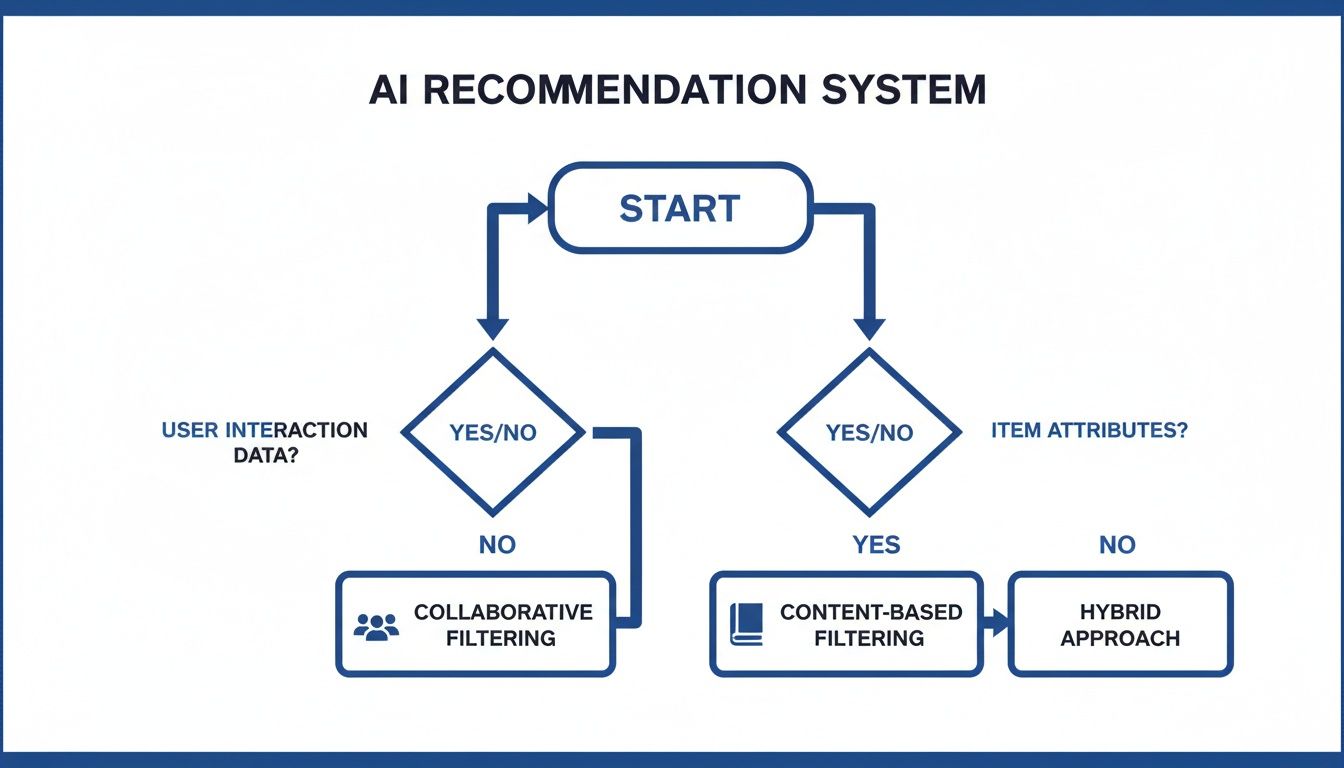
This visual breaks down how each method relies on different types of data, which should help you match your strategy to the customer and product information you actually have on hand.
The push to adopt this kind of tech is real. In Canada, a Harris Poll found that AI use among small businesses jumped from 32% to 54% in only four years. And for those who’ve made the leap? 93% say it’s been helpful. This isn’t just a trend; it’s a fundamental shift in how businesses stay competitive. You can discover more about these findings on The Harris Poll.
Choosing Your Implementation Path
With a solid data strategy in place, your next big call is how you’ll actually build the thing. You essentially have three routes: buy an off-the-shelf solution, install a simple plugin, or build a system from scratch.
Your final decision will come down to a mix of your budget, timeline, in-house technical skills, and where you see your business heading. As we’ve touched on in our guide to AI-powered ecommerce development, the “best” path is simply the one that fits your operation.
Your choice of implementation is a major strategic crossroad. A SaaS solution gets you to market quickly, while a custom build gives you total control and a unique edge that no competitor can copy.
To make this decision a bit clearer, let’s compare the two most common routes – using a third-party SaaS provider versus building your own custom solution. This is a vital planning step for any AI-driven ecommerce website development project.
Choosing Your Path: SaaS vs. Custom AI Development
Deciding whether to buy or build is one of the most important technical decisions you’ll make. This table breaks down the key trade-offs to help you find the right fit.
| Factor | SaaS / Plugin Solution | Custom Development |
|---|---|---|
| Cost | Lower initial cost, typically a recurring subscription fee. Predictable monthly expenses. | Higher upfront investment in development, infrastructure, and talent. |
| Time to Market | Very fast. Can often be implemented in days or weeks with minimal technical setup. | Significantly longer. Development, testing, and deployment can take many months. |
| Customisation | Limited. You are constrained by the features and algorithms the provider offers. | Fully customisable. The system is built to your exact business logic and specifications. |
| Scalability | Generally scalable, but you are dependent on the provider’s infrastructure and pricing tiers. | Highly scalable, with infrastructure designed specifically for your growth trajectory. |
| Control & Data | Less control over algorithms and data. Data may be stored on third-party servers. | Complete ownership and control over the code, algorithms, and customer data. |
| Maintenance | Handled by the provider, including updates and bug fixes, reducing your internal workload. | Requires an in-house team or a dedicated partner for ongoing maintenance and updates. |
Ultimately, the best choice boils down to your resources and strategic goals. A good software development company can walk you through these factors and point you toward the most effective solution for your business.
Measuring the Success of Your AI Recommendations
An AI recommendation engine is a powerful tool, but how do you know if it’s actually working? You can’t just rely on a gut feeling. To really understand its value, you need to track specific, measurable results that tie directly back to your business goals. This is how you prove its worth, justify the investment, and discover ways to make the system even smarter.
The first step is zeroing in on the right Key Performance Indicators (KPIs). Think of these not as just numbers on a dashboard, but as clear signals telling you how well your recommendations are connecting with customers and influencing what they do next.
Key Metrics for Recommendation Engines
To get a clear picture of your engine’s impact, focus on a few core metrics that directly translate into business value.
Here are the most important ones to keep an eye on:
- Click-Through Rate (CTR): This is your most direct measure of engagement. It’s simply the percentage of people who click on a recommended product. A high CTR is a fantastic sign that your suggestions are hitting the mark and grabbing your customers’ attention.
- Conversion Rate Lift: This is where the magic happens. This metric compares the conversion rate of shoppers who engage with recommendations to those who don’t. A positive lift is solid proof that your AI is successfully nudging customers toward a purchase they might have otherwise skipped.
- Average Order Value (AOV) Lift: Is your recommendation engine encouraging customers to add more to their basket? This KPI tracks the increase in the average total value of orders that include a recommended item. It’s the perfect way to see how well your cross-selling and upselling strategies are performing.
And the appetite for these features is definitely there. Recent data shows that more than 54% of Canadians have checked out AI-driven product suggestions from online retailers, and nearly 31% have bought something based on those recommendations. Canadians are also warming up to AI when it gives them more control – 64% are happy to use it for tracking orders. You can discover more insights about AI in Canadian ecommerce on Canada Post.
Validating Impact with A/B Testing
While the metrics above offer great insight, the absolute best way to prove your engine’s effectiveness is through A/B testing. This method gives you undeniable proof by isolating the impact of the recommendations themselves.
An A/B test is straightforward: you show one group of users (Group A) your site without AI recommendations, while another group (Group B) sees the version with them. By comparing the behaviour of both groups, you can confidently say that any differences in conversion rates or AOV are a direct result of the AI.
This systematic approach takes the guesswork out of the equation and provides the hard data you need to justify the investment. As a leading software development company, we build this kind of rigorous testing directly into our AI-driven ecommerce website development projects. It ensures that every feature, especially one as powerful as an AI recommendation engine, is clearly contributing to growth. We’ve seen this structured approach deliver consistent wins for our clients, a topic we also cover, as we explored in our software development solutions guide.
Finding the Right Partner to Power Your Growth
Throughout this guide, we’ve seen how AI-powered product recommendations are no longer a futuristic concept but a very real, accessible tool for driving business growth. It’s about moving beyond the old “one-size-fits-all” model and creating a truly personal shopping journey for every customer.
When you get this right, the results speak for themselves: a dramatic increase in sales, a higher average order value, and the kind of customer loyalty that truly sets you apart. Your first step on this path is choosing the right strategy and the right partner to bring your vision to life.
Whether you decide on a quick-to-market SaaS solution or build a completely bespoke system, the goal remains the same. You’re aiming to create a smarter, more intuitive experience that doesn’t just react to what customers are doing but actually anticipates their needs, guiding them to products they’ll love.
Charting Your Course with Expert Guidance
Making the leap into AI is about more than just plugging in some new technology. You need a partner who takes the time to understand your specific business challenges and what you’re trying to achieve.
A skilled team will guide you through the entire process, from hashing out your initial data strategy and navigating privacy compliance to the final implementation and ongoing fine-tuning. This kind of partnership ensures your investment delivers a real, tangible return.
For businesses aiming for a unique competitive edge, a custom AI-driven ecommerce website development project offers unmatched control and flexibility. A dedicated partner can build a solution that is a perfect extension of your brand, deeply understands your customers, and supports your long-term ambitions.
Choosing your implementation partner is just as critical as choosing the technology itself. The right team isn’t just a vendor; they’re a strategic ally committed to your success, ensuring your recommendation engine becomes a core driver of revenue and customer satisfaction.
As a leading software development company, our speciality is turning business goals into powerful, working technology. We’ve guided countless businesses through this exact process, building robust, intelligent systems that deliver measurable results – a process we’ve detailed, as we explored in our software development solutions guide.
Ready to see what AI-powered product recommendations can do for your business? Learn more about us and get in touch with our team of experts today. Let’s talk about your specific needs and build your future together.
Frequently Asked Questions
Diving into the world of AI-powered product recommendations often brings up a few questions. We get it. Here are some straightforward answers to the things business owners most often ask us.
How Much Data Do I Need to Start?
You probably need less data than you think. While it’s true that more high-quality data is always helpful, a good system can get to work with just a few thousand user interactions – think clicks, add-to-baskets, and purchases.
The real key isn’t massive volume; it’s the quality and consistency of the data you already have.
Can AI Work with a Small Product Catalogue?
Absolutely. If you have a curated or smaller product lineup, a smart AI recommender can still make a huge impact. For this scenario, we’d often lean on a content-based filtering approach.
This method focuses on the nitty-gritty details and attributes of your products to suggest similar items. It’s a fantastic way to make sure even a specialised inventory gets showcased in a way that feels incredibly relevant to each shopper.
What Is the Difference Between Personalisation and Customisation?
It’s a great question, and the two are often mixed up. Think of it like this:
Personalisation is what the AI does for the customer, automatically. It watches a user’s behaviour, what they click on, what they buy, and then serves up recommendations it thinks they’ll love. It’s a hands-off, behind-the-scenes process.
Customisation, on the other hand, is when the user tells the system what they want. They take the driver’s seat, manually setting preferences like choosing their favourite brands or filtering by specific product categories.
How Long Does Implementation Take?
The timeline really depends on the path you choose. A ready-to-go SaaS solution can be integrated and running in just a few weeks. It’s a fast and effective option.
Building a completely custom solution, maybe through a service like AI-driven ecommerce website development, is a deeper partnership. That kind of project takes several months to design, build, and fine-tune perfectly to your business.
As a leading software development company, our job is to help you figure out which approach makes the most sense for your goals. We’ve covered this, as we explored in our software development solutions guide, and you can learn more about how we work by reading about us.