

When we talk about ecommerce personalization using AI, we’re really talking about using smart algorithms to understand what your customers are doing and deliver a shopping experience that feels like it was made just for them. It’s about going way beyond simple customer groups to predict what each person wants to see next, showing them the right product recommendations, content, and offers at the perfect moment.
Why AI Personalisation Is The New Standard In Ecommerce
The days of a one-size-fits-all storefront are long gone. Shoppers today don’t just appreciate a personal touch; they flat-out expect it. This shift has made AI-driven personalisation less of a “nice-to-have” and more of a core part of any serious online retail strategy. It’s no longer enough to just use a customer’s first name in an email – you need to know what they’re looking for before they do.
This entire movement is powered by the incredible amount of data at our fingertips. Every click, every product view, and every purchase tells a part of a customer’s story. For a growing business, trying to manually decode these stories for thousands of visitors is an impossible task. That’s where ecommerce personalisation using AI comes in. It acts as the brain, processing all that complex data to automatically create unique experiences at scale.
The Competitive Edge For Growing Businesses
Let’s be honest, for smaller businesses, trying to compete with the retail giants on price or shipping speed is an uphill battle. But AI gives you a way to level the playing field. You can create a superior, more intimate customer experience that builds real, lasting loyalty. Instead of blasting generic offers to everyone, you get to have a quiet, relevant conversation with each person.
This approach pays off in ways you can actually measure:
- Increased Conversion Rates: When you show customers exactly what they’re likely to want, you remove the guesswork and make it incredibly easy for them to hit “add to basket.”
- Higher Average Order Value (AOV): Smart, data-driven suggestions like “frequently bought together” or “you might also like” are proven ways to encourage shoppers to add just one more item.
- Enhanced Customer Loyalty: Shoppers who feel understood and valued come back. Personalisation turns a simple transaction into a genuine relationship. You can get a broader view of the general impact of AI in retail and ecommerce in our detailed guide here: AI in retail and ecommerce
The goal is simple: use technology to mimic the experience of a fantastic in-store sales associate, one who knows your style and preferences, and scale it for thousands of online shoppers at once. This is the new benchmark for success.
The market data backs this up. Right now, 51% of ecommerce businesses are already using AI to create better, more personal shopping journeys. To see how this is reshaping the industry, you can explore how harnessing AI in ecommerce for retail success is driving modern growth. This isn’t some far-off trend; it’s happening now. In fact, the market for AI ecommerce tools is on track to hit nearly USD 17 billion by 2030.
Building a Solid Data Foundation for AI Success

Before we even talk about AI models and recommendation engines, we have to address the most critical piece of the puzzle: your data. It’s the fuel for everything that follows. I like to think of AI as a brilliant chef – even the best chef in the world can’t make a masterpiece with rotten ingredients. In the same way, the most sophisticated AI is completely lost without clean, comprehensive, and well-organised data.
This isn’t a call to hoard every bit of information you can find. It’s about being strategic and collecting the right information. The entire success of your personalisation effort rests on the quality of the data you feed it. Get this right, and your AI can move beyond clunky segments and start understanding the subtle nuances of what makes each customer tick.
Identifying Your Most Valuable Data Points
So, where do you start? The best approach is to focus on the data that gives you the richest insights into your customers’ behaviour and motivations. For most online stores, this boils down to three main categories. Each tells a different part of the story, and when you weave them together, you get a powerful, complete picture.
- Behavioural Data: Think of this as your shoppers’ digital body language. It’s every click, page view, item added to a basket, and search query they type. How long did they linger on a product page? This is where you uncover real-time intent and interest.
- Transactional Data: This is the hard proof of what works. It includes purchase history, average order value (AOV), how often someone buys, and product returns. This tells you exactly what your customers are willing to spend their money on.
- Demographic & Contextual Data: This layer adds crucial context, like a customer’s location, the device they’re using, or how they found your site. Whilst you have to be mindful of privacy, this data helps your AI make smart adjustments, like showing prices in the local currency or ensuring the site looks great on a mobile screen.
Here’s something I’ve learned over the years: successful AI personalisation is less about having a massive volume of data from day one and more about making sure the data you do have is accurate, organised, and consistent. Quality trumps quantity, every time.
Practical Steps for Effective Data Collection
The good news is you don’t need a huge budget or a dedicated data science team to get started. You can begin pulling in high-quality data using tools you probably already have. The trick is making sure they’re set up to capture what your AI models will need.
If you’re on a platform like Shopify, you’re in a great position. A ton of this data is collected automatically. Your order history is a goldmine of transactional data, and the built-in analytics track customer behaviour across your site. Pair this with a tool like Google Analytics 4 (GA4), and you get a much deeper understanding of the entire customer journey, from first click to final purchase.
Don’t forget about your Customer Relationship Management (CRM) system. It’s another treasure trove, tracking everything from customer support tickets to email engagement. This adds another layer of invaluable context to your customer profiles. We dive deeper into how this works in our guide on using ecommerce predictive analytics to boost sales.
Maintaining Data Hygiene for AI Readiness
Finally, collecting the data is only half the job. You have to keep it clean. This practice is often called data hygiene, and it’s absolutely essential. It means regularly tidying up your datasets: removing duplicate entries, fixing typos, and standardising formats. For example, making sure all postcodes follow the same format or that customer names are consistent prevents your AI from getting confused by messy inputs.
This isn’t a one-off project; it’s an ongoing commitment. As your business grows, so will your data. By building simple, regular maintenance routines, you ensure your AI always has a reliable source of truth to work from. This discipline is the very bedrock on which powerful, profitable, and genuinely helpful ecommerce personalisation is built.
Picking the Right AI Personalisation Tools
Once you have a handle on your data, it’s time for the exciting part: choosing the tools that will actually do the personalising. The market is absolutely flooded with options, from massive all-in-one platforms to tiny, specialised plugins. It’s easy to get overwhelmed, but the secret is to let your business goals lead the way, not the flashy features.
Honestly, there’s no single “best” tool out there. The goal is to find the best fit for your specific needs, your budget, and how comfortable your team is with technology. Getting this right from the start means you’re investing in something that will grow with you and deliver a real, measurable return.
Match the Tool to Your Business Model
Every ecommerce business is different, so a one-size-fits-all AI tool just won’t cut it. You need to think about what your customers truly care about and find a tool that directly serves that need.
Think about a fast-fashion brand. Their world revolves around visual discovery and what’s trending right now. For them, a powerful visual search tool, where a shopper can upload a photo to find similar items, isn’t a gimmick; it’s a game-changer. It instantly solves the customer’s “I want this look” problem.
Now, contrast that with a subscription box service. Their biggest worry is keeping subscribers happy month after month. The perfect tool for them might be a churn prediction engine. This kind of AI sifts through customer behaviour to flag subscribers who are likely to cancel, giving the business a chance to step in with a special offer or a personalised note to win them back.
The most effective AI tool isn’t the one with the longest feature list. It’s the one that solves your most painful business problem, whether that’s helping people find products, boosting loyalty, or taking a load off your support team.
The Make-or-Break Factors in Your Decision
Before you sign on the dotted line for any platform, you need to do your homework. Running through a few core factors will help you compare your options and save you from major headaches later on.
- Integration Capabilities: How nicely will this tool play with your current setup? You need something that connects smoothly with your ecommerce platform (like Shopify or Magento), your CRM, and your email marketing software. A clunky integration creates more manual work and defeats the whole purpose.
- Scalability and Performance: Think ahead to your busiest day of the year. Can the tool handle a Black Friday traffic spike without slowing your site to a crawl? A recommendation widget that takes forever to load will kill conversions faster than it creates them.
- Ease of Use: Be honest about your team’s technical skills. Some tools are genuinely plug-and-play, built for marketers who don’t write code. Others are incredibly powerful but require a dedicated dev team to get them running and keep them maintained.
- Cost and Pricing Model: The price tags on these tools are all over the map. You’ll see subscription fees based on traffic, a percentage of revenue, or different feature tiers. Make sure you calculate the total cost of ownership and that it makes sense for your budget and the return you expect to see.
Comparing AI Personalisation Tool Types
To help you narrow down the search, it’s useful to understand the main kinds of AI tools available. Each one is designed to tackle a different part of the customer journey. This table breaks down the most common categories to help you figure out where to start looking.
| Tool Category | Primary Function | Ideal Business Type | Example Use Case |
|---|---|---|---|
| Recommendation Engines | Suggests relevant products based on user behaviour and history. | Retailers with large catalogues (e.g., fashion, electronics). | Displaying a “Customers Also Bought” section on a product page. |
| Personalised Search | Delivers search results tailored to individual user intent and past actions. | Stores where search is a primary discovery method (e.g., parts suppliers). | Prioritising search results for a brand that a user frequently views. |
| Predictive Analytics | Forecasts future customer behaviour, like churn or lifetime value. | Subscription-based services and businesses focused on retention. | Identifying high-value customers for a VIP loyalty programme. |
| Dynamic Content Tools | Modifies website content, like banners and copy, for different user segments. | Any business looking to tailor its messaging for various audiences. | Showing a “Free Shipping to London” banner to visitors from that city. |
In the end, choosing your AI tools is the strategic step that connects your data foundation to the real, customer-facing experiences you want to create. By focusing on your unique business needs and carefully vetting the practical side of things like integration and performance, you’ll make an investment that pays off.
If you’re curious about what goes on under the bonnet, you can dig deeper into AI-powered ecommerce development to see how these systems are built. This kind of informed approach is what ensures you pick a partner that helps you build genuinely compelling experiences for every single customer.
Putting AI-Powered Personalisation Techniques into Action
Once you have your data and tools sorted, it’s time for the fun part: implementation. This is where you actually start building those “wow” moments that turn a casual window shopper into a repeat customer. The idea is to make these sophisticated AI tactics feel less like rocket science and more like a natural extension of great customer service.
For most online stores, dynamic product recommendations are the first port of call, and for good reason. They are one of the fastest ways to lift your average order value. These engines use AI, typically collaborative or content-based filtering, to sift through a user’s behaviour and compare it against mountains of other data points.
Collaborative filtering is basically crowdsourcing recommendations. It finds shoppers with similar tastes and suggests products that others in that same group have bought and loved. This is the magic behind the classic “customers who bought this also bought” feature. Content-based filtering, on the other hand, is all about the product’s attributes. If a customer keeps looking at and buying blue running shoes, the AI will serve up more blue running shoes, no matter what other people are buying.
Supercharging On-Site Search and Discovery
Personalised on-site search is another absolute game-changer. A standard search bar gives everyone the same results, but an AI-powered one gets smarter with every single click. It looks at a user’s past searches, browsing patterns, and purchases to re-order results in real-time.
Think about it: if a customer always buys the same organic dog food brand from you, the AI should be smart enough to push that brand to the top of their search results for “dog food” next time they visit. It’s a small tweak that removes a ton of friction and helps people find what they’re looking for instantly. This turns your search box from a simple utility into a guided discovery tool.
A quick win for smaller businesses is to implement a smart recommendation widget on product and basket pages. Many ecommerce platforms like Shopify have apps that can be installed in minutes, using your existing sales data to start generating relevant suggestions almost immediately.
This flowchart breaks down the simple, foundational process for selecting the right AI tools to bring these techniques to life.
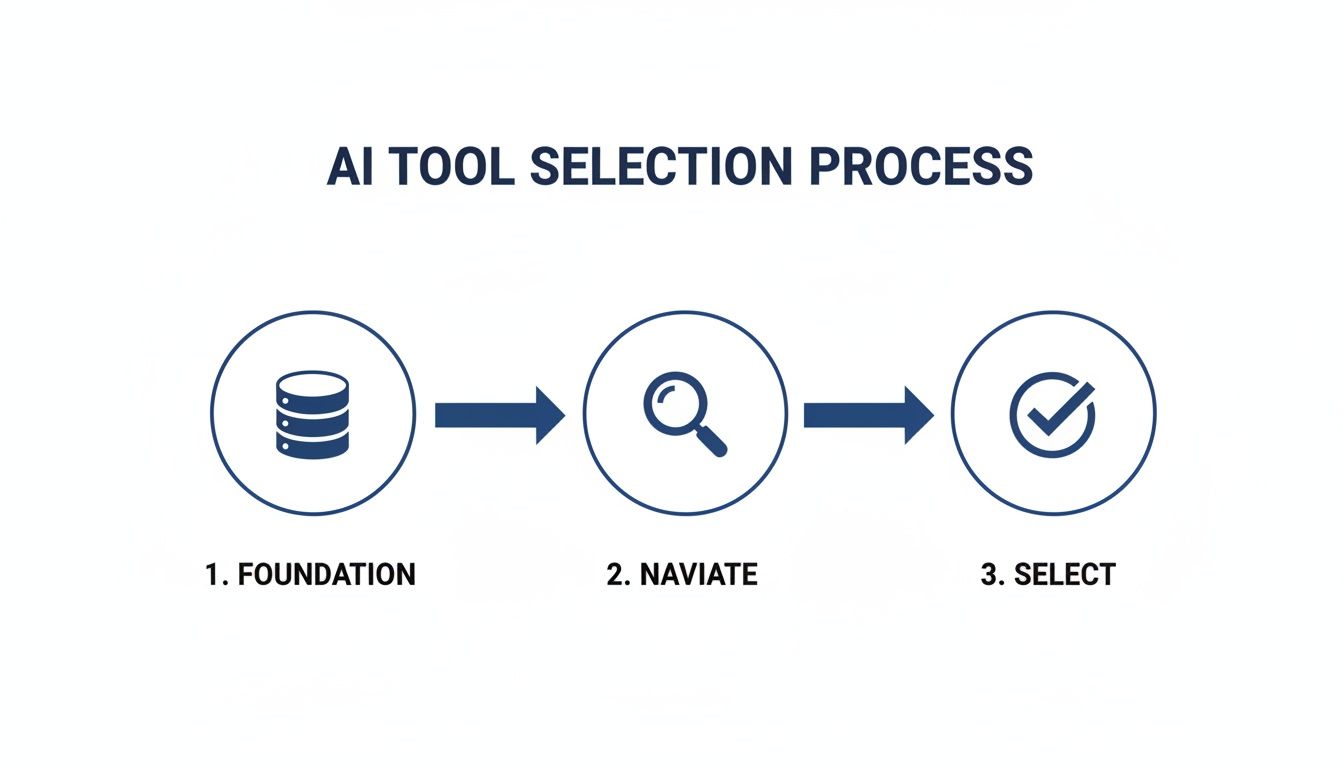
The main takeaway here is that you can’t pick the right tech without a solid data foundation. From there, it’s about navigating your options and making a clear, informed choice.
Crafting Intelligent Email and Content Experiences
AI-driven email marketing goes way beyond just slotting in a customer’s first name. Modern systems can build entire emails on the fly, populating them with product recommendations based on browsing history. They can send abandoned basket reminders at the exact time an individual is most likely to act. The AI can even figure out the best time of day to send the email by analysing when that specific user is most likely to be checking their inbox, giving your engagement rates a serious boost.
Dynamic website content follows the same logic. Instead of showing every visitor the same generic homepage banner, you can use AI to tailor the content to different user segments.
- New Visitors: Might see a banner promoting a first-time purchase discount.
- Returning Customers: Could be shown new arrivals in categories they’ve shopped from before.
- Location-Based Segments: A visitor from Vancouver might see ads for raincoats, while someone logging in from Calgary sees promotions for winter jackets.
This level of customisation makes your whole site feel more relevant and personally curated. The growth in this space is significant. In Canada, the artificial intelligence-based personalisation market was valued at USD 20.8 billion in 2024 and is forecast to hit USD 29.59 billion by 2035. This steady climb shows just how committed Canadian businesses are to integrating these technologies.
For those looking to get their hands dirty with practical applications, exploring a guide to personalised AI agents can offer some great insights. These strategies, which once felt out of reach for anyone but the biggest players, are now accessible to businesses of all sizes. The trick is to start with one clear goal, implement a single technique, and measure its impact before you move on to the next one.
Measuring Success and Navigating the Bumps in the Road
Getting your AI strategy off the ground is a huge step, but it’s really just the starting line. To make sure your investment in ecommerce personalisation actually pays off, you need a rock-solid way to measure what’s working and what’s falling flat. Without it, you’re just guessing, unable to tell if a sales spike was due to your new algorithm or just a random Tuesday.
Measuring success isn’t just for victory laps; it’s about learning from every single outcome. This constant feedback loop is what lets you fine-tune your approach, justify the budget, and build a personalisation engine that gets smarter with every click. It turns a one-off project into a cycle of continuous improvement.
The Numbers That Actually Matter for AI Performance
To get a real sense of your AI’s impact, you have to look past the flashy “vanity metrics” and zero in on the key performance indicators (KPIs) that connect directly to your business goals. These are the numbers that prove your personalisation efforts are actually hitting the bottom line.
Here’s what you should have your eyes on:
- Conversion Rate: This is the most direct measure of success. A great personalisation strategy should make it dead simple for customers to find what they’re looking for and hit “buy.” If your conversion rate is climbing steadily, it’s a powerful sign your AI is on the right track.
- Average Order Value (AOV): Are those AI-powered product recommendations actually convincing people to add more to their baskets? A rising AOV is proof that your suggestions are relevant and compelling, successfully bumping up the value of each sale.
- Customer Lifetime Value (CLV): This one’s the long game. It looks at the total revenue you can expect from a customer over their entire relationship with you. Smart personalisation builds loyalty and brings people back, which should drive a serious lift in CLV over time.
At the end of the day, the real test for any AI personalisation effort is whether it can move these core business metrics. If you’re seeing positive movement in conversion rate, AOV, and CLV, you know you’ve got a winner.
A/B Testing: How to Prove It’s Working
So, how can you be certain it’s your AI and not something else driving those improvements? The only way to know for sure is through rigorous A/B testing. The idea is simple: one group of visitors (the control) gets the standard, one-size-fits-all experience, while another group sees the personalised version. By comparing the results, you can isolate the impact of your changes with confidence.
You could, for instance, test a personalised homepage banner against a generic one. By tracking the click-through rates and, more importantly, the conversion rates for both groups, you get hard data on what truly performs better. This methodical approach is what separates data-driven decisions from pure guesswork.
Tackling the Hurdles You’ll Inevitably Face
Whilst the potential of AI is massive, the road to getting it right isn’t always a smooth one. Let’s talk about a few of the most common obstacles.
Data Privacy and Compliance
One of the biggest hurdles is navigating the tricky landscape of data privacy. In Canada, regulations like the Personal Information Protection and Electronic Documents Act (PIPEDA) have strict rules about how you can collect, use, and store customer data. Your best strategy here is transparency. Be completely upfront with your customers about how you’re using their data to make their experience better, and always give them an easy, obvious way to opt out.
The “Cold Start” Problem
Another classic challenge is the “cold start” problem. What happens when a brand-new visitor lands on your site? Your AI has no history to work with: no past purchases, no browsing data, nothing. A good way to handle this is to start with broader recommendations, like showing them your best-sellers or what’s currently trending. As they start clicking around, your AI can begin to learn their preferences and narrow its suggestions.
Keeping the Human Touch
Finally, it’s crucial to remember that AI is here to assist, not completely replace, the human element of your brand. If you go too far with automation, the experience can start to feel sterile and impersonal. The real magic happens when you blend AI’s efficiency with a genuine human touch – think a personalised follow-up email from a real customer service rep after a purchase. That’s how you create an experience that people remember.
The Canadian artificial intelligence in retail market is set for explosive growth, projected to expand from USD 254.54 million in 2024 to an incredible USD 2,769.23 million by 2032. However, this growth is tempered by real challenges, including data privacy concerns under PIPEDA and the high implementation costs that can be a major barrier for smaller shops. You can explore a deeper analysis of the Canadian AI in retail market trends on credenceresearch.com.
Got Questions? We’ve Got Answers
Stepping into AI-driven personalisation can feel a bit like exploring a new country. It’s exciting, but you’re bound to have some questions. We get it. Here are some of the most common ones we hear from merchants, along with straightforward answers from our experience.
“How Much Data Do I Actually Need to Get Started?”
This is probably the number one question we get, especially from smaller businesses worried they’re starting from zero. The great news is, you likely need less than you think. Whilst more data is always nice, today’s AI tools are surprisingly good at finding patterns even in smaller datasets.
The focus should really be on quality, not quantity. A clean, organised set of data is far more powerful than a massive, messy spreadsheet. You can start with the basics: purchase history, which products people are looking at, and what they’re adding to their basket. Honestly, even a few hundred transactions can be enough for a recommendation engine to start making some smart, valuable connections.
The biggest mistake is waiting for the “perfect” amount of data. The most important thing you can do is set up a solid data collection process now. Your AI will get smarter as your business grows and your data accumulates.
“Isn’t AI Personalisation Just for Big Companies With Big Budgets?”
It’s a common myth that anything with “AI” attached comes with a painful price tag. A few years ago, that might have been true, but the game has completely changed. Powerful personalisation tools are now well within reach for businesses of all sizes.
Many of the best solutions, especially those built for platforms like Shopify, run on flexible subscription models. You’ll often find pricing tiers based on your store’s traffic or revenue, so you can start small and only scale your investment as you see the results come in.
Think about it less in terms of cost and more in terms of return on investment (ROI). Good personalisation directly fuels your growth by:
- Lifting conversion rates: When you show people exactly what they want, they’re far more likely to buy.
- Increasing average order value: Smart cross-sells and “you might also like” suggestions are incredibly effective.
- Boosting customer loyalty: A shopping experience that feels like it was made just for them keeps people coming back.
A great way to start is by picking one high-impact area, like adding recommendations to your product pages, and finding a focused tool for that specific job. You don’t need a massive, all-in-one enterprise suite to see a real difference.
“How Do I Personalise the Experience Without Being Creepy?”
This is such a crucial question. There’s a fine line between being a helpful guide and an intrusive stalker, and staying on the right side of that line is key to building trust. The two principles that should guide every decision are transparency and value.
First, be upfront about how you use customer data. Your privacy policy shouldn’t be a wall of legal jargon. Write it in plain English, explaining what you collect and how it helps you create a better shopping experience.
Second, make sure every bit of personalisation is genuinely helpful. Recommending a pair of shoes that matches the dress someone just viewed? That’s great service. Using their exact location to send a push notification the second they walk by a park? That’s invasive. You want to be the helpful shop assistant who remembers a customer’s style, not the security camera tracking their every move.
Focus on solving their problems. Use data to help them find products they’ll genuinely love, remind them about an item they were considering, or let them know when something on their wish list is back in stock. Always give customers easy-to-find controls over their data. When people see personalisation as a service that helps them, you build trust instead of breaking it.
Ready to create those intelligent, data-driven experiences for your own store? The team at Cleffex Digital Ltd specialises in building custom software and AI solutions that help businesses connect with their customers in a more meaningful way. Discover how we can help you implement powerful ecommerce personalisation today.