

AI retail software development is about giving Canadian businesses smarter tools to run their operations, connect with customers on a personal level, and get ahead of market trends. Think of it as a strategic move for any retailer looking to work more efficiently and stand out in a busy marketplace.
The New Era of AI in Canadian Retail
The ground is shifting under the Canadian retail sector. Shoppers today expect a lot more than just a product on a shelf. They want smooth, personalised, and quick experiences, whether they’re browsing online or walking into a physical store. This isn’t just a minor trend; it’s a fundamental change that makes artificial intelligence a must-have tool for survival and growth, not just a neat idea for the future.
This shift creates both pressure and a massive opportunity for Canadian retailers. The challenges are real, from managing intricate supply chains that stretch from coast to coast to earning customer loyalty in a culturally diverse market. AI offers practical solutions to these very problems.
Why AI Is a Necessity Now
Could you imagine trying to manually keep track of what thousands of individual customers prefer? Or guessing when a sudden cold snap will drive up demand for winter coats in Calgary but not in Vancouver? It’s simply not possible for a human team to manage that scale of complexity. This is where AI retail software steps in, doing the heavy lifting by analysing huge datasets to deliver clear, actionable insights.
This kind of technology gives businesses the ability to:
Anticipate customer needs before they even realise what they want.
Fine-tune stock levels to avoid the financial drain of overstocking or the frustration of stockouts.
Create highly personalised marketing campaigns that actually connect with individual shoppers.
Boost efficiency across the board, from the warehouse floor to the checkout counter.
While the benefits are obvious, many businesses are still on the sidelines. According to Statistics Canada, only 12.2% of all Canadian businesses reported using AI in the second quarter of 2025. Even though that’s up from 6.1% the year before, it shows there’s still a huge opening for proactive retailers to get a serious jump on the competition.
Setting the Stage for Strategic Adoption
Bringing AI into your business isn’t about replacing your people; it’s about making them better at their jobs. It gives your team the power to make smarter, data-backed decisions that improve every part of the retail experience. This is the foundation for building the next generation of ecommerce software that can keep up with a market that never stops changing.
The goal is to move from reactive problem-solving to a proactive strategy. Instead of guessing what customers want, AI allows you to know what they want, often before they do, creating a more responsive and successful retail business.
What Is AI Retail Software, Really?
Let’s cut through the buzzwords. At its heart, AI retail software isn’t some far-off concept about sentient robots. It’s much more practical. Think of it as adding a team of brilliant digital specialists to your staff, each with a very specific, powerful skill to support your human experts.
Unlike traditional software that just follows a strict set of commands, these systems learn and adapt. They dig into the data your business creates every single day to make intelligent predictions. This is exactly why AI retail software development in Canada is becoming so important for businesses trying to succeed in our unique market. The goal is simple: give your people the insights they need to make smarter, faster decisions everywhere, from the stockroom right to the customer’s hands.
The Three Pillars of Retail AI
To get a real feel for what this software does, it helps to break it down into its three core components. Each one is like a different kind of specialist, and they work together to look at your business from every possible angle.
Machine Learning (The Forecaster): This is the predictive brain of the whole operation. Machine learning algorithms pore over your historical sales data, pick up on seasonal trends, and can even factor in things like local Canadian weather patterns to forecast future demand with incredible accuracy. It’s the specialist who helps you know what your customers will want before they do, saving you from the pain of overstocking or the frustration of running out of a popular item.
Natural Language Processing (The Communicator): Usually just called NLP, this is the part of AI that actually understands and responds to human language – in both English and French, of course. It’s the technology behind those smart chatbots that answer customer questions around the clock. It also sifts through customer reviews and feedback to paint a clear picture of what people are really saying about your brand.
Computer Vision (The Observer): This technology gives software the ability to “see” and make sense of the visual world. It can analyse in-store camera feeds to map out how customers move through your space, or it can power a feature that lets someone find a product just by taking a picture of it. For example, exciting new tools like AI clothing try-on technology are changing how people shop online, and computer vision is what makes it all possible.
The magic of AI isn’t in any single one of these pieces. It’s in how they all come together to create a system that genuinely learns from your business data. It turns raw numbers into a real strategic advantage that helps you serve your customers better.
From Instructions to Intelligence
Traditional software is fantastic at following orders. You tell it to process a sale or update a stock count, and it does it perfectly, every time. AI software takes it a big step further by learning from those very actions.
Think about a standard inventory system. It can tell you that you sold 100 winter coats last week. An AI-powered system, however, gives you context. It might report back, “You sold 100 winter coats last week, which is 30% more than we typically see in November. This spike happened right after the first major snowfall in Toronto, so I recommend we increase stock levels in our Ontario warehouses by 15% for the next two weeks.”
That’s the fundamental difference. The system isn’t just logging what happened; it’s figuring out why it happened and suggesting what you should do about it. For Canadian retailers who have to manage inventory across vast and varied regions, that kind of insight is invaluable. You can see a great example of this in action by reading up on how businesses are using AI for ecommerce inventory management. It’s a practical application that delivers a clear competitive edge.
How AI Changes the Game for Canadian Shoppers
It’s one thing to talk about AI in theory, but where does the rubber meet the road for Canadian retail? The real magic happens when AI applications start to actively reshape the entire customer journey, from the moment someone lands on your site to the final click of the “buy” button. This is where AI retail software development in Canada proves its worth, turning raw data into smarter operations and genuinely better shopping experiences.
Let’s break down four key ways AI is making a tangible difference right now.
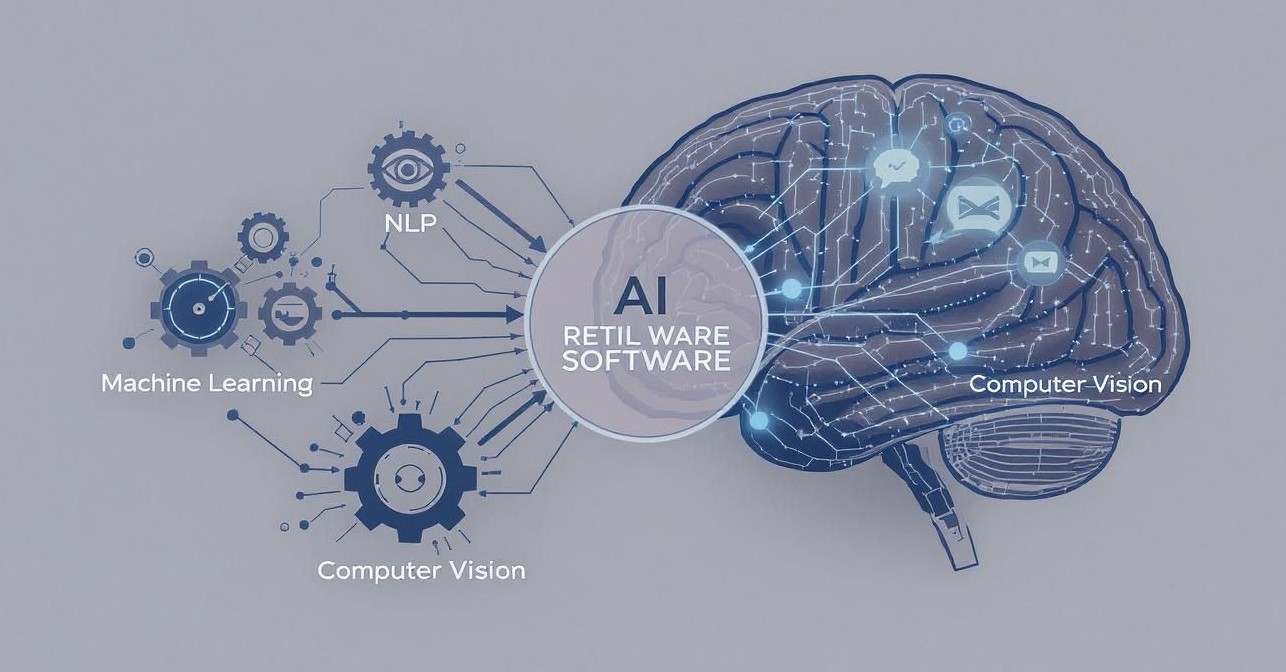
Think of this as the brain of a modern retail operation. Core technologies like machine learning, natural language processing, and computer vision are the different lobes, each powering specialised functions that work together to solve complex retail challenges.
Hyper-Personalisation at Scale
Imagine having a personal shopper for every single customer: someone who intuitively knows their style, remembers what they’ve bought, and even sees what they’ve been browsing. That’s exactly what AI-driven hyper-personalisation delivers, but on a massive digital scale. It crunches huge amounts of data, from past orders to real-time clicks, to serve up product recommendations that feel like they were picked by hand.
This is worlds away from the old “customers who bought this also bought…” model. True AI anticipates needs. For example, if a customer in Edmonton buys a new winter jacket, the system might suggest matching thermal gloves and a toque a week later, right as the first snowfall hits the forecast. It’s that level of relevance that makes a customer feel seen and understood.
This isn’t just a nice-to-have; it’s becoming essential. A 2025 industry report found that 90% of Canadian shoppers expect personalised experiences, and businesses that deliver are rewarded; those customers are 80% more likely to make a purchase. It’s no surprise that the Canadian AI in Retail market is set to explode from USD $254.54 million in 2024 to an estimated USD $2,769.23 million by 2032.
Demand Forecasting and Smart Inventory
There’s nothing more frustrating for a shopper than finding the perfect item, only to be met with an “out of stock” notice. AI-powered demand forecasting is the solution. It goes beyond simple sales history, analysing seasonality, regional trends, and even external factors like upcoming holidays or local events to predict what will sell, where, and when.
This allows Canadian retailers to keep just the right amount of stock in the right places. The system might flag a coming surge in demand for camping gear in British Columbia ahead of a long weekend, while also predicting a need for different items in urban centres like Montréal.
By shifting from reactive restocking to predictive ordering, retailers slash costs tied to overstocking and, more importantly, avoid losing sales because an item wasn’t available. It’s a direct route to a healthier bottom line and happier, more loyal customers.
Intelligent Customer Support
In a bilingual country like Canada, offering fast, effective support in both English and French is fundamental. This is where AI-powered chatbots and virtual assistants shine. These smart agents can instantly handle a huge volume of common questions – 24/7.
They can field queries about order status, return policies, or store hours without needing a human on the other end. This frees up your human support team to tackle the more complex, nuanced customer issues that require a personal touch. Thanks to modern Natural Language Processing (NLP), these bots understand intent and context, making the interactions feel surprisingly natural. This is a key part of using AI-driven ecommerce analytics Canada to truly understand what your customers are asking for.
Visual Search: Shop with a Photo
The way people discover products is evolving beyond the search bar. Visual search lets a customer use a picture to find what they want. Instead of fumbling with keywords to describe a unique lamp or a specific style of dress, they can just upload a photo. The AI then scans the retailer’s catalogue and returns the exact match or a list of visually similar items.
This technology makes finding things incredibly intuitive. It’s also a powerful tool for turning inspiration into a purchase, especially in visual-heavy sectors like fashion, home decor, and beauty. Even product pages themselves are getting smarter, with things like AI-generated backgrounds for improved conversion rates, making items more appealing. Visual search closes the gap between seeing something you love and being able to buy it.
To bring it all together, here’s a quick overview of how these AI applications tackle specific business problems in the Canadian retail space.
Key AI Applications in Canadian Retail
| AI Application | Core Technology | Business Benefit | Example Use Case |
|---|---|---|---|
| Hyper-Personalisation | Machine Learning, Predictive Analytics | Increased conversion rates, higher AOV, improved customer loyalty. | Recommending a specific brand of hockey skates based on a user’s past searches for NHL gear. |
| Demand Forecasting | Time-Series Analysis, Machine Learning | Reduced stockouts, lower inventory holding costs, optimised supply chain. | Increasing stock of rain jackets in Vancouver stores ahead of a predicted wet season. |
| Intelligent Support | Natural Language Processing (NLP), Chatbots | Lower support costs, 24/7 availability, faster response times. | A bilingual chatbot helping a customer track a package or initiate a return in French or English. |
| Visual Search | Computer Vision, Image Recognition | Enhanced product discovery, higher engagement, increased sales for visual products. | A shopper uploads a photo of a chair they saw in a magazine to find a similar one for sale. |
Each of these applications leverages a specific branch of AI to solve a distinct challenge, ultimately creating a more intelligent, responsive, and profitable retail operation.
Navigating Canadian Data Privacy and Compliance
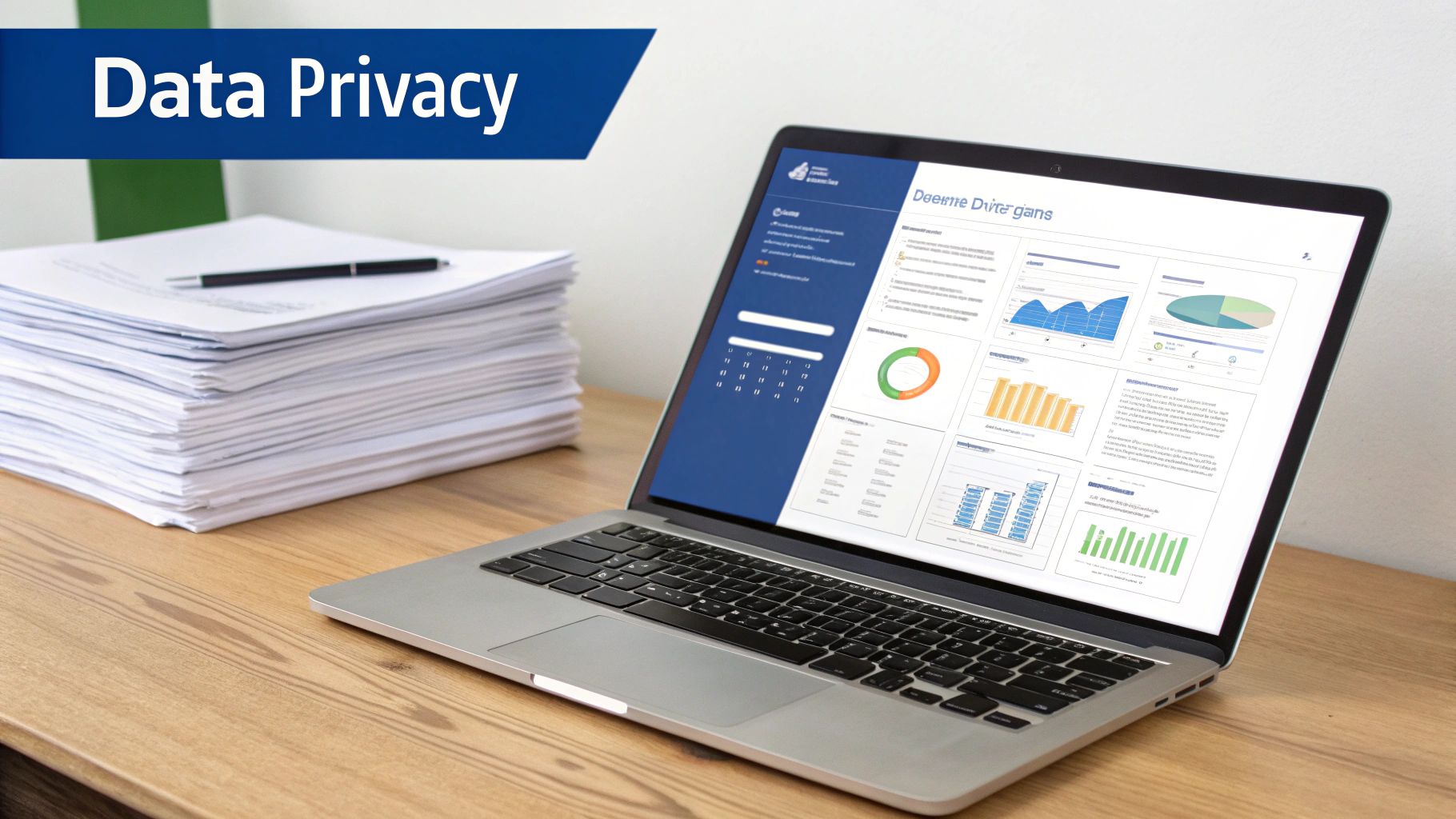
Bringing powerful AI tools into your retail business is a game-changer, but it also comes with a serious responsibility: protecting your customers’ data. Here in Canada, that’s not just a nice-to-have; it’s the law. Our legal landscape is unique, so you have to tread carefully to make sure you’re innovating responsibly.
Think about it, customer trust is everything in retail. When shoppers share their purchase history, location, or personal tastes, they’re trusting you to keep it safe. A data breach doesn’t just lead to hefty fines; it can shatter your brand’s reputation for good.
That’s why understanding the rules is a non-negotiable first step in any AI retail software development Canada projects. It’s far easier to build compliance into your software from day one than to try and bolt it on as an afterthought.
Understanding PIPEDA: The Federal Privacy Law
The main piece of federal legislation you need to know is the Personal Information Protection and Electronic Documents Act (PIPEDA). You can think of PIPEDA as the ground rules for how all private-sector businesses in Canada collect, use, and share personal information during any commercial activity.
PIPEDA is built on ten fair information principles, which are essentially the DNA of Canadian privacy law. For any retailer using AI, these are the big ones:
Consent: You have to get clear, meaningful consent from customers before you collect their data. They need to know exactly what they’re agreeing to.
Purpose Limitation: You can only use customer data for the specific reason you told them about. Want to use it for something new? You’ll need to ask for their consent all over again.
Accountability: Your business is on the hook for protecting the personal information you handle. That means assigning someone to oversee compliance and ensuring data is safe, even if a third-party service is processing it for you.
PIPEDA demands a transparent relationship with your customers. You can’t just collect data to process an order and then quietly use that same data to train a sophisticated AI personalisation model without being completely upfront about it.
Navigating Provincial Privacy Legislation
While PIPEDA sets the national standard, it’s not the final word. Several provinces have their own privacy laws that are considered “substantially similar” to PIPEDA, and in those provinces, the local rules apply.
For retailers, the most important ones to watch are:
Québec’s Bill 25: This is arguably the toughest privacy law in the country. It brings in strict new rules for data governance, requires privacy impact assessments for certain projects, and gives people much more control over their personal information.
British Columbia’s PIPA: The Personal Information Protection Act in B.C. dictates how private businesses in that province must handle personal data.
Alberta’s PIPA: Just like B.C., Alberta’s Personal Information Protection Act sets the data privacy rules for businesses operating within its borders.
This mix of federal and provincial laws means a one-size-fits-all approach just won’t cut it. If you have customers from Vancouver to St. John’s, your AI strategy has to respect the rules in every single jurisdiction.
Serving a Bilingual Nation Equitably
Canada’s bilingual identity is one of its defining features, and this has a direct impact on how you should develop AI. It’s not enough for your AI to simply work in both English and French; it has to perform equally well in both.
This means training your AI models on diverse datasets that properly represent both French and English-speaking communities. For instance, an AI-powered chatbot has to offer the same level of sophisticated help to a customer in Trois-Rivières as it does to one in Toronto.
Getting this right is both a technical challenge and a legal necessity. It really highlights why it’s so important to work with developers who understand the unique cultural and legal fabric of Canada.
Choosing Your Path: Build, Buy, or Partner?
So, you’re ready to bring AI into your retail operations. That’s a huge step. The next big question is, how do you actually do it? You’ve got three main paths in front of you, and the right one for your business depends entirely on your budget, your team’s technical skills, and where you see your company heading in the long run.
Think of it as a trade-off between your immediate needs and your future ambitions. Are you looking for a quick, straightforward fix to a common problem? Or are you aiming to build something completely unique that gives you a long-term competitive advantage? Let’s break down the options: buying an off-the-shelf product, building your own system from the ground up, or partnering with a specialist firm.
The “Buy” Option: Off-the-Shelf Solutions
Buying a ready-made AI software package is easily the fastest and most budget-friendly way to get started. These solutions are often designed to be “plug-and-play,” giving you standard features like AI-powered product recommendations or basic inventory forecasting that can be integrated into your existing setup without too much fuss.
This path is a great fit for small to medium-sized businesses that want to tap into AI capabilities without a massive upfront investment. The catch? You’re trading customisation for convenience. You’re limited to the features the vendor offers, which might not perfectly align with your unique business processes or data.
The “Build” Option: In-House Development
Building your own custom AI platform from scratch gives you ultimate control. You can design a system that’s a perfect match for your specific operational needs, creating a proprietary tool your competitors simply can’t copy. This approach means you own the intellectual property and can build a serious strategic asset for the future.
Of course, this is also the most demanding route. It requires a significant investment in hiring a dedicated team of AI specialists, data scientists, and engineers, which is a major hurdle for many companies. You’re also looking at a much longer timeline from idea to launch, and it comes with the highest risk if the project doesn’t pan out.
The reality for many Canadian businesses is that building a full-scale AI team just isn’t practical. The focus tends to be more on applying AI to improve what they already do, rather than undertaking massive, ground-up development projects.
This isn’t just a hunch; national data backs it up. A Statistics Canada report on business conditions from the second quarter of 2025 found that common AI activities included developing new workflows (40.1%) and training current staff (38.9%). Tellingly, only 12.6% of businesses planned on hiring new AI specialists. This trend highlights why options that don’t require building an internal army are so appealing.
The “Partner” Option: Outsourcing Development
For a growing number of Canadian retailers, partnering with a specialist AI retail software development Canada firm like Cleffex offers the ideal middle ground. This collaborative model gives you the customisation of building in-house, but without the heavy overhead and long-term commitment.
When you outsource, you get immediate access to a team of experts who live and breathe retail AI. They can work with you to design and build a solution that tackles your specific challenges, whether that’s optimising your supply chain for the Canadian market or creating a bilingual customer service chatbot. It’s a way to get a high-impact, tailor-made solution that fits your business perfectly, making it an incredibly popular strategy for gaining that competitive edge.
Deciding which path to take is a major strategic decision. To make it a bit clearer, let’s compare these three approaches side-by-side.
Comparison of AI Software Sourcing Models
| Approach | Key Advantages | Key Disadvantages | Best For |
|---|---|---|---|
| Buy (Off-the-Shelf) | – Fast implementation | ||
| – Lower upfront cost | |||
| – Predictable pricing | – Limited customisation | ||
| – May not fit unique workflows | |||
| – Vendor lock-in risk | Businesses needing a quick, standard solution without a large budget or in-house tech team. | ||
| Build (In-House) | – Complete control and customisation | ||
| – Own the intellectual property | |||
| – Creates a unique competitive asset | – Highest cost and risk | ||
| – Requires specialised talent | |||
| – Long development timeline | Large enterprises with specific needs, significant resources, and a long-term strategic vision for AI. | ||
| Partner (Outsource) | – Access to expert skills | ||
| – Custom solution without hiring | |||
| – Faster than in-house build | – Less control than in-house | ||
| – Ongoing vendor management | |||
| – Costs more than off-the-shelf | Companies wanting a custom solution but lacking the internal resources or desire to build a full AI team. |
Ultimately, there’s no single “best” answer. The right choice hinges on a clear-eyed assessment of your company’s resources, timeline, and strategic goals. Whether you buy, build, or partner, the key is to choose the path that empowers you to use AI effectively for your specific corner of the Canadian retail market.
Getting Started with AI in Your Retail Business
We’ve covered a lot of ground in this guide, from how AI is personalising the shopping experience to how it’s untangling complex supply chains across Canada. If there’s one thing to take away, it’s that artificial intelligence isn’t some far-off concept; it’s a practical tool that retailers are using right now to get ahead.
Making the leap to AI retail software development in Canada is really about shifting your mindset. It’s about moving from reacting to problems as they happen to anticipating them with a clear, data-backed strategy. This technology gives your team the kind of insights that lead to smarter inventory decisions, marketing that actually connects, and a customer base that keeps coming back.
The first step is simply understanding where you are now and being open to how these tools can solve your biggest headaches.
Your Actionable Next Steps
It’s easy to feel overwhelmed, but getting started is more straightforward than you might think. We’ve put together a simple checklist to help you turn these ideas into action. Think of it as your starting line for bringing AI into your business.
This isn’t about overhauling everything overnight; it’s about building a solid foundation, one step at a time.
You don’t need to have all the answers before you start. The key is to ask the right questions. Pick one significant business problem you want to solve and let that be your starting point.
Here’s how you can build a concrete plan:
Take a Hard Look at Your Data: Before you do anything else, be honest about the state of your data. Is it clean, organised, and easy to access? Good data is the fuel for any AI engine, so this step is non-negotiable.
Pick One Big Problem: Don’t try to boil the ocean. Zero in on your single biggest pain point. Is it constant stockouts? Customers who never return? A swamped support team?
Set a Clear, Measurable Goal: What does “fixed” actually look like? Get specific. Maybe it’s “cut our inventory holding costs by 15%” or “boost our repeat customer rate by 10%.”
Research the Right Tools: Now that you know the problem, you can look for the solution. Start exploring the types of AI tools – like personalisation engines, forecasting software, or chatbots – that are built to tackle your specific challenge.
Book a Consultation with an Expert: The fastest way to cut through the noise is to talk to someone who does this every day. A quick chat with an AI development expert can give you a realistic picture of costs, timelines, and the best path forward for your business.
A Few Common Questions
Diving into AI naturally brings up some practical questions about cost, time, and what you actually need to get started. Let’s tackle the most common ones we hear from Canadian retailers to help you map out your next steps.
What’s a Realistic Budget for Custom AI Retail Software in Canada?
The cost for custom AI retail software in Canada can swing quite a bit depending on what you’re trying to achieve, but it’s important to think of it as an investment, not just a purchase. You’re building a solution designed specifically for your business’s unique challenges.
For a smaller, more focused project, think a custom chatbot or a basic product recommendation engine, a starting budget would likely fall in the $25,000 to $75,000 range. If you’re looking at something more substantial, like a predictive inventory system or a sophisticated personalisation platform, you should plan for an investment starting around $100,000 and potentially exceeding $250,000.
What drives that final number? It really comes down to a few things:
The Scope: How many features do you need, and how complex are the AI models behind them?
Your Data: Is your data clean, organised, and ready to go? The amount of prep work needed can affect the timeline and cost.
Integration Work: How much effort will it take to plug the AI into your existing ecommerce platform, ERP, or CRM?
Long-Term Support: Don’t forget to factor in ongoing maintenance, model retraining, and system updates to keep it running smoothly.
How Long Until an AI Retail Solution Is Up and Running?
Getting an AI solution live isn’t like flipping a switch; it’s a phased process. A well-managed project ensures the tool you end up with actually drives results. While every build is unique, you can expect a structured journey from idea to launch.
A smaller-scale project can often be wrapped up in 3 to 6 months. For larger, more complex systems, it’s more realistic to expect a timeline of 6 to 12 months, sometimes longer.
Think of it like building a custom home. You wouldn’t rush the blueprint and design phase. Skipping ahead there often leads to a house that doesn’t quite work for you, forcing expensive changes later. It’s the same with software.
The rollout typically breaks down into these key stages:
Discovery & Strategy (2-4 Weeks): We nail down your business goals and take a look at your data.
Prototyping & Model Development (4-8 Weeks): This is where we build and train the core AI models.
Full Development & Integration (8-16 Weeks): We build out the full software and connect it to your other systems.
Testing & Deployment (4-6 Weeks): We make sure everything is working flawlessly before it goes live.
Do I Really Need Massive Amounts of Data to Get Started?
This is probably the biggest myth out there. You absolutely do not need a Google-sized data warehouse to start getting value from AI. It’s not about quantity; it’s about the quality and relevance of the data you already have.
Many fantastic AI projects kick off by tackling one specific, high-impact problem with a clean, focused dataset. For instance, you could use just a few months of sales data to build a simple model that predicts which products customers are likely to buy together. This gives you a quick win, proves the concept’s value, and builds momentum for bigger things down the road. The trick is to start small, show results, and scale from there.
Ready to see how a custom AI solution could give your retail business a real boost? The team at Cleffex Digital Ltd specialises in building tailored AI software that solves practical challenges for Canadian retailers. Let’s build your competitive edge together.