

Picture a tireless, brilliant assistant for your online store. This assistant works around the clock, knows exactly what your customers are looking for before they do, and handles all the repetitive, behind-the-scenes work without a single mistake. That, in a nutshell, is AI ecommerce automation. It’s about using smart technology to build faster, more intuitive, and deeply personal shopping experiences, all without needing you to manually pull the levers.
What Is AI Ecommerce Automation

Simply put, AI ecommerce automation involves using artificial intelligence to automatically handle and enhance different parts of an online retail operation. It’s a huge leap from basic, rule-based scripts to systems that can actually learn, predict, and adapt on their own.
Let’s look at a simple example: the order confirmation email. Standard automation sends the same generic message to every single customer. An AI-powered system, on the other hand, looks at that customer’s buying habits and sends a confirmation that also suggests other products they’re genuinely likely to love.
This is where AI really shifts the dynamic. It’s not just about getting things done automatically; it's about getting them done intelligently.
Beyond Basic Automation
Most businesses are already familiar with some level of automation. A system that triggers a shipping notification email is a classic example. It follows a straightforward, pre-programmed rule: if an order status changes to "shipped," then send an email. Simple.
AI automation operates on a whole different level because it can make its own decisions. Instead of just following rigid "if-then" instructions, it crunches data through complex algorithms to figure out the best move. This is the core of AI-powered workflow automation, which completely redefines what's possible for businesses, especially in ecommerce.
At its heart, AI ecommerce automation gives your business a 'brain'. It learns from customer behaviour, predicts future trends, and makes real-time adjustments to marketing, pricing, and support, creating a far more dynamic and responsive store.
The Technologies Driving the Change
So, what makes this all possible? Two key technologies are doing the heavy lifting: Machine Learning (ML) and Natural Language Processing (NLP).
Machine Learning (ML): This is the analytical powerhouse, the 'brain' of the operation. ML algorithms sift through massive datasets: sales figures, browsing patterns, and market trends, to spot patterns and make startlingly accurate predictions. For example, ML can forecast which products are about to trend next quarter, letting you stock up ahead of the rush.
Natural Language Processing (NLP): Think of this as the 'ears' and 'voice.' NLP gives computers the ability to understand, interpret, and respond to human language. It's the magic behind those surprisingly helpful chatbots that can hold a real conversation and solve a customer's problem on the spot.
Working together, these technologies give your online store a degree of insight and efficiency that used to be reserved for retail giants with entire data science departments. For businesses of any size, getting a handle on AI ecommerce automation is no longer a futuristic nice-to-have; it’s a fundamental tool for staying competitive and delivering an exceptional customer experience.
So, Why Should Your Online Store Bother with AI Automation?
Let's cut through the noise. Bringing AI into your business isn't a sci-fi fantasy anymore; it’s a practical decision that delivers real, measurable results. The true power of AI ecommerce automation isn't about buzzwords; it's about growing your business, running a tighter ship, and giving your customers an experience they’ll remember. It genuinely changes how you connect with people and manage your day-to-day operations.
For a lot of businesses, the biggest game-changer is the ability to offer radical personalisation on a massive scale. Imagine tailoring a unique shopping journey for every single person who lands on your site. AI makes that a reality. It analyses customer behaviour in the moment to show them the perfect product at the perfect time, which builds loyalty and has a huge impact on your conversion rates.
This isn't just a trend; it's a fundamental shift. By the second quarter of 2025, 12.2% of Canadian businesses reported using artificial intelligence, a huge jump from just 6.1% in the same period of 2024. Seeing AI adoption double in just a year shows just how quickly companies are weaving automation into their business, especially in ecommerce. You can dig into the specifics in the full Canadian business AI adoption report on www150.statcan.gc.ca.
Unlock Radical Operational Efficiency
One of the first things you'll notice with AI automation is how it blitzes through repetitive, time-sucking tasks with incredible speed and accuracy. This frees up your team to focus their brainpower on the strategic work that actually grows the business.
Think about the immediate wins in these areas:
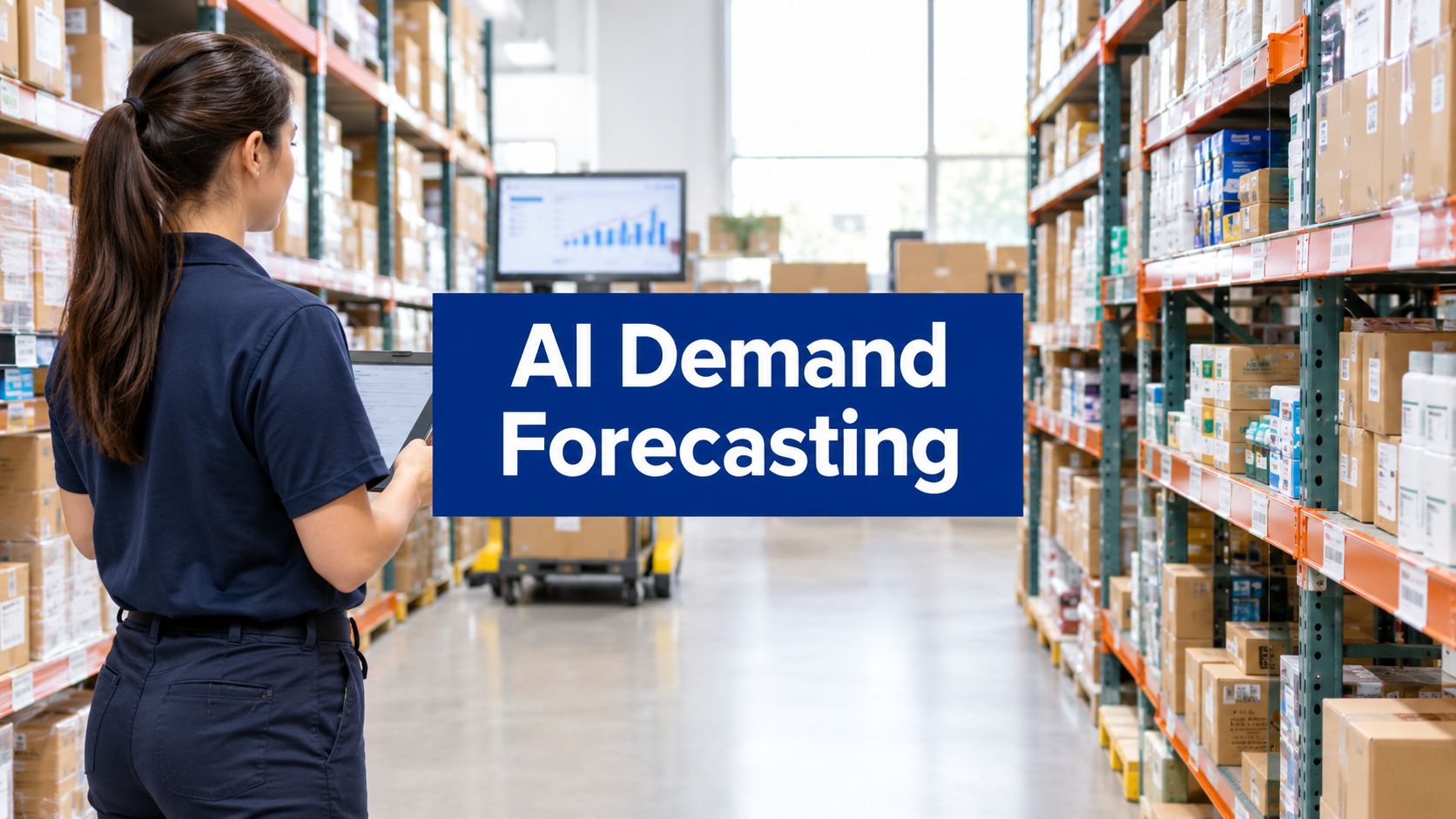
Inventory Forecasting: AI digs into your past sales data, seasonal trends, and market shifts to predict what customers will want next. This means you can finally stop guessing, avoid the cost of overstocking, and prevent those frustrating "out of stock" moments.
Automated Customer Service: AI-powered chatbots can handle common questions about order status or return policies 24/7. Your customers get instant answers, and your support team can focus on more complex issues.
Fraud Detection: Smart systems scan transaction data as it happens, flagging suspicious activity before it becomes a problem. This protects your revenue and shows customers that you’re a secure place to shop.
By automating these tasks, your team can stop putting out fires and start thinking about the future – building better customer relationships, trying new marketing ideas, and strengthening your brand.
AI automation doesn’t replace your team; it empowers them. By taking over the monotonous but necessary tasks it allows your people to apply their creativity and expertise where it matters most – driving growth and building your brand.
Make Smarter Data-Driven Decisions
In ecommerce, data is gold. But raw data is just a jumble of numbers until you can make sense of it. AI analytics acts as your interpreter, finding hidden patterns in customer behaviour and market trends that a person could never spot on their own.
This is what helps you shift from being reactive to proactive. Instead of wondering why sales dipped last month, you can actually predict which customers might be about to leave and send them a targeted offer to win them back. To see how this works in practice, check out our guide on implementing AI-driven ecommerce analytics in Canada.
Here's a concrete example: predictive analytics might reveal that customers who buy a certain coffee machine are highly likely to purchase a specific brand of coffee pods within three weeks. With that knowledge, your automated marketing system can send a perfectly timed, personalised discount email, landing an easy follow-up sale.
It's the same with dynamic pricing. Algorithms can adjust prices in real-time based on demand, what your competitors are doing, and even how much stock you have left, all to maximise your revenue. Imagine a flash sale where the system automatically nudges up the price of a best-seller as stock gets low, capturing extra profit from scarcity without anyone lifting a finger. Investing in AI is how modern ecommerce businesses turn their data into their most powerful strategic advantage.
Real-World Examples of AI Ecommerce Automation in Action
Let’s move past the theory and look at what AI ecommerce automation actually does for a business. These aren't just futuristic ideas; they're practical tools that online stores are using right now to work smarter, sell more, and build stronger relationships with their customers.
Essentially, each of these examples shows how AI turns mountains of data into smart, automatic decisions. The result? A better experience for your shoppers and a more efficient workflow for your team.
Hyper-Personalisation at Scale
The era of showing the same homepage to every visitor is officially over. Today's shoppers expect you to know what they want, and AI is the only way to deliver that truly personal touch to thousands of people simultaneously.
Think about it. The old way was to feature your best-selling items and hope for the best. It’s a safe, but incredibly generic, approach.
Now, imagine an online store that reshapes itself for every single visitor. An AI system watches a shopper's real-time behaviour: what they click, how long they look at certain products, what they’ve bought before, and instantly customises the product recommendations. Someone who loves hiking sees the latest boots and all-weather gear. The next visitor, an avid home cook, sees new kitchen gadgets and speciality ingredients. It’s like giving every customer their own personal stylist.
When you create these unique, one-to-one shopping journeys, you make customers feel seen and understood. This does more than just lift conversion rates; it builds the kind of loyalty that turns one-time buyers into lifelong fans.
Intelligent Customer Support
Quick, helpful support isn't a bonus feature anymore; it's a basic expectation. AI-powered chatbots and virtual assistants are changing the game by providing immediate answers, turning customer service from a cost centre into a powerful tool for customer retention.
Picture a customer asking, "Where is my order?" In the past, this simple question would create a ticket, forcing the customer to wait for a human agent to manually look up the tracking information. That delay, even if just a few hours, can be incredibly frustrating.
An AI chatbot, on the other hand, is integrated directly with your logistics systems. It pulls up the order status and provides a precise, real-time update in seconds, any time of day or night. If the issue is more complex, the bot intelligently routes the conversation to a human agent, along with the full context, so they can pick up right where the bot left off.
Before AI: Customers get stuck in queues for simple questions, and your support team spends most of its day on repetitive tasks.
After AI: Customers get instant gratification, and your human experts are freed up to handle the complex problems where their skills truly matter.
Smart Operations and Logistics
Behind every smooth-running online store is a finely tuned operational engine. AI automation is the key to streamlining the complex, behind-the-scenes work that directly affects your bottom line, from pricing and stock levels to security.
AI Ecommerce Automation Impact Across Business Functions
To really see the difference, let's break down how AI transforms core ecommerce functions. The table below highlights the common headaches businesses face and how AI automation provides a powerful solution.
| Business Function | Challenge Without AI | AI Automation Solution |
|---|---|---|
| Product Recommendations | Generic, best-seller lists that ignore individual tastes. | Dynamically suggests products based on a user's real-time behaviour and purchase history. |
| Customer Support | Slow response times; agents bogged down by repetitive queries. | 24/7 chatbots provide instant answers to common questions and escalate complex issues. |
| Pricing Strategy | Manual, slow price adjustments that can't keep up with market changes. | Algorithms monitor competitors and demand to automatically optimise prices for maximum profit. |
| Inventory Management | Guesswork leads to stockouts or costly overstocking. | Predictive analytics forecast demand, preventing stock issues and improving cash flow. |
| Fraud Detection | Manual review is slow and often misses sophisticated fraud attempts. | Real-time analysis of transaction data flags and blocks suspicious orders instantly. |
| Marketing Campaigns | Broad audience targeting results in wasted ad spend and low ROI. | Identifies high-value customer segments and optimises ad spend across channels automatically. |
As you can see, the shift isn't just about doing things faster; it's about doing them with an intelligence that was previously out of reach.
Smarter, Data-Driven Operations
Let's dig a little deeper into a few of those operational areas.
Dynamic Pricing is a perfect example. Trying to manually track competitor prices, market demand, and your own stock levels to set the perfect price is a losing battle. AI algorithms do this work for you, monitoring the market 24/7 and making micro-adjustments to keep you competitive while protecting your margins.
The same goes for inventory management. Instead of relying on gut feelings to place new stock orders, AI dives into your sales data, spotting seasonal trends and predicting future demand with stunning accuracy. This means no more capital tied up in slow-moving products and no more lost sales from an unexpected stockout. To see just how powerful this can be, check out our in-depth guide to AI inventory management for ecommerce.
Finally, AI acts as your tireless security guard for fraud detection. It can analyse thousands of data points in a single transaction, like location, device ID, and purchase time, to spot patterns that signal fraud, stopping bad actors in their tracks and protecting your revenue.
Automated Marketing and Advertising
Getting the right message in front of the right person is the whole point of marketing. AI takes the guesswork out of the equation, ensuring every pound you spend on advertising works as hard as it possibly can. And customers are ready for it.
A 2025 Léger survey found that one in four Canadian shoppers already uses AI-powered tools weekly, and 51% are open to using personalised recommendation tools. This signals a huge opportunity for businesses that embrace automation. You can read more about these findings in the full report on AI in ecommerce from Novatize.
Instead of spending hours building manual audience segments, an AI system can sift through your customer data to automatically identify lookalike audiences with a high probability of converting. It then takes things a step further by optimising your ad spend in real time, funnelling your budget to the campaigns and channels that are actually delivering a solid return. You’re not just reaching more people; you’re reaching the right people.
Your Roadmap to Implementing AI Automation
Ready to get started? Making the switch to an automated, intelligent ecommerce model is more of a journey than a single leap. By following a clear, structured roadmap, you can bring AI ecommerce automation into your business thoughtfully, making sure each step adds real value and sets you up for long-term success.
This isn’t about ripping out your entire operation and starting over. It’s about making smart, strategic choices that solve actual problems and deliver results you can see right from the beginning.
Step 1: Define Your Goals
Before you even glance at a single AI tool, you need to figure out what you’re trying to achieve. AI is a powerful solution, but it needs a specific problem to solve. Start by pinpointing the biggest headaches in your current operations.
Are you dealing with a sky-high cart abandonment rate? Is your customer service team buried under the same questions day after day? Maybe you’re losing sales because your most popular items are always out of stock.
Zero in on one or two primary objectives. For example, your goal might be to:
Reduce customer support response times by 50% by launching an AI chatbot.
Increase the average order value by 15% with smarter, personalised product recommendations.
Cut down on inventory holding costs by getting your demand forecasting right.
Having clear, measurable goals will be your North Star, guiding everything from which tools you choose to how you calculate your return on investment.
Step 2: Audit Your Data
Think of data as the fuel for your AI engine. Without high-quality, organised data, even the most sophisticated algorithm is going to stall. Before you can automate anything effectively, you have to get a handle on the data you have and make sure it's clean and accessible.
This means taking a hard look at your key data sources: your customer relationship management (CRM) system, sales records, and website analytics. Hunt for inconsistencies, missing information, or data silos where valuable insights are probably trapped.
A successful AI implementation is built on a foundation of clean data. Taking the time to organise and unify your customer and operational data is a non-negotiable step that pays massive dividends down the road.
This is your chance to build good data hygiene habits that will support not just this project, but every data-driven decision you make in the future.
Step 3: Choose the Right Tools
With your goals set and your data in order, it’s time to pick the tech that will make it all happen. The market is full of options, but they generally fall into two camps.
Integrated Platform Solutions: These are AI features baked right into major ecommerce platforms like Shopify. Tools like Shopify Magic give you native abilities for things like writing product descriptions or automating email campaigns, making them incredibly easy to get started with.
Specialised Third-Party Apps: These are dedicated tools that are laser-focused on solving one problem extremely well. Think of a sophisticated chatbot app or a powerful fraud detection service. They often have more advanced features than integrated solutions, but might take a bit more work to connect to your existing systems.
The right choice really depends on your specific needs and technical comfort level. For businesses just dipping their toes in, integrated solutions are a great entry point. Companies with more complex challenges might get more value from a best-in-class third-party tool.
This flow chart gives you a simple visual of how different AI functions, from customer chat to personalisation and back-end operations, can work together in an automated system.

The key thing to notice is how they’re all connected. Insights from one area, like what customers are asking about in chat, can feed into others, like which products to recommend, creating a much smarter experience overall.
Step 4: Start Small and Scale Up
It’s tempting to try to automate everything all at once, but that "big bang" approach is often risky and just plain overwhelming. The most successful projects I’ve seen all follow a phased approach: start with a small, manageable pilot project, prove it works, and then build on that success.
For example, instead of trying to overhaul your entire marketing, support, and logistics workflow at the same time, just start with one high-impact project. Setting up an AI chatbot to handle after-hours customer questions is a perfect place to start.
This lets you learn the ropes in a low-stakes environment, iron out any wrinkles, and show your team a clear win. Once that pilot is running smoothly and delivering results, you can use what you’ve learned to tackle your next automation goal with confidence.
Step 5: Measure and Iterate
Finally, putting AI in place isn’t a one-and-done task. To really get the most out of it, you have to constantly measure how it’s performing and tweak your strategy based on what the data is telling you.
Go back to the key performance indicators (KPIs) you set in the first step. Are you actually seeing that reduction in response times? Has the average order value gone up? Keep a close eye on these numbers.
Use those insights to make improvements. Maybe your chatbot's script needs a few adjustments to better answer certain questions, or your recommendation engine could be tuned to push higher-margin products. This cycle of measuring, learning, and improving is what turns a good AI project into a great one, ensuring your AI ecommerce automation strategy grows right along with your business and your customers.
Choosing the Right AI Tools and Navigating the Risks
Picking the right technology is only half the job. The real key to long-term success with AI ecommerce automation is understanding and getting ahead of the potential problems that can crop up. This means you need to make a smart choice – finding technology that’s not just powerful, but also practical and principled.
The whole process starts with a hard look at your own business needs. A massive, complex AI suite that’s perfect for a multinational corporation will likely just be an expensive headache for a growing startup. You’re looking for that sweet spot: a tool that fits your operation today but has enough room to grow with you tomorrow.
What to Look for When Evaluating AI Tools
It's so easy to get wowed by a long list of flashy features during a sales demo. But if you want to avoid buyer's remorse, you need to cut through the noise and focus on a few core things that actually matter for your business. A systematic approach ensures you end up with a genuine asset, not just another piece of software to manage.
Here’s what you should really be focusing on:
Integration Capabilities: How well does this tool actually connect with what you already use? Seamless integration with platforms like Shopify, your CRM, and your inventory management system isn't a "nice-to-have"; it's a must. A tool that traps data in its own little world is working against you.
Scalability: Ask yourself, will this solution still be working for us in a year? How about five years from now? You need a tool that can handle a spike in traffic during the holidays, manage bigger and bigger datasets, and take on more complex jobs as your ecommerce business expands.
Ease of Use: Your marketing or customer service team shouldn't need a degree in data science to use the platform. An intuitive interface and clear, helpful documentation mean your people can get up to speed quickly and actually use the tool effectively without months of training.
Support and Training: Because something will eventually go wrong, and when it does, you'll want solid support. Look for providers who offer great documentation, useful training materials, and a support team that actually responds when you need help.
When you start digging into specific technologies, checking out a roundup of the best chatbots for ecommerce can give you a great feel for what’s out there and how different options stack up against these very criteria.
To help organise your evaluation process, a simple checklist can make all the difference. It ensures you're comparing apples with apples and not overlooking a critical piece of the puzzle.
AI Tool Selection Checklist
| Evaluation Criterion | Key Questions to Ask | Importance (High/Medium/Low) |
|---|---|---|
| Integration with Current Stack | Does it connect easily with our ecommerce platform, CRM, and ERP? Are the APIs well-documented? | High |
| Scalability and Performance | Can it handle our projected growth in traffic and data over the next 3-5 years? What’s the uptime guarantee? | High |
| User-Friendliness | Can our non-technical teams use this day-to-day without constant help? Is the dashboard intuitive? | High |
| Data Security & Compliance | Is it fully compliant with GDPR, CCPA, and other relevant regulations? How is our customer data protected? | High |
| Customisation and Flexibility | Can we tweak the algorithms or workflows to fit our unique business rules? How much control do we have? | Medium |
| Vendor Support and Training | What kind of onboarding is provided? Is technical support available 24/7? Are there help docs and tutorials? | Medium |
| Reporting and Analytics | Does it provide clear, actionable insights? Can we build custom reports to track our specific KPIs? | Medium |
| Pricing and ROI | Is the pricing model transparent and predictable? Does the potential return justify the cost? | Low |
Using a structured list like this helps ground your decision in facts, not just feelings, ensuring the tool you select is truly the best fit for your business.
Navigating Critical Risks and Compliance
Bringing AI into your operations is a game-changer, but it also comes with some serious responsibilities, especially when it comes to data and ethics. Getting out in front of these risks isn't just about ticking compliance boxes; it's about earning and keeping your customers' trust. If you get this wrong, the damage to your reputation and bottom line can be huge.
The most successful AI strategies are built on a foundation of trust. This means being transparent with customers about how you use their data and ensuring that your automated systems operate fairly and ethically at all times.
There are three big areas you absolutely have to pay close attention to:
Data Privacy and GDPR: Regulations like the General Data Protection Regulation (GDPR) have very strict rules about how customer data is gathered, kept, and used. You have to ensure any AI tool you bring on board is fully compliant and that you’re totally transparent about your data practices. Your customers have a right to know what you’re collecting and why your algorithms need it.
Algorithmic Bias: AI models are only as good as the data they learn from. If your historical data has biases baked into it, say, from past marketing campaigns, the AI will learn and even amplify those biases. This could lead to unfair results, like only showing your best products to certain groups of people. You have to regularly check your algorithms for bias to make sure every customer gets a fair shake.
Maintaining the Human Touch: Automation is incredibly efficient, but it can’t replace a real human connection. Leaning too heavily on automation can make your brand feel cold and distant. To learn more about striking the right balance between technology and customer experience, check out our insights on building next-gen ecommerce software.
A great way to manage these risks is to set up clear rules for when a human needs to step in. For instance, a chatbot can handle simple questions about order status, but it should be smart enough to pass a frustrated or confused customer over to a live agent immediately. This hybrid approach gives you the best of both worlds: the efficiency of machines and the empathy and smart thinking that only a person can provide.
Looking Ahead: The Future of AI in Canadian Ecommerce
Stepping into AI ecommerce automation isn't just about shaving off a few operational costs. It's about fundamentally rewiring your business to be smarter, more agile, and completely in tune with your customers. As we've seen, AI touches every part of an online store, from creating those "wow" personalised shopping moments to untangling the complex logistics humming away in the background.
In today's market, adopting this technology isn't just a forward-thinking move; it's essential for staying relevant and competitive.
The Canadian digital marketplace is growing at an incredible pace, and AI is a huge part of that story. Since August 2019, ecommerce sales in Canada have more than doubled, hitting around $4.3 billion per month as we head towards 2025. This isn't a coincidence; it’s a direct result of retailers using AI to sharpen their operations and connect with customers more effectively.
What’s Next on the Horizon?
Looking forward, some truly exciting advancements are poised to change the game all over again. AI is starting to deliver on capabilities that once felt like science fiction, making online shopping feel more natural and intuitive than ever before.
Here are a few key developments to keep an eye on:
AI-Powered Visual Search: Imagine customers uploading a photo of a jacket they saw on the street to find similar items in your store. It completely redefines how people discover products.
Augmented Reality (AR) Try-Ons: This technology lets shoppers virtually try on a pair of sunglasses or see how a new sofa would look in their living room, all through their phone.
Hyper-Automated Supply Chains: Think of a supply chain that practically runs itself. AI uses predictive analytics to manage inventory and logistics with incredible precision, often spotting and solving potential disruptions before they even happen.
The message here couldn't be clearer: getting in early gives you a serious leg up. The businesses that embrace AI today aren't just making things run a bit smoother; they're setting themselves up to be the leaders of the next chapter in online retail.
To not just survive but thrive, Canadian businesses need to be part of this shift. By integrating AI ecommerce automation, you can unlock new levels of growth, build genuine, lasting customer loyalty, and secure your place in the market for years to come. The time to get started is now.
Frequently Asked Questions
Thinking about bringing AI into your ecommerce operations often sparks a few questions. We get it. Here are some straightforward answers to the things business owners ask us most.
How Much Does AI Automation Cost?
The price tag for AI automation isn't one-size-fits-all, which is actually good news. It means there’s a solution for just about every budget.
For smaller businesses, you can get started with some incredibly powerful off-the-shelf tools. Think AI chatbots or smart product recommenders from SaaS providers, often for a simple, predictable monthly fee.
Larger companies might be looking at a more significant investment, especially for custom-built systems designed to solve very specific problems. This could involve bringing in developers and data scientists. The real key is to find a starting point that fits your current reality and then scale up as you see the results.
Will AI Replace My Customer Service Team?
This is a big one, but the short answer is no. AI isn't here to replace your people; it's here to make them better at their jobs.
Think of it this way: AI acts as your front line, fielding all the simple, repetitive questions that eat up your team's day. "Where's my order?" or "What's your return policy?" – AI has those covered.
This frees up your experienced human agents to handle the tricky stuff: the complex issues, the sensitive customer conversations, and the moments that truly build loyalty. It’s about creating a powerful partnership where technology handles the routine, so your team can deliver exceptional, human-centric service.
AI handles the predictable, freeing up your team to manage the exceptional. The goal is a powerful partnership between human expertise and machine efficiency, not a replacement of one for the other.
Which AI Feature Should I Start With?
The best place to start is with your biggest headache. Don't just jump on the bandwagon for the newest AI trend; dig into your own data and find the area where you can make the biggest impact, fast.
Here’s a simple way to think about it:
Losing sales at checkout? If you have a high cart abandonment rate, start with AI-powered product recommendations or an automated email sequence to bring those shoppers back.
Customers can't find things? If your search bar is letting people down, an AI-driven search engine can completely change the game, making product discovery a breeze.
Support team buried in tickets? If your agents are overwhelmed, an AI chatbot is a no-brainer. It provides instant answers to common questions and lightens the load immediately.
By zeroing in on a specific, high-impact problem first, you'll see a clear return on your investment, which makes it much easier to build a case for future AI ecommerce automation projects.
Ready to see how AI automation can transform your business? The team at Cleffex Digital Ltd specialises in building innovative software solutions that drive growth. Visit us to learn more about our services.