

Think of your online store less like a rigid, pre-built shop and more like a set of high-tech building blocks. That's the essence of headless commerce: it separates the customer-facing storefront (the "head") from all the complex machinery running in the background. This gives you the freedom to build completely custom, lightning-fast experiences for any device you can imagine.
Now, what happens when you give those building blocks a brain? That’s where AI comes in.
A Smarter Way to Sell Online
In today's crowded ecommerce space, a generic, one-size-fits-all approach just doesn't cut it anymore. Shoppers have come to expect interactions that feel personal, move at the speed of thought, and just work, seamlessly. This is precisely why combining a flexible headless architecture with the power of artificial intelligence is becoming such a critical move for businesses that want to stay ahead.
This guide will walk you through what it really means to pair headless commerce with AI. We'll break down how unhitching your front-end presentation layer from your back-end commerce engine gives you the agility to design and deliver unique shopping experiences anywhere, from your website and mobile app to in-store kiosks, smart mirrors, or even voice-activated devices.
Bringing the Brains and the Brawn Together
So, how does AI supercharge a headless setup? If you think of headless architecture as the adaptable, strong skeleton, AI is the intelligent, constantly learning brain that controls it. This pairing turns structural freedom into real-world business advantages by driving smarter, more personal interactions at every turn.
This isn't just some far-off trend; it's the next logical step for any business serious about building a strong, future-proof digital presence.
Here’s what that powerful combination actually looks like in practice:
Deeply Personal Shopping: AI algorithms can sift through customer data in the blink of an eye, serving up unique product recommendations, customised promotions, and even changing the content on the page to match each visitor's tastes.
A Better Customer Journey: The entire experience becomes smoother and more helpful. Think search results that understand what you mean, not just what you type, or AI-powered chatbots that can solve customer issues 24/7.
Smarter Operations: Behind the scenes, AI can take over complex tasks like predicting inventory needs and optimising how orders are fulfilled, which frees up your team to focus on bigger-picture growth.
For anyone leading a business, this duo is the key to creating deeper customer connections and running a more efficient operation. Of course, turning this powerful technology into tangible growth requires a solid plan and the right expertise. Working with a skilled custom software development company can be the difference-maker, helping you architect a system that’s not only powerful but also perfectly tuned to your specific business goals.
Understanding Headless Commerce Architecture
So, what does 'headless' actually mean? Let's break it down.
Imagine a traditional ecommerce platform as a typical brick-and-mortar shop. The storefront where customers browse, the cash registers, and the back stockroom are all part of the same, single building. Sure, you can repaint the walls or rearrange the shelves, but you can't easily move the front door or add a new wing without a major renovation.
Headless commerce throws that old blueprint out the window. Think of it more like having a central, high-tech warehouse (the backend) that can supply products to any kind of storefront imaginable. It could be a slick mobile app, a digital kiosk at a trade show, a shoppable post on social media, or even a voice-command shopping experience through a smart speaker.
The ‘head’: the part the customer sees and interacts with, is completely detached from the ‘body,’ which is the backend engine running everything from inventory to payments. This separation is the secret sauce.
The API-First Connection
If the frontend and backend are separate, how do they talk to each other? That's where Application Programming Interfaces, or APIs, come in. APIs are like the trusted messengers that create a constant, seamless line of communication between your backend commerce functions and any frontend experience you dream up.
This API-first approach is the bedrock of agile, modern retail. Instead of being boxed into a single, rigid system, you have the freedom to innovate. You can deliver consistent, highly customised shopping journeys wherever your customers happen to be.
The diagram below shows how this flexible foundation, supercharged by an AI brain, works to create a genuinely personal customer experience.
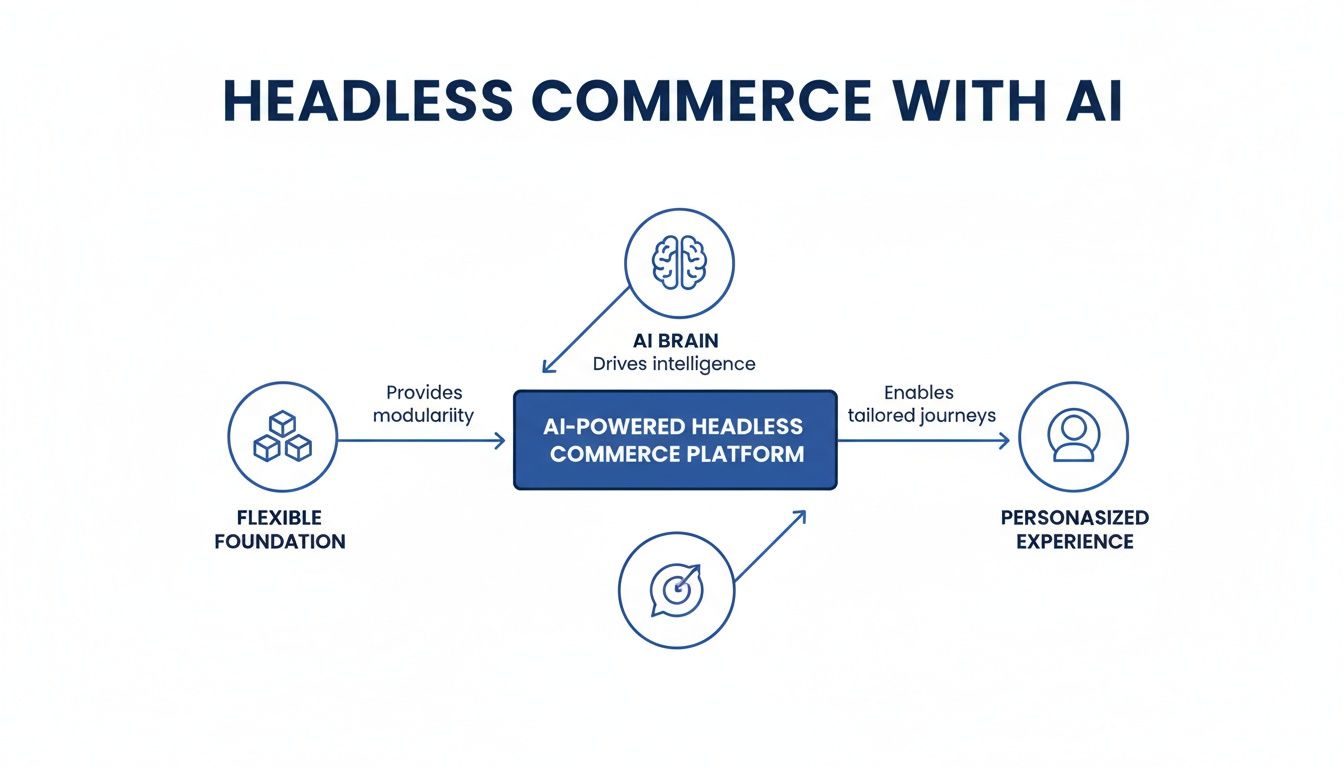
As the visual shows, once the frontend is decoupled, businesses can plug in an intelligent AI layer. This layer analyses customer data and then pushes hyper-personalised content, offers, and recommendations out to any and every customer touchpoint.
Traditional vs. Headless: A Quick Comparison
Putting the two models side-by-side really clarifies the difference and shows why so many businesses are making the switch.
| Feature | Traditional Commerce | Headless Commerce |
|---|---|---|
| Structure | Monolithic (all-in-one system) | Decoupled (separate frontend and backend) |
| Flexibility | Limited by platform templates | High creative and technical freedom |
| Speed to Market | Slower for new features or channels | 50% faster to launch new digital experiences |
| Omnichannel | Difficult to maintain consistency | Natively supports multiple channels |
This isn't just about making things look prettier; it's about fundamentally changing how quickly you can adapt to new opportunities. If you're curious about the nuts and bolts, you can learn more about the most popular headless architecture technologies in our deep-dive guide.
This architectural shift is really about future-proofing your business. It allows you to integrate emerging technologies, from augmented reality try-ons to IoT-connected devices, without having to rip out and replace your entire system. You're building a resilient foundation that's ready for whatever comes next.
How AI Supercharges Your Headless Strategy
If headless architecture gives your digital store a flexible, agile body, think of Artificial Intelligence as the brain that makes it smart. Bringing AI into a headless setup is what takes a responsive system and turns it into a proactive, learning machine – one that actually anticipates what customers want and streamlines how you run your business. This combination is where the real magic of headless commerce with AI happens.
By plugging intelligence into your decoupled architecture, you're no longer just showing products on different screens. You're crafting dynamic, individual shopping journeys that change in real-time for every single user. Let's dig into five game-changing ways AI can give your headless strategy a serious competitive edge.
Here's a quick look at the key ways AI enhances a headless setup.
AI Use Cases in Headless Commerce
| AI Application | Functionality | Business Benefit |
|---|---|---|
| Hyper-Personalisation | Analyses user data (browsing, purchase history) to serve unique content, layouts, and promotions on any frontend. | Boosts engagement, increases conversion rates, and fosters customer loyalty. |
| Intelligent Search | Uses Natural Language Processing (NLP) to understand user intent, correct typos, and deliver highly relevant search results. | Reduces friction, improves product discovery, and shortens the path to purchase. |
| Smart Recommendations | Employs machine learning algorithms to suggest products based on individual behaviour and similar user patterns. | Increases Average Order Value (AOV) and enhances the overall shopping experience. |
| Conversational Commerce | Deploys AI-powered chatbots and virtual assistants for 24/7 customer support across all channels. | Improves customer satisfaction, reduces support costs, and frees up human agents for complex issues. |
| Backend Optimisation | Leverages AI for demand forecasting, inventory management, and intelligent order routing. | Minimises stockouts, lowers operational costs, and speeds up fulfilment times. |
Each of these applications moves you from simply selling online to creating truly intelligent and efficient commerce experiences.
1. Hyper-Personalisation at Scale
The one-size-fits-all storefront is dead. AI-driven personalisation is the new standard, digging into massive streams of customer data: like browsing history, past purchases, and what a user is doing right now, to custom-fit the shopping experience for every visitor.
This means you can automatically show different homepage layouts, unique product carousels, and targeted offers across any frontend, whether it's your website, a mobile app, or even an in-store kiosk. For instance, a regular customer who loves running gear might see new shoe arrivals from their favourite brands right away, while a new visitor could be shown a curated collection of best-sellers to help them get started.
The ability of AI to comb through data and create these personal touches is a huge driver for sales, as explored in this data-driven guide on improving ecommerce conversion rates.
2. Intelligent and Predictive Search
Let's be honest, a standard keyword search can be clumsy. A customer might type in "summer dresses," but what they really mean is a breathable, floral-print sundress perfect for a beach trip. AI-powered search gets this. It understands the intent behind the words, going way beyond simple keyword matching.
Using Natural Language Processing (NLP), an intelligent search function can decipher nuances, fix typos, and pull up incredibly accurate results. This completely changes the search bar from a basic tool into a helpful shopping assistant, cutting down on frustration and helping people find exactly what they’re looking for, faster.
3. Smart Product Recommendations
Good product recommendations are a massive revenue booster. Old-school systems might just suggest popular items, but AI elevates the game by using predictive algorithms that learn from each user's unique patterns.
By analysing which products are viewed, added to carts, and bought together, AI can serve up highly relevant "you might also like" suggestions. This doesn't just increase the average order value; it makes the customer's experience better by helping them discover other products they’ll actually love.
If you're thinking about adding this to your site, our article on creating effective AI-powered product recommendations is a great place to start.
4. AI-Driven Backend Optimisation
The impact of headless commerce with AI isn't just limited to what the customer sees. AI algorithms can completely reshape your backend operations, bringing a new level of smarts to inventory and fulfilment.
Demand Forecasting: AI can look at past sales, market trends, and even outside factors like weather to predict future demand with startling accuracy. This helps you avoid running out of hot items or getting stuck with too much seasonal stock.
Inventory Management: By forecasting demand, AI helps you keep just the right amount of product in your warehouses, cutting down on carrying costs and freeing up cash.
Fulfilment Logic: AI can instantly figure out the best warehouse to ship an order from based on the customer’s location, shipping costs, and current stock levels. The result? Faster delivery and lower operational expenses.
5. Advanced Conversational Commerce
Finally, think about AI-powered chatbots and virtual assistants offering instant, surprisingly human-like support, 24/7. When tied into a headless architecture, these bots can pop up anywhere: on your website, in your mobile app, or even on social media.
They can handle all sorts of questions, from tracking an order and processing a return to giving product details and walking a customer through checkout. This lets your human support team focus on trickier problems, while ensuring your customers always get the immediate help they need.
Why Bother With Headless and AI? It's All About the Bottom Line
Let's be honest: adopting new technology is a big decision, and it has to do more than just make you look modern. Any investment, especially in something like a headless commerce and AI strategy, needs to deliver real, measurable results for your business.
At the end of the day, it all comes down to creating a customer journey that's not just better, but more profitable. When you can serve up truly personalised content, timely offers, and smart recommendations, you start to see key metrics move in the right direction. Shoppers feel like you actually get them, and that feeling translates directly into higher conversion rates and customers who keep coming back. Your online store stops being a static catalogue and starts acting like a personal shopping assistant.
Unleash Your Team's Agility
Another massive win here is the sheer speed and freedom it gives your teams. If you’ve ever worked with a traditional, all-in-one ecommerce platform, you know the pain. Launching a simple seasonal campaign, a new feature, or even a new sales channel can feel like moving a mountain, tangled in the rigid structure of the system.
Headless architecture completely shatters those chains. Your front-end developers can innovate and build new customer experiences without ever having to mess with the back-end. This means they can launch new features and campaigns in a tiny fraction of the time it used to take. That kind of speed is a serious competitive advantage, letting you pivot and respond to market shifts almost instantly.
This isn't just a short-term fix. It’s about future-proofing your business. You're building a flexible tech stack that's ready for whatever comes next, be it augmented reality (AR), virtual reality (VR), or the Internet of Things (IoT), without having to rip everything out and start over.
This newfound freedom is a genuine game-changer, especially in the fast-paced Canadian ecommerce scene where headless is catching on quickly. We’re seeing Canadian businesses that switch to headless boost their conversion rates by up to 25% simply because their sites are faster and the experience is more personal. On top of that, mid-sized firms in Canada have cut the time it takes to launch new digital experiences by a whopping 50%, giving them the agility to jump on market trends.
Supercharge Your Performance and SEO
Site speed isn't just a nice-to-have for the tech team; it's a critical business metric. Headless front-ends are incredibly lightweight, which means they deliver blazingly fast site speeds and a snappy user experience. This has a direct, positive impact on both customer happiness and how you rank in search engines.
Better Core Web Vitals: Faster load times and a smoother interface lead straight to better Google Core Web Vitals scores, which help boost your organic search visibility.
Drastically Lower Bounce Rates: When a page loads in a blink, people stick around. They explore. They buy. A slow site just sends potential customers running to your competitors.
More Mobile Conversions: The majority of your traffic is likely coming from smartphones. A high-performance front-end is no longer optional if you want to convert those on-the-go shoppers.
These aren't just minor tweaks. They create a fundamentally better experience that search engines actively reward and customers genuinely appreciate. For any business serious about its online presence, the SEO benefits alone make a powerful argument for making the switch.
A New Era for Your Marketing Team
A huge part of the business case for headless and AI is how it completely changes the game for marketing. The two together unlock a level of automation and one-to-one personalisation that just wasn't possible before. For a deeper dive into what this looks like in practice, check out this fantastic guide to ecommerce marketing automation.
Ultimately, investing in headless commerce with AI is about building a smarter, more resilient business that puts the customer at the absolute centre of everything. It gives you the toolkit to not only meet today's expectations but to adapt and win as the world of digital retail continues to change.
Your Implementation Roadmap
Moving to a headless, AI-powered architecture isn't just a technical upgrade; it's a strategic shift. You can't just flip a switch. It requires thoughtful planning and a phased rollout to make sure everything clicks into place. This roadmap breaks the journey down into clear, manageable stages, taking you from a rough concept to a fully tuned, intelligent commerce engine.
Think of it like building a custom car. You wouldn't just start welding random parts together. You'd start with a detailed blueprint, pick the best engine and chassis for your needs, and then carefully assemble and test every single component. The same logic applies here – a successful headless commerce with AI project is built on a solid foundation of strategy and design.
Phase 1: Strategy And Assessment
Before you even think about code, the first step is to figure out what success actually looks like for your business. This is the foundational phase, where you get everyone in a room to align the project with your bigger business goals.
You need to get specific. Are you trying to bump up conversion rates by 25%? Or maybe you need to shave seconds off your site speed to climb the SEO rankings? Perhaps the goal is to break into new channels like a mobile app or even IoT devices.
This stage is all about:
Defining Business Goals: Get crystal clear on the outcomes you want. This could be anything from grabbing more market share to improving customer lifetime value or cutting down on operational overhead.
Identifying Key Performance Indicators (KPIs): You need to know how you'll measure success. Pin down the specific metrics you'll track, like conversion rate, average order value, site load time, or customer satisfaction scores.
Auditing Existing Systems: Take a hard look at what you have now. A full audit of your current tech stack, data sources, and your team's skills will show you where you're strong, where you're weak, and what integration challenges lie ahead.
Phase 2: Technology Selection
Once you have a clear strategy, it's time to pick your tools. The headless ecosystem is packed with options, so this phase is about putting together a "best-of-breed" stack that fits your specific needs, budget, and plans for growth. Working with a trusted software development company can be a huge help in navigating these choices.
Your core setup will probably include:
Headless Ecommerce Platform: This is your backend workhorse for managing products, orders, and payments. Think platforms like Shopify Plus, BigCommerce, or commercetools.
Headless CMS: This is where all your content lives, from product descriptions to blog articles. Popular choices include Contentful, Strapi, and Sanity.
AI and Personalisation Tools: These are the brains of the operation, driving recommendations, search, and analytics. You might look at Algolia for search, or consider other specialised tools and custom models.
Frontend Framework: This is what your developers will use to build the actual customer experience. Common frameworks are React, Vue.js, and Next.js.
Phase 3: Architecture And Integration
This is where the blueprint starts becoming a reality. Your development team will design the API-first architecture that acts as the connective tissue holding your entire system together. The objective is to build a solid, scalable framework where data can flow smoothly between all your backend services and whatever frontend you put on top.
This phase is arguably the most critical for long-term success. A well-designed architecture ensures your system is not only powerful today but also flexible enough to accommodate future technologies and sales channels without requiring a complete overhaul.
The main job here is to design and build the APIs that link your chosen platforms. It's a complex but non-negotiable step in any project that relies on expert ecommerce development services.
Phase 4: Development And AI Training
With the architecture in place, the work splits into two parallel tracks: building the front-end experience and training your AI models. Your frontend developers will get to work with the chosen frameworks, crafting the fast and engaging interfaces your customers will see on your website, mobile app, or other touchpoints.
At the same time, your data science or AI team starts feeding the algorithms. This means cleaning up historical customer and product data and using it to train the models that will eventually power your personalisation, search, and recommendation features.
Phase 5: Testing, Launch, And Optimisation
The home stretch is all about making sure you have a smooth launch and then committing to making things better over time. You absolutely cannot skip rigorous testing. This means performance tests, security audits, and user acceptance testing (UAT) to squash any bugs before you go live.
You might want to launch in stages – maybe start with just one sales channel or roll out to a small beta group to get early feedback. But the job isn't done once you launch. Headless commerce with AI is not a "set it and forget it" solution.
After launch, the focus shifts to continuous improvement. By keeping a close eye on performance data and customer behaviour, you can constantly refine your AI models, tweak the user experience, and add new features. As we've explored in our software development solutions guide, this kind of iterative approach is the real key to getting the most out of your investment.
Building Your Future-Proof Commerce Engine
Moving to a headless commerce setup powered by AI isn't just another tech upgrade; it's a completely different way of thinking about your business. We're moving away from the old model of a static online shop and into an era of creating living, intelligent retail ecosystems that are built to adapt.
This combination gives you the freedom to innovate quickly, the smarts to make every customer interaction feel personal, and the operational muscle to scale without friction. For any business, big or small, this is how you create the kind of memorable experiences that build real loyalty and, of course, drive growth. It’s about looking beyond the webpage to a future where commerce is connected and intelligent, meeting your customers wherever they are.
We dive deeper into these kinds of forward-thinking solutions in our guide to next-gen ecommerce software.
From Static Storefront to Intelligent Ecosystem
Making this shift from a simple online store to a dynamic commerce engine takes a clear vision and some serious technical know-how. The real goal is to build a system that doesn't just react to what customers want but actually starts to anticipate their needs.
By plugging AI into a decoupled architecture, you create a powerful feedback loop. Every click, every search, and every purchase make the entire system smarter and more in tune with what your customers are looking for.
This is where finding the right technology partner is so important. An experienced team can help you map out the architecture, pick the best tools for the job, and actually implement the AI models that bring your business goals to life.
Shaping the Future of Retail
At the end of the day, adopting headless commerce and AI is about more than just new tech. It’s a strategic decision to build a foundation that can handle whatever the future throws at it, whether that's a new device, a new sales channel, or a sudden shift in how people shop.
It's about making sure your business isn't just keeping up with the future, but actively shaping it.
Got Questions? We've Got Answers
Thinking about making the switch to headless commerce with AI? It’s a big move, and you probably have a few questions. Let's tackle some of the most common ones we hear from businesses.
Is This Really a Fit for My Small Business, or Just for Big Enterprises?
That's a common misconception, but no, it's definitely not just for the big players anymore. While large companies love the scalability, the tools and approaches for headless AI have become incredibly accessible for small and medium-sized businesses. With the right tech stack and a good partner, you can build a cost-effective system that grows with you.
For a startup, starting headless from the get-go is actually a smart move. It saves you from a massive, expensive replatforming project later on and lets you innovate much faster. The beauty of it is the modular design – you can begin with a solid headless foundation and then layer in specific AI tools as you grow and your needs evolve.
What Are the Biggest Hurdles I Should Expect During Implementation?
The two main challenges are usually the technical complexity and the upfront investment. Moving away from a traditional, all-in-one system means your team needs to think "API-first." You're essentially knitting together a collection of specialised services: your CMS, ecommerce engine, search tools, and AI platforms, and that requires a specific kind of expertise.
The initial build might cost more than a simple all-in-one platform. But when you look at the long-term return on investment, driven by better agility, higher conversion rates, and streamlined operations, the business case is usually very strong.
This is why teaming up with a specialist in ecommerce development services is often the best way forward. It helps you sidestep the common pitfalls and ensures the whole process is as smooth as possible.
How Long Does a Headless Commerce Project Actually Take?
Honestly, it all comes down to the scope of your project. For a smaller business doing a straightforward migration with a pre-built frontend, you could be looking at a timeline of 3-6 months.
On the other hand, a larger, more complex build for a mid-sized enterprise: one that includes a completely custom frontend, numerous integrations, and training sophisticated AI models, could easily take 9-18 months.
But here’s the best part about going headless: you don't have to build it all at once. You can launch in phases. Get the new website live first, then follow up with a mobile app or an IoT experience later, all without having to rip apart your backend. This phased rollout, as we have explored in our software development solutions guide, makes the project far less risky and delivers value much sooner.
Ready to build a smarter, more flexible future for your business? The team at Cleffex has the expertise to guide you through every step of your headless commerce and AI journey. From strategy to launch and beyond, we build solutions that drive real growth. Learn more about our approach and values on our about us page.