

Creating a successful healthcare app is about so much more than writing clean code. It's about building a digital tool that both patients and healthcare providers can genuinely trust in an industry where the stakes are incredibly high. This guide is your practical roadmap, designed to walk you through the entire journey, from that first spark of an idea to a successful launch.
Building Your Foundation for Healthcare App Development
The mobile health (or mHealth) market is booming. Projections show it rocketing past £640 billion globally by 2030. This isn't just hype; the growth is fuelled by the real-world value these apps deliver, from making care more accessible for patients to boosting efficiency for clinicians.
But jumping into this space isn't for the faint of heart. It comes with its own unique set of challenges. A truly great health app is built on a solid foundation of trust, and that trust is only earned through rigorous planning and flawless execution.

The real work begins long before a single line of code is written. It all starts by pinpointing a genuine, unmet need in the healthcare system. Are you trying to make it easier for seniors to manage their complex medication schedules? Or maybe you want to build a tool that simplifies appointment booking for a busy city-centre clinic? The answer to that core question will guide every single decision you make from here on out.
The Core Pillars of a Trusted Health App
To build an app that people feel safe and confident using, you need to bake three non-negotiable pillars into your project from day one. If you cut corners on any of these, you're risking not just project failure, but also serious regulatory fines and a total collapse of user trust.
Airtight Regulatory Compliance: Following rules like PIPEDA (in Canada), HIPAA (in the US), and GDPR (in Europe) is mandatory, not optional. These laws exist to protect incredibly sensitive patient data, and your app's entire architecture must be designed to meet their stringent requirements.
Robust Data Security: Compliance is the baseline, but true security goes further. Your app must have powerful security measures in place, like end-to-end encryption for data both as it's being transmitted and when it's stored. People are handing over their most private information; a security breach isn't just bad PR, it's a disaster.
User-Centred Design: If your app is confusing or frustrating to use, people will abandon it. Worse, in a clinical environment, a poor user experience (UX) could lead to dangerous errors. The design has to feel intuitive for its specific audience, whether that’s a tech-savvy specialist or a patient who isn't as comfortable with technology.
Think of it this way: a healthcare app isn't just another piece of software. It's an extension of the care journey itself. Every feature, every button, and every line of text has to be considered through the lens of patient safety and clinical value.
Consider this guide your briefing for the entire development lifecycle. We'll break down each critical phase, from untangling the legal maze to designing an interface that people actually want to use. Getting these foundational pieces right is the first, most important step toward building a digital health tool that truly makes a difference.
For a wider look at the entire industry, you might find our guide on custom healthcare software development helpful, as it covers solutions for the broader medical ecosystem.
Navigating the Complex World of Healthcare Regulations

When you're building a healthcare app, think of regulatory compliance as the bedrock. It’s not just another item on a checklist; it's the very foundation of trust and long-term success. Get it wrong, and you're looking at more than just a setback; you could face crippling fines, a shattered reputation, and a user base that vanishes overnight.
That's why a deep understanding of the rules governing patient data has to be part of the conversation from day one. Different regions have their own iron-clad frameworks for protecting sensitive health information, and your app must be built to respect every single one of them.
Getting to Grips with Key Regulatory Frameworks
The specific laws you’ll need to navigate depend entirely on where your users are. Whilst each regulation has its own unique quirks, they all share one common, non-negotiable goal: giving people control over their personal health data.
Here are the major regulations you absolutely need to have on your radar:
PIPEDA in Canada: The Personal Information Protection and Electronic Documents Act dictates how private-sector organisations handle personal information. The cornerstone here is consent. You must get clear, informed permission from users before you collect, use, or share their data.
HIPAA in the US: The Health Insurance Portability and Accountability Act is the gold standard for protecting patient health information in the US. It applies to "covered entities" (like clinics and hospitals) and their "business associates", which is exactly what your app becomes if it handles their data.
GDPR in Europe: The General Data Protection Regulation is arguably the most stringent privacy law on the planet. It places heavy obligations on any organisation that processes data related to people in the EU, with a huge emphasis on data minimisation and user rights.
It's critical to ensure your technical foundation is solid from the start. Building on HIPAA-compliant platforms can save an incredible amount of time and dramatically reduce risk as you move forward.
Turning Legal Theory into Practical Reality
Knowing the acronyms is one thing, but translating them into tangible features is where the real work begins. This isn't something you bolt on at the end; you need to be designing for compliance from the very first wireframe.
Think about something as simple as user consent. A pre-ticked box buried in the terms and conditions just won't cut it, especially under GDPR. What you need is a clear, granular consent flow. Users should be able to actively opt-in to specific uses of their data and, just as importantly, easily revoke that permission whenever they choose.
This level of detail has a direct impact on your budget and timeline. The average cost to develop a healthcare app can range from $50,000 to $450,000, with development taking anywhere from 6 to 40 weeks. Strict privacy laws and the absolute necessity of HIPAA compliance are major drivers behind these figures.
Here's the key takeaway: Compliance isn't a final hurdle you clear before launch. It's a continuous design principle that must be woven into the fabric of your app. Every single feature that touches user data needs to be seen through a regulatory lens.
Essential Compliance Actions for Your App
Building a compliant app means taking several concrete actions that touch everything from backend architecture to the user experience.
Here are the absolute must-dos:
Implement End-to-End Encryption: This is non-negotiable. All Protected Health Information (PHI) must be encrypted both in transit (whilst it's moving between the app and your servers) and at rest (when it's stored in a database). This is a fundamental requirement across the board.
Secure a Business Associate Agreement (BAA): If your app handles PHI for a HIPAA-covered entity like a doctor's surgery, you need a BAA. This is a formal, legally binding contract that clearly outlines everyone's responsibilities for protecting that data.
Conduct Regular Security Audits: Don't just assume your app is secure, prove it. Regular penetration testing and vulnerability scans are crucial for finding and fixing weaknesses before they can be exploited. This proactive approach is a powerful demonstration of due diligence.
Design for Data Minimisation: Follow this simple rule: only collect the data you absolutely need for your app to do its job. Hoarding unnecessary patient information dramatically increases your risk profile and flies in the face of core principles in regulations like GDPR.
By embedding these practices into your development process, you're doing more than just avoiding fines. You're building a product that both patients and providers can genuinely trust, and in the competitive healthcare market, that trust is your most valuable asset.
Choosing the Right Technology Stack for Your App
Picking your technology stack is one of those foundational decisions that will echo through the entire life of your app. It’s not just a technical choice; it's the very blueprint that determines your app's performance, how it scales, and what it will feel like to maintain it years from now. This goes far beyond just choosing a popular programming language; it’s about strategically aligning your technology with the real-world problem you're trying to solve.
Get this wrong, and you could be facing a sluggish app, glaring security holes, or a constant headache every time you want to add a new feature. Think about it: a real-time telemedicine app that needs to stream crystal-clear video has completely different guts than a simple medication reminder app. One needs a powerhouse backend to handle massive data streams, whilst the other might be better off prioritising low battery use and rock-solid offline notifications.
Native, Hybrid, or Web App: What’s the Best Fit?
One of the first forks in the road is deciding on the development approach. Each path has its own set of benefits and baggage, especially in healthcare, where performance and security aren't just nice-to-haves; they're non-negotiable.
Native Apps (iOS/Android): Built from the ground up for a specific operating system (think Swift for iOS, Kotlin for Android), native apps deliver the best possible performance. They tap directly into device features like the camera or GPS and offer that smooth, polished user experience people expect. This is usually the go-to for apps that do heavy lifting, like complex medical calculations or real-time data visualisation.
Hybrid Apps: Using a framework like React Native or Flutter, you can write your code once and ship it to both iOS and Android. It’s a huge time and money saver. The trade-off? Performance might not quite match a native app, which could be a deal-breaker for certain high-stakes clinical functions.
Progressive Web Apps (PWAs): These are essentially websites that act like native apps. Users can access them through a browser without ever visiting an app store. They’re fantastic for accessibility and straightforward content delivery, but their access to device hardware is limited, making them unsuitable for features that need deep integration.
If you want to get into the weeds on this, our step-by-step guide to selecting the right tech stack breaks down how to make the right call for your specific project.
Building Bridges with Interoperability
In healthcare, an app that can't talk to other systems is just a digital dead end. Its real power is unlocked when it connects to the broader health ecosystem. This is where interoperability moves from a buzzword to a critical technical requirement. Your app might need to securely pull a patient’s history from an Electronic Health Record (EHR) or push their daily step count from a wearable device.
The goal is to create a seamless flow of information. Without it, your app becomes just another data silo, creating more clicks and manual entry for providers instead of making their lives easier.
The modern way to achieve this is by using standardised protocols, and the big one you need to know is FHIR (Fast Healthcare Interoperability Resources). Think of FHIR as the universal translator for health data. By building your app with FHIR-compliant APIs, you ensure it can speak the same language as hospitals, labs, and other digital health tools, making it infinitely more useful.
The Rise of AI in Healthcare Technology
Artificial intelligence isn't some far-off concept anymore; it's being woven directly into the tech stacks of today's best healthcare apps. AI adoption has exploded, with 22% of healthcare organisations in the U.S. already using domain-specific AI tools. Startups are really leading the charge here, accounting for a whopping 85% of all generative AI spending in the sector.
This means features powered by predictive analytics for disease risk, smart chatbots that help triage patients, or machine learning algorithms that can help interpret medical images are quickly becoming the new standard. As you map out your tech stack, you have to consider how well it plays with AI and machine learning libraries like TensorFlow or PyTorch. Building this in from the start will future-proof your app and open the door to some incredibly powerful capabilities.
Designing an Experience Patients and Providers Will Actually Use
A brilliant tech stack doesn't count for much if your app is a nightmare to use. In healthcare, a clunky user experience (UX) isn't just an annoyance; it can lead to users abandoning the app or, worse, cause dangerous errors in a clinical setting. The data is clear: a shocking 80% of patients will delete a health app after a bad first experience.
The real challenge here is that you're designing for two very different groups: patients and clinicians. Patients are looking for clarity, reassurance, and a sense of control over their health. On the other hand, clinicians need speed, efficiency, and a tool that fits neatly into their already chaotic workflow. Your app has to serve both without cutting corners.
Creating an Empowering Experience for Patients
When a patient opens your app, it should feel like a helpful guide, not another source of stress. The goal is to simplify complex medical information and make managing their health feel less overwhelming. This all comes down to simplicity and accessibility.
Your design has to put readability and intuitive navigation first. That means clean layouts, lots of white space to avoid a cluttered feel, and large, easy-to-read fonts. Ditch the medical jargon for plain language, and make sure every screen has a single, clear purpose.
Think about an app for managing diabetes. Someone logging their blood sugar shouldn't have to hunt through three different menus to do it. The input field needs to be front and centre, with big buttons and clear visual feedback that confirms their entry was saved.
The ultimate goal for the patient-facing side is to reduce cognitive load. The app should do the heavy lifting, organising information in a way that feels logical and effortless for someone who might be feeling unwell or anxious.
Building an app that feels genuinely helpful is about more than just a pretty interface. It’s about putting the user in control through thoughtful, empathetic design. This is a core principle of human-centred design, which you can read more about in our guide on designing for people.
Designing for Clinical Efficiency
For healthcare providers, the focus shifts from empowerment to pure efficiency. Clinicians are under immense time pressure. Any app that adds extra clicks or administrative tasks will be ignored. The interface has to be built to slash administrative work and show critical data at a glance.
A doctor pulling up a patient's chart needs to see the most important details: allergies, recent vitals, and current medications, immediately. This is where a strong visual hierarchy is non-negotiable. Using colour, size, and strategic placement to highlight key information allows a clinician to assess a situation in seconds, not minutes.
To cut down on friction even further, look into smart input methods. For example, understanding the power of healthcare voice recognition software can lead to features that let doctors dictate notes directly into the app, which is a massive time-saver compared to typing.
Striking the Perfect Balance
The secret to great healthcare UX is finding that sweet spot between these two distinct user needs within one cohesive app. This requires a deep understanding of both the patient’s journey and the realities of a clinical workflow.
Here are a few practical principles to keep in mind:
Consistency is Key: Use the same design elements, terminology, and interaction patterns across the entire app. A consistent interface feels reliable and trustworthy to both patients and providers.
Prioritise Accessibility: Your app must work for everyone, including people with visual or motor impairments. Following Web Content Accessibility Guidelines (WCAG) isn't just a best practice; it's a must-have for inclusivity.
Visualise Data Clearly: Both patients and clinicians understand complex health data better when it's visual. Use simple charts and graphs to show a patient their blood pressure trends or to help a clinician track treatment outcomes.
Prevent Errors: Use clear labels, validation messages, and helpful hints in forms to stop common mistakes before they happen. If an error does occur, provide simple, actionable instructions to fix it.
Ultimately, a successful healthcare app feels like it was built specifically for its user, whether they're a patient managing a chronic condition at home or a doctor making critical decisions in a busy clinic.
Taking Your Healthcare App from Concept to Launch
Getting your healthcare app idea off the drawing board and into the hands of users is where the real work begins. This is a journey that takes precision, a bit of foresight, and a serious commitment to quality. You’re moving from plans and designs into the nuts and bolts of building, testing, and releasing a live product. It's the ultimate test of all that meticulous planning around compliance and user experience.
To get this right, you need a smart development strategy. That means starting small with a Minimum Viable Product (MVP), being absolutely ruthless with your testing, and then carefully managing the deployment to the app stores. Nail each of these, and you're on your way to launching a healthcare app people can actually trust and use.
Starting Smart with a Minimum Viable Product
It’s tempting to throw every feature you’ve ever dreamed of into the first version of your app, but that’s a classic mistake. A much better approach is to launch with a Minimum Viable Product (MVP). An MVP isn't a cheap, half-baked version; it's a focused first release that solves one core problem for your users, and solves it incredibly well.
Think about it this way: if your app is designed to help patients manage diabetes, your MVP might only do one thing perfectly: like tracking and logging blood glucose levels. All the other bells and whistles, like meal planning, community forums, or fitness tracker integrations, can come later. This lets you get a working, secure product to market much faster, which is key for validating your core idea with real people.
Going the MVP route has some serious advantages:
Faster Time-to-Market: You get the app into users' hands quickly, so you can start gathering feedback that actually matters.
Reduced Initial Costs: By concentrating your budget on core functionality, you keep the initial investment down. A simple MVP for a meditation app might run you about £20,000, whilst something more complex, like a doctor-on-demand service, could start closer to £35,000.
Validated Learning: Seeing how people actually use your app gives you data that’s far more valuable than any internal guesswork. You learn what users do, not just what they say they’ll do.
The Uncompromising World of Healthcare App Testing
When it comes to healthcare apps, testing isn't just about squashing bugs. It’s about protecting patient safety and securing sensitive data. Your testing phase has to be incredibly thorough, covering every single aspect of the app's performance and security before it ever gets near a patient or a doctor.
A solid testing plan is more than just a quick quality check. It's a multi-layered strategy designed to push your app to its limits, making sure it’s not only functional but also secure, reliable, and easy to use for its intended audience.
This process is all about finding the right balance between different needs, as the diagram below shows.
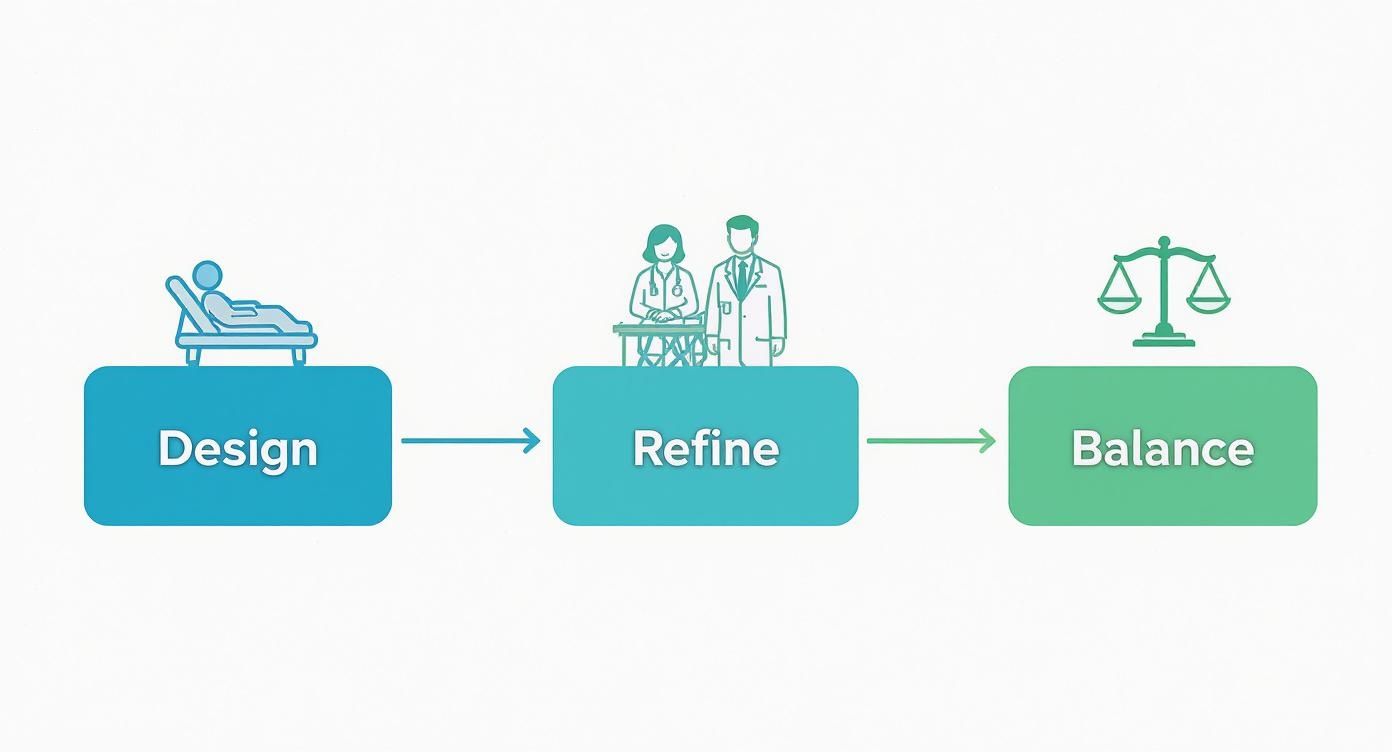
It’s a constant interplay between designing for the patient experience, getting feedback from clinicians, and finding a balance that makes the final product genuinely useful.
Essential Testing Protocols for Your App
To get your app truly ready for prime time, you need to run it through a gauntlet of different tests. Each one looks at a different, critical piece of the puzzle.
Functional Testing: This is the basics. Do every button, form, and feature do what they're supposed to do? We’re talking both manual and automated tests that run through every possible user journey to catch any glitches.
Usability Testing: Now, bring in the real experts: your users. Sit down with actual patients and healthcare providers and just watch them use the app. Is it intuitive? Do they get stuck anywhere? Their feedback is pure gold.
Security Penetration Testing: It’s time to call in the cavalry. Hire ethical hackers to do their worst and try to break into your app. They'll hunt for vulnerabilities in your code, APIs, and servers, mimicking real-world attacks to find weaknesses before the bad guys do.
Compliance Verification: This isn’t a technical test, but it’s just as critical. It's a deep audit to confirm that every process for handling, storing, and sending data meets regulations like PIPEDA or GDPR. You’ll likely need legal experts to help you dot the i's and cross the t's.
A single security flaw or a confusing interface can kill trust instantly. In healthcare, you don't get a second chance to make a first impression when it comes to safety and reliability.
Navigating App Store Deployment
After your app has been built and put through the wringer, the final hurdle is getting it onto the Apple App Store and Google Play Store. This is more than just hitting "upload." Both platforms have very strict guidelines for health and medical apps, designed to protect users from apps that are misleading or downright dangerous.
Be ready to provide extensive documentation on what your app does, your data privacy practices, and any relevant credentials. Apple, in particular, is known for putting medical apps under the microscope. If your app could be classified as a medical device, they might ask for proof of regulatory approval.
To help things go smoothly, here's what I recommend:
Read the Guidelines Thoroughly: Get intimately familiar with Apple’s Human Interface Guidelines and Google’s Developer Policies, especially the sections on health and safety.
Craft a Clear Privacy Policy: Your app needs an easy-to-find and easy-to-read privacy policy that explains exactly what data you collect and how you use it. No jargon.
Prepare for a Longer Review: Don't be surprised if your health app takes longer to get reviewed than a simple game. Build that potential delay right into your launch timeline.
Once you’re live, the job isn’t over. You need to constantly monitor the app for performance issues and crashes, and keep an eye on user feedback. Regular updates are a must; not just for new features, but for security patches and OS compatibility, ensuring your app stays safe, secure, and valuable for years to come.
Your Top Questions About Healthcare App Development Answered
When you're stepping into the world of healthcare app development, a few big questions always come up. How much will this really cost? What are the timelines? And what common mistakes can sink the project before it even gets off the ground?
Getting straight answers to these questions is crucial. It helps you set realistic expectations, budget properly, and steer clear of costly missteps. Let’s break down the most common queries we hear from clinics, startups, and hospitals looking to build their first digital health tool.
How Much Does It Truly Cost to Develop a Healthcare App?
There's no one-size-fits-all answer here, as the cost is tied directly to the app's complexity. For a lean Minimum Viable Product (MVP), say, a simple app for booking appointments, you might be looking at a starting point around £40,000. But think of that as the ground floor.
If you're aiming for a comprehensive, multi-platform app with telemedicine features, EHR integration, and bulletproof compliance with regulations like GDPR or PIPEDA, the investment can easily climb past £350,000.
Several key factors will shape your final budget:
The Feature Set: Every single feature, from a secure login to a real-time chat function, adds to the development clock.
Platform Choice: Building separate native apps for both iOS and Android will cost more than focusing on one or using a cross-platform framework.
Third-Party Integrations: Do you need to connect with an EHR, a payment gateway, or pull data from wearable devices? Each integration requires specialist expertise.
Regulatory Rigour: The depth of security audits, penetration testing, and documentation needed to satisfy health regulations is a major cost driver.
What Are the Biggest Mistakes to Avoid in mHealth App Development?
I've seen many well-intentioned healthcare app projects hit the same, avoidable roadblocks. Knowing these pitfalls ahead of time can save you a world of pain, time, and money.
The number one mistake is treating regulatory compliance as an afterthought. Bolting on HIPAA or GDPR compliance at the end is a recipe for disaster, often forcing expensive re-architecting or, worse, landing you in serious legal trouble. Compliance needs to be baked in from the very first line of code.
Another classic error is creating a clunky user experience. An interface that confuses a patient or slows down a busy clinician is doomed to fail, no matter how clever the underlying tech is. You have to design for your specific users; patients and providers have very different needs.
Forgetting about interoperability is the silent killer of health apps. If your tool can’t talk to the essential systems a clinic already uses, like their EHR, it becomes an isolated data silo with very limited real-world value. Focus on security, compliance, and a fantastic user experience right from the start.
How Long Does the Healthcare App Development Process Typically Take?
Much like the cost, the timeline hinges entirely on your app's scope and complexity. A focused MVP can often move from concept to launch within 4-6 months. This tight timeframe works when you're zeroed in on a core set of features and essential compliance.
For a more robust application with richer features like video consultations or patient data analytics, a 9-12 month timeline is far more realistic. This allows for proper development cycles, thorough usability testing with actual users, and the careful integration of more advanced functions.
For large-scale enterprise solutions needing deep integration with hospital legacy systems and multi-stage compliance audits, you should plan for a project that takes well over a year. That comprehensive schedule ensures every phase, from discovery and design to testing and deployment, gets the meticulous attention it deserves in healthcare.
At Cleffex Digital Ltd, we specialise in transforming complex healthcare challenges into secure, compliant, and user-friendly digital solutions. Let us help you build the future of healthcare technology.