

Creating a healthcare app isn’t just about building another piece of software; it’s about delivering care, improving lives, and managing incredibly sensitive information. These apps are the digital bridge between patients and providers, covering everything from virtual check-ups to managing chronic conditions on the go. The goal is to make healthcare more accessible, efficient, and smarter for everyone involved.
The Modern Landscape of Healthcare Apps
Let’s be honest, patient expectations have completely changed. People are used to managing their banking, shopping, and travel from their phones, and they’re starting to demand that same level of convenience from their healthcare. The days of endless phone calls, long waits in crowded rooms, and stacks of paper forms are quickly becoming a thing of the past.
This is where healthcare apps come in. They act as the new digital front door, putting patients in the driver’s seat. It’s a fundamental shift from a provider-centric model to a patient-centric one. This isn’t just a fleeting trend; it’s the direction healthcare is headed, driven by real-world needs.
Drivers Behind the Digital Health Shift
So, what’s really pushing this movement forward? A few key things are at play.
Patients want convenience: People want to book an appointment, check their lab results, or message their doctor without jumping through hoops. It’s about fitting healthcare into their lives, not the other way around.
Data is king for clinicians: To make the best decisions, doctors need a clear, continuous picture of a patient’s health. Apps connected to wearables or that allow patients to report their own symptoms provide a steady stream of valuable data, moving beyond the once-a-year check-up.
The rise of preventative care: Many apps are designed to help people stay healthy in the first place. Think fitness trackers, nutrition guides, and mental wellness tools. They empower users to build good habits and catch potential issues before they become serious problems.
The numbers back this up. The digital health market in the United States alone is on track to hit $172 billion, and over 1.3 billion people worldwide have already jumped on board with digital health solutions. It’s a clear sign that this technology is being embraced on a massive scale. If you want to dive deeper, you can discover more insights about mobile technology trends on emerline.com.
Categorising Healthcare Applications
Not all healthcare apps serve the same purpose. They generally fall into two main buckets, each playing a different but vital role in the ecosystem.
Building a healthcare app is like constructing a specialised medical facility. It demands precision, absolute security, and unwavering user trust. This mindset is crucial when handling sensitive patient data and navigating the complexities of the industry.
Figuring out which category you’re building for is the first step. It clarifies your target audience, the features you’ll need, and the specific challenges you’re going to face.
Clinical Applications: These are the heavy-hitters, used directly for diagnosing, treating, and managing medical conditions. We’re talking about Electronic Health Record (EHR) apps for doctors, telemedicine platforms for virtual visits, and remote patient monitoring systems that track vital signs from a distance.
Wellness and Lifestyle Apps: This group is all about general health and prevention. It includes everything from fitness trackers and diet planners to medication reminder apps and mental health platforms. Their main job is to encourage healthy habits and help people manage their day-to-day well-being.
Navigating Healthcare Compliance and Security
Building a healthcare app isn’t like building any other piece of software. You’re not just handling user data; you’re dealing with Protected Health Information (PHI), which is some of the most sensitive, highly regulated data out there. When you’re in the healthcare space, compliance isn’t just a box to tick; it’s the very foundation of trust your entire application is built on.
Think of your app’s security as a digital fortress. A single weak spot, whether it’s a poorly secured API or unencrypted data, can bring the whole thing crashing down. And we’re not just talking about avoiding massive fines, which can easily climb into the millions. It’s about your ethical and legal responsibility to protect the people who are trusting your app with their well-being.
This diagram shows the two main categories healthcare apps usually fall into: clinical and wellness, and each comes with its own set of compliance rules.
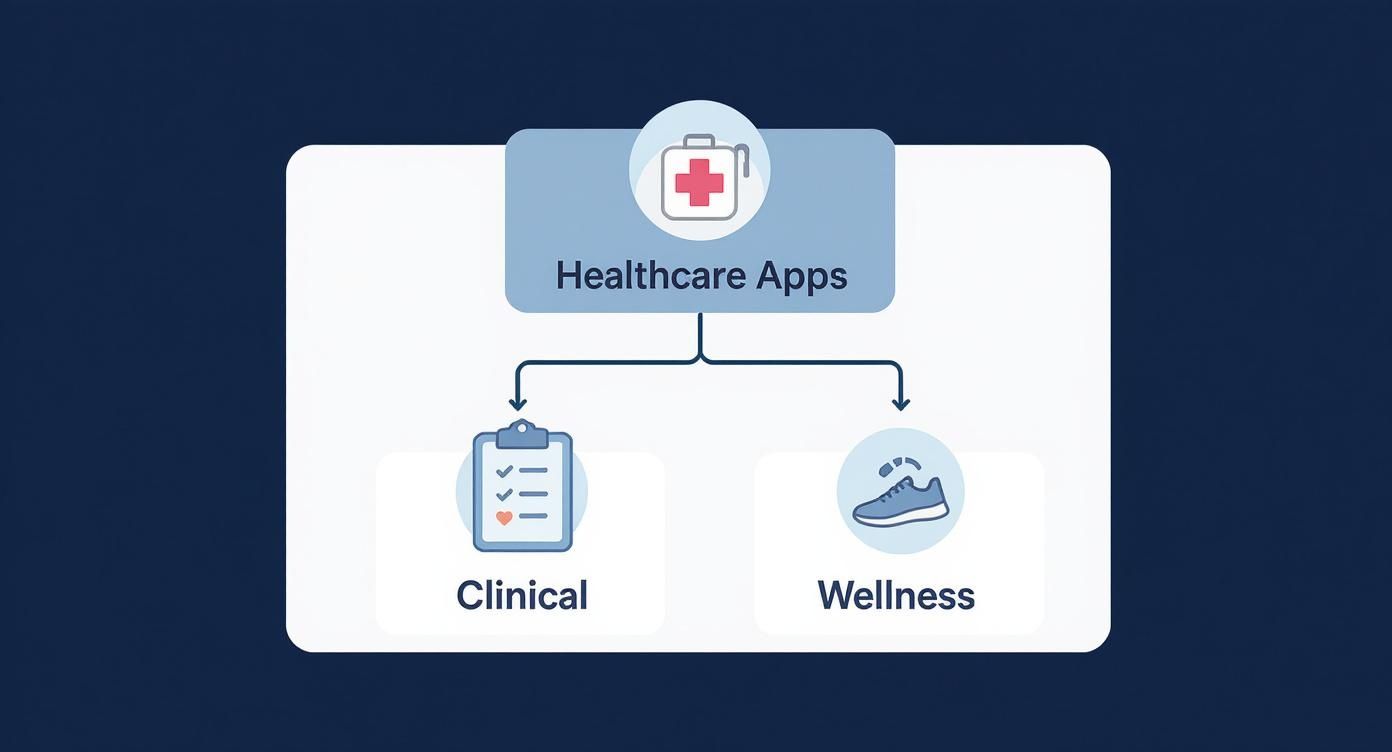
Knowing whether your app is for clinical use or general wellness is your first step in figuring out which security and compliance path you need to follow.
Demystifying HIPAA and GDPR
When you start talking about regulations, two acronyms immediately come up: HIPAA and GDPR. People often lump them together, but they cover different parts of the world and have their own distinct rules.
HIPAA (Health Insurance Portability and Accountability Act) is the big one in the United States. It applies to what are called “covered entities” (think hospitals, insurers) and their “business associates”, which is likely what your app would be if it handles PHI for them. Bottom line: if your app stores, processes, or sends PHI for American users, you absolutely must be HIPAA compliant.
GDPR (General Data Protection Regulation) is the European Union’s major data privacy law. If you have users in the EU, you have to play by GDPR’s rules. It gives people a huge amount of control over their personal information, especially health data. Core principles like “privacy by design” mean security has to be baked in from the start, not bolted on later.
It’s a common myth that only big hospitals need to sweat the details of compliance. The reality is, a startup’s new health app is held to the exact same high standards. A single slip-up can lead to fines ranging from $100 to $50,000 per violation, a risk that no development team can afford to take.
A Practical Roadmap for Compliance and Security
Turning dense legal jargon into actual code and infrastructure can feel daunting. The key is to think in layers: multiple lines of defence working together to keep sensitive information safe. Here are the core pillars you need to focus on.
1. Implement Robust Encryption Everywhere
Encryption is your first and most powerful line of defence. It scrambles data, making it completely unreadable to anyone who doesn’t have the key. If a breach ever happens, encrypted data is essentially useless to the attackers.
Data at Rest: Any PHI you store in databases, on servers, or even on a user’s phone must be encrypted. This protects the information when it’s just sitting there.
Data in Transit: When data is moving between the user’s device, your servers, and any other services, you need to use strong protocols like TLS (Transport Layer Security) to encrypt it.
2. Enforce Strict Access Controls
Not everyone in a clinic or on your internal team needs to see all patient data. This is where the Principle of Least Privilege comes in. It’s a simple idea: people should only have access to the bare minimum of information they need to do their job.
This is where Role-Based Access Control (RBAC) becomes critical. You assign permissions based on a user’s role, like doctor, nurse, admin, or patient. A patient, for example, should only ever see their own records, while a doctor can view the records of the patients they are treating. Simple as that.
3. Maintain Detailed Audit Trails
You absolutely must be able to track who accessed what data, and when. Audit logs are just detailed records of every single activity in your system: logins, data views, edits, you name it.
These logs are indispensable. They help you monitor for suspicious activity and are your proof of compliance if you ever face an audit. They answer the critical questions: who, what, when, and where for every single interaction with PHI. Getting to grips with the HIPAA Security Rule requirements is vital for protecting patient data and staying on the right side of the law. For a broader look at security, check out our guide on software security best practices.
By embedding these principles into your development lifecycle from day one, you build the kind of trust that’s non-negotiable for success in this market.
Choosing the Right Tech Stack and Architecture
Picking your technology is a bit like laying the foundation for a new hospital. If that foundation is weak or ill-suited for the job, everything you build on top of it, from patient safety features to daily operations, is compromised from the start. In the world of healthcare apps, your tech stack and architecture are that foundation, and they have a direct say in your app’s performance, security, and ability to talk to the wider healthcare world.
This isn’t just a technical decision for the dev team; it’s a strategic one that will shape your app’s future for years. The first big question you’ll face is whether to build a dedicated native app for each platform or use a cross-platform framework to build once for both.
For many healthcare apps, especially those handling intensive tasks like streaming data from a heart monitor or conducting a high-definition video call, native development is the gold standard. It gives you raw power and security.
On the other hand, if your app is more about patient education, booking appointments, or filling out forms, a cross-platform solution like React Native or Flutter can get you to market much faster and more affordably.
The Bottom Line: For apps that demand peak performance, real-time data processing from medical devices, or the highest possible level of security, native development is the safest bet. For simpler apps focused on information and basic engagement, cross-platform offers a smart, cost-effective alternative.
Building Bridges with Interoperability Standards
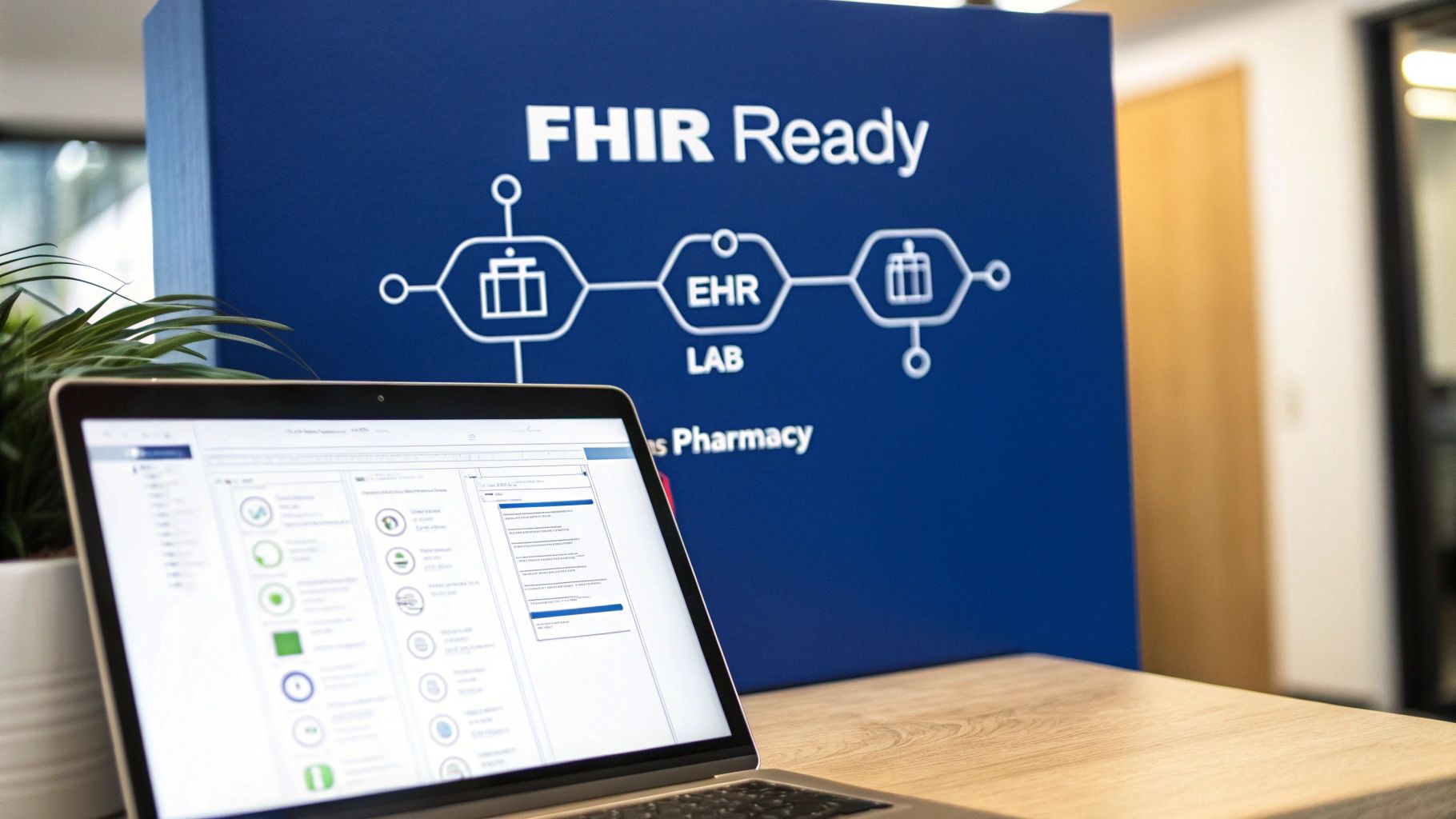
In healthcare, no app can afford to be an island. Its real value skyrockets when it can securely exchange information with other systems; think of a hospital’s Electronic Health Record (EHR), a pharmacy’s prescription database, or a diagnostic lab’s results portal. This ability for systems to talk to each other is called interoperability.
Without it, you end up with data silos. These are isolated pockets of patient information that prevent doctors and patients themselves from seeing the complete health picture. This is where crucial standards like FHIR and HL7 come into the picture.
The Role of FHIR and HL7
Think of these standards as universal translators for medical data. They create a common language and structure so that completely different software systems can understand each other without a hitch.
HL7 (Health Level Seven): This is the old guard, the established standard that most hospitals and large clinics have used for decades. It’s incredibly thorough but can be notoriously complex and rigid to work with.
FHIR (Fast Healthcare Interoperability Resources): FHIR is the modern, flexible successor to HL7. It’s built using the same web technologies (like RESTful APIs) that developers use every day, making it vastly easier and quicker to implement. For any new healthcare app, FHIR is the way to go.
By designing your app’s architecture around FHIR from day one, you’re building a system that can plug into the broader healthcare ecosystem securely and efficiently. This is what allows for game-changing features, like a doctor pulling a patient’s real-time glucose readings from your app directly into their EHR. This focus on connectivity is also a cornerstone of effective healthcare data management software development, ensuring that critical patient information flows freely and accurately between different points of care.
With your architecture sorted, it’s time to tackle the heart of your application: the features. Think of this as moving from the blueprints of a hospital to deciding what goes in each room. Every feature you build needs to serve a clear purpose, solving a specific problem for either a patient trying to get care or a clinician managing their day.
The features you select will ultimately define your app’s identity and value. A telemedicine app without a rock-solid video conferencing tool is like a clinic with no exam rooms; it just doesn’t work. Likewise, a patient engagement app that makes it a hassle to view health records has missed the entire point. The goal here is to create a focused, intuitive tool that solves real-world headaches for your users.
Core Features for Telemedicine Platforms
Telemedicine apps are all about creating a virtual bridge between patients and their doctors, making quality remote care a reality. For these apps to be truly effective, they need a specific set of features that not only replicate the in-person experience but, in many cases, actually improve upon it. These are the absolute must-haves.
Secure Video Conferencing: This is the engine of any telemedicine app. It has to be HIPAA-compliant, delivering crisp, stable video and audio for clear communication. Adding simple tools like screen sharing so a doctor can walk a patient through their lab results can make a world of difference.
Intuitive Appointment Scheduling: Patients want to book, change, or cancel appointments in just a few taps. Your system needs to show real-time availability, fire off automated reminders through push notifications or texts, and sync seamlessly with both the patient’s and the provider’s calendars.
Streamlined E-Prescribing: This feature lets clinicians send prescriptions directly to a patient’s chosen pharmacy, all electronically. It cuts down on errors from bad handwriting, is far more convenient for the patient, and keeps a perfect digital trail of all medications.
Must-Haves for Patient Engagement Apps
These apps are designed to put patients in the driver’s seat, giving them the tools and information they need to take an active role in their own health. Success here really comes down to creating a supportive and highly personalised user experience.
One of the biggest mistakes I see is teams trying to cram too many features into their app right from the start. A great healthcare app isn’t one that does everything; it’s one that does a few essential things exceptionally well. Figure out the biggest pain points for your users and solve those first.
Here are the key functionalities to focus on:
Personalised Health Dashboards: This is the patient’s command centre. It should offer a clean, at-a-glance overview of their vital health data: things like upcoming appointments, new test results, medication schedules, and metrics pulled from wearable devices.
Secure Provider Messaging: Patients need a simple and secure way to ask their care team a quick question. A built-in messaging feature, which works like email but has the robust security needed for PHI, helps build a stronger patient-provider relationship and cuts down on endless phone tag.
Access to Educational Content: Giving patients reliable, easy-to-digest information about their conditions, treatments, or general wellness can dramatically improve their health literacy. This could be anything from articles and videos to interactive guides, all tailored to the patient’s unique health profile.
The Growing Role of AI in App Features
Artificial intelligence isn’t some far-off concept in healthcare anymore; it’s a practical tool that is making core app features smarter and more powerful. AI can comb through massive datasets to uncover insights that were once out of reach, allowing for a much deeper level of personalisation.
The uptake of AI in healthcare settings has skyrocketed. In fact, a significant number of healthcare organisations in the United States have already rolled out domain-specific AI tools, marking a sevenfold increase from the previous year. This trend is especially noticeable in places like California, where health systems are leading the charge in AI integration. You can get a clearer picture of this shift by exploring the state of AI in healthcare and its future projections.
Here’s how AI is being woven into app features today:
Intelligent Symptom Checkers: Instead of just clicking through a static checklist, AI-powered symptom checkers use natural language processing to have a more natural, conversational chat with the user. They can ask follow-up questions to get a more accurate preliminary assessment.
Predictive Analytics for Chronic Disease: For a patient managing diabetes or heart disease, AI algorithms can analyse data from their wearables and self-reported logs to spot trouble before it starts. It might predict a likely hyperglycemic event, for instance, and alert both the patient and their care team to step in proactively.
So, What’s the Real Cost and Timeline?
Let’s talk numbers. Budgeting for a healthcare app isn’t like planning for a standard consumer app. The stakes are much, much higher. You’re dealing with sensitive data, strict regulations, and the absolute need for clinical accuracy, all of which have a real impact on the bottom line and how long it takes to build. Get this wrong, and you could face major funding shortfalls or, even worse, launch a product that’s not compliant.
A good way to think about it is like building a physical medical facility. A simple wellness tracker? That’s like setting up a small, one-room clinic. But a full-blown telemedicine platform that syncs with electronic health records? You’re basically building a digital, multi-speciality hospital. The foundation, infrastructure, and specialised tools are worlds apart, and so are the costs.
Where Does the Money Actually Go?
Your total budget isn’t just one big lump sum for coding. It gets broken down across a few critical stages. Trying to skimp on any of these is a classic mistake that almost always leads to bigger, more expensive problems later, especially when it comes to security or compliance.
Here’s a rough sketch of how resources usually get allocated:
Discovery and Planning (10-15%): This is your blueprinting phase. It’s all about market research, nailing down your target audience, deciding on core features, and creating a rock-solid technical spec sheet.
UI/UX Design (10-15%): For patients to actually use your app, it has to be intuitive and accessible. This stage covers everything from wireframes and prototypes to user testing, ensuring people of all abilities can navigate it with ease.
Development (Backend & Frontend) (40-50%): The main event. This is the biggest chunk of the budget, where the actual coding happens. It involves building out the server, databases, APIs, and the part of the app that users actually see and interact with.
Quality Assurance and Testing (15-20%): This is non-negotiable in healthcare. We’re talking about more than just bug hunting; it’s about stress-testing the system, and, critically, running exhaustive security and compliance audits to make sure patient data is locked down tight.
Deployment and Maintenance (5-10%): Getting the app into the app stores isn’t the final step. This covers server setup and the ongoing work of fixing bugs, releasing updates, and keeping everything running smoothly.
Realistic Estimates for Your Project
The final bill for healthcare app development is a direct reflection of its complexity. A basic medication reminder app is going to be faster and cheaper to build than a sophisticated remote patient monitoring platform that needs to pull data from medical devices. It just makes sense.
So, what’s a realistic range? Most projects land somewhere between $50,000 and $450,000. For example, a feature-rich telemedicine app could run anywhere from $150,000 to $450,000 and take 16 to 32 weeks. On the other hand, a simpler wellness or fitness app might be in the $55,000 to $120,000 range and take 8 to 20 weeks. If you want to dive deeper into the numbers, you can learn more about healthcare app development costs and their influencing factors.
To give you a clearer picture, here’s a breakdown of what you can generally expect.
Estimated Cost and Timeline by App Type
| App Type | Estimated Cost (USD) | Estimated Timeline (Weeks) |
|---|---|---|
| Wellness & Fitness Apps | $55,000 – $120,000 | 8 – 20 |
| Medication Adherence Apps | $70,000 – $150,000 | 12 – 24 |
| Patient Engagement Apps | $80,000 – $250,000 | 16 – 28 |
| Telemedicine & RPM Platforms | $150,000 – $450,000+ | 16 – 32+ |
| EHR/EMR Mobile Solutions | $200,000 – $500,000+ | 24 – 40+ |
Of course, these are just ballpark figures. The final cost will always depend on your specific feature list, the complexity of integrations, and the level of regulatory scrutiny required for your particular solution.
One of the biggest mistakes founders make is forgetting about post-launch costs. A solid rule of thumb is to budget an extra 15-20% of the initial development cost per year for maintenance. This covers crucial security patches, server hosting, and adding new features to stay competitive.
Launching and Scaling Your Healthcare App
Getting your healthcare app built is a huge win, but it’s really just the starting line. A fantastic app that nobody uses is simply a missed opportunity. Your launch strategy is what connects your finished product with the patients and clinicians who genuinely need it. This isn’t about just flipping a switch; it’s a careful plan to build momentum and carve out a space for your app in a very competitive market.
That initial rollout is your chance to gather real-world data and start building trust. A great launch paves the way for sustainable growth, turning your app from a novelty into an essential tool in the healthcare ecosystem.
Crafting a Go-to-Market Strategy
Your go-to-market plan needs to hit on multiple fronts, speaking to both the clinical and consumer sides of the healthcare world. A smart first move is to start small with a pilot program; think of a single clinic or a specific group of patients. This lets you squash any last-minute bugs and collect powerful testimonials before you go big.
Next, you have to get through the app store approval gauntlet. Both Apple’s App Store and the Google Play Store have incredibly strict rules, especially for medical apps. Make sure your privacy policy is airtight, your data practices are transparent, and your app’s function is spelt out clearly to avoid getting stuck in review limbo.
While that’s happening, you need to nail your marketing message.
For Patients: Your message should be all about convenience, empowerment, and better access to their own care. Talk up features like one-tap appointment booking or seeing test results the moment they’re ready.
For Providers: The focus here is on efficiency, better patient outcomes, and cutting down on administrative headaches. You need to show them exactly how your app saves them time and helps them provide better care.
Post-Launch Maintenance and Iteration
Once your app is out in the wild, the job changes from building to maintaining and improving. This is where you lay the groundwork for long-term success. You absolutely need a solid plan for ongoing support, security updates, and adding new features based on how people are actually using the app.
The most successful healthcare apps evolve with their users. Launch day isn’t the finish line; it’s the starting point for a continuous cycle of listening, learning, and iterating. Neglecting post-launch feedback is the fastest way to become irrelevant.
Set up a clear feedback loop with in-app surveys, support tickets, and app store reviews. This user feedback is pure gold; it’s your roadmap for what to build next. Keep a close eye on your analytics, tracking key performance indicators (KPIs) like user engagement, session length, and which features are getting the most use. This data-first mindset is critical; you can find some powerful strategies in our guide to healthcare data analytics solutions.
Finally, get a schedule in place for regular updates. This isn’t just for rolling out cool new features. It’s for crucial security patches, performance tweaks, and updates to stay compliant with any new regulations. This proactive approach keeps your app secure, reliable, and valuable, setting you up for scalable growth and a lasting impact.
Frequently Asked Questions
When you’re diving into healthcare app development, a lot of questions come up. It’s a complex space, and getting the right answers from the start is key to building an app that people trust and actually use.
How Do You Ensure Patient Data Is Kept Private?
This is, without a doubt, the most important question. Protecting patient privacy isn’t just a feature; it’s the foundation of your entire application. It all starts with strictly following regulations like HIPAA in the US or GDPR in Europe, but the real work happens in the code and infrastructure.
Here’s how we tackle it:
End-to-End Encryption: Think of this as an unbreakable, sealed envelope for data. We make sure information is scrambled and unreadable both when it’s sitting on a server (at rest) and when it’s moving between the app and the server (in transit).
Access Control: We use something called Role-Based Access Control (RBAC). In simple terms, this means people only see what they absolutely need to see. A patient can access their own records, and a doctor can see their patient’s chart, but neither can see information that isn’t relevant to their role.
Secure Infrastructure: You can’t just host a healthcare app anywhere. We rely on cloud providers that are specifically certified as HIPAA-compliant. These services are built from the ground up to securely manage Protected Health Information (PHI).
What Drives User Adoption For Healthcare Apps?
Building a great app is only half the battle. Getting patients and doctors to actually use it is the real challenge. The secret? Solve a real, nagging problem and make the solution incredibly easy to use.
People are looking for convenience. If your app lets them book an appointment in 30 seconds instead of sitting on hold, or if it gives them instant access to their lab results without a follow-up call, they’ll use it.
Ultimately, if your app saves someone time or a headache, they’re far more likely to make it a part of their routine. It has to be more helpful than the old way of doing things.
How Much Does Healthcare App Development Cost?
The cost can swing wildly depending on what you want to build. Think of it like building a house – a simple one-bedroom is very different from a custom-built mansion.
A Minimum Viable Product (MVP) with just the core essentials, like appointment booking and secure messaging, might land in the $50,000 to $100,000 range.
On the other hand, a full-blown platform with features like live video consultations (telemedicine), deep integration with electronic health records (EHR), and custom analytics could easily push past $250,000. The final price tag really comes down to the number of features, the complexity of the compliance work, and the technology you choose.
At Cleffex Digital Ltd, we specialise in creating secure, compliant, and user-centric healthcare applications that solve real-world challenges. Let’s build the future of healthcare together.